DNA Mutations Study Notes
Cycle Four Overview
Good morning and welcome to cycle four.
Focus of this cycle: DNA mutations
Topics to be covered: types of mutations, their causes, mechanisms of repair.
Introduction:
The pattern will be: Type, Cause, Repair.
Sources of DNA Damage
Two main categories of sources of DNA damage:
Exogenous Sources:
Sources from the environment affecting DNA:
UV Light:
Damages DNA by forming thymine dimers between adjacent thymine bases.
DNA polymerase may stall during replication when it encounters thymine dimers, potentially leading to incomplete synthesis or mutations.
Chemicals:
Inhalation and ingestion of chemicals may increase or decrease mutagenesis in cells.
Many chemicals are banned in various countries for their harmful effects.
Ionizing Radiation:
Causes double-strand breaks in DNA, which can lead to severe mutation due to instability.
Endogenous Sources:
Sources within the cell responsible for DNA mutations:
DNA Replication Errors:
Occurs when DNA polymerase mismatches a base.
Repair can be done either by DNA polymerase (through proofreading) or through repair enzymes.
Reactive Oxygen Species (ROS):
Generated during aerobic respiration, specifically in the electron transport chain.
ROS can damage DNA by producing double-strand breaks.
Mechanisms of Mutation Repair
Proofreading:
DNA polymerase can recognize and correct mismatched bases during synthesis.
Uses 3' to 5' exonuclease activity to remove incorrect bases and insert the correct ones.
Mismatch Repair:
Involves additional repair enzymes and is driven by the protein p53, which scans for mismatches and initiates repair processes.
Distinguishes between the newly synthesized and template DNA strands to correct errors.
/
Types of DNA Mutations
Substitution mutations (Point Mutations):
A change in one base pair in the DNA sequence.
Example: Wild type AT can change to GC due to a mutation.
Deletion:
Loss of one or more base pairs from the DNA sequence compared to the wild type.
Insertion:
Addition of base pairs into the DNA sequence that were not present in the wild type.
Inversion:
A segment of DNA is flipped in orientation.
Distinction between DNA Damage and Mutations
DNA Damage:
Refers to changes in single strands of DNA that can be repaired.
Mutation:
Involves changes in complementary base pairing and requires a double-stranded change.
Once repaired using mismatched base interpretation, the error becomes a stable mutation.
Mechanisms Leading to Mutations
Indel mutations:
Caused by DNA polymerase slipping during replication, leading to either insertions (backward slippage) or deletions (forward slippage).
Tautomeric Shifts:
Bases can change from their keto form (dominant) to enol form (rare), resulting in mispairing during DNA replication, causing a mutation.
Transition and Transversion Mutations
Transition Mutation:
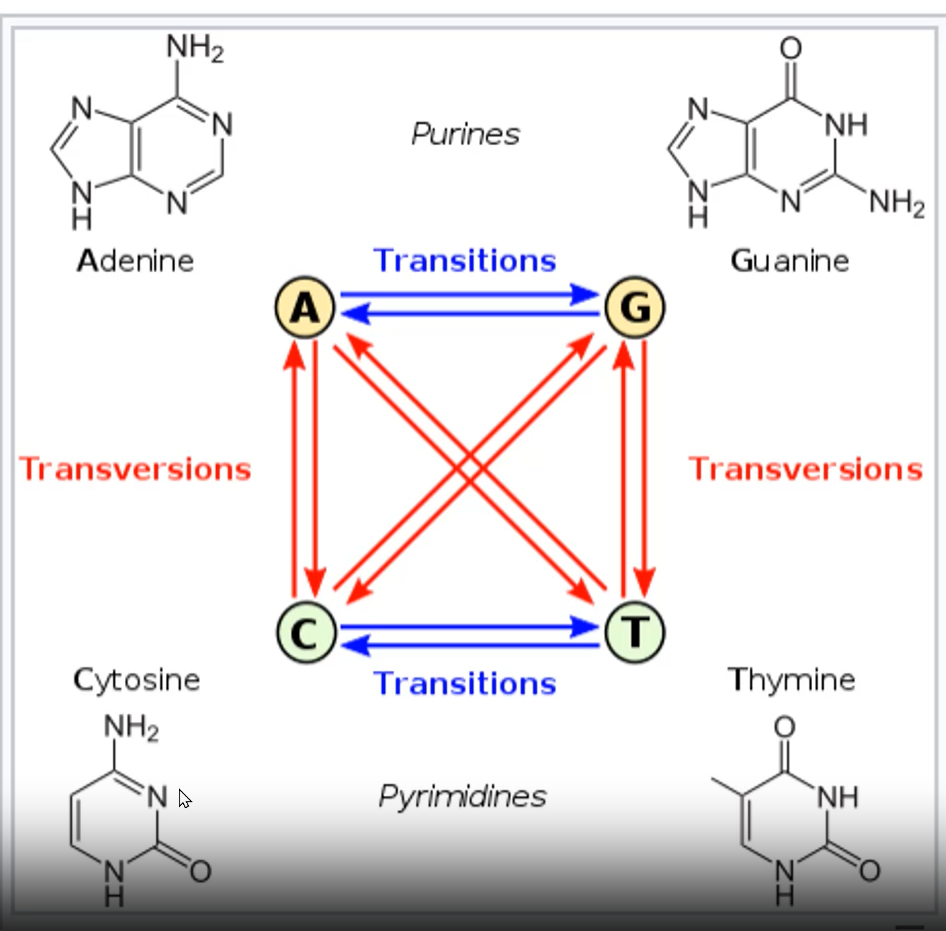
A base change from one purine to another (A <-> G) or one pyrimidine to another (C <-> T).
Transversion Mutation:
A base change from a purine to a pyrimidine or vice versa.
Transposable Elements (TEs)
Definition & Function:
Sections of DNA that can move around, known as „jumping genes.”
They can cause mutations or genomic variations through cutting and pasting or copying and pasting.
First discovered by Barbara McClintock through her work with corn kernels.
Significant Impacts of TEs:
Lead to variations in phenotype by interfering with gene expression, which can result in observable traits like the color of corn kernels.
Can play an essential role in genomic evolution by rearranging the genome; increased TE counts are seen in organisms with higher genomic complexity.
Human Genome and TEs:
Approximately 50% of the human genome consists of TEs.
Acts mainly as structural components, typically found in intronic regions and remain inactive to prevent harmful mutations.
Concluding Remarks
Understanding these mechanisms and types of mutations is vital for comprehending the complexities of genetic variation and disease mechanisms.
Students are encouraged to prepare lists of the different mechanisms generating genomic variation covered in this cycle for further review and understanding.