Chapter 19 - Catalysts
19.1 Catalysts
Catalysts increase the rate of a chemical reaction. The change in rate is often very substantial. Their action can be explained using collision theory and energy changes during a reaction. Catalysts are important in industrial chemistry, limiting air pollution, and controlling biochemical processes.

Catalysts and Activation Energy
The activation energy (Eₐ) is the minimum energy required for a reaction to occur. On an energy profile diagram it is measured from the energy of the reactants to the peak.

Catalysts are not consumed in the reaction and do not appear as reactants or products in the chemical equation.
Catalysts provide an alternative reaction pathway with a lower activation energy. The original higher-energy pathway is still available, but the lower-energy pathway is also available when a catalyst is present.

With a lower activation energy, a greater proportion of colliding particles have enough energy to react, so the reaction rate increases.

Important points:
Catalysts lower the activation energy by providing an alternative reaction pathway.
This increases the proportion of successful collisions.
Catalysis is the increase in the rate of a chemical reaction due to the presence of a catalyst.
Types of Catalysts
Homogeneous catalysts: same physical state as the reactants and products.
Heterogeneous catalysts: different physical state from the reactants and products.
Example of homogeneous catalysis: Chlorine atoms (from CFCs) act as catalysts in the upper atmosphere, speeding up the decomposition of ozone into oxygen gas.
Example of heterogeneous catalysis: Manganese(IV) oxide (MnO₂) powder catalysing the decomposition of hydrogen peroxide solution.
Catalysts in Industry
Chemists prefer heterogeneous catalysts because they are:
more easily separated from the products
much easier to reuse
able to be used at high temperatures
Solid catalysts work by adsorption – gas molecules stick to the surface. This distorts or breaks bonds, allowing the reaction to occur more easily (lower activation energy).
Important: Adsorption is the attraction and binding of molecules or particles of one substance to the surface of another.
Powdered or sponge-like catalysts are often used because they have a large surface area, so more reactant molecules can be adsorbed.

Enzymes
Enzymes are biological catalysts (proteins) that speed up almost all chemical reactions in living things. They can increase reaction rates by factors of up to 10¹⁰.
Digestive enzymes break down large food molecules into smaller ones.

Enzymes have a specifically shaped active site that interacts with particular reactants (substrates).
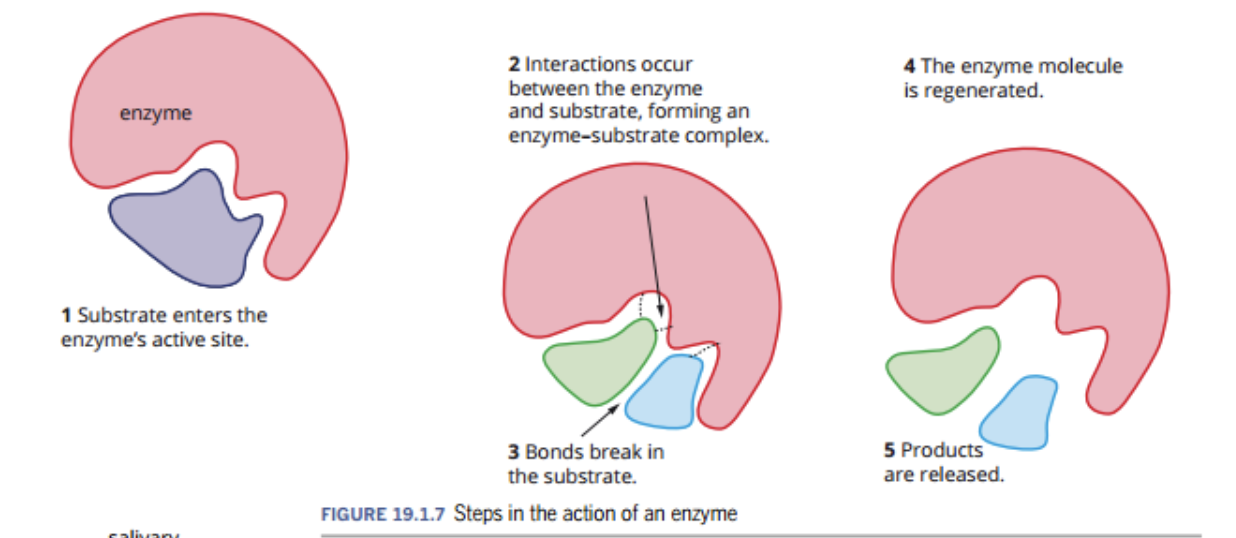
Compared with inorganic catalysts, enzymes:
can produce much faster reaction rates
are highly selective (usually catalyse only one specific reaction)
are much more sensitive to pH and temperature changes


Examples of enzyme use:
Detergents (remove protein stains and greasy residues)
Fabric softeners
Production of vinegar, wine, beer and bread (yeast enzymes)
Yoghurt production
Paper manufacturing and “stonewash” denim
Heterogeneous Catalysis and the Haber Process (Extension)
The Haber process produces ammonia:
N₂(g) + 3H₂(g) → 2NH₃(g) ΔH = −92 kJ mol⁻¹
Without a catalyst, temperatures over 3000°C would be needed. With an iron catalyst, the reaction proceeds economically at about 500°C.
Hydrogen and nitrogen molecules adsorb onto the iron surface, bonds break, and the atoms combine to form ammonia, which then leaves the surface. The catalyst is unchanged.

Nanoparticles as Catalysts
Metal nanoparticles have a very large surface area, so more catalytic reactions can occur in a given time. Research is ongoing into the best size, design and support materials for nanocatalysts.

Catalytic Converters in Cars
All new cars sold in Australia have a catalytic converter between the engine and the exhaust pipe. It converts harmful exhaust gases into less harmful ones.
Reactions include:
2NO(g) → N₂(g) + O₂(g)
2CO(g) + O₂(g) → 2CO₂(g)
2C₈H₁₈(g) + 25O₂(g) → 16CO₂(g) + 18H₂O(g)
The catalyst is usually a mixture of platinum, palladium and rhodium metals and aluminium oxide, mounted on a honeycomb-shaped support with a large surface area.

Catalytic converters require unleaded petrol. Lead in exhaust gases would coat the catalyst and make it ineffective. Unleaded petrol was introduced in Australia in 1985, and catalytic converters followed in 1986.
Key Points Summary
Catalysts increase reaction rate by providing an alternative pathway with lower activation energy.
They are not consumed in the reaction.
Heterogeneous catalysts are preferred in industry (easy to separate and reuse).
Enzymes are highly efficient but sensitive biological catalysts with active sites.
Catalytic converters reduce air pollution from car exhausts.