Lecture 10 - short term memory/working memeory and the prefrontal cortex
Lecture Reading
Chapter 11: "The remembering brain" from Ward (2019).Reference: The Student's Guide to Cognitive Neuroscience, 4th Edition, Psychology Press.
Wider Reading:
Ranganath et al. (2004): Category-specific modulation of inferior temporal activity during working memory encoding and maintenance.
Memory Types
Short-Term Memory (STM)
Definition: Memory that holds a limited amount of information in an easily accessible form for a brief period, typically seconds to a minute.
Capacity: Limited, often compared to the display screen of a mobile device, typically retaining between 5 to 9 items (Miller, 1956).
Long-Term Memory (LTM)
Definition: Memory that involves the storage of information over extended periods, possibly for a lifetime. It allows for the retention of knowledge and personal experiences beyond immediate awareness.
Capacity: Virtually unlimited, analogous to the extensive storage capabilities of a hard drive.
Working Memory (WM)
Overview: Unlike STM which focuses on temporary storage, WM is crucial for the active manipulation of information, facilitating complex cognitive tasks such as reasoning and comprehension.
Importance: Essential for daily functionalities; if LTM fails, individuals may continue to function, but failure in WM severely hampers everyday tasks.
Definition (Roth et al. 2005): Encompasses performing tasks, encoding new information, and formulating sequential goals necessary for complex problem-solving and planning.
Lecture Content Overview
Working Memory Model
Baddley working memory model
Central Executive:
The "boss" of working memory that allocates attention and manages cognitive tasks.
Responsible for switching between tasks, focusing attention, and inhibiting irrelevant information.
STM Components:
Phonological Loop:
Responsible for verbal and auditory information processing.
Stores verbal and auditory information.
Includes phonological store (temporary storage) and articulatory rehearsal (keeps information active).
Example: Repeating a phone number to yourself before dialing.
Visuospatial Sketchpad:
Handles spatial and visual information.
Maintains visual and spatial information.
Crucial for navigation, mental imagery, and recognizing objects.
Example: Remembering where you parked your car.
Episodic Buffer:
Integrates information across domains and links with LTM.
integrates information from different sources (verbal, spatial, and LTM).
Helps form a coherent "scene" in the mind.
Example: Remembering a specific conversation in the context of a location.
Theoretical Inquiry: Investigates whether these components function separately or interactively, and how they operate under various cognitive loads.
Phonological and Visuospatial Buffers: Experiments
Phonological Buffer Experiment
Design: Involving two participants where one recalls a number while the other simultaneously echoes a different number, showcasing interference effects on memory recall.
Visuospatial Buffer Experiment
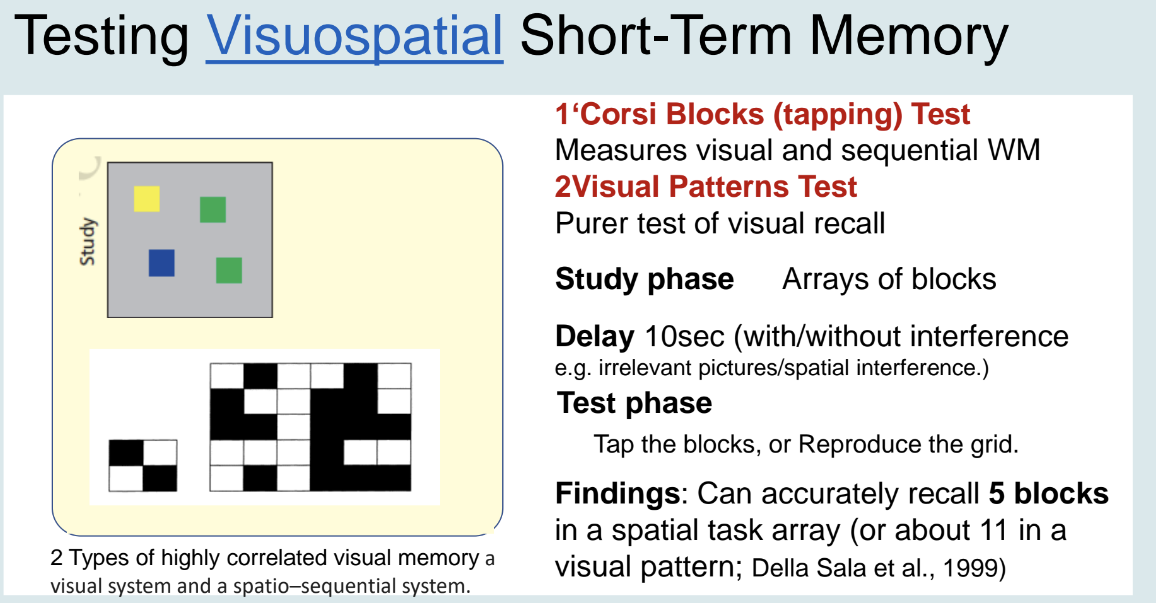
Design: Participants engage in tasks requiring them to tap sequences on colored blocks or reproduce specific patterns, enabling the assessment of memory accuracy over time.
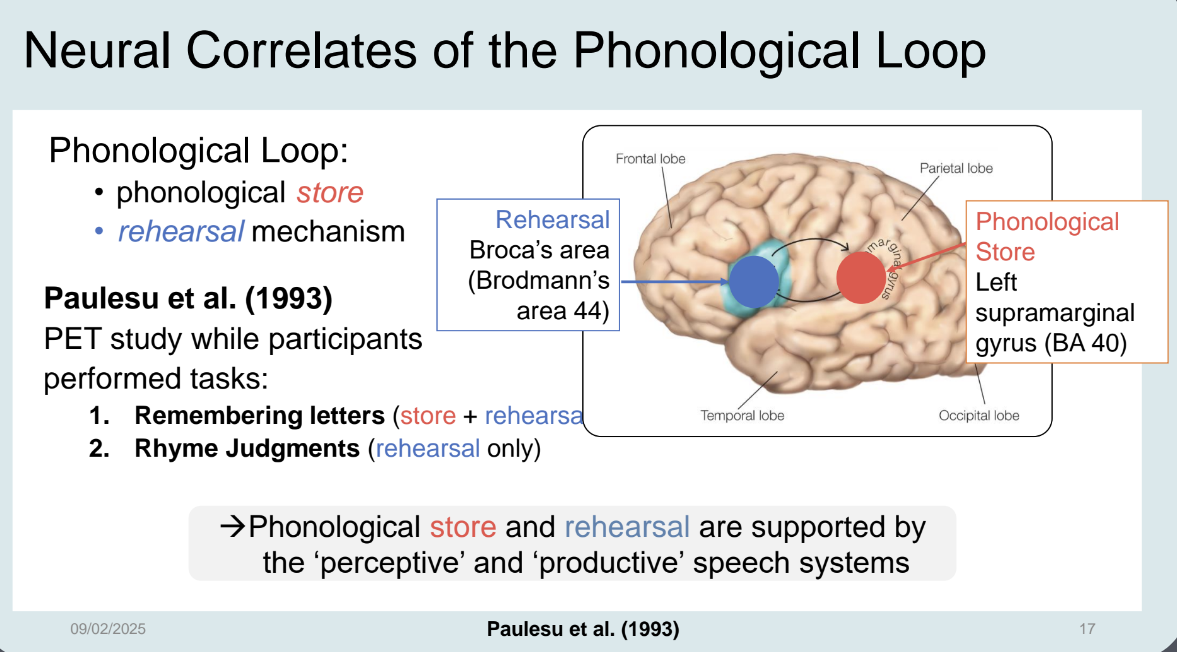
Neural Correlates of Phonological Loop
Components:
Phonological Store: Temporary storage for verbal items.
Rehearsal Mechanism: Vital for transferring information into LTM and involves areas such as Broca's area (Brodmann’s area 44) for verbal rehearsal.
Findings (Paulesu et al. 1993): Key brain areas engaged include the left supramarginal gyrus (BA 40), crucial for the phonological store's function, linking neuroanatomy with cognitive tasks.
Testing Memory Through Tasks
Phonological STM Tests
Verbal Digit Span Test: Average span of approximately 7±2 digits, exemplifying capacity limits in STM.
Most people recall 7 ± 2 digits (Miller, 1956).
This capacity can be improved through chunking (e.g., remembering "1776" instead of four separate digits).
Recall Limitations: Faster recall for short words vs. longer ones due to cognitive load; rehearsal plays a crucial role, where articulatory suppression can impede memory performance.
Articulatory Suppression
What happens if you interfere with verbal rehearsal?
Example task: Try repeating a phone number while saying "one two three four" continuously.
Findings:
Reduces ability to retain verbal information.
Suggests that active rehearsal is crucial for phonological STM.
Models of Visuospatial STM
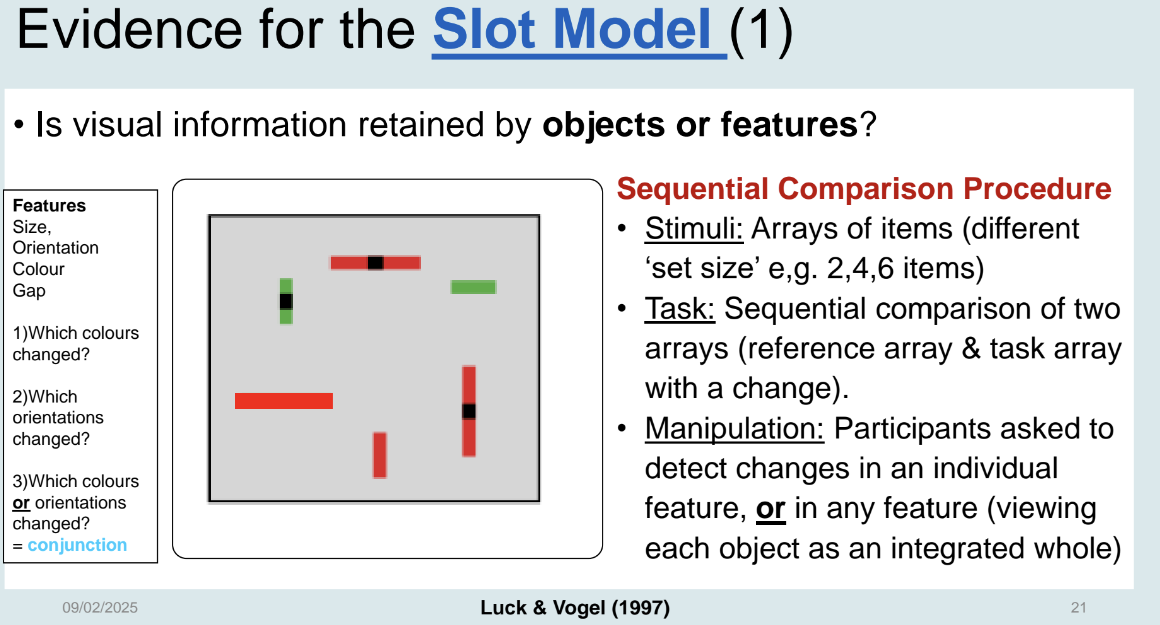
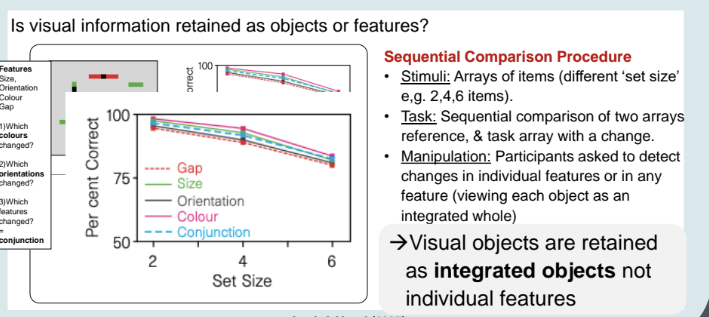
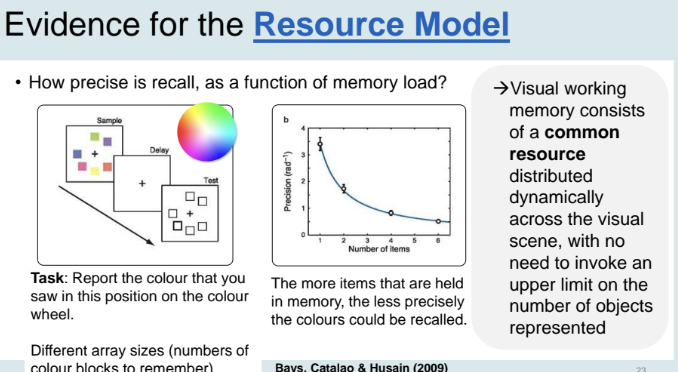
Slot Model: Suggests a fixed number of memory slots for distinct visual objects.
Resource Model: Proposes that there is no strict limit on the amount of information stored, but data precision declines with increased cognitive load.
Neural Correlates of Visuospatial WM
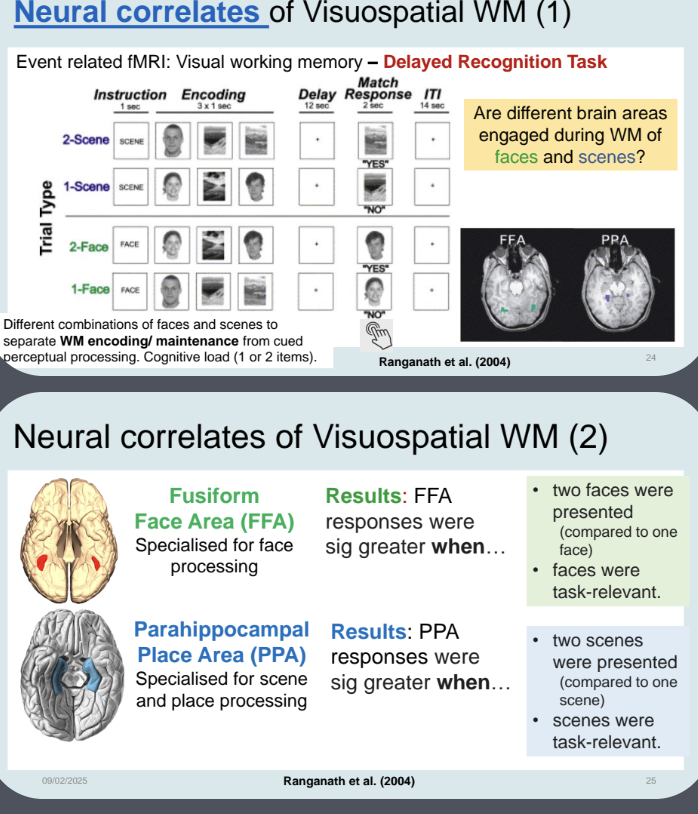
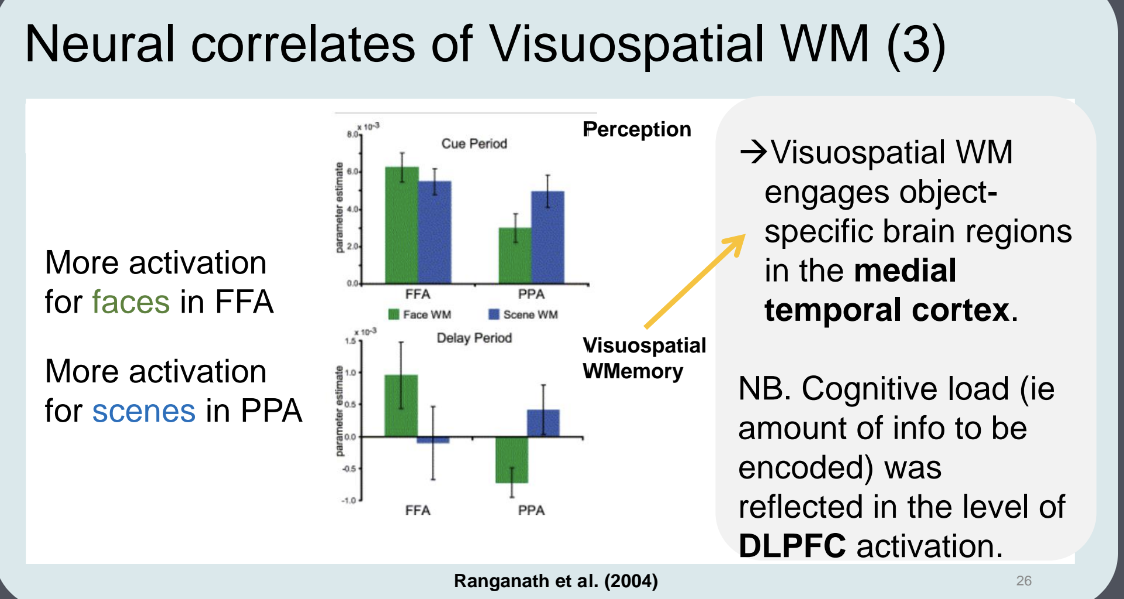
Findings: Different brain areas (FFA for faces and PPA for scenes) are specialized for processing visual inputs in working memory contexts. DLPFC activation varies depending on cognitive load, indicating its role in information management.
Frontal Lobe Functionality in Memory
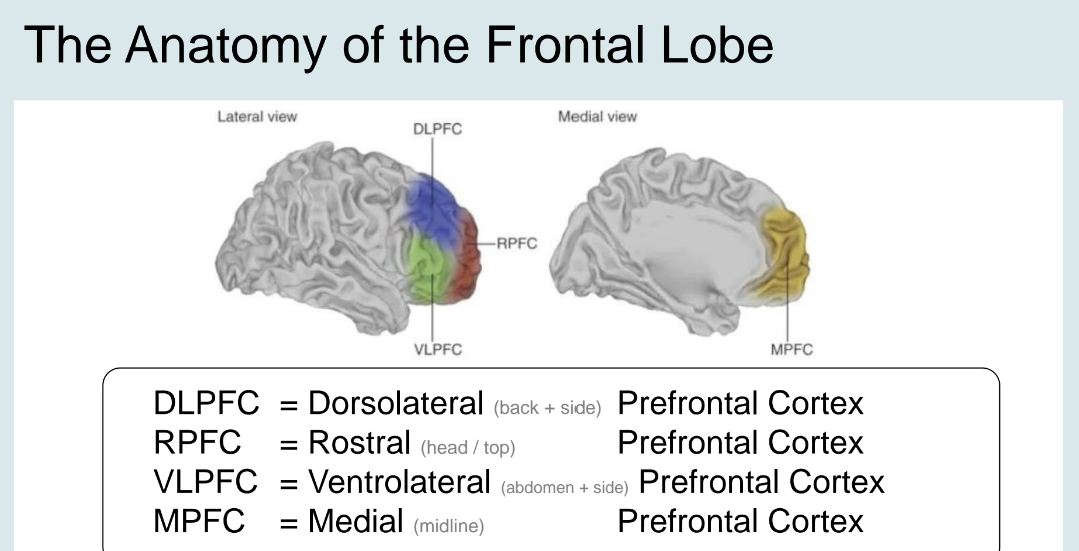
DLPFC (Dorsolateral PFC): Facilitates manipulation of information.
VLPFC (Ventrolateral PFC): Maintains active information, showing distinct roles in memory processing.
PFC lesions on WM in monekys
Studies on monkeys demonstrate that lesions in the PFC impair working memory tasks, particularly those requiring maintenance of information.
In associative memory tasks, monkeys with PFC lesions can learn associations without retaining visuospatial information, indicating a specific role for the PFC in working memory maintenance.
Research on monkeys shows that damage to a part of the brain called the prefrontal cortex (PFC) makes it hard for them to remember and hold onto information for short periods, especially in tasks that require keeping track of details.
However, they can still learn to connect different ideas without needing to remember where things are, which suggests that the PFC is specifically important for keeping information active in our minds.
Research on monkeys reveals that damage to the prefrontal cortex (PFC) affects their ability to remember information temporarily, especially in tasks that involve tracking details. However, they can still learn to make connections between ideas, showing that the PFC's main role is in maintaining active information in our minds.
Evidence on STM and LTM Divisions
Case Studies:
Patient H.M.: Known for preserved STM but impaired LTM, providing insights into memory systems.
Patient K.F.: Exhibited impaired STM while maintaining intact LTM, suggesting shared mechanisms between systems.
Hypothesis: Rather than being entirely separate, STM may reflect temporary activation originating from LTM, indicating their interconnected nature.
Summary Components
Comprehensive View: Working memory integrates domain-specific functions for visual, verbal, and object-related processing.
Manipulation and Maintenance: The DLPFC is crucial for manipulation, while the VLPFC is essential for maintaining active memory, further emphasizing the complexity of these cognitive processes.
Capacity Limits: Explored through the lens of both STM slots and competition for cognitive resources, highlighting the challenges faced in memory tasks.
Important Brain Regions & Functions
Key Areas:
Broca’s Area: Language production and processing.
FFA: Fusiform Face Area, involved in face recognition.
PPA: Parahippocampal Place Area, crucial for scene recognition.
DLPFC: Dorsolateral Prefrontal Cortex, key for executive functions.
VLPFC: Ventrolateral Prefrontal Cortex, important for task maintenance.
Significance: Understanding the functional localization of these areas is essential for unraveling the mechanisms underlying various memory processes and their implications for cognitive health.