UGA GEOG1111 Chapter 7
Soil-Water Budget:
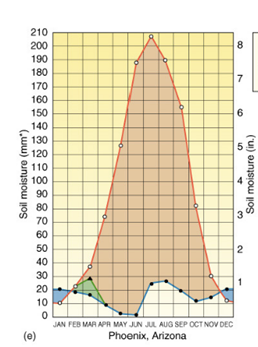
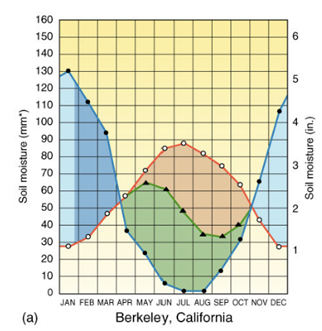
Precipitation = income, evaporation/transpiration/runoff = expenses, soil moisture = savings account
Income (precipitation) > expenses (evaporation & friends) = surplus
Income (precipitation) < expenses (evaporation & friends) = deficit (moisture pulled from soil to fix)
100th meridian – boundary between tallgrass prairie and shortgrass prairie.
PET – Potential evapotranspiration is the amount of water that would evaporate and transpire under unlimited soil moisture conditions. PET in the Southwest leads to aridity because the amount of precipitation is less than the expenses. Florida will likely never have a deficit because precipitation is high.
Soil Moisture: If there’s a surplus, the soil can absorb some. If there’s a deficit, it loses it.\
Gravitational Water – Water found in the immediate subsurface following a rainstorm (lawn after rain very soft). That water is pulled down due to covalent bonding. This water is unavailable to plants because there’s no empty room for them.
Capillary Water – Water that plants can pull up using their roots (grass, shrubs, trees) from the soil because it is NOT fully saturated and there’s plenty of space still available. Field capacity occurs after excess gravitational water drains, leaving the room for the plants. Silt has a higher field capacity than clay because it holds more water.
Hydroscopic Water – Water that is bound to clay particles. Clay takes water from the soil and prevents plants. The wilting point occurs when the only water remaining in the soil is unavailable for plants (taken by the clay).
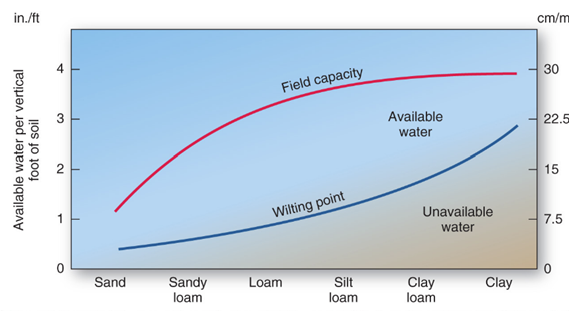 Plants growing in sand or sandy loam can pull moisture out of it. As we move towards clay, theres a lot less available water and they wilt.
Aquifer – subsurface, permeable rock layers, that store water
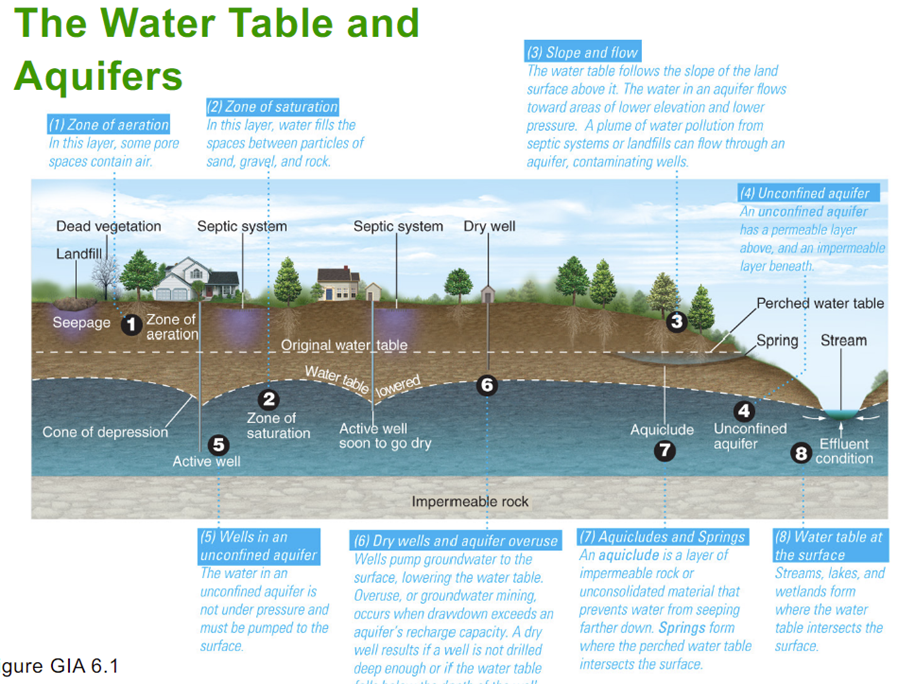 Effluent conditions – Water table is so high that in a river channel, the water table is higher than the stream surface, causing groundwater to flow into the stream.
Influent conditions – Water table is so low that the stream will flow into the subsurface around the channel and into the groundwater.
Overuse of groundwater: Groundwater is a scarce resource
High plains aquifer – largest known aquifer (South Dakota – Texas), has been used extensively since the 1950s, the surface of the water table has dropped 50 feet in the last 50 years, takes 100,000 years to recharge.
Collapsing Aquifers: removal of water weakens the internal structure of an aquifer, leading to sinkholes
Saltwater encroachment: near oceans, excessive pumping of coastal aquifers leads to saltwater intrusions
Point and Non-Point Water Pollution:
Non-Point sources come from fertilizers and stuff that gets carried into streams. Also comes from feedlots and urban streets (where the street chemicals are carried to streams). Hard to control.
Point source comes from pipes, such as from factories dumping in the river. Wastewater treatment plants could also do this. Point source pollution is easier to stop (with legislation).