[7.11-] Interwar Foreign Policy
Political Isolationism Takes Hold
Rejecting Collective Security
Refused League of Nations membership
Avoided agreements requiring military force
Maintained freedom of action in foreign policy
Anti-War Sentiment Grows
Hemingway's A Farewell to Arms (1929)
Remarque's All Quiet on the Western Front (1929)
Trumbo's Johnny Got His Gun (1939)
The Nye Committee
Senate investigations began 1934
Blamed "merchants of death" for WWI entry
Appealed to Depression-era anti-business sentiment
The London Conference
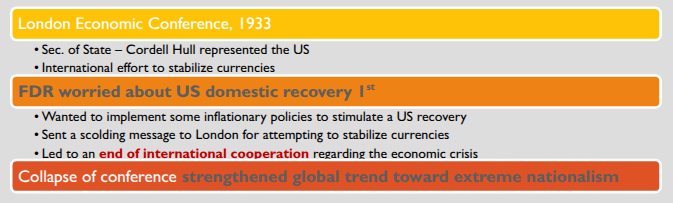
Internationalism vs. Isolationism
FDR tried to make a better relationship with other countries, the Good Neighbor Policy
Latin America- Renounced the Roosevelt Corollary of the Monroe Doctrine - officially announced policy of US nonintervention at the 7th annual Pan-American Conference
Haiti- Withdrew troops in 1934
Cuba – arranged better terms than the Platt Amendment
Mexico – seized US oil interests, but no armed intervention
FDR became the most popular US president in Latin America
US had need to establish goodwill for potential allies due to growing European threat
Reciprocal trade agreements
FDR gets congress to pass the trade agreement, it lowered highrates of the Smoot-Hawley Tariff
1934 – Reciprocal Trade Agreement Act
President given power to lower rates up to 50% WITHOUT Senate approval
Landmark piece of legislations – paved the way for American-led free trade international economic system in the post-WWII world
Storm-Cellar Isolation
1930’s saw the growth of ultranationalism, totalitarianism, and fascism- individual is nothing, state controls all
Soviet Union & Joseph Stalin
Italy & Mussolini
1935- attacks Abyssinia
Germany and Hitler- wanted world domination
1933- left league of Nations
1936- rome-berlin axis
Problems in Far East- Imperial Japan
1934– canceled Washington Naval Treaty
1935 – left League of Nations
1940 –Tripartite Pact
Isolationism received strong boost from these events
WWI seen as colossial blunder
Munich Agreement – Sept 1938
Western concessions made to Hitler over Czechoslovakia in order to achieve “pace in our time”
America Dooms Loyalist Spain
Spanish Civil War – 1936-1939
Republican government in power
General Francisco Franco led a Fascist revolt – aided by Hitler and Mussolini
Western world vows “nonintervention.”
Spanish republican government fell without US help
America refused to build up its armed forces; the navy declined in strength
1938 – FDR finally gets Congress to pass a billion-dollar Naval Construction Act – too late
Appeasing Aggressors
Japan
1937 – invaded China; 2nd Sino-Japanese War begins
FDR doesn’t declare it a “war,” so the Neutrality Acts don’t apply
Japan bought war materials from the US
China is in need of US aid (especially munitions)
Quarantine Speech – Chicago, 1937
FDR suggested quarantining aggressor states and faced an isolationist backlash
Panay Incident, Dec 1937
Japanese sink US gunboat – 2 killed, 30 wounded
Americans are outraged and call for action
Japan quickly apologized and paid indemnity
Sharp contrast to the USS Maine incident
Neutrality Acts of 1935, 1936, 1937
If President proclaimed the existence of foreign war:
No American can sail on belligerent ship
No American can sell munitions to a belligerent nation
No American can make loans to a belligerent nation
No difference was made between an aggressor nation or victim nation
Completely abandoned the policy of freedom of seas
Hitler VS, U.S. Neutrality
Nazi Germany attacks Poland- Sep 1939
August 1939- Nazi-Soviet Pact
France and Britain declare war on Germany
Us Remains neutral
US NEUTRALITY REVAMPED
The outbreak of war promptly heated up the neutrality issue in the US
Britain and France urgently needed American planes and weapons
Neutrality Act of 1937 strictly forbade that
Neutrality Act, 1939 - ”Cash & Carry”
European democracies are allowed to purchase US war materials,
Stipulation – they’d pay for them in cash and transport them in their own ships
America would avoid loans, war debts, and the torpedoing of US ships
Unneutral neutrality law hurt China – blockaded by Japan
The Fall Of Frances
In June of 1940, France will fall, and Germany will take over
1940: France surrendered. Britain stood virtually alone against Nazi Germany.
US will be shocked into action
FDR asks for building of large air fleet and navy
Congress grants $37B for preparation
Conscription Law – Sept 1940 – 1st peacetime draft
Havana Conference of 1940
US agreed to share with its 20 neighbors in the Americas the responsibility of upholding the Monroe Doctrine.
Bolstering the British
July to Oct 1940 – the Battle of Britain
Royal Air Force (RAF) – heroic efforts to protect England
Did not want germany to land nazi troops on their soil
Reports broadcasted on radio to US – public sentiment started changing
Debate intensified in US over what foreign policy to embrace
FDR’s dilemma – hunker down in “Fortress America” or bolster beleaguered British?
FDR was more and more supportive of entering the war with britain
The Destroyer Deal Sept 1940
FDR (without Congressional approval) agreed to transfer to Britain 51 US destroyers left over from WWI
Used simple Executive Agreement
US given 8 valuable defense base sites for 99 years- a part of british empire
Flagrant violation of neutral obligations
Criticized by isolationists and some Republicans
Isolationists are very critical
The Landmark Lend-Lease Law
Britain is about to collapse
Passa new act- U.S. loan military supplies to the allies, after the war, they return backk to the U.S.
This is no longer neutral, and isolationists are opposing it
Marked abandonment of any pretense of neutrality
Germany gives up on trying to take over Britain and takes over the Soviet Union
Hitler saw this as economic warfare by the United States, they will enter the War
Hiitler Invades The USSR
Hitler & Stalin - uneasy truce despite non-aggression pact
Stalin didn’t want Hitler to have control of the Balkans
June 22, 1941 – Germany invades the Soviet Union – Operation Barbarossa
Needed its oil and other resources
Thought they could crush Russia in a matter of a few weeks
FDR says to Stalin we are giving you a hand so you are not taking over by Germany
US expanded Lend-Lease to the Soviet Union
$11B by war’s end
If he never done this, he could have conquered Britain and may have conquered the entire European continent.
US Destroyers Vs. Hitler’s U-Boats
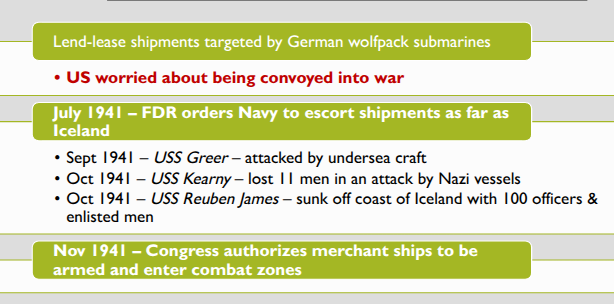
Summer 1941 -FDR has a secret meeting with Winston Churchill- they go over what they think the war should look like when the war is over, FDR wanted to see the right time to enter war
Result – the Atlantic Charter – 8 points on goals after the war
Similar to Wilson’s 14 Points
Opposed imperialistic annexations
Supported self-determination
Called for new international security organization to replace the defunct League of Nations
Freedom from Fear and Freedom From Want
Tensions in the Pacific Theater
Japan had been formal ally of Nazi Germany since Sept 1940
Japan’s position in Far East had grown considerably but still mired in costly “China incident”
Its war machine fatally dependent on US shipments of steel, scrap iron, oil , etc
Late 1940 – US imposed 1st embargo on Japan-bound supplies
Mid-1941 – froze Japanese assets in US and stopped all shipments of gas and war materials to Japan
Nov-Dec 1941 – tense negotiations with Japan in DC
DC officials had cracked the top-secret Japanese diplomatic code; knew Tokyo had decided on war
Most believed the attack would fall on British Malaya or the Philippines
PEARL HARBOR December 7, 1941
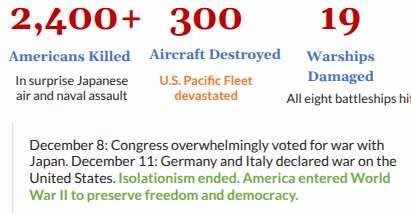
Pearl Harbor naval base in Hawaii was struck3 without warning
Battleship fleet virtually wiped out
Approximately 3000 casualties
Fortunately, 3 priceless aircraft carriers were outside of the harbor
Congress declared war the next day
Germany and Italy declare war on US on December 11th
Pacific fleet had been nearly destroyed but the event unified and angered the US