soils and climate change
Why soils are important
Largest terrestrial carbon store/ sink
Place to grow food
Habitats
Biodiversity
Hydrological - filter water
Minerals and fuels
Archaeological remains
Record of change
What is soil?
A non- renewable resource that is natural and unconsolidated comprised of mineral and organic components that is the layer above the bedrock, capable of supporting plant growth.
It takes 200-400 hundred years to generate 1cm of soil.
Composed of :
Small rock particles
Humus
Water
Air
Peat soils = no mineral components- 100% organic matter.
Soil separates
Mineral matter- particle sizes
Textural class triangle
Sands- light, mostly sands
Clays- heavy, mostly clay
Loams - most agricultural soil, most complex and mixture of all 3.
PEDS- picking up soil and it clumps together- aggregates
Crumb
Platy
Blocky
Prismatic
PANS- dense layer that interfere with penetration of roots and water.
Soil profile
Horizons= layers between soil profile
Not all possible horizons always present and frequently sub-divided.
Brown soils- deep well- drained permeable soils (S and E UK)
Podzolic soils- soils with a peaty or humose layer and subsoils enriched with iron or organic carbon. (NW UK)
Soil types
Zonal- climate, rock type, vegetation, relief, time
Intrazonal- local factors- geology, topography
CATENA- sequence of soils developed from similar parent material under similar climatic conditions.
Podzols
Ash-grey subsurface horizonal bleached by organic acids on top of a dark accumulation horizon with brown or black illuviated humus and red iron compounds.
Occur in humid areas- temperate zones/ tropics.
More iron leaching- more acidic
No worms
Brown soils
Zonal soil, found in drier environments, equal amount silt, sand and clay producing a loamy texture- very fertile.
More easily broken down- presence of worms
Soil nutrients
Critical metals- potassium (K)
Critical non-metals- phosphorus (P) and nitrogen (N)
Low soil fertility- low levels of NPK or Ca, Mg
Nitrogen
Most absorbed element
Released through microbial processes into mineral forms
Abundant in atmosphere- plants can only utilise inorganic form, except legumes where N fixing occurs.
Phosphorus
Energy storage in cells
Potassium
Absorbed second to N
For root development and controls water content by transpiration
Calcium
Important for early age plant growth and lost by leaching
Magnesium
Component of chlorophyll
Toxicity
= High levels elements
Low concentrations= essential/ high= toxic
pH influences availability
Threats to soil quality
Climate change
Sealing
Compaction
Erosion
Landslides
Loss of organic matter
Contamination
Atmospheric deposition
Waste to land contamination
Change in soil biodiversity
National ecosystem assessment (NEA) - demonstrates soil quality and can do it against air and water quality.
Sustainable soil management
Could switch from agricultural land use to forest and grassland.
Plant crops during non-harvesting season - involves growing a crop - legumes- for the purpose of maintaining a vegetative cover.
Implement contour cultivation or terracing on hillslopes.
Regenerative agriculture (RA)
Minimise soil disturbance
Reduce chemical inputs
Maximise crop diversity
Keep soils covered
Maintain living roots year round
Global issues
Soil erosion
Decreasing organic matter
Contamination
Structural damage
Anthropogenic climate change - the increasing average global temperatures cause climatic changes brought about by a chain effect, changing statistical distribution of weather patters over long periods of time.
Weather- the state of the atmosphere at a particular time in a given location
Climate- 'the aggregate or totality of the weather at a particular place or area over a protracted period, conventionally at least 30 years' (Matthews et al, 2003)
Climate change- “a change in the state of the climate that can be identified by changes in the mean and/or the variability of its properties… typically over decades or longer”
Solar radiation (sun’s energy) primary driver of climate system
Today - Climate more than just atmospheric system – recognised in 2nd half of 20th Century
So climate is made up of:
Climate is the status of the climate system, comprising the; atmosphere, Oceans, Ice sheets
Acting as a single body
This UNIT is regarded as the World climate system - most important interactions between highly dynamic atmos (thro which solar energy comes into the system) and oceans (store and transport large amounts of energy – esp thermal)
Other workers add other components – which add complexity
Active layer of land (where permafrost thaws)Lithosphere – rocky/stony layer
Biosphere – living world – influences both incoming radiation and outgoing re-radiation; human transformation of land cover affects atmos. composition via greenhouse gases
Toposphere – landforms
Pedosphere – soils and sediments
All interdependent – fluxes of mass and heat – complex system
Full understanding of climate change – take account of changes in other elements
Sun gives off short wavelength radiation - high energy
Atmosphere
Nitrogen= 75%
Oxygen= 21%
Argon = 0.93%
Very unstable and dynamic
Oceans- sluggish in terms of thermal inertia but important for regulating temperature conditions.
Deep oceanic water thought to be static but not- significant velocity.
2 main regions where dense water sinks- North Atlantic between Scandinavia and Greenland and antactica.
As warm water flows from the equator to the poles it cools and some evaporation occurs, which increases the amount of salt. Low temperature and a high salt content means high density and the water sinks deep in the oceans. The cold, dense water also moves slowly. Eventually, it gets pulled back to the surface and warms in a process called “upwelling” and the circulation is complete.
Climate forcing
Climate forcing- the initial drivers of a climate shift- positive or negative
Sources:
External - affects incoming short wave solar radiation (solar activity, orbital variation)
Internal- alterations in compostion of atmosphere which affects outgoing long wave radiation (changes to land surface, geological- volcanoes, atmospheric dynamics- el nino)
Imbalance between incoming solar radiation and outgoing terrestrial radiation = forcing
Positive forcing= heating up of the system
Natural climatic changes
'snowball earth' = before complex life ice covered the earth- albedo feedback.
Since complex life started (Cambrain period)= 4 major glaciations
Since quaternary period- 20 glacial advances and retreats
The Holocene (last 12000 years) provided a 'long summer' of stable climate aiding the development of human civilisation.
Sun gives off short wavelength radiation- some reflected into space but most passes to earth surface and warms it.
Some absorbed by atmosphere- radiated back as long wavelength radiation (infra-red) = more easily absorbed by GHG .
Questions
Charles keeling began collecting carbon dioxide samples in 1958- strong seasonal variayions in CO2.
Peaked during times of plant growth and decreased during dormancy.
Measurements at Mauna Loa, Hawaii 315ppm 1958 à 360ppm 1991. 10% rise in 35 years
Increase in CO2 largely due to fossil fuel burning, deforestation land use changes
Natural atmospheric gas which contributes to greenhouse effect traps more long wave radiation emissions from surface and increase mean temperature. Research has shown a close relationship on a long term basis between global temperatures and CO2, {but not clear which increases first or if changes are synchronous}
Other gases – GWP; Global Warming Potential is value used to compare the abilities of different greenhouse gases to trap heat in the atmosphere
Methane = 18% contribution to extra global warming- 20x more effective than CO2 - increasing faster than CO2/
From anaerobic decompostion of organic matter - digestive processes of cattle
Landfill
Chloroflurocarbons (CFCs)
14% contribution
40x more GWP than CO2
Needed at mid- troposphere to destroy pollutants/ stratosphere- absorbs harmful UV
Ozone
Bad at top of atmopshere - trapping heat and lower troposhere- makes smog
Sulphur
From biomass and fossil fuel burning= sulphate aerosols
Contributes to acidity of precipitation
Cooling effect
Fossil fuels are the only source of CO2 large enough to raise atmospheric carbon dioxide as high and as quick.
Increase between 1800 and now is 70% larger than the increase that occurred when earth left the last ice age between 17500 and 11500 years ago- 100 to 200 times faster.
Measured by ice cores, dendrology (tree growth rings)
Main anthropogenic sources of GHGs
FOLU- forestry and other land uses
AFOLU - agriculture, forestry and other land uses


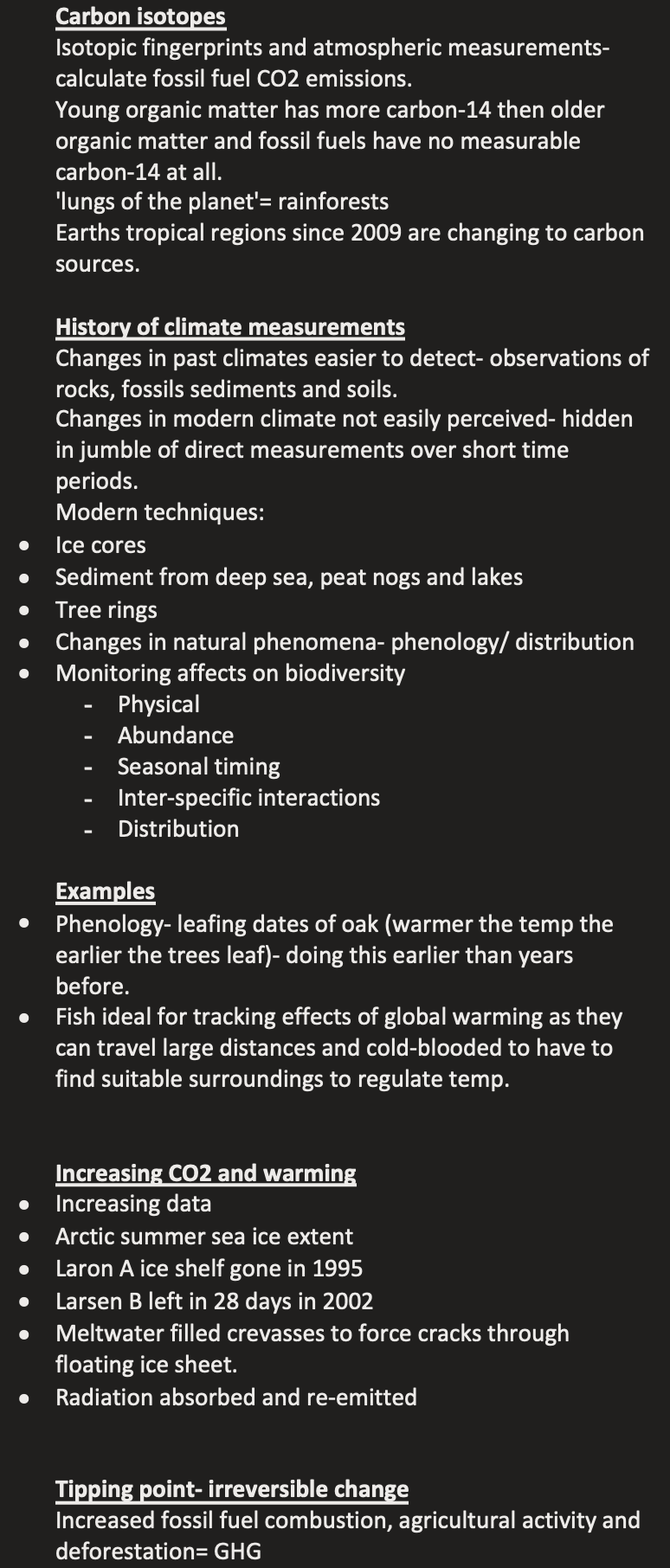
Carbon isotopes
Isotopic fingerprints and atmospheric measurements- calculate fossil fuel CO2 emissions.
Young organic matter has more carbon-14 then older organic matter and fossil fuels have no measurable carbon-14 at all.
'lungs of the planet'= rainforests
Earths tropical regions since 2009 are changing to carbon sources.
History of climate measurements
Changes in past climates easier to detect- observations of rocks, fossils sediments and soils.
Changes in modern climate not easily perceived- hidden in jumble of direct measurements over short time periods.
Modern techniques:
Ice cores
Sediment from deep sea, peat nogs and lakes
Tree rings
Changes in natural phenomena- phenology/ distribution
Monitoring affects on biodiversity
Physical
Abundance
Seasonal timing
Inter-specific interactions
Distribution
Examples
Phenology- leafing dates of oak (warmer the temp the earlier the trees leaf)- doing this earlier than years before.
Fish ideal for tracking effects of global warming as they can travel large distances and cold-blooded to have to find suitable surroundings to regulate temp.
Increasing CO2 and warming
Increasing data
Arctic summer sea ice extent
Laron A ice shelf gone in 1995
Larsen B left in 28 days in 2002
Meltwater filled crevasses to force cracks through floating ice sheet.
Radiation absorbed and re-emitted
Tipping point- irreversible change
Increased fossil fuel combustion, agricultural activity and deforestation= GHG
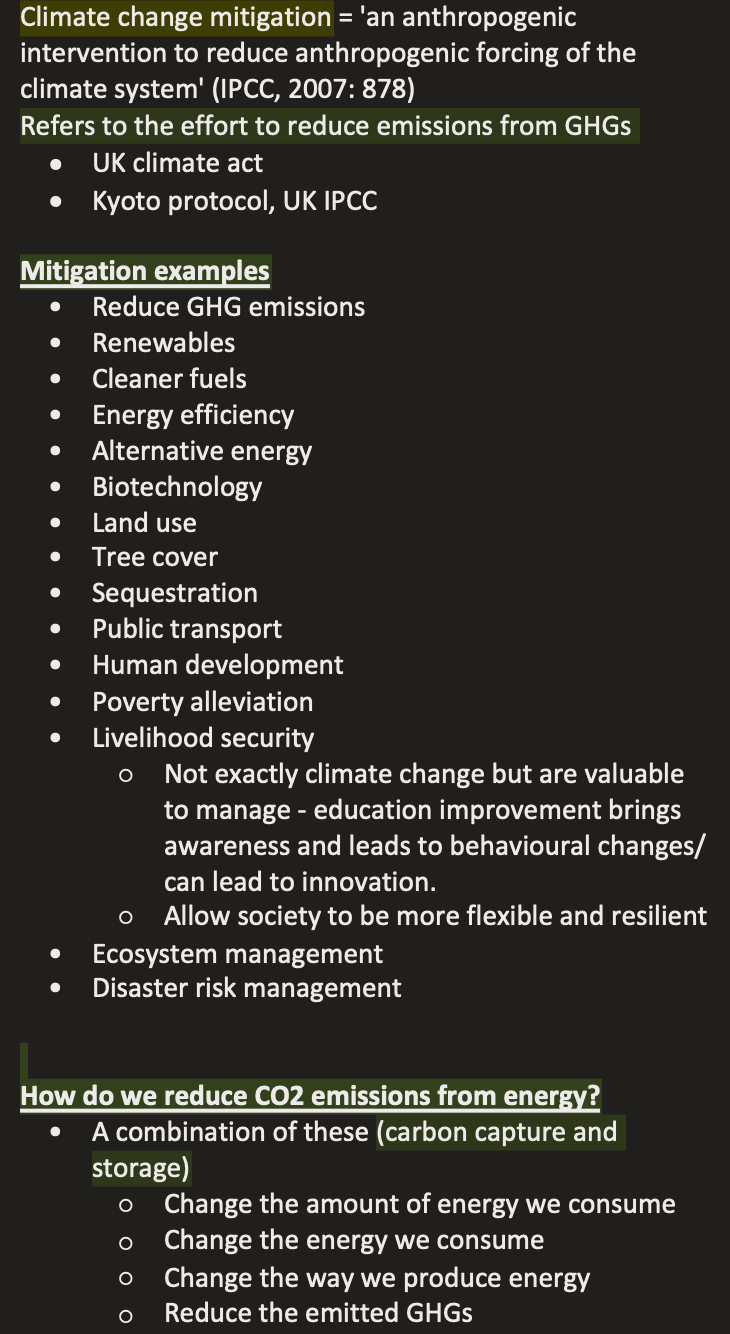
Climate change mitigation = 'an anthropogenic intervention to reduce anthropogenic forcing of the climate system' (IPCC, 2007: 878)
Refers to the effort to reduce emissions from GHGs
UK climate act
Kyoto protocol, UK IPCC
Mitigation examples
Reduce GHG emissions
Renewables
Cleaner fuels
Energy efficiency
Alternative energy
Biotechnology
Land use
Tree cover
Sequestration
Public transport
Human development
Poverty alleviation
Livelihood security
Not exactly climate change but are valuable to manage - education improvement brings awareness and leads to behavioural changes/ can lead to innovation.
Allow society to be more flexible and resilient
Ecosystem management
Disaster risk management
How do we reduce CO2 emissions from energy?
A combination of these (carbon capture and storage)
Change the amount of energy we consume
Change the energy we consume
Change the way we produce energy
Reduce the emitted GHGs
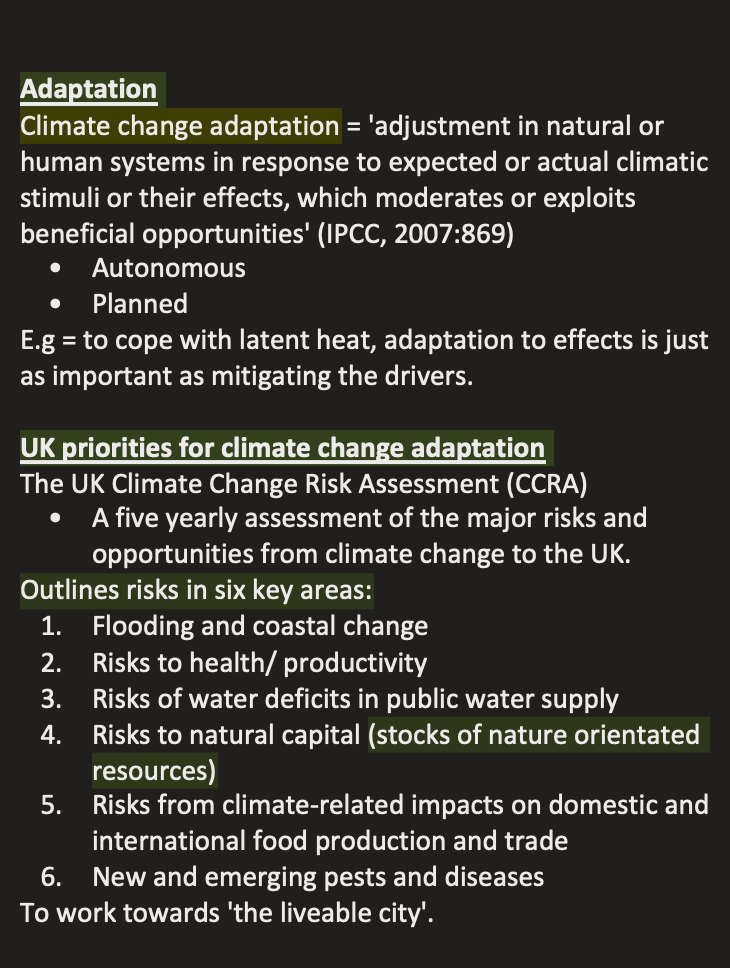
Adaptation
Climate change adaptation = 'adjustment in natural or human systems in response to expected or actual climatic stimuli or their effects, which moderates or exploits beneficial opportunities' (IPCC, 2007:869)
Autonomous
Planned
E.g = to cope with latent heat, adaptation to effects is just as important as mitigating the drivers.
UK priorities for climate change adaptation
The UK Climate Change Risk Assessment (CCRA)
A five yearly assessment of the major risks and opportunities from climate change to the UK.
Outlines risks in six key areas:
Flooding and coastal change
Risks to health/ productivity
Risks of water deficits in public water supply
Risks to natural capital (stocks of nature orientated resources)
Risks from climate-related impacts on domestic and international food production and trade
New and emerging pests and diseases
To work towards 'the liveable city'.
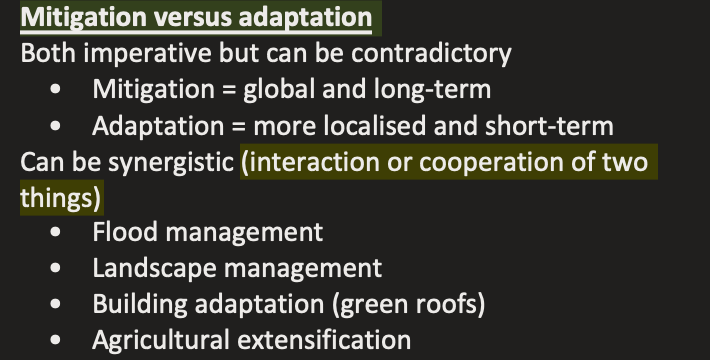
Mitigation versus adaptation
Both imperative but can be contradictory
Mitigation = global and long-term
Adaptation = more localised and short-term
Can be synergistic (interaction or cooperation of two things)
Flood management
Landscape management
Building adaptation (green roofs)
Agricultural extensification