Logic Stuff
D = A + B + C;// (plus is the or operator)F = A*B*C; E = (( A * B C') + (A C B') + (C B A'));
// second way
E = [(A * B) + (A * C) + (B * C)] * (ABC)'
proving this:
Demorgan's Law
Distributive law
Distributive law
Inverse law
Null law
Identity law
Proofs
NOR is equivalent to AND with inputs complemented
(X + Y)' = X' * Y';
(X * Y)' = X' + Y'; // This one supports the NAND example
NAND is equivalent to OR with inputs complemented
Half Adder
With A, B, Sum, Carry
Sum is adding them,
While Carry is multiplying them
Part 1;
A, B, Carry-in = inputs.
Sum, Carry-out = outputs.
Sum = A' B' Cin + A' B Cin' + A B' Cin' + A B Cin;
// adding the sums of each potential options, highlighint the only options that will produce 1, which are odd batches of 1's(1 one in a combination, or all three)
Carry-out = A' B Cin + A B' Cin + A B Cin' + A B Cin;
// the only ones where you have at least 2 1's, which is four of them. (3 of them, the other one(last one), is all three in a combination being 1.
Simplifying the Carry-out.
Cout = A' B Cin + A B' Cin + A B Cin' + A B Cin;

(Idempotency) = A' B Cin + A B' Cin + A B Cin' + A B Cin + A B Cin
(Commutative) = A' B Cin + A B Cin A B' Cin + A B Cin' + A B Cin
(Distributive) = (A' + A) B Cin + A B' Cin + A B Cin' + A B Cin
(Inverse) = (1) B Cin + ...
(Idempotency) = B Cin + A B' Cin + A B Cin' + A B Cin + A B Cin
(Commutative) B Cin
(Distributive)
(Inverse)
(Distributive)
(Inverse)
= B Cin + A Cin + A B
Boolean minimization
(helps to reduce it from the beginning to the end, shown below.
Logic Gates Further
And can also be X down sign Y
Or can also be X up sign Y
Instead of drawing a lot of logic inverters, it would have bubbles pointing to other ones.
Different Realizations of a function
for 1(two-level realization), having and and or, (round bulb is and, sharp bulb is or)
(we don’t count NOT gates)
for first bulb, it is ABC’
for second bulb, it is A’C
for third bulb, it is B’C
for the sharp bulb or, it is the sum of products of all the minterms(the combination of and terms)
for 2.(multi-level realization),
(gates with fewer inputs)
for 3(XOR gate, simplier, but more expensive to build)
Which realization is best?
Reduce number of inputs:
literal: input variable(complemented or not)
Fewer literals means less transistors
Fewer inputs implies faster gates
Fan-ins(# of gate inputs) are limited in some technologies
Reduce number of Gates
Fewer gates (and the packages they come in) means smaller circuits
Reduce numbers of levels of gates
fewer levesl fo gates implied reduced signal propagation delays
minimum delay configuration typically requires more gates
How to explore tradoffs between circuit delay and size?
Automated tools to generate different solutions
Logic minimization: reduce number of gates and complexity
PA + PA' = P(A' + A) // need rest of formulaCanonical Forms
Sum of products: a logical sum (OR) of products( terms using the AND operator)
Produce of sums: A logical product (AND) of sums (terms using the OR operator)
Example
D = A + B + C
F = A*B*CE = (A*B*C') + (A*C*B') + (B*C*A') ( sum of products)
other solution for E is Noncanonical, since it had multiplying and adding (AND and OR) between terms Disjunctive normal form, minterm expansion:
Alternative ways of saying the sum of products
For Minterm expansion
F(A, B, C) = Sigmam(1,3,5,6,7)(position of 1’s in the outputs)
F’(A,B,C) = Sigma m(0,2,4)
Product term(minterm)
ANDed product of literals (which the output is true)
Each variable appears exactly once, in true or inverted form(not both)
Canonical form is not equal to the minimal form
Need to use the Boolean algebra laws to simplify
Product of sums
Conjunctive normal form, maxterm expansion
Alternative ways of saying product of sums
F(A,B,C) = M(0,2,4)(capaital version of sigma)
(A’+B’+C’)( A’+B+C’) (A+B’+C’)(no)
F = (A + B + C) (A + B’ + C) (A’ + B + C)// fpr maxterm, you need to make it zero, so it would be reverse what you would normally have
F’ = the regular way
Sum Term
ORed sum of literals
same variable condition as minterm
can still be minimized using logical laws
Minterm and MAXterm are the same thing, leading to the same result(for example , AB + C
Mapping between canonical forms
Minterm to maxterm conversion
Use maxterms whose indices do not appear in the minterm expansion
Maxterm to minterm conversion
same thing as before, but opposite(use minterms who indices do not appear in maxterm conversion
Minterm expansion of F to maxterm expansion of F’
same thing as the first one
Maxterm expansion of F to minterm expansion of F.’
same thing as the second one
De Morgan’s theorem can change S-o-P to P-o-S, and back.
Programmable Logic Array
The relationship between a truth table and a two-level representation allows us to generate a gate-level implementation of any set of logic functions.
S-o-P(Sum of Products) corresponds to a programmable logic array.
From 0-9, binary-coded decimal digits are encoded from 0000 to 1001.
“past 0-9, there are “dont care terms”, where the output of these input patterns/combinations doesn’t matter, like output is X or D
The set of 0000 is called the offset of W
the set of 1001 as on-set of W
MAxterm set uses don’t care set(D) + offset
Minterm set uses don’t care set(d) + on-set
output don’t care is when the output is free to be true or false
input don’t care is when only some of the inputs work i assume
F = m(2,3,4) + 0,7(d)
F = M(1,5,6) + 0,7(D)
Simplification of two-level combinational logic
Goal is to find a minimal sum of products or product of sums realization
Uniting theorem. : A(B’ + B) = A
Boolean cubes: Visual technique for when the uniting theorem can be applied. n input variables = n-dimensional “cube”
Faces represent an expression in one variable, with F(ABC) = m(4,5,6,7)
Karnaugh maps
Flat map of Boolean cube
Wrap around at edges
Hard to draw and visualize past 4 dimensions
virtually impossible for more than 6 dimensions
Alternative to truth-tables to help visualize adjacencies
Guide to applying the uniting theorem
On-set elements with only one varibale changing value are adjacent unlike the situation in a linear truth-table
GRay-code: only one bit changes between cells
Layout for 2-4 dimension k maps
for homework
it goes from 000 to 111( 001, 010, 011, 100, 101, 110, 111
Examples of karnaugh maps
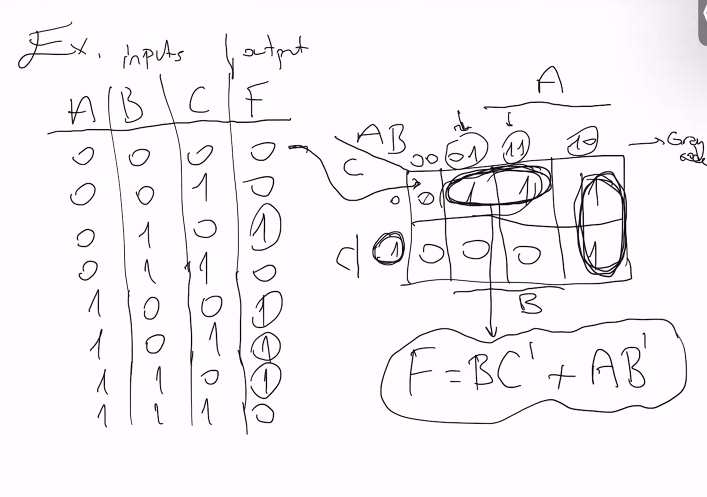
(this one makes so much sense now, the gray scale is just the binary representations of AB, C, the big 0/1 are just F, where A/B/C is 1 is where they are, outside of that C’, B’, A’, the groups make sense, etc.)
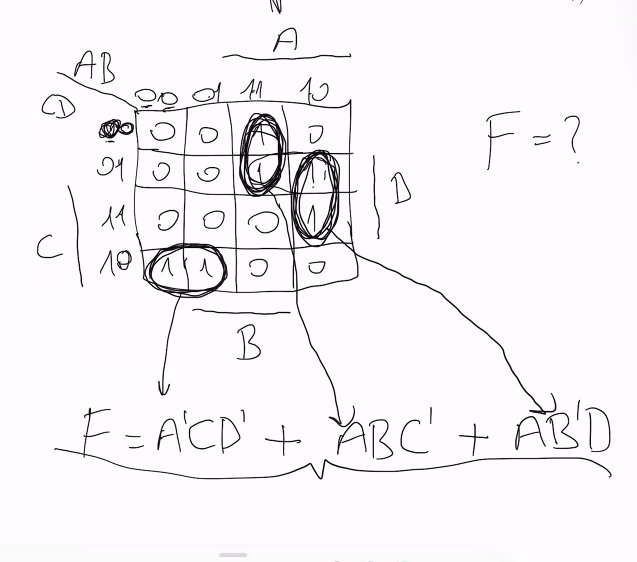
(this is with four variables. where it lines up and more.
Definitions of terms for two-level simplifcations
Implicant
single element of On-set or DC-set or any group of these elements that cna be combined to form a subcube
Prime implicant
implicant that can’t be combined with another to for a larger subcube
Essential prime implicant
prime implicant is essential if it alone covers an element of ON-set
will particiapte in All possible covers of the ON-set
DC-set used to form prime implicants but not to make implicant essential
Objective
Grow implicants into prime implicants (minimize literals per term)
Cover the ON-set with as few prime implicants as possible(minimize number of product terms)