COMM 130 Exam 1
· What is oral interpretation? What are some of its conventions?
—> The “oralization” of literature
—> Dramatic readings of prose, poetry, and drama
· What is the Elocutionary Movement? Offer examples of elocutionary exercises. Think of the videos we watched in class (e.g., My Fair Lady and The King’s Speech)
—> An 18th-20th century educational movement that focused on correct delivery of clear speech, enunciation, expressiveness, and body language
—> Examples: Tongue twisters (“The rain in Spain stays mainly in the plain” from My Fair Lady), physical exercises, breathing exercises, and facial exercises.
· What are the five Classical rhetorical canons? (DAIMS)
—> Delivery, Arrangement, Invention, Memory, Style
· Why is it important to learn about poetry in a public speaking class?
—> Poetry consists of elements that help develop creative tools for crafting memorable speeches
—> “History’s greatest speeches are poetic”
· What are schemes and tropes?
— Schemes: Creative arrangement of words
— Tropes: Deviations from the literal meaning of words
· What’s anaphora, chiasmus, rhyme, assonance, consonance, alliteration, onomatopoeia, metaphor, simile, irony, hyperbole, synecdoche, and allusion?
Schemes
— Anaphora: A repetition of words at the beginning of successive sentences to create emphasis and rhyme
—> Example: “I have a dream…” speech by Dr. MLK
— Chiasmus: A statement consisting of two parallel parts in which the second part is structurally reversed
—> Example: “Ask not what your country can do for you; ask what you can do for your country”
—> Rhyme: Two or more words with corresponding sounds
—> Example: Clown, town, brown
— Assonance: Repetition of vowel sounds in close proximity
—> Example: Cloud, brown, sound
— Consonance: Repetition of consonant sounds (clammy mammals)
— Alliteration: Repetition of initial consonant sounds at the start of neighboring words
—> Example: “Thick as thieves”
— Onomatopoeia: Words that imitate sounds they describe
—> Example: Buzz, boom, and splash
— Repetition: Repeating words and phrases for emphasis
Tropes
— Metaphor: Comparing two dissimilar ideas
— Simile: Comparison using “like” or “as”
— Irony: Saying the opposite of what you mean
— Hyperbole: Exaggeration for emphasis
— Synecdoche: Part-for-the-hole reference
— Allusion: Brief reference to a literary work or historical event
· What’s a poetry slam? Who created it? In what decade did it first emerge?
—> A competitive performance of spoken-word poetry where poets perform original work for an audience and judges, who score their performance
—> Created by Marc Smith, a construction worker who thought a competitive format would make poetry readings more interactive
—> Made in 1984, but became more popular in the 90s
· How long are slam poems? Why are they that length?
—> 3 minutes long
—> Mirrors the length of songs and keeps the show short
· Describe the general format of a slam competition. Who is the ideal judge? How do they judge each performer?
—> Each poet performs a 3-minute or under performance and is scored based on their performance. The first round consists of 12 poets. Top-scoring poets move on to the next round. 12 → 6 → 3
—> The ideal judge has no formal training in poetry
—> Judges use Olympic-style score cards: 0-10, using decimals to help avoid ties
— Points are deducted if a poet goes overtime
· What was the “Simon Says” poem about?
—> Utilizing the child game, “Simon Says” as a parallel to children being told to shut up and listen in school —> jail (explores that pipeline)
· Why do poems include line breaks?
— Visual cues that separate lines of poetry
— Establishes pace/rhythm, separates units of meaning, enhances sound devices
· What components comprise the performance model?
— Performer, text, context, audience
· What’s the difference between verbal and nonverbal communication?
— verbal communication = words
— nonverbal communication = delivery
· What are some verbal things you should avoid in public speaking?
— Filler words (example: “like”)
— Male-generic language (example: “policeman”)
— Spotlighting (example: “male nurse”)
— Cliches (example: “pregnant pause”)
— Jargon that isn’t specifically defined (example: acronyms)
— Generalizations (example: “society thinks”)
—> MUST ALWAYS CITE PERSON
— Mispronounces words
· What is a pathetic fallacy, male-generic language, spotlighting, affect displays, paralanguage, and conversationality?
— Pathetic fallacy: Using human emotions to describe inanimate objects
—> Example: “The newspaper said”
— Male-generic language: Using the word “man” or masculine pronoun to refer to people of any gender
—> Example: “mankind” or “policeman”
— Spotlighting: To bring upon someone based on a part of their identity
—> Example: “male nurse” or “actress”
— Affect Displays: Facial signals of emotion that tell the audience how you feel
— Paralanguage: Using register, timbre (the way voice feels), prosody (variety), pace (speed), pitch, and volume to express certain emotions within speech
—> Example: Think of your “toolbox”
— Conversationality: Giving the sense of having a conversation with audience even though they are not talking back. (ex: eye contact)
· How should you handle citations in your speech, and what requires citation?
—> Citations should be handled by simply stating the article or author’s name after you state their idea within your speech
—> Cite ideas that aren’t your own
· What is proxemics, and why should you consider proxemics when delivering a speech?
—> Use of space
—> Consider the layout of the room, audience placement, and the usage of the public speaking triangle
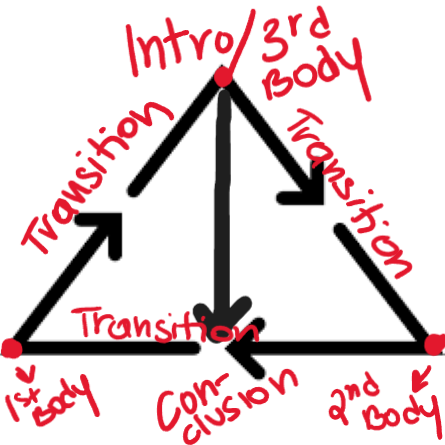
· What’s the preferred walking pattern for public speakers? When should you walk?
—> The public speaking triangle
—> Walk after finishing a body/during transitioning to a new point
· Why is organization crucial in a public speech?
—> Organizes ideas
—> Makes it easier for an audience to follow a speaker’s ideas
· What are the three primary parts of a speech? What percent of your speech should each section be?
—> Introduction: 20%
—> Body: 70%
—> Conclusion: 10%
· What belongs in an introduction and conclusion?
Introduction: attention-getter, establishing significance, state thesis, preview
Conclusion: review, restate thesis, conclude speech (circle back to attention-getter)
· What are previews and reviews? In what parts of your speech do they belong?
— Previews: Tell the audience what you’re going to say before you say it
—> Belongs towards the end of the intro and the start of each major point in the speech’s body
— Reviews: Remind the audience of what you just said
—> Belongs at the end of each major point of the speech’s body and toward the start of the conclusion
· What’s a transition?
—> Ensures a logical progression from one point to the next
—> Synthesizes ideas through: Idea 1 → Idea 2 → Idea 3
—> Consists of language that gets you from point 1 to point 2
· What are the goals of an informative speech?
—> Education, explain, and increase understanding of a topic
—> Tailor info to the audience’s knowledge
· Know three major types of informative speech covered in the lecture.
—> Lectures: Instructional presentations
—> Example: Ted talks
—> Briefs/reports: Information updates where the audience already has a basic understanding
—> Demonstrations - “how-to” speeches
—> Example: A cooking tutorial
· In class, we watched a Ted Talk about effective communication. What acronym did the speaker provide to encourage good communication habits.
—> Honesty, Authenticity, Integrity, Love (HAIL)
· What are the different forms of supporting information you should include in an informative speech?
—> Explanations of what, how, and why
—> Comparisons/metaphors (example: Plato’s Cave)
—> Stories and examples → helps animation
—> Expert testimony: only credible and unbiased people
—> Stats: quantify information to see a bigger picture
—> Using stats
· Regarding stats, what’s the difference between magnitudes and trends?
—> Magnitudes: describe scope and seriousness (example: “1 in have experienced…”
—> Trends: where we were, are, and headed
· What should you do before outlining a speech?
—> Select a topic
—> Research the topic
—> Allow themes to emerge from your research
· What is consubstantiality?
—> Group together similar ideas
· What’s the difference between a claim/argument and evidence?
—> Claim/argument: What you’re trying to argue/prove
—> Evidence: How you support your claim
· What’s the basic format of an outline? (Some of you struggled with outlines during the first workshop, so make sure you review this lecture.)
—> I, A, 1 (1 implies a 2, A implies a B)
—> I, II, III refer to Intro, Body, Conclusion
—> A, B, C refer to main aspects
—> 1, 2, 3 are supporting details
· What is a parenthetical citation? What’s a works cited page? What’s the relationship between parenthetical citation and a works cited?
—> A simple citation including the source’s name and page
→ Example: (Fox, 10)
—> A list of all the sources used for the speech, usually in a certain format (APA, MLA, etc.)
—> Parenthetical citation is a way to vocalize the source briefly in the speech, so that if the audience wants to learn more about the evidence that was provided, they can look in the works cited page.
· In class, we watched an outstanding, informative speech about African nations. What, specifically, was the speech about?
Homophobia in current-day Africa, in contrast to the deep history Africa has with homosexuality
· What are a few things to avoid with visual aids?
—> Avoid chalkboards and dry erase
—> Lots of text (or text at all)
—> Don’t pass it around to the audience
· Why might you want to avoid text in a visual aid?
—> VAs are supposed to supplement what you say, so the text should not repeat or replace what you say
· What are some visual-aid best practices?
—> Knowing it (Anticipating and having remedies for potential problems)
—> Aiming for interaction (moveable VAs are more dynamic)
—> Relevant but not overly complicated
· What’s the proper protocol for presenting your visual aid?
—> Has to be located on the same point when you talk
—> Keep it hidden until you use it
—> Hide it again after it’s done being used
—> Introduce it, Present, Explain, then put away
· Identify different types of visual aids.
—> Tables and Graphs
—> Charts: visual classifications
—> 3D visual representations