Sensory system: lecture 1 - Sensory reception, transmission and processing
Sensing the Environment
Sensing and processing information about your internal and external environment is crucial for survival and reproduction.
Animals have evolved a wide range of somatic and special senses to achieve this making the way individual species experience their environment unique
for example:
Sharks use the Earths magnetic field for orientation and navigation
Butterflies can detect potential mates several kilometres away
Polar bears can smell a seal from 1-2km away
The Sensory System
information about the external environment is detected by sensory receptors and send to the brain where it is interpreted and results in an appropriate response
Sensory input → Integration in the CNS → Motor Output
Steps in Sensory Processing
Information about the external environment is detected by sensory receptors which send signals to the brain that interprets the signals before creating an appropriate response, It goes as follows
Sensory Reception - A sensory receptor detects a stimulus
Sensory Transduction - The stimulus is converted into an electrical signal
Sensory Transmission - The Electrical signal is transmitted through nerve cells
Perception and Response - The brain processes the signal and triggers a response
Sensory Reception
Sensory reception is when a sensory receptor detects a stimulus
all stimuli represent forms of energy!
sensory receptors convert this energy into a change in the membrane potential (= receptor potential)
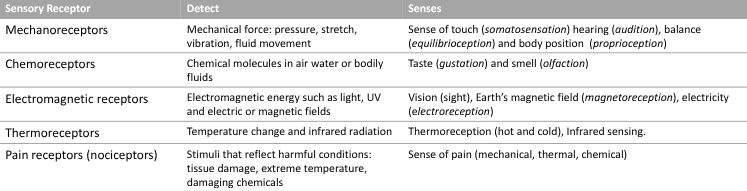
Sensory receptors fall into one of the five classes below based on the energy they transduce:
Sensory Receptors
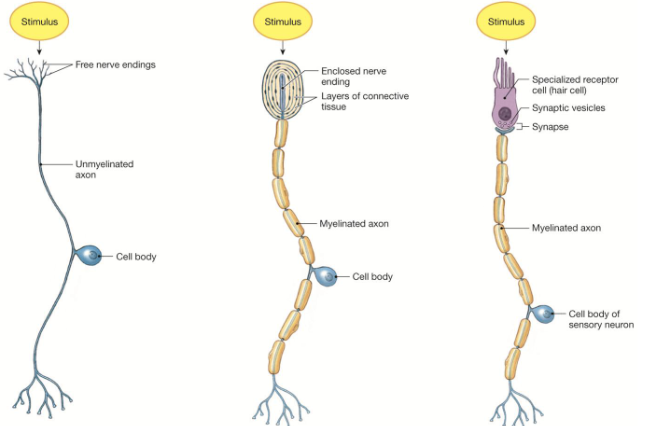
Sensory receptors can be neuronal or non-neuronal
Sensory Transduction
Sensory Transduction is the conversion of the stimulus (e.g. light, sound, pressure, chemicals) into an electrical signal
The activation of a receptor by stimulus will:
open or close ion channels
cause membrane deformation
or activate GPRC pathways causing depolarisation (in most cases) or Hyperpolarisation (photoreceptors) of the membrane
This is the receptor potential
Receptor potentials are graded i.e they increase in strength depending on stimulus strength
saturation:
all receptor proteins are activated
ion channels are maximally open
equilibrium of the ions
→ no further change in membrane potential
Graded Receptor Potentials
Graded receptor potentials are variable strength signals that travel over short distances and lose strength as they travel through the cell
amplitude is directly proportional to the strength of the stimulus
they spread massively and decrease in strength with distance
Summate - temporal and spatial
An action potential is triggered if graded potential is > the threshold when it reaches the axon hillock
! A graded potential will lose strength the farther it travels due to being passive and the amplitude decreasing the farther away it travels from stimulus site. !
sensory transmission
sensory transmission is the sending of the electrical signal through afferent neurons to areas in the brain
if the receptor potential is strong enough it will trigger an action potential → ‘ALL-OR-NOTHING’
How can we detect differences in stimuli?
measuring the rate or frequency of action potentials (i.e intensity of stimulus
measure the no. of receptors activated
measuring the specific receptors that are activated
Sensory Perception & Response
sensory perception and response is the interpretation of signal by the brain
Stimuli from different sensory receptors travel as action potentials along dedicated neural pathways (transmission)
The brain distinguishes stimuli from different receptors based on the path that the action potentials arrive
The Thalamus acts as the distribution centre, where information comes in and distributed to different areas of the cortex dedicated to processing that sense
the olfactory system is an exeption to this !!!!