Space physics
Our solar system
Anything that orbits a planet is a satellite
Natural, like moons
Artificial, that are man-made - communications, telescopes

The planets are in elliptical orbit around the sun
The path they take isn’t a perfect circle - it is slightly squished
Asteroids are mostly made of rock and metal
They are found mostly in the asteroid belt - between Mars and Jupiter
Comets are mostly ice and dust
They are in much larger elliptical orbits, and travel to the edges of the solar system
Galaxies are collections of billions of stars, each with their own solar systems
All the stars are held together by gravity and they orbit the centre
For example, the milky way
The Universe is a vast expanse of mostly empty space scattered with galaxies
It is full of solar systems, that each have a star with surrounding planets and satellites
The life cycle of stars
Nebulas are the star of a star’s life cycle
They are a cloud of space and gas
The attractive force of gravity begins to grow and creates a protostar
A protostar is formed by gravity, and more particles join as they collide
This causes the protostar to grow as more gas and dust add to it
This causes the force of gravity to increase
Particles in the protostar are then more effected by gravity, and get more densely populated
There are more collisions, so the temperature and pressure increases
When the temperature and pressure is high enough, hydrogen and helium in the protostar undergo nuclear fusion
Through this, lots of energy is released
This leaves the core of the star very hot
A main sequence star is the created by this process of nuclear fusion
There is lots of outward pressure due to nuclear fusion, which is perfectly balanced by the inward pressure from gravity
Main sequence stars stay the same for a long stable period
Our sun is currently in this phase
Over billions of years, it starts to run out of hydrogen as fuel, so gravity outweighs the outward pressure
This causes the star to be contracted to a small ball, until it is hot enough with high enough pressure to restart nuclear fusion
This nuclear fusion creates hydrogen and helium, but also heavier elements - up to iron on the periodic table
How much the star expands depends on how big the initial star was
If the initial star was small/medium it ends up as a red giant
If the initial star was really big, it ends up as a red super giant
A red giant becomes unstable after a short time
It expels its outer layers
It leaves a lot dense solid core
It then becomes a white dwarf, which gets cooler and darker as it emits energy
It the becomes a black dwarf, as it no longer has enough energy to emit light
A red super giant starts to grow brightly again after more nuclear fusion
It undergoes several cycles of expansion and contraction
It then becomes a supernova
Elements heavier than iron are formed and ejected all over the universe
If it was a very big star, it becomes a neutron star with a very dense core
If it was an absolutely massive star, it becomes a black hole which is caused by a supernova collapsing in on itself
Gravity is able to pull in any light that passes
Orbits
An orbit is the curved path of one celestial object around another celestial object
Newton’s first law states that an object continues constantly unless there is another resultant force
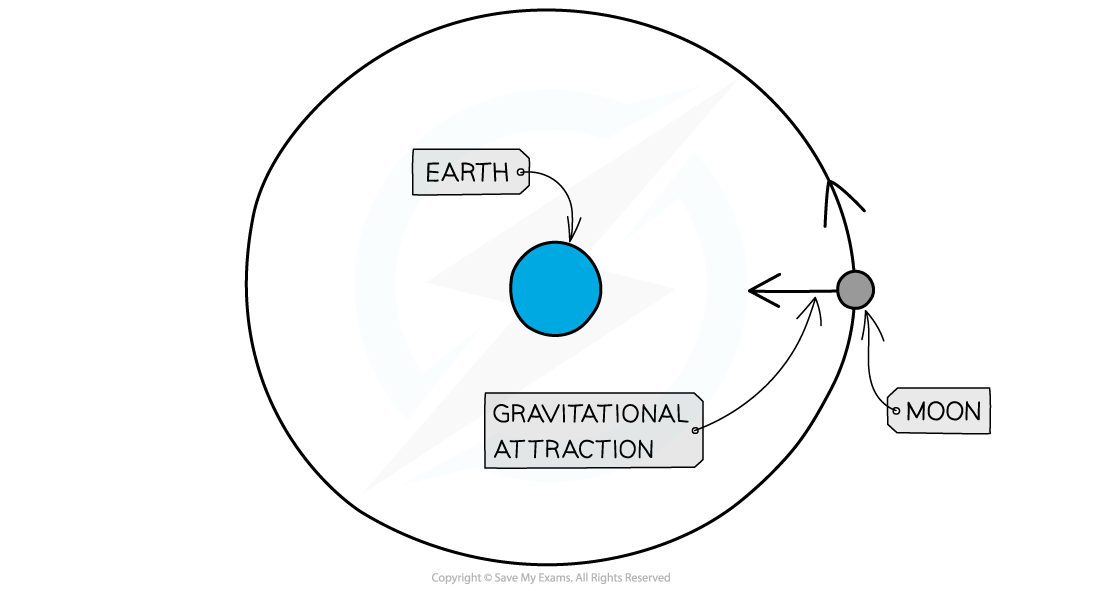
The moon constantly travels forward (instantaneous velocity), and experiences a strong gravitational pull towards earth
The moon has a lot of momentum forward, so can’t be completely pulled in by gravity, only change its direction slightly
The force is always there, so it always orbits at a constant speed
The velocity constantly changes, as it is a speed in a direction
The speed is constant, but direction differs
Acceleration = velocity change / time
The moon is constantly accelerating because the velocity changes, but speed differs
The size of an objects orbit changes the speed of an object
The smaller an object’s orbit, the faster the object must travel to maintain a steady orbit
If it has a larger orbit, it travels slower to stay in orbit
Red shift
Essentially, the universe is constantly expanding :)
This can be proved by red shift, because of the big bang theory
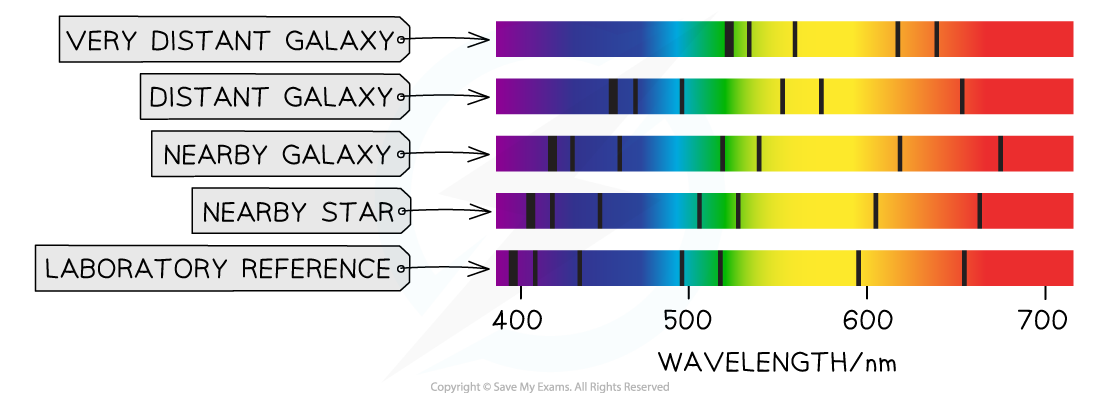
The absorption spectra shows all visible light, all emitted from the sun
At the red side of the absorption spectra, there are longer wave lengths of light
At the purple side, there are shorter wave lengths
Chemicals in the atmosphere absorb certain wavelengths, so these wave lengths are missing
They appear as dark lines on the absorption spectra
When analysing light from different galaxies, spectras have the same patterns of black lines, but they are shifted towards the red end
This is called red shift
Red shifts happen as light waves get stretched as they make their way to earth
For example, if a wave length was originally 600nm, it could be shown as 650nm on our spectra
This is because as galaxies move away, the light waves stretch
The galaxy is not moving through space, but as the space and galaxy is expanding, they end up further away
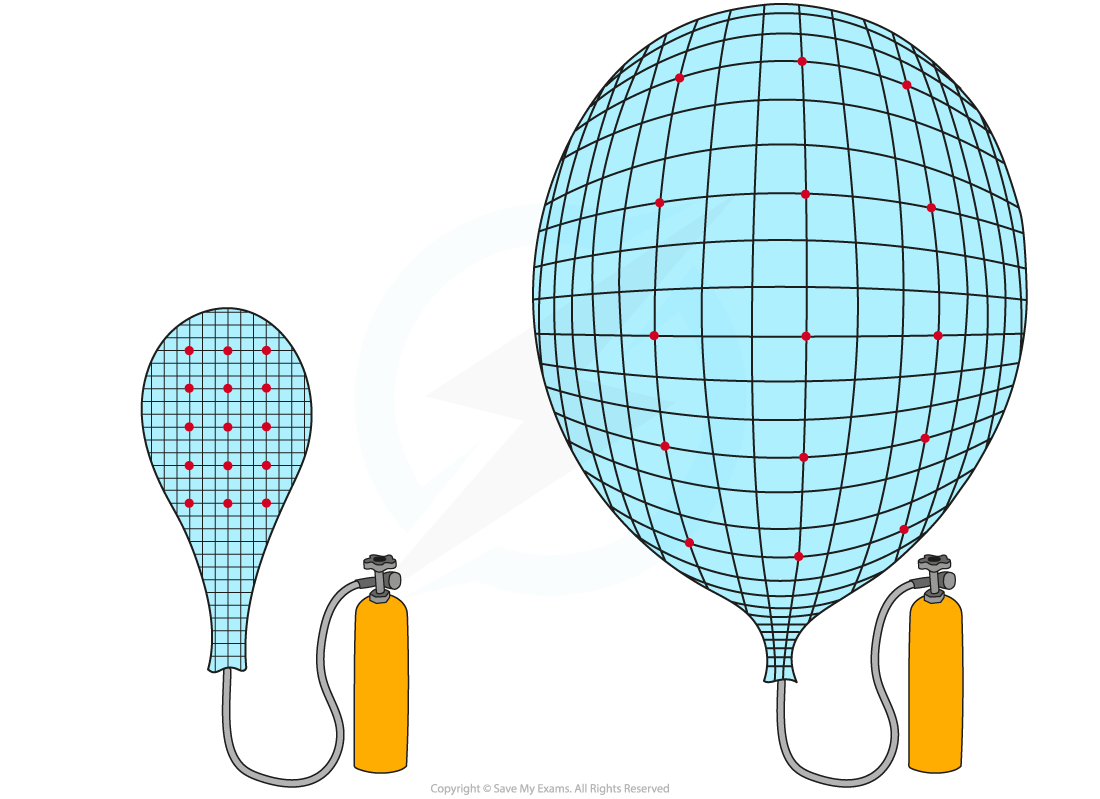
As the balloon (universe) inflates, the space between galaxies is stretched
The further away galaxies are, the quicker they seem to move
The galaxies themself don’t actually move, but the distance between them grows
However, balloons only stretch so far, and galaxies should be in the balloon as well - the model is not entirely accurate
As the universe is constantly growing, we can tell that it used to be smaller in the past
We can use this to tell how the universe could have started, as it was originally very tiny
It started to grow, which could be explained by the big bang theory
Originally all matter in the universe was tiny - it was incredibly dense and hot
This matter was so hot and dense, that it suddenly exploded, which it stills continues to
DONE!!!!