BANK. notes.docx
BANK - is a financial institution deals in money, generally accept deposits and make loans.
Bangko sentral ng pilipinas - is under the regulatory of the government not under the authority.
Rothschild family - richest family in the world, noble banking family.
BSP LOGO - DESIGN ELEMENTS:
GOLDEN PHILIPPINE EAGLE - The logo employs a photorealistic rendering of a Philippine eagle in flight, signifying the strength of leadership and foresight that the BSP provides in the financial sector and the economy.
- The eagle's outstretched wings and tail feathers symbolize the BSP's balanced, inclusive approach to growth and development, while also conveying the central monetary authority's mastery over its field.
- The eagle's head and eyes face east, expressing the BSP's vigilance and readiness to seize challenges and opportunities that rise over the horizon.
- The talons represent the strong will, resolve, and the monetary and financial tools that the central bank uses in discharging its mandates.
SHAPE - The logo is contained within a perfect circle—without sides, a beginning, or an end—accentuated by a bold border, to convey the singular and integrative nature of the BSP and its impartial approach to holistic growth and development.
GOLDEN STARS - The three golden stars represent the three pillars of central banking (price stability, stable banking system, and a safe and efficient payments and settlements system), as well as the BSP's commitment to promote and sustain a high quality of life for all Filipinos, across Luzon, Visayas, and Mindanao.
CORPORATE TEXT - The name of the Bangko Sentral ng Pilipinas is rendered in gold, using a clean sans-serif font, to signify the Bank's operational efficiency, clarity of vision, and single-mindedness of purpose.
DOMINANT COLORS - Yellow gold and midnight blue dominate the new logo’s color scheme to evoke the BSP’s stature as a premier government agency.
- The yellow gold foreground elements represent the BSP's aim to promote economic growth and prosperity, and the high standards of ethics and performance it holds.
- The two-tone midnight blue background is evocative of the honor, dignity, and noble character of the Filipino people, and the BSP's unwavering commitment to serve the nation.
Historical Perspective of the World
- 2000 BC - early banking practices started in the Babylon, credit transaction engaged evidence by tablet of clay.
- 4th Century BC - temples, public bodies and private firms deal in deposit and loaning of funds.
- 2nd Century AD - transactions were registered by public notaries.
- 8th Century - banks draft and checks were in wide use in Assyria.
- Medici family ushered in the 2nd period of Florentine financial power.
- 16th Century - ruled by Fugger Family. John’s law financial system almost spelled ruin to France
PHILIPPINE BANKING HISTORY
Spanish Era
- Obras Pias (the first bank in the philippines)
- on 16th century, the first financial institution was organized flourishing galleon trade between the Philippines and Mexico, its capital came from pious catholic and funds were loaned out interest.
- charitable foundations for the support of hospitals, convents, missions, and schools, as well as chaplaincies, which were established during the colonial period.
- Banco Espanol-Filipino
- (1828) first established commercial bank performing general banking functions and partly finance foreign trade.
- October 17, 1854 it was given a priviledge note of issue. Today its bearing name is Bank of the philippine island ( banco delas islas filipinas )
- Opening of suez canal (1869) led to accessibility of european markets.
- Chartered banks of india, autralia , and china established branches in the country.
- Monte de piedad
- (1882) a savings bank was established intended for the poor. Its original name is Monte de Piedad y Caja de Ahorros.
- Banco Peninsular Ultramarino in Madrid
- Put up a branch in the Philippines in 1853
American Era
Banks continue to do business and soon joined by the branches of international banking corporation and the guaranty trust company. Postal saving banks was also created a parcel to the bureau of post.
Banks established after World War 1
- Yokohama Specie Bank (1919)
- China Banking Corporation (1920)
- Peoples Bank and Trust Company (1926)
- Mercantile Bank of China (1926)
Upon establishment of Commonwealth,
- Netherlands Indische Handels bank (1973)
- Philippine bank of Commerce (1938)
- the first private bank with genuine Filipino capital.
- Bank of Commonwealth (1939)
- Philippine Bank of Communications
- Agricultural Industrial Bank (government-owned)
- commenced commercial banking operations.
Japanese Era ( in this era isang bangko lng ang ginamit, mickey mouse money - wlng value ang pera)
During the Japanese occupation only Filipino and Japanese-owned banks were given permission to operate.
- The Southern Development Bank (1942)
- opened a branch in Manila.
- which acted as fiscal agent of the Japanese government in the Philippines.
Post War Era
- Presidential Directive, Executive Order 96, invalidated all Japanese occupation deposits.
- Executive Order 48 paved the way for the reopening of the pre-war banks.
- Rehabilitation Finance Corporation was created by virtue of Republic Act 85 0n January 2, 1947.
- In 1949 republic act No. 265 known as Central Bank Act was passed.
- In 1972, Presidential Decree no. 72 was issued amending Republic act no. 265 in attuned in changing economics.
- In 1973 Constitution, Presidential decree no. 1801 designated Central Bank of the Philippines as the central monetary authority which was adopted aimed by the1987 Constitution.
Philippine Banking Today
Republic Act No. 7653 or the New Central Bank Act of 1993, governs Philippine banking today. It provides for the establishment of an independent monetary authority to be known as Bangko Sentral ng Pilipinas (BSP).
The business of banking has changed irreversibly. Developments in technology have more contributions in these irreversible changes in the banking system. Technology has brought us E-Banking, the provision of banking services. The devise used to provide e-banking services are called E-money which can be divided into three groups:
- Access devices- these allow people to withdraw or deposit cash, transfer funds and pay bills from their bank accounts without physically going to the banks or writing a check.
- Card-based products- these are prepaid cards in which funds are stored in electronic form on a computer chip embedded in cards.
- Prepaid software products or network money- involve funds that are stored in electronic form and are transferred over communication networks among participants in network.
Republic Act No. 8791 known as General Banking Law of 2000, institutionalized a certain mass of banking reforms in the Philippines. It provides regulation of the organization and operation of banks, quasi-banks, and trust entities.
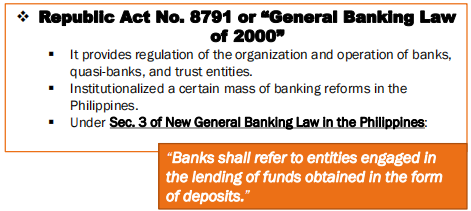
Republic Act No. 9160 known as the Anti-Money Laundering Act of 2001, was passed into law on 29 September 2001.
On April 19, 2000 the Monetary Board approved the issuance of Circular No.237, consolidating and clarifying all existing rules and regulations on mergers and acquisitions. Bank mergers and consolidations are distinguished as follows:
- Merger- is the absorption of one or more corporations by another existing corporation which retains its identity and takes over the rights, privileges, franchises, and properties and assumes all liabilities and obligations of the absorbed corporations.
- Consolidation- the union of two or more corporations into a single new corporation, called the consolidated corporation.
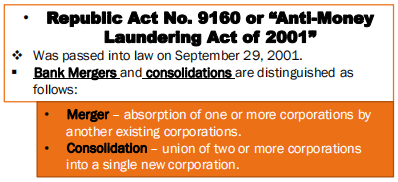
Banks- shall refer to entities engaged in lending of funds obtained in the form of deposits.
What is the difference between bank and banking?
BANK - tangible objects
- refers to physical resources
BANKING - intangible (service)
- refers to the output (financial service) of the bank by utilizing those resources.
Nature of Banking Business- “Banks makes money out of other people’s money”
Principle of Banking Business
- A certain amount deposited will support several times as much in credit, known as the partial reserve system.
- A greater portion of deposits in commercial banks arises out of the proceeds of loans.
TYPES OF BANKS
AS TO OWNERSHIP:
- Privately owned - organized and capitalized by private citizens for their profit.
- Publicly owned - organized by the state and sometimes has a minimum private ownership.
AS TO THE PLACE OF INCORPORATION:
- Domestic - incorporated under philippines laws. Majorityof the stocks are owned by filipinos.
- Foreign - incorporated under laws of other country although the bank might be doing business in the philippines.
AS TO STRUCTURE:
- Stock corporation - when they sell shares of stock to the general public to raise capital
- Non stock corporation - the organization is on a membership, such as savings and loans associations
AS TO FUNCTION THE LINE OF DEVELOPMENT:
- Commercial Bank - it is one that receives demand deposits and give short-term loans.
- Trust Company - an institution which deals in fiduciary activities such as administrator of estates, guardian of minor’s interests, executor of last wills and testaments etc. This function was originally a legal function and was handled bylegal officers and lawyers.
- Savings or Thrift Banks - it is one primarily receives money for safekeepingfrom person who have no immediate need for cash andinvest these funds in long-term investments.
- Rural Bank - organized primarily to cater to the needs of small farmers, small businesses, small cottage industries and cooperative associations. They also receive deposits and loan our of funds.
- Development Bank - takes care of giving loans to be used for developing the economy and may therefore engage in medium and longterm lending. The organization of private development banks shall be, under the control and supervision of the Development Bank of the Philippines (formerly Rehabilitation Finance Corporation)
- Cooperative Bank - it is organized to furnish the credit needs of duly registered and operating cooperative associations of different kinds.
- Investment Bank - assist government bodies and newly organized corporations to raise funds for capital through sale of stocks and bonds.
- Central Bank - banks of all banks; it does not directly deal with the public. It is the supervisory and regulatory agency which makes all banks “tow the line”
AS TO MANAGEMENT:
- Unit Bank - refers to a bank that is a single, usually small bank that provides financial services to its local community. A unit bank is independent and does not have any connecting banks — branches — in other areas.
- Group Bank - owned by two or more banks.
- Branch Bank - refers to a bank that is connected to one or more other banks in an area or outside of it; to its customers, this bank provides all the usual financial services but is backed and ultimately controlled by a larger financial institution.
- Chain Banking - is a group of banks (minimum is 3) held together by a group of individuals for effective banking activities while the banks function independently without any hindrance of a holding company. These activities don't overlap so that the revenue is maximized to the best possible extent
ECONOMIC SIGNIFICANCE OF BANKS
- A bank facilitates dealings between debtors and creditors because it acts as an intermediary in the flow of credit funds. It allows others the use of idle funds of the community in productive activities.
- Creates money out of proceeds of loans.
- A bank maintains foreign trade
WHY THE STATE SUPERVISES BANKS?
“The state does not only supervise banks, but with the advent of central banking. It also controls the bank’s operation.”
Reasons:
- The banks are entrusted with other people’s money.
- The state wants to assure that the banks will perform their functions in the best interest of their clients through honest and efficient conduct of their functions.
- The banks may either abuse their power or use them prudently.
- The banks are quasi-public corporations and as in all other corporations of this calling, the state must exert its restraining influence to safeguard the welfare of its constituents.
MODULE 2
General Aspects in Establishing Banks
1. Economic justification for banks. The organizers must be armed with facts and figures such as degree of competition, degree of risk, potential customers, availability of manpower, businesses and products, habits and customs of the people, and such other matters which they have to analyze carefully before proceeding to their project and which will also contribute to the banks successful operation.
2. Selection of stockholders. This is an essential consideration in setting up a bank because on such choice may depend its success or failure. The organizers have to make sure that these men are of: Good moral character, Have adequate knowledge on the business of banking, Equipped with the necessary capital, Known in the community as honest and righteous citizens, Willing and able to contribute to the bank's success.
3. The determination of the kind of bank to be formed. Determination of the type of bank depends upon the economic survey. The chosen type of bank will determine the amount of capital to be raised.
4. Determination to the type of the capital to be raised. The organizers will find it easier to determine the amount of capital to be raised after they have agreed on the type of the bank. In a nutshell, there must be enough capital to see the bank through until it has gained prominence and has become profitable.
Organization, Management and Administration
After taking the preliminary steps, organizers can proceed to the formal establishment of the bank itself. Philippine banking laws and the Corporation Code shall serve as guide to the organizers. To be specific, the New General Banking Act (Republic Act No. 8791) requires that all bank shall be established as stock corporations.
Section 8. Organization. - The Monetary Board may authorize the organization of a bank or quasi-bank subject to the following conditions:
- 8.1 That the entity is a stock corporation;
- 8.2 That its funds are obtained from the public, which shall mean twenty (20) or more persons; and
- 8.3 That the minimum capital requirements prescribed by the Monetary Board for each category of banks are satisfied.
No new commercial bank shall be established within three (3) years from the effectivity of this Act. In the exercise of the authority granted herein, the Monetary Board shall take into consideration their capability in terms of their financial resources and technical expertise and integrity. The bank licensing process shall incorporate an assessment of the bank's ownership structure, directors and senior management, its operating plan and internal controls as well as its projected financial condition and capital base.
Section 9. Issuance of Stocks. - The Monetary Board may prescribe rules and regulations on the types of stock a bank may issue, including the terms thereof and rights appurtenant thereto to determine compliance with laws and regulations governing capital and equity structure of banks; Provided, That banks shall issue par value stocks only.
Section 10. Treasury Stocks. - No bank shall purchase or acquire shares of its own capital stock or accept its own shares as a security for a loan, except when authorized by the Monetary Board: Provided, That in every case the stock so purchased or acquired shall, within six (6) months from the time of its purchase or acquisition, be sold or disposed of at a public or private sale.
Section 11. Foreign Stockholdings. - Foreign individuals and non-bank corporations may own or control up to forty percent (40%) of the voting stock of a domestic bank. This rule shall apply to Filipinos and domestic non-bank corporations. The percentage of foreign-owned voting stocks in a bank shall be determined by the citizenship of the individual stockholders in that bank. The citizenship of the corporation which is a stockholder in a bank shall follow the citizenship of the controlling stockholders of the corporation, irrespective of the place of incorporation.
Section 12. Stockholdings of Family Groups of Related Interests. - Stockholdings of individuals related to each other within the fourth degree of consanguinity or affinity, legitimate or common-law, shall be considered family groups or related interests and must be fully disclosed in all transactions by suchcorporations or related groups of persons with the bank.
Section 13. Corporate Stockholdings. - Two or more corporations owned or controlled by the same family group or same group of persons shall be considered related interests and must be fully disclosed in all transactions by such corporations or related group of persons with the bank.
Section 14. Certificate of Authority to Register. - The Securities and Exchange Commission shall not register the articles of incorporation of any bank, or any amendment thereto, unless accompanied by a certificate of authority issued by the Monetary Board, under it seal. Such certificate shall not be issued unless the Monetary Board is satisfied from the evidence submitted to it:
- 14.1 That all requirements of existing laws and regulations to engage in the business for which the applicant is proposed to be incorporated have been complied with;
- 14.2 That the public interest and economic conditions, both general and local, justify the authorization; and
- 14.3 That the amount of capital, the financing, organization, direction and administration, as well as the integrity and responsibility of the organizers and administrators reasonably assure the safety of deposits and the public interest.
The Securities and Exchange Commission shall not register the by-laws of any bank, or any amendment thereto, unless accompanied by a certificate of authority from the Bangko Sentral.
Section 15. Board of Directors. - The provisions of the Corporation Code to the contrary notwithstanding, there shall be at least five (5), and a maximum of fifteen (15) members of the board or directors of a bank, two (2) of whom shall be independent directors. An "independent director" shall mean a person other than an officer or employee of the bank, its subsidiaries or affiliates or related interests. (n) Non-Filipino citizens may become members of the board of directors of a bank to the extent of the foreign participation in the equity of said bank. (Sec. 7, RA 7721) The meetings of the board of directors may be conducted through modern technologies such as, but not limited to, teleconferencing and video-conferencing.
Section 16. Fit and Proper Rule. - To maintain the quality of bank management and afford better protection to depositors and the public in general the Monetary Board shall prescribe, pass upon and review the qualifications and disqualifications of individuals elected or appointed bank directors or officers and disqualify those found unfit. After due notice to the board of directors of the bank, the Monetary Board may disqualify, suspend or remove any bank director or officer who commits or omits an act which render him unfit for the position. In determining whether an individual is fit and proper to hold the position of a director or officer of a bank, regard shall be given to his integrity, experience, education, training, and competence.
Section 17. Directors of Merged or Consolidated Banks. - In the case of a bank merger or consolidation, the number of directors shall not exceed twenty-one (21).
Section 18. Compensation and Other Benefits of Directors and Officers. To protect the finds of depositors and creditors the Monetary Board may regulate the payment by the bark to its directors and officers of compensation, allowance, fees, bonuses, stock options, profit sharing and fringe benefits only in exceptional cases and when the circumstances warrant, such as but not limited to the following:
- 18.1. When a bank is under comptrollership or conservatorship; or
- 18.2. When a bank is found by the Monetary Board to be conducting business in an unsafe or unsound manner; or
- 18.3. When a bank is found by the Monetary Board to be in an unsatisfactory financial condition.
Section 19. Prohibition on Public Officials. - Except as otherwise provided in the Rural Banks Act, no appointive or elective public official whether full-time or part-time shall at the same time serve as officer of any private bank, save in cases where such service is incident to financial assistance provided by the government or a government owned or controlled corporation to the bank or unless otherwise provided under existing laws.
Section 20. Bank Branches. - Universal or commercial banks may open branches or other offices within or outside the Philippines upon prior approval of the Bangko Sentral. Branching by all other banks shall be governed by pertinent laws. A bank may, subject to prior approval of the Monetary Board, use any or all of its branches as outlets for the presentation and/or sale of the financial products of its allied undertaking or of its investment house units. A bank authorized to establish branches or other offices shall be responsible for all business conducted in such branches and offices to the same extent and in the same manner as though such business had all been conducted in the head office. A bank and its branches and offices shall be treated as one unit.
Section 21. Banking Days and Hours. - Unless otherwise authorized by the Bangko Sentral in the interest of the banking public, all banks including their branches and offices shall transact business on all working days for at least six (6) hours a day. In addition, banks or any of their branches or offices may open for business on Saturdays, Sundays or holidays for at least three (3) hours a day: Provided, That banks which opt to open on days other than working days shall report to the Bangko Sentral the additional days during which they or their branches or offices shall transact business. For purposes of this Section, working daysshall mean Mondays to Fridays, except if such days are holidays.
Section 22. Strikes and Lockouts. - The banking industry is hereby declared as indispensable to the national interest and, notwithstanding the provisions of any law to the contrary, any strike or lockout involving banks, if unsettled after seven (7) calendar days shall be reported by the Bangko Sentral to the secretary of Labor who may assume jurisdiction over the dispute or decide it or certify the sane to the National Labor Relations Commission for compulsory arbitration. However, the President of the Philippines may at any time intervene and assume jurisdiction over such labor dispute in order to settle or terminate the same.
The organizers must consider all these provisions of the laws in drafting their articles of incorporation to avoid undue delay in receiving the grant of authority by the state. The drafting of the articles of incorporation is accompanied by the sworn statement of the temporary treasurer as well as the financial statements as mandated by the Securities and Exchange Commission - where the papers will be scrutinized and finally registered. The SEC will also require bank organizers to pass the Certificate of Authority to Organize that is issued by the Bangko Sentral ng Pilipinas. This will serve as the “GO” signal to formally establish a bank. Further, this same office shall charge an examination and filing fee which is “one-tenth of one percent of the authorized capital stock but in no case shall the fee be less than twentyfive pesos or more than one thousand pesos” (for stock corporation) and “that the fee for the examination and filing of the articles of incorporation of a non-stock corporation shall be twenty-five pesos,” as provided for in section 1(a) of RA No. 944. If all requirements are passed and in order, the Certificate of Incorporation shall be issued by the Securities and Exchange Commission and the Certificate of Authorityto Operate will be given by the Monetary Board.
Within a month from the date of the registration of the articles of incorporation, the by-laws shall also be presented and registered with the SEC. But before that, the drafted by-laws must be scrutinized by the BSP’s Department of Supervision and Examination that will also charge a filing fee.
Licensing of Foreign Banks
The pertinent provisions for licensing of foreign banking institutions are also cited below.
Section 72. Transacting Business in the Philippines. - The entry of foreign banks in the Philippines through the establishment of branches shall be governed by the provisions of the Foreign Banks Liberalization Act. The conduct of offshore banking business in the Philippines shall be governed by the provisions of the Presidential Decree No. 1034, otherwise known as the "Offshore Banking System Decree."
Section 73. Acquisition of Voting Stock in a Domestic Bank. - Within seven (7) years from the effectivity of this act and subject to guidelines issued pursuant to the Foreign Banks Liberalization Act, the Monetary Board may authorize a foreign bank to acquire up to one hundred percent (100%) of the voting stock of only one (1) bank organized under the laws of the Republic of the Philippines. Within the same period, the Monetary Board may authorize any foreign bank, which prior to the effectivity of this Act availed itself of the privilege to acquire up to sixty percent (60%) of the voting stock of a bank under the Foreign Banks Liberalization Act and the Thrift Banks Act, to further acquire voting shares such bank to the extent necessary for it to own one hundred percent (100%) of the voting stockthereof.
In the exercise of the authority, the Monetary Board shall adopt measures as may be necessary to ensure that at all times the control of seventy percent (70%) of the resources or assets of the entire banking system is held by banks which are at least majority-owned by Filipinos.
Any right, privilege or incentive granted to a foreign bank under this Section shall be equallyenjoyed by and extended under the same conditions to banks organized under the laws of the Republic of the Philippines.
Section 74. Local Branches of Foreign Banks. - In the case of a foreign bank which has more than one (1) branch in the Philippines, all such branches shall be treated as one (1) unit for the purpose of this Act, and all references to the Philippine branches of foreign banks shall be held to refer to such units.
Section 75. Head Office Guarantee. - In order to provide effective protection of the interests of the depositors and other creditors of Philippine branches of a foreign bank, the head office of such branches shall fully guarantee the prompt payment of all liabilities of its Philippine branch. Residents and citizens of the Philippines who are creditors of a branch in the Philippines of a foreign bank shall have preferential rights to the assets of such branch in accordance with the existing laws.
Section 76. Summons and Legal Process. - Summons and legal process served upon the Philippine agent or head of any foreign bank designated to accept service thereof shall give jurisdiction to the courts over such bank, and service of notices on such agent or head shall be as binding upon the bank which he represents as if made upon the bank itself.
Should the authority of such agent or head to accept service of summons and legal processes for the bank or notice to it be revoked, or should such agent or head become mentally incompetent or otherwise unable to accept service while exercising such authority, it shall be the duty of the bank to name and designate promptly another agent or head upon whom service of summons and processes in legal proceedings against the bank and of notices affecting the bank may be made, and to file with the Securities and Exchange Commission a duly authenticated nomination of such agent.
In the absence of the agent or head or should there be no person authorized by the bank uponwhom service of summons, processes and all legal notices may be made, service of summons, processes and legal notices may be made upon the Bangko Sentral Deputy Governor In-Charge of the supervising and examining departments and such service shall be as effective as if made upon the bank or its duly authorized agent or head.
In case of service for the bank upon the Bangko Sentral Deputy Governor In-charge of the supervising and examining departments, the said deputy Governor shill register and transmit by mail to the president or the secretary of the bank at its head or principal office a copy, duly certified by him, of the summons, process, or notice. The sending of such copy of the summons, process, or notice shall be a necessary part of the services and shall complete the service. The registry receipt of mailing shall be prima facie evidence of the transmission of the summons, process or notice. All costs necessarily incurred by the said Deputy Governor for the making and mailing and sending of a copy of the summons, process, or notice to the president or the secretary of the bank at its head or principal office shall be paid in advance by the party at whose instance the service is made.
Section 77. Laws Applicable. - In all matters not specifically covered by special provisions applicable only to a foreign bank or its branches and other offices in the Philippines any foreign bank licensed to do business in the Philippines shall be bound by the provisions of this Act, all other laws, rules and regulations applicable to banks organized under the laws of the Philippines of the same class, except those that provide for the creation, formation, organization or dissolution of corporations or for the fixing of the relations, liabilities, responsibilities, or duties of stockholders, members, directors or officers of corporations to each other or to the corporation.
Section 78. Revocation of License of a Foreign Bank - The Monetary Board may revoke the license to transact business in the Philippines of, any foreign bank, if it finds that the foreign bank is insolvent or in imminent danger thereof or that its continuance in business will involve probable loss to those transacting business with it. After the revocation of its license, it shall be unlawful for any such foreign banks to transact business in the Philippines unless its license is renewed or reissued. After the revocation of such license, the Bangko Sentral shall take the necessary action to protect the creditors of such foreign bank and the public. The provisions of the New Central Bank Act on sanctions and penalties shall likewise be applicable.
Why Banks are established as Corporations
A corporation is organized by individuals who gather their resources to put up a business for profit. The financing methods for this type of organization like selling stocks and bonds can generate more capital which is desirable to embark on a business with diverse functions. Additionally, loans are granted for long duration in some instances and only entity with a long tenure could be beneficial in such as case. A corporation then meets this assessment because of its perpetual life.
The gained risk of a corporation’s investor is only limited to the extent of his contribution. Further, a corporation’s charter represents a tripartite contract among the state, the stockholders and the bank. Therefore, the privileges and responsibilities of each involved party in the contract guarantees safe conduct of business. The delegation of management to a few who compose the board of directors, will allow flexible management, expansion and departmentalization. The method of administration leads to specialization and division of labor which favors a bank functions.
Bank Location
There are various influential factors to consider in choosing a bank’s location. In justifying the essentials of strategic sites, the organizer must assure the availability of transportation. Whether it is within a commercial district or not, the location’s accessibility for both human and vehicular traffic should
be considered. The organizer must also look for the place’s provisions of the facilities compromising consumer shopping needs. These will improve the chances of the bank to attract more potential depositors and customers.
Role of Regulatory Government Bodies in Bank Organization
The role of the regulatory government bodies in the bank organization is to facilitate the
processing and approval of pertinent documents to make the organizational legal.
- Securities and Exchange Commission – examines the documents to see that all requirements are met; approves the by-laws of the bank; issues the Certificate of Incorporation
- Supervising and Examining Department of the BSP – processes the application and other important papers for bank organization; gives recommendation to the Monetary Board if the bank is worthy to be established
- Monetary Board of the Bangko Sentral ng Pilipinas – examines the bank’s articles of incorporation; issues the Certificate of Authority
TRUE OR FALSE. Write BANK if the statement is TRUE. Otherwise, write ORG.
TRUE 1. The Securities and Exchange Commission shall not register the articles of incorporation of any bank, or any amendment thereto, unless accompanied by a certificate of authority issued by the Monetary Board, under its seal.
FALSE 2. All banks including their branches and offices shall transact business from Monday to Friday for at least five (5) hours a day.
FALSE 3. If banks will undergo a merger or consolidation, the number of their directors must not exceed twenty-five (25) members.
TRUE 4. A bank’s location must be accessible to both human and vehicles to gain more prospect clients.
TRUE 5. The Monetary Board may regulate the payment by the bank of its directors and officers of compensation, allowances, fees, bonuses, stock options, profit sharing, and fringe benefits only in exceptional cases and when the circumstances warrant.
ESSAY. Briefly discuss the following:
- Why should banks be established as corporations?
- Banks are established as corporations to provide limited liability for their owners and to facilitate raising capital through the sale of stock.
- Explain how banks are established by stating the government bodies involved and the required documents that must be prepared or acquired.
- The process involves applying to a government regulatory body, such as the Office of the Comptroller of the Currency (OCC) for national banks or a state banking department for state banks, and providing documentation like a business plan, financial statements, and information about the management team