MIDTERM TEST - G10 - shared book
PREPOSITIONS
Congratulate sb on sth: Chúc mừng ai về việc gì.
Crowded with sth/sb: Đông đúc với cái gì/ai.
Boast of / about sth: Khoe khoang về điều gì. (she keeps boasting her new bf)
Refuse to comment on sth: Từ chối bình luận về điều gì.
Clever at sth: Giỏi/khéo léo trong việc gì.
Capable of sth: Có khả năng làm gì.
The cause of sth: Nguyên nhân của cái gì.
Put the blame on sb: Đổ lỗi cho ai.
Blame sb for sth: Đổ lỗi cho ai vì việc gì.
Astonished at / by sth: Ngạc nhiên, kinh ngạc về điều gì.
Belong to sb: Thuộc về ai.
Concentrate on sth: Tập trung vào việc gì.
Charge sb [money] for sth: Tính phí ai tiền gì.
Charge sb with sth: Buộc tội ai về tội danh/việc gì.
In connection with sth: Liên quan đến việc gì.
Connection between sth and sth: Mối liên hệ giữa cái này và cái kia.
Care for sb / sth: Chăm sóc hoặc thích ai/cái gì.
Care about sth: Quan tâm, bận tâm về điều gì.
Compare sth/sb to sth/sb: So sánh cái này/ai với cái kia/ai.
Compare favourably with sth: Sánh ngang hoặc tốt hơn khi so sánh với cái gì.
PHRASAL VERBS
Phrasal verbs with “bring":
Bring about (cause to happen): Dẫn đến, gây ra điều gì xảy ra.
Bring back - 1 (recall): Gợi nhớ lại (ký ức, kỷ niệm).- 2 (reintroduce): Đưa trở lại, áp dụng lại (luật lệ, phong tục...).
Bring down - 1 (cause to fall): Làm sụp đổ, hạ bệ (chính quyền, ai đó).-2 (reduce prices): Giảm giá, hạ giá thành.
Bring forward (suggest an idea): Đề xuất, gợi ý một ý tưởng.
Bring on (cause, usu sth unpleasant): Gây ra (thường là điều gì tồi tệ, không hay).
Bring out (publish, release sth to the public): Xuất bản, phát hành, ra mắt (sách, sản phẩm, album...) ra công chúng.
Bring round - 1 (help sb regain consciousness; bring to): Làm cho ai tỉnh lại (sau khi xỉu/mất trí giác). 2. (persuade sb to change opinion): Thuyết phục ai thay đổi ý kiến/quan điểm.
Bring up - 1 (raise a child): Nuôi nấng, dạy dỗ một đứa trẻ.
2 (vomit): Nôn, mửa.
3 (introduce a subject): Đưa một chủ đề/đề tài vào cuộc trò chuyện.
4 (mention): Đề cập, nhắc đến điều gì
Phrasal verbs with “ Come”:
Come across (meet/find by chance): Tình cờ gặp/tìm thấy ai hoặc cái gì.
Come by (obtain): Đạt được, kiếm được cái gì.
Come down with (become ill with): Bị bệnh, ngã bệnh (do bệnh gì đó).
Come into (inherit): Thừa kế, hưởng tài sản.
Come off: 1) Diễn ra (happen); 2) Thành công (succeed).
Come out: 1) Được xuất bản, ra mắt (be published); 2) Nở hoa (bloom).
Come round: 1) Ghé thăm chơi (visit casually); 2) Tỉnh lại (regain consciousness; come to); 3) Được thuyết phục đổi ý kiến (be persuaded to change opinion).
Come on (come along; hurry up): Đi cùng; Nhanh lên.
Come through (survive): Sống sót, vượt qua (khó khăn, thử thách).
Come up (be mentioned): Được đề cập, được nhắc đến.
Come up to (equal): Bằng, đạt mức, đáp ứng được (tiêu chuẩn, kỳ vọng).
Come up with (find - an answer, solution, etc): Nghĩ ra, tìm ra (câu trả lời, giải pháp...)
Phrasal verbs with “cut”:Cut across (take a shorter route): Đi tắt, đi đường ngắn hơn.
Cut back (on) (reduce - production): Cắt giảm (sản lượng, quy mô...).
Cut down (reduce length of sth): Cắt ngắn độ dài của cái gì.
Cut down (on) (reduce amount consumed): Giảm lượng tiêu thụ (ăn, uống, dùng ít lại).
Cut in/into (interrupt - conversation): Xen vào, ngắt lời (cuộc trò chuyện).
Cut off (disconnect): Ngắt, ngắt kết nối (điện, nước, điện thoại...).
Be cut off (be isolated): Bị cô lập, bị chia cắt.
Cut out: 1) Cắt bỏ, loại bỏ (leave out; remove); 2) (for) (passive) Thích hợp, phù hợp cho (be suited for).
Cut up (cut into small pieces): Cắt ra thành nhiều mảnh nhỏ.
WORD FORM
SUCCESS → successful (adj)
COMBINE → combination (n)
CREATE → creative (adj)
PRACTISE → practical (adj)
DOCUMENT →documentary (n)
COOK → cookery (n)
NATION → national / nationwide (adj)
SPECIAL → specialise / specialize (v)
HEALTH → unhealthy (adj)
OPEN CLOZE UNIT 3
Throw away sth: Vứt bỏ, ném đi cái gì.
Use up sth: Dùng hết, tiêu thụ hết cái gì.
End up in/at sth: Rốt cuộc/cuối cùng rơi vào, ở chỗ nào.
Contribute to sth: Góp phần, đóng góp vào cái gì.
Think about sth: Suy nghĩ về điều gì.
Cut down on sth: Cắt giảm cái gì.
In advance: Trước (làm gì đó trước, ví dụ: lên kế hoạch trước).
As good (as): Tốt như, ngon như (so sánh bằng).
Turn into sth: Biến thành, chuyển thành cái gì
SENTENCE TRANSFORMATION
1 We weren't advised to book in advance. ADVISE They didn't advise us to book in advance.
2 They need to consider the plan more carefully. CONSIDERED The plan needs to be considered more carefully.
3 He advised us not to eat between meals. EATING He advised not eating / us to avoid eating between meals.
4 You really need to renew your passport before you go on holiday. NEEDS Your passport really needs renewing / to be renewed before you go on holiday.
5 They require hotel guests to vacate their rooms by twelve noon. ARE Hotel guests are required to vacate their rooms by twelve noon.
1 He arrived too late to catch the 9.30 train. ARRIVE He didn't arrive early enough to catch the 9.30 train.
2 He wasn't tall enough to become a policeman. SHORT He was too short to become a policeman.
3 She prefers taking the train to travelling by coach. TAKE She prefers to take the train rather than travel by coach.
4 The police let the suspect make one phone call. WAS The suspect was allowed to make one phone call.
5 The tourists found the carnival fascinating. WERE The tourists were fascinated by the carnival.
6 During the rush hour it takes me over an hour to get to work. GETTING During the rush hour, getting to work takes me over an hour.
7 It was difficult for me to hear what he was saying. HARDLY I could hardly hear what he was saying.
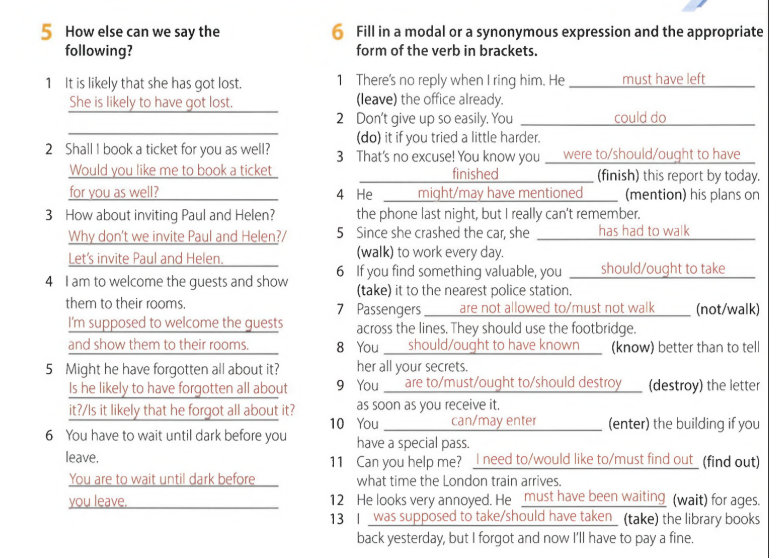
SEN TRANS USING MODEL VERBS
1 It wasn't necessary for him to write to his mum because she rang him. NEED He didn't need to write to his mum because she rang him.
2 We took more luggage than was necessary on our holiday. TAKEN We needn't have taken so much luggage on our holiday.
3 There's no need for you to water the plants this morning. HAVE You don't have to water the plants this morning.
4 It wasn't necessary for Arthur to get the train because his brother offered to give him a lift. NEED Arthur didn't need to get the train because his brother offered to give him a lift.
5 She came early last night, which wasn't necessary because the party didn't start till ten. COME She needn't have come (so) early last night because the party didn't start till ten.
1 I'm sure she has given up smoking. HAVE She must have given up smoking.
2 I'm sure she isn't feeling sick now. BE She can't be feeling sick now.
3 Perhaps they were working for the enemy. HAVE They may/might have been working for the enemy.
4 Perhaps he will be on time. BE He may/might be on time.
5 Perhaps he was too ill to take part in the race. BEEN He may/might have been too ill to take part in the race.
6 I'm sure they informed the police about the robbery. HAVE They must have informed the police about the robbery.
7 Perhaps Harry will be sunbathing this time tomorrow. BE Harry may/might be sunbathing this time tomorrow.
8 I'm sure he had warned the soldiers about the coming danger. HAVE He must have warned the soldiers about the coming danger.
9 I'm sure Jenny hasn't been working there that long. HAVE Jenny can't have been working there that long.
10 Perhaps she was telling you the truth. BEEN She may/might have been telling you the truth.
11 Perhaps she's been working hard. BEEN She may/might have been working hard.
12 Perhaps she'll come with us. MAY She may come with us.
13 I'm sure she hadn't prepared her speech. HAVE She can't/couldn't have prepared her speech.
14 Perhaps he was asleep when we rang. BEEN He may/might have been asleep when we rang.
15 Perhaps he'll be waiting when we get there. MAY He may be waiting when we get there.
16 I'm sure she didn't know about it. KNOWN She can't/couldn't have known about it.
17 I'm certain it has stopped raining now. HAVE It must have stopped raining now.
18 Perhaps you left your keys on the table. HAVE You may/might have left your keys on the table.