AP Environmental Science Notes
Unit 1: The Living World - Ecosystems
1.1 Introduction to Ecosystems
Ecosystem Basics
Individual - One single organism (an elk)
Organism - Any living thing, from microscopic bacteria to large whales
Population - Group of organisms that are all of the same species (elk herd)
Community - All of the living organisms in a given area (includes the trees, the grass, beavers, rabbits, and even bacteria and fungi that live in the soil)
Ecosystem - All of the living and non-living organisms in a given area (so a community but with non-living components like rocks, soil, and water, they interact with the living things in the ecosystem)
Biome - a large area that has a similar climate and that’s going to ultimately determine the plants and animals that can live there
Ex: tropical rainforest since it is an area that’s very warm, has really high rainfall and that’s why we see such a wide variety fo plant animal species in the tropical rainforests
Predator-Prey Relationships
Predation - win-lose situation
When one organism uses another as its food source or is its energy source, that species will either die or be severely harmed by that use of energy
So herbivores, animals that eat plants are practicing predation, although we may not think of a giraffe eating the leaves of a tree, it is using that tree for its energy so yes it would still be considered predation
Then we have true predators like carnivores, so things like the leopard or the lion that are going to eat the giraffe
We call these true predators to distinguish them from the herbivores
Then we have a parasite which is still going to use another organism for energy, but it’s usually much smaller than what we call the host organism
The organism that it often lives inside of or attaches to the outside of, oftentimes the parasite will be able to draw energy from the host without killing it
Ex: Sea lamprey, eel-like organism, that will attach itself to a fish and draw the blood out of the fish
As well as, mosquitoes, tapeworms, and again they’re just going to draw energy out of the organism and they don’t nessacarily have to kill the organism
Then we have a parasitoid which is a very specific type of parasite that’t going to lay its eggs inside of the host organism, then when the eggs hatch the larvae or the young will eat their way out of the host organism
This often kills the host and we have an exmaple here of a parasitic wasp that’s going to inject its eggs into this poor caterpillar and then when those eggs hatch, they’re gonna eat their way outside of the caterpillar and great energy source for the wasp but unfortuanately the caterpillar is going to die as a result of this interaction
Symbiotic Relationships (Symbiosis)
Symbiosis
sym = together | bio = living | osis = condition
Any close and long-term interaction between two organisms of different species
Mutalism (+/+), commensalism (+/o), and parasitism (+/-) are all symbiotic relationships
Mutualism - win-win situation
A relationship that is beneficial for both species (coral and photosynthetic algae)
SO both species are going to come away from thsi relationship better off than they would have been without it and in many cases they depend on each other to the extent that they couldn’t really survive apart
Great example is the coral reef ecosystem
So coral are actually tiny animals, and they are going to create the reef structure that algae rely on for and provide carbon dioxide for the algae to do photosynthesis
In return the algae provide sugars via photosynthesis that the coral uses as energy
An individual coral is called a polyp and so they’re going to live in the reef but again they’re going to produce that carbon dioxide that teh algae need in order to perform photosynthesis
And the reef that they create is a home for the algae so it’s a great relationship for both and they really depend on each other
We have another mutualistic relationship which is actually such a close relationship that we consider the two species one single composite organism, you need to liev so closely together that they function like one organism and that’s lichen
Refers to a borad class of organisms where fungi live in very vlose proximity with algae
the algae providing the sugars or the energy that the fungi need and the fungi providing the nutrients that the algae need in order to photosynthesize and grow
Commensalism - win-0 situation
Referred to as a free-rider, so one species benefits and one species that really isn’t affected (birds making their nests in trees)
Competition
Competition - lose-lose situation
Organisms are fighting over a shared resource like food or shelter and this is going to limit their population size because there just aren’t enough resources to go around
As a result however, something called resource partitioning or resource sharing can allow these different species to utilize the same resource in slightly different ways and that’s going to reduce competition
The species don’t get together and have a meeting about this, they don’t strategize, it’s just the idea that evolution favours traits that allow them to utilize the same resource but in a slightly different way, organisms or species that compete for a shared resource
There are three types of resource partitioning, we’ll talk about examples of each here
Resource Partitioning
Temporal Partitioning
Using resources at slightly different times to avoid direct competition
So here we have the wolf and the coyote, they’re both going to hunt for small mammals but they’re going to do so at different times of the day so that they avoud directly competing for the same hunting territory
Spatial Partitioning
Using different areas of a shared resource
So we have an example of two different grasses, one can send its roots to an extremely deep portion of the soil while the other can access shallow reports of the soil
They’re not going to compete directly for water and nutrients in the soil because of the different levels that the roots occupy
And the warbler which will occupy slightly different portions of the same tree to make their nests
Morphological Partitioning
Evolving slightly different body features in order to utilize different portions of that resource
So we have a ferret and ermine which have evolved slightly different jaw sizes and slightly different tooth pattern which enables them to hunt for different sized prey
And so they don’t have to compete directly for the exact same resource
The big takeaway here from resource partitioning is that it reduces competition and so that enables species to thrive and grow to larger population sizes because they don’t have to directly compete with each other for the same exact resources in the same place at the same time
1.2 Terrestrial Biomes
Biomes - Areas that share a combination of average yearly temperature and precipitation also known as climate
Climate - Combination of average temperature and precipitation trends over a year
Some examples of biomes include rain forests, tiagas, temperate deciduous forests, grasslands, deserts, and tundras
The rain forest is of course going to be a biome that over the course of the year is going to have really really high rainfall as well as reallly really warm temperatures
Whereas the desert is going to be a biome that is characterized by a very very low precipitation, now it may also have high temperatures, but that low precipitation is the big distinguisher between the tropical rainforest and the desert
Really important to point out that the community of organisms that live in biomes are uniquely adapted to the climate of those biomes
So this is our sort of thinking like a mountain opportunity because instead of thinking of the biome and trying to memorize what organisms can survive there just remember that any organism in a biome must be uniquely adapted to survive
So we’ve got some examples here, we have camels and cacti, camels have humps which store energy in the form of fat for times when they are unable to find energy for a long period of time
Cacti have thick, waxy cuticles or coats that basically prevent water loss through evaporation
So those are both adaptations that allow those organisms to survive the harsh, dry conditions of the desert
We have shrubs and wild flowers, they’re gonna have long deep roots that store a lot of energy so that when there’s wildfires that devastate the landscape of that they live in, they’re gonna be able to quickly regrow because they’ve stored so much energy deep in the ground in their roots
Characteristics of Biomes
The two most important characteristics of a biome are its temperature and precipitation
In fact, they are the defining characteristics
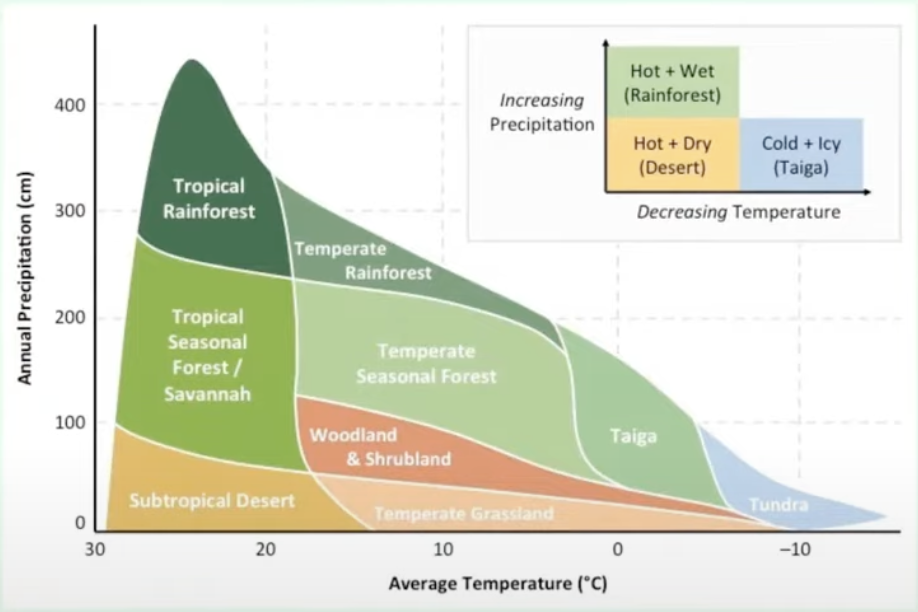
So if we look at a graph here, we’ll see that we have different ranges of both temperature and precipitation foot
So for instance if we look at the tropical seasonal forests, also notice the savanna, we’ll notice that they range in annual precipitation from maybe 60 or 75 centimeters of annual precipitation all the way up to maybe 280
Then if we look at the temperature, we’ll notice that those tropical seasonal forests are gonna range from oh maybe 18 degrees or so all the way up to about 29 degrees celsius
So just keep in mind that all of these biomes are defined by the range of precipitation and temperature found in them
What we’ll notice is that these temperature and precipitation ranges will also predict where on earth we can find the biomes
So we can look at the biomes mapped across Earth’s surface and we’ll see that there’s very predictable patterns
If we look at biomes such as the tundra and the boreal forest, if you remember from our graph, they’re very low in precipitation and they’re also colder biomes, so we’re gonna see them farther away from the equator concentrated around 60 degrees latitude
Now if we look at the temperate biomes, these are gonna be things like temperate grasslands, temperate seasonal forests, we’re gonna see them concentrated on the middle latitudes between 30 and 60
This is because these are latitudes that receive a moderate amount of rainfall and then have a moderate temperature year-round, so they’re gonna be reasonably warm but they’re gonna get somewhat cool in the winter
And then finally we have the tropical biomes, so this would be the tropical rainforest and the tropical seasonal forest of the savanna and we’ll notice that they’re concentrated around the equator and that’s going to be characterized by really warm temperatures because it gets the most direct sunlight and really high precipitation
So again instead of trying to memorize all of these different biomes we need to think about how these patterns of temperature and precipitation are influenced by the distance that we are from the equator and that’s going to tell us where we’re gonna find different biomes
We will see our colder dier biomes up near 60 degrees and north, so the further away we get from the equator, we’ll see our temperate biomes in those
Middle latitudes around 30 to 60 degrees
And then we’ll see our tropical, really warm and our really rainy biomes near the equator
Another very important characteristic of biomes in their nutrient availability
Now this is because plants need soil nutrients in order to grow so the availability of the nutrients in the soil is ultimately going to determine which plants and how many species of plants can survive in different biomes
So we have a great example here we can think about the tundra, now you could have memorized that the tundra has a lot of snow and ice and so it doesn’t have as many plant species but we want to try to actually understand the reasoning behind that, so because the soil in the Tundra is permanently frozen year-round that limits the decomposition of organic matter which recycles nutrients
so because those soils are so frozen for so
much of the year we don't recycle our
nutrients and so there are low nutrient
levels in the soil that's gonna also
lead to low water availability due to it
being frozen
and then finally that's
gonna result in very few plants able to
survive these conditions
so we can see
here that the active layer the layer of
the soil that thoughts out each year and
is available for plant growth is very
small compared to the permafrost again
that results in very few species of
plants being able to survive here and
therefore fewer animal species as well
now we can look at a few more examples
Examples
the tropical rainforest
even though it has a ton of plant growth
and you might think it has a really
nutrient-rich soil is actually going to
be quite nutrient poor and it's because
there are so many plants that are
competing for the nutrients that they
get quickly absorbed in the soil as soon
as they're made available then we have
the boreal forest boreal forest remember
our cold they're gonna be dominated by
coniferous trees like pine trees Aspen
spruce and they're going to also have
nutrient poor soils but for a different
reason it's because the temperature is
so low for much of
year that the decomposers like
earthworms and fungi are not going to be
able to break down dead organic matter
fast enough to cycle those nutrients
quickly then finally we have the
temperate forests those are the force
that you're used to seeing in West
Michigan and it costs much of the u.s.
they have very high nutrient levels in
the soil and that's because they have
broad leaves like Oaks and maples that
drop their leaves each fall that leads
to a lot of organic matter on the forest
floor and they're moderate temperatures
are gonna allow for a faster rate of
decomposition which makes those
nutrients available in the soil so this
is a great example of how another biome
characteristic nutrient availability
ultimately determines which plants and
which animals can survive in that biome
and finally we talked about how biomes
Changing Locations
can shift in their locations that is
because climate is not stable on earth
climate is subject to human activities
that are changing it rapidly right now
and so as the climate continues to warm
that will shift biomes such as the
boreal forest further north as those
soils that used to be frozen for much of
the year are thawing out and able to
have the large tree species of a boreal
forest now grow in those conditions
they're also going to lose some of their
southern range as it becomes too warm
for the trees that dominate that boreal
forest biomes such as Aspen in screws so
we have here the current range from 1971
to 2000 of the Aspen which again is a
very characteristic tree species found
in the boreal forest versus the
predicted change in that biome from 2007
t1 to 2100 we noticed that the predicted
range is far further north again that's
due to these soils that were previously
frozen thawing out an enabling tree
growth further north and a lot of those
southern regions that we see in the
northern US and in southern Canada
becoming too warm for these tree species
we can see an actual picture of this
progress happening these are photos of
the same exact Arctic plot of land in
1962 and then again in 2004 and we can
see that the forest is slowly creeping
northward as global warming makes those
previously too cold soils warmer
for the boreal forest tree species to
survive in our practice up our queue for
topic 1.2 today will involve the skill
of concept explanation so I want you to
identify one characteristic of a biome
and then explain how that characteristic
determines the community of organisms
that are found in that biome alright
everybody thanks for tuning in today
don't forget to like this video if it
was helpful subscribe for future apes
video updates and check out other notes
over here to the side and as always
think like a mountain right like a
scholar