7. German-English contrastive phonology
Why?
phonemic vs. phonetic principle
principal differences from German pov
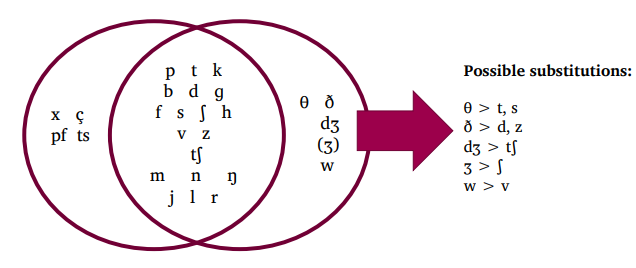
fricatives /θ/, /ð/: (don’t mix up faith – face!)
semi-vowel /w/ =/ /v/
voicing in /dʒ/ as against /tʃ/: jazz – chess (but Ger. Jazz = Eng. chess) cf. Eng. job – Ger. Job; junk ≠ chunk
tenseness and spiartion in word-initial unvoiced stops (/p t k /)
Major differences
/r/: phonetically different
• /ŋɡ/, e.g. fnger, hungry: not in Ger. (Finger, hungrig: /ŋ/ only)
certain phonotactic possibilities / phoneme sequences
/ð + m|n + z/ (rhythms)
/θ/ (+/s/) after consonants (ffths, months, wealth, twelfth)
/θ/ + /r|w/ (throw, thwart)
cons. + /w/ (twice, quarter, dwarf)
word-initial /st-/: not /ʃt-/ (strike – Ger. Streik)
Minor differences
voiced consonants word-finally (in German Auslaufverhärtung) bag - back
allophonic variation e.g. with respect to /l/
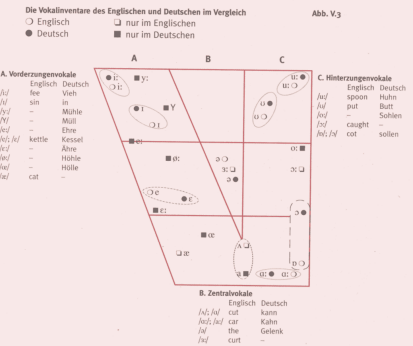
exact quality of many vowel phonemes:
/ɜː/ girl
/æ/ (salary ≠ celery!!)
/ʌ/ but, sun (≠ Ger. /a/)
/eɪ, əʊ/: not monophthongised cf. cakes > Ger. Keks, cokes > Ger. Koks
Phoneme systems contrasted → Vowels in comparison
Consonants in comparison:
Cognates in contrast: sC - ʃC
/sC/
stone, spare, sling, snow, smack
/ʃC/
Stein, sparen, Schlinge, Schnee, schmecken
Cognates in contrast: t - s
English
out, bite, vat, great, water
German
aus, beißen, Fass, groß, Wasser
Cognates in contrast: v - b
English
even, give, have, live, evil
German
eben, geben, haben, leben, übel
Cognates in contrast: ð ~ d
English
brother, think, thank, thirst, with
German
Bruder, denken, danken, Durst, wieder/wider