Intro to MS Family Theory
Notes from Reading
“Questions about people’s behaviors are the essence of social science inquiry. The focus may be on individuals, families, social groups, communities, or cultures.”
(Smith et al., )
Propositions are statements that demonstrate how concepts fit together in a context. They are the relationships between the concepts, the “glue” holding the theory together.
must be specific enough to help describe, explain, and predict phenomena and to ask questions that would guide their research in deductive ways.
“Theories provide a general framework for understanding data in an organized way and show us how to intervene” (Burr 1995)
And show us how to intervene….I LOVE this idea!!
“As our lives and society become more complex, so do the issues we need to address as social scientists” (Smith et al., )
Family Theory helps us to generate knowledge about families
Stan Knapp (2009) identifies the “generative” capacity of family theory in each of the following five functions:
descriptive function,
the descriptive function of theory is to name, classify, and organize phenomena in such a way that we can understand them. By articulating basic concepts and the relationship between events, theory helps us to describe what we hope to study.
sensitizing function,
The sensitizing function of family theory is to be aware of processes, events, and phenomena that we may not have otherwise noticed. It sensitizes us to matters that we might have missed without calling our attention to them.
integrative function
The integrative function of family theory is to make connections between events or processes that appear to be distinct and unrelated. It identifies the interrelatedness of disparate concepts and propositions, tying together ideas in a new way to make sense of data.
explanatory function
The explanatory function of family theory is to explain data. It attempts to answer the questions “how” and “why,” or why do things happen as they do? It also attempts to make predictions about phenomena that can be tested in future research.
this is the most common of maybe even the most bare bones function of family theory.
value function
The value function of theory is to push forth certain (hopefully positive) values through what we see or want to see, and the lens that we look at it through. For instance, studying growth mindset, or community cohesion, or maternal and paternal roles, etc.
Knapp (2009) notes that theories “become receptacles for valued ideas in making sense of our world” (135). The values embedded in theoretical assumptions, descriptions of concepts, and the like advocate for certain value stances. Thus, it is important to be aware of the underlying values espoused within a particular theory.
May change depending on the cutlure, or values may explain why certain theories do not seem to work as well within certain communities or cultures
According to Knapp, we must see the many functions of theory and not just be consumed by its integrative and explanatory functions or we will miss the potential to better understand our subject.
Personal notes
i really want to help future generations from all kinds of backgrounds, but I also want to focus on people from my own background
in a sense, an aspect of it could be better incorporated into schools. In another sense, the work I want to do with African American families seems like it would work best if it was outside of schools.
A theory could be made out of this: something about community, community thriving and what makes teens thrive or communities healthily pass on.
The only thing about doing the AA work is that I do not think I would have enough support to do it, and it would take a lottttt of support.
Maybe I should try to talk to Dr. Shetay, why not
Maybe I can do something on self-esteem of
But the thing about this is that, it all ties back to community….
HOWEVER a good angle for this could be like, let’s break down the perception of how well each demographic feels AND make discrimnation and perceptions of imposter syndrom and stereotype threat as a factor to community cohesion and adolescent goal persistence (health of families (transmission of positive skills…what’s associated with this, maybe positive display of religion), active citizenship, school trust, local kindness (find a way to make this quantitative, standardized, and measurable)…..)
and likelihood of them coming back to build up their community, or another community.
I can illustrative a concept map to help myself visualize this idea MUCH much better and think about what kind of work I want to do in the future, or in what order
Assumptions behind my theory: community is essential to healthy people groups, societies, economies, schools, and all institutions
there are units that bring about that health
families, individuals, belief systems, individual health, collective health (can be defined more clearly and do lit review
I feel like these factors can either make or break community and therefore highly influence individuals on various levels. My focus is on adolescents transitioning or preparing to transition into emerging adulthood, and setting those foundations for life and persistence
What determines the value and quality of a family theory?
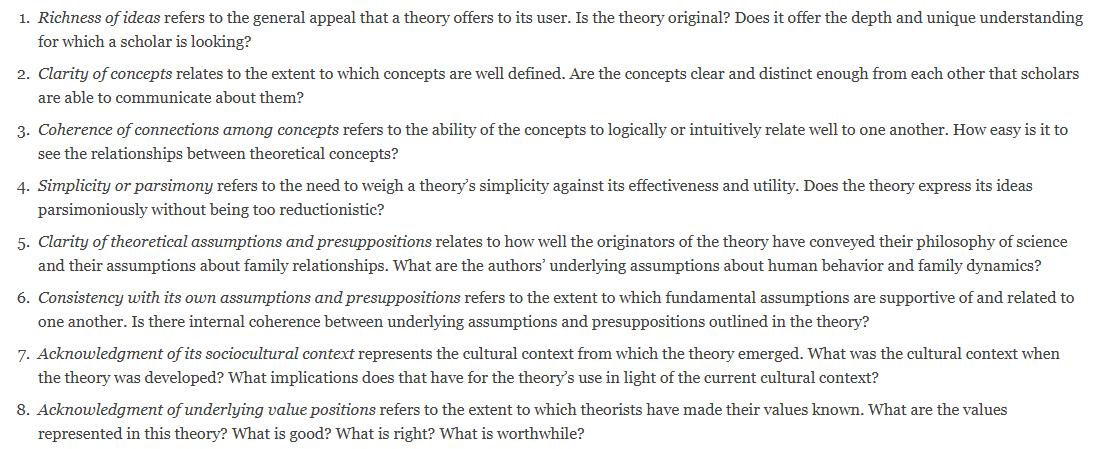

Select a theory to use for research by asking these 5 questions:
Is the theory easy to understand and use in the context of the topic I am studying?
Does the theory help explain or predict behavior, help guide the types of questions I will ask, and assist in interpreting my findings?
Is it likely the theory is comprehensive enough to cover all the possible populations and variables I want to study?
Is it sensitive to and useful for understanding diverse family experiences?
Will the theory add value to our work with individuals, couples, and families by leading to new information that will contribute to human and interpersonal thriving?
Family Theories and Social Theories, according to some, are not entirely the same, nore should htye be. THis is how families are different
According to White, Klein, and Martin (2015), families differ from other social groups in four ways:
families last much longer than most social groups and require lifetime memberships.
Families are intergenerational, unlike other social groups,
and virtually ensure a range of ages. Although most social groups are primarily based on affinity, families represent biological and affinal (e.g., legal) relationships.
Finally, families are connected to larger kinship networks.
I like to study family theories because I believe that family is the core of who we intially become, and that can be extremely helpful, or incredibly harmful. It is a springboard for us, and so it is important for it to function healthily to give everyone an opportunity for positive well-being and positive persistence in life.
A nice quote: “Whereas in the natural sciences we are examining objects and life forms that are less complex than we are, in human development we do not have the advantage of a higher intelligence than the subject to get a good metaperspective” (Smith et al., ).
I think this is a good definition of family: a unit or set of people related by reproduction, development, and primarily intimate interpersonal, emotional, physiological, and/or developmental care. Family is often complicated, but its health and functionality helps us define it into sensible boxes.
Out Ten Family Theories
symbolic interactionism
Family Development Theory
Family systems theory
Conflict Theory
Family Stress Theory
Social Exchange Theory
Attachment Theory
Ecological Theory
Feminist Theory
Biosocial theory
Lecture Notes
What struck you the most when reading the first two chapters by Mead?
collectivism vs. individualism
What leads different human groups to create different cultural scripts?
Family roles (who does what and why and how)
food and resources they have access to, and interactions with different people groups
can influence what beliefs are formed about ourselves or others
the environment
reflecting on the past
government
how big of a role should this play?
What is a cultural script
a phrase that is said or done that comes from a cultural belief or practice
it may feel natural for you, but will not for other people (or may not)
How would I describe the Arapesh or the Mundugumor if I was a part of them vs. outside of it?
I think how well I did vs.
If I could do a chapter in a textbook
I think one thing about the US is that we think a lot about self-improvement. and Reflection, kind of like Scientific process/management
I would describe historical/affects of policies and our Reactions to those policies
power roles, survival, what we consider thriving and why
what makes us feel good (also collectivism vs. individualism)
but also, oppression makes some individuals or small pockets of people feel good, no matter if that’s through words, towards people groups, through violence or with substances. BUT what can be shown
and collectivism and individualism and utilizing both to find a healthy middle ground
Some don’t air their dirty laundry for various reasons
some people don’t even know their cultural norms until they’re violated
do you know yourself and the origin of various value and beliefs
will always be bias, i wonder how much political science teaches and focuses on this and had checks for this
Statistics are more valuable than stereotypes when working with families
Always lead with understanding, be gentle, don’t brainless rip off the band-aid, that approach isn’t always beneficial, receive families with open arms
reminds me of stereotype threat, the harsh teachers and parents get less reception, less change, and less disclosure
understanding, asking questions, and being consistent with all families is so important