23 community ecology
Ecological species concept: individuals exploiting the same ecological niche, in the same way
– Can be just as problematic given the vagueness of ‘ecological niches’.
• It involves a species in a lineage that occupies an adaptive zone minimally different from any other lineage in its range, and evolves separately from all lineages outside its range (Van Valen 1976)
– Not all species fit this model and it is hard to confirm without extensive genetic study.
Defining Species: Two More Problems
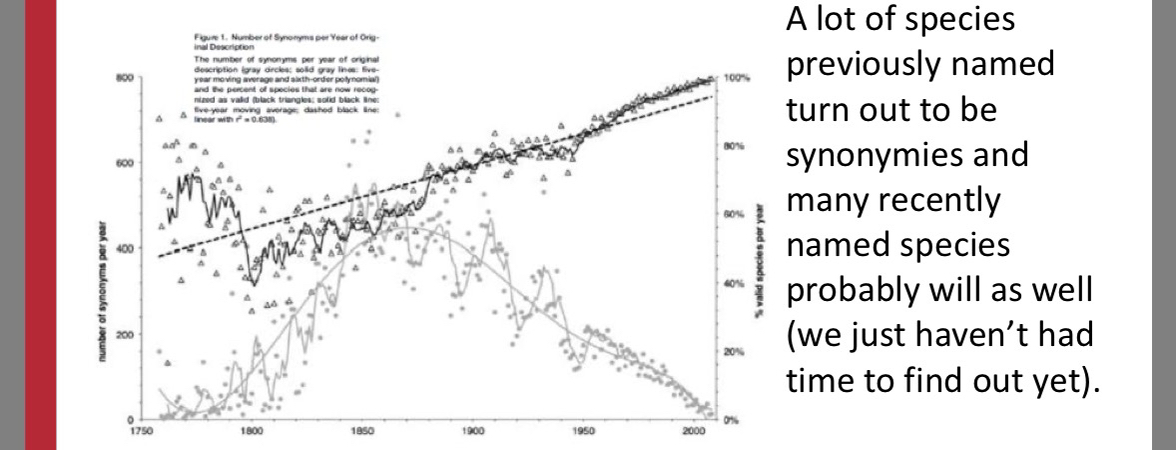
Many species that have been named twice are actually one species. This is synonymy (grey in graph below).
Many species that have been named once are actually two species. This is homonymy.
• This work predicted there are many millions of multicellular animals still to find.
• They showed predicted species numbers matched those recorded for better-known taxa well, with an overall estimate of 91% of marine species and 84% of terrestrial species still to find.
• Microbial diversity is far less well known than multicellular animals, and some new species are still being found in well- known groups including birds and mammals.
Succession
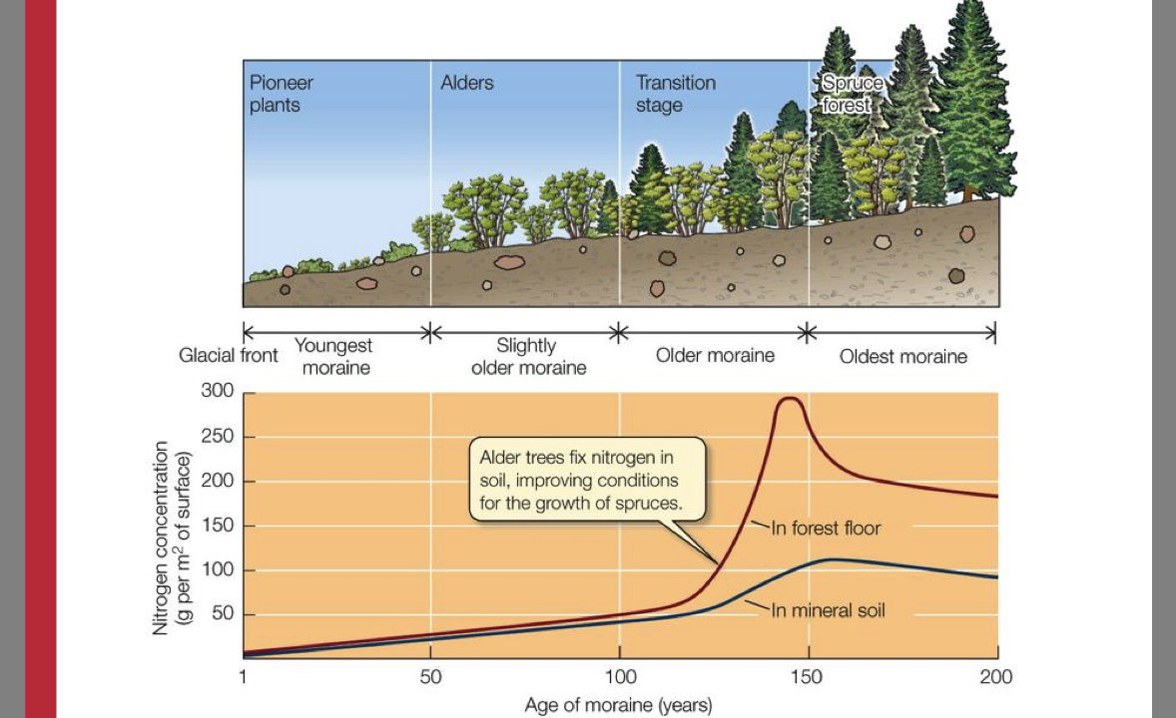
• Ecological succession is the sequence of community changes after a disturbance
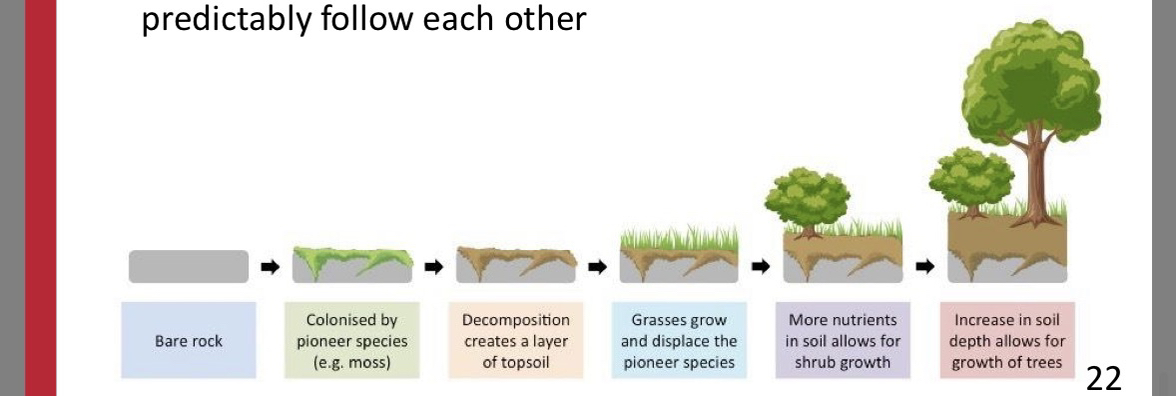
• It is a process of changing transitional stages that lead to a climax community, each stage contains different species that predictably follow each other
Primary Succession
Primary succession - colonising a lifeless area e.g. bare rock or a volcanic island, where soil has not yet formed
- Initially, only autotrophic prokaryotes may be present
- Next, mosses and lichens colonise and cause soil development.
- Once soil is present, pioneer communities can form, e.g. grasses, shrubs, and trees sprout from seeds blown or carried in from nearby areas.
The Process of Soil Formation
• Main processes:
– Accumulation of dead and decomposing material and
– Erosion of rock by weathering
Climax Community
• The final stable and self-perpetuating community.
• A climax community is often described as having one dominant species or several co-dominant species. (trees are about)
Secondary Succession
• Secondary succession - replacement of one community of species by another through the gradual process of colonization:
-occurs where there is already vegetation.
– Herbaceous species grow first, from wind-blown or animal-borne seeds.
– Woody shrubs replace the herbaceous species, and they in turn are replaced by forest trees.
Early arrivals and later-arriving species are linked in one of three key processes:
The “early” species may facilitate, inhibit or not affect the “late” species.
Factors affecting succession
• Autogenic - changes caused by the organisms that make up the community, as in the biological processes of the organisms themselves
– Inhibition - some species inhibit the growth of others
• E.g. trees shading and killing plants underneath
– Facilitation - current species modify the landscape and stimulates growth of the next community
• E.g. earthworms produce more nutrient-rich soils
Factors affecting succession
• Allogenic – species composition is disturbed by environmental factors unrelated to the organisms present,
i.e. external factors
– climate, geological disturbance, fire (some plants require heat and fire for germination, other)
– human disturbance - example in tropical rainforests
– slash and burn agriculture
– timber harvest
– ranching
– development
Seres
A seral community (or sere) is an intermediate stage in ecological succession in an ecosystem advancing towards its climax community.
Depending on the substratum and climate, a seral community can be one of the following:
• Hydrosere – community in water
• Lithosere – community on rock
• Psammosere – community on sand
• Xerosere – community in dry areas
• Halosere – community in saline bodies (e.g. saltmarsh)
Zonation
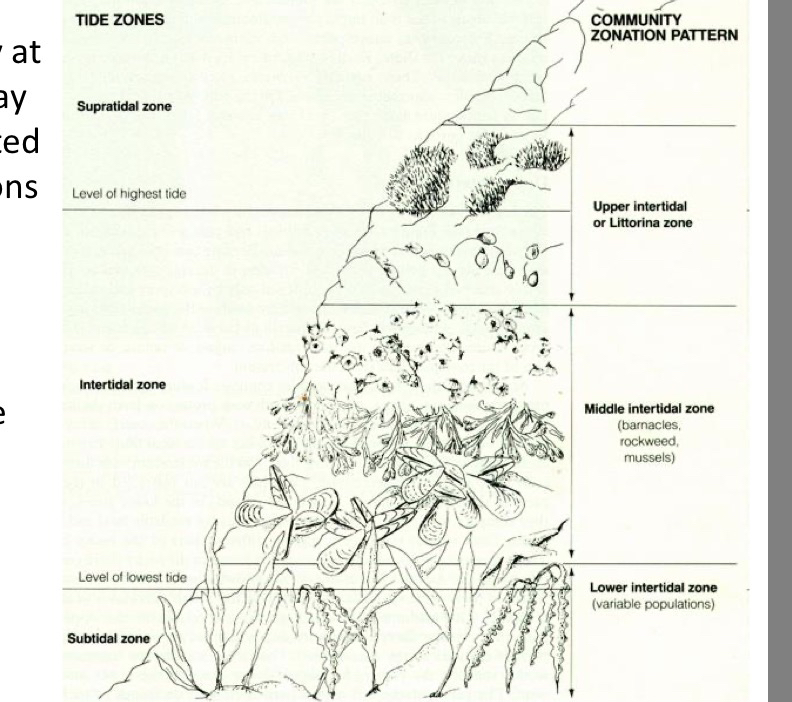
Within a community at any time, species may be spatially distributed according to variations of the physical environment.
Seashores and mountain ranges are classic examples of ecological zonation
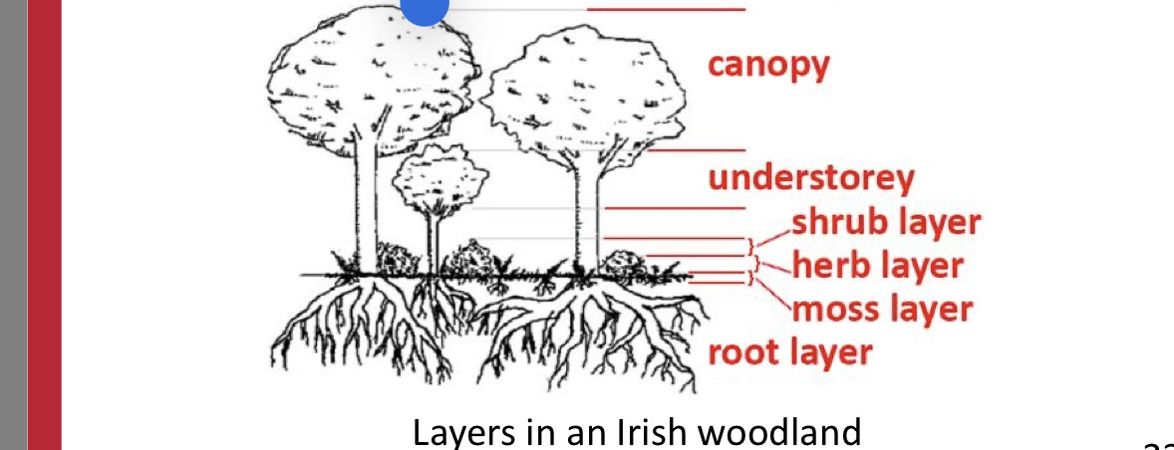
Stratification
• Stratification in ecology is the vertical layering of a habitat; the arrangement of vegetation in layers.
• It classifies the layers (singular: stratum, plural: strata) of vegetation largely according to the different heights to which their plants grow.
Primary Productivity
• Gross primary productivity (GPP) - rate at which solar energy is captured in sugar during photosynthesis
-Producers (plants) use it for metabolism/cellular respiration and some for growth (building tissues)
• Net primary productivity (NPP) – GPP minus the rate of energy loss to metabolism and maintenance
-the rate energy is stored as biomass by plants or other primary producers and made available to the consumers in the ecosystem
Primary Productivity
Plants typically capture and convert ~1 to 1.5% of solar energy that reaches Earth's surface and use ~25% of this for metabolism and maintenance. Therefore about 1% of solar energy reaching the Earth's surface ends up as NPP.
NPP varies among ecosystems, depending on many factors:
solar energy input,
temperature, moisture,
CO2 levels,
nutrient availability,
community interactions
, etc.
In terrestrial ecosystems, NPP varies from ~2kg/m2/yr in highly productivetropical forest and salt marsh to <100 g/m2/yr in some deserts. 35
—
Production / Respiration ratio (P/R ratio) is the relationship between gross primary production (GPP) and total community-level respiration.
• If P/R is persistently >1 or <1, then organic matter either accumulates or is depleted, respectively.
l
• Where P/R = 1, a steady- state community results.
Plagioclimax Community
• Plagioclimax community is a habitat where human influence has prevented the ecosystem from any further development
• It has been stopped from reaching its full climatic climax or deflected towards a different climax by disturbance activities such as:
• Cutting down existing vegetation
• Burning for forest clearance
• Planting trees/crops
• Grazing/trampling by domesticated animals
• Harvesting plant crops
• Etc.