Newton's Second Law
Newton’s Second Law of Motion — Notes
Everyday Observation
Objects with greater mass are harder to move.
Example:
A car requires a large force to push.
A shopping cart requires less force.
A toy car requires very little force.
This happens because mass resists changes in motion.
Mass and Force
Mass: the amount of matter in an object.
The greater the mass, the more force is required to accelerate the object.
Lighter objects accelerate more easily than heavier ones.
Newton’s Laws Connection
Newton’s First Law:
Objects at rest stay at rest.
Objects in motion stay in motion.
Unless acted on by an external force.
This law explains why force is needed, but not how much force.
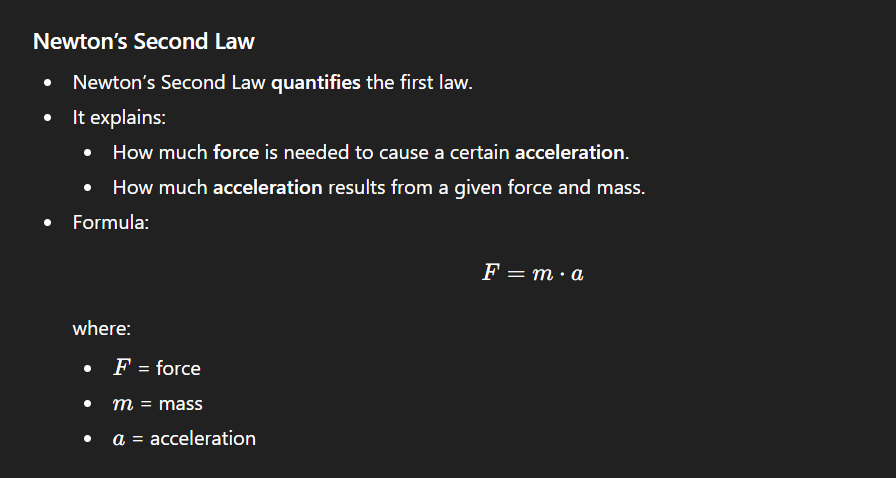
Key Relationships
If mass increases, acceleration decreases (for the same force).
If force increases, acceleration increases (for the same mass).
Acceleration depends on both force and mass.
Importance
Newton’s Second Law is one of the most fundamental laws in classical mechanics.
It is used to:
Predict motion
Design vehicles
Understand forces in everyday life and science

