Transcription and mRNA Processing
Lecture Overview
Topic of Transcription:
Understanding genes as units of information.
Mechanism of transcription and its regulation.
Discussion on mRNA processing integrated with transcription.
Central Dogma of Molecular Biology
Flow of information: DNA → RNA → Proteins.
DNA Replication: copying of DNA.
Transcription: interpreting DNA to produce RNA.
Translation: RNA translates to protein (developing a phenotype).
Coined by Francis Crick.
Notable exceptions:
Reverse Transcription: RNA → DNA (e.g., in retroviruses like HIV).
Non-coding RNAs (e.g., rRNA, tRNA, and microRNAs).
Prions: protein-only inheritance, not traditionally aligned with the dogma.
Definition of a Gene
Gene as a sequence on a chromosome (unit of information).
Structure breakdown:
Promoter: initiates transcription, upstream of gene body.
Coding Sequence: region that codes for proteins, includes exons (coding) and introns (non-coding).
Termination Sequences: signals the end of transcription.
Transcription Process
Initiation:
RNA polymerase binds to the promoter, unwinds DNA.
Elongation:
RNA polymerase synthesizes RNA strand (5' to 3' direction), copes from the template strand.
Termination:
Signals RNA polymerase to stop transcription and release the pre-mRNA.
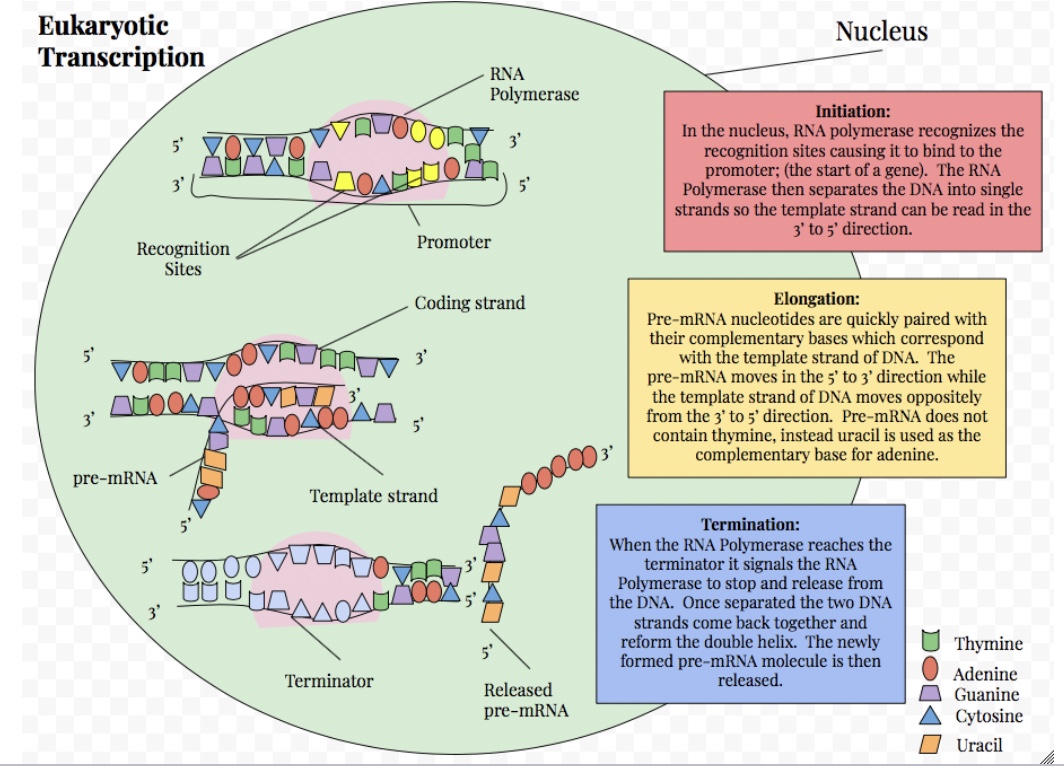
RNA Polymerase
Multi-subunit enzyme responsible for transcription.
Different types:
Eukaryotic: RNA polymerase I (rRNA), II (mRNA), III (tRNA).
Prokaryotic: One type, which performs all functions.
Importance: Targeted by various biological drugs due to its essential role.
Promoter Characteristics
Functions as a landing site for RNA polymerase.
Must be upstream of the transcription start site (TSS).
Orientation-dependent: sequence and directionality matter.
Transcription Factors
General Transcription Factors: required by all genes to initiate transcription.
Regulatory Transcription Factors: specific to certain genes or cell types, triggered by cellular signals.
Enhancers
Regulatory sequences promoting transcription, can be located far from the gene.
Involved in forming complexes and looping DNA to connect to promoters for transcription initiation.
mRNA Processing
Occurs simultaneously with transcription.
Key modifications:
5' Capping: adds methylguanosine for stability and signaling.
Polyadenylation: adds poly-A tail for stabilization and export.
Splicing: Removal of introns and joining of exons.
Alternative Splicing: Allows production of multiple proteins from one gene by including/excluding specific exons.
Eukaryotic vs Prokaryotic Transcription
Eukaryotic transcription occurs in the nucleus; prokaryotic in cytoplasm.
Eukaryotes: extensive mRNA processing; prokaryotes: no processing.
mRNA is translated simultaneously with transcription in prokaryotes.
Final Notes
Transcription is a multilayered and complex process involving initiation, elongation, and termination.
Understanding the specific mechanisms of regulation is essential for detailed molecular biology.
Further discussions will continue on eukaryotic gene regulation in upcoming lectures.