Legal Studies Revision
The Legal System
Basic Legal Concepts
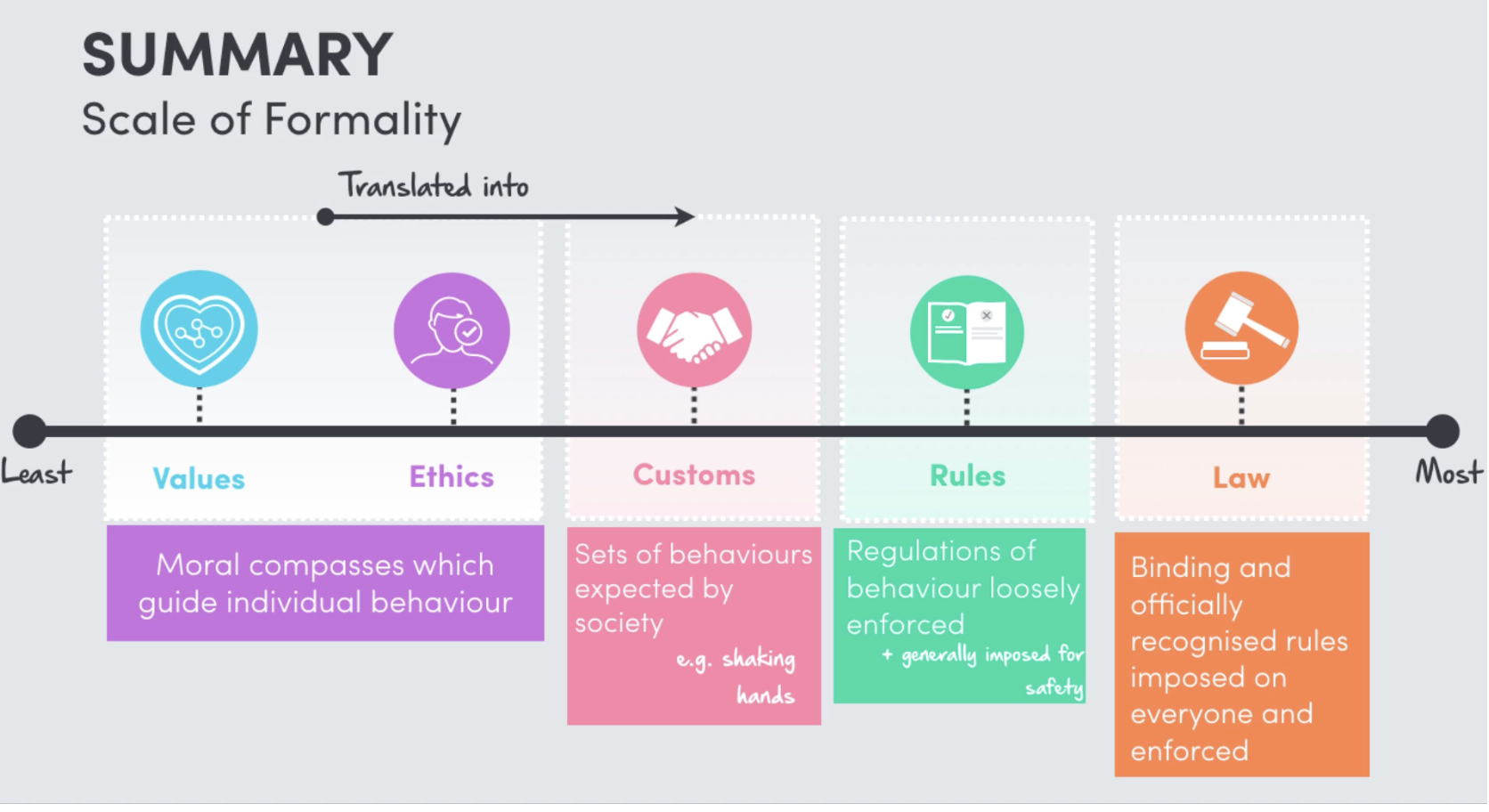
Distinguish between customs, rules, laws, values and ethics
Law: a set of rules imposed on all members of a community, which are officially recognised, binding and enforceable by persons or organisations such as the police and/or Courts.
Differing Characteristics (Legal System and Law)
1 Laws are binding on the whole community.
2 Laws can be enforced.
3 Laws are officially recognised.
4 Laws are accessible (or discoverable).
5 Laws relate to public interest.
6 Laws reflect rights and duties.
Reasons for Laws
Establish boundaries of acceptable behaviour and determine which actions will not be tolerated. For example, drink-driving laws reflect society’s attitude that placing other road users at risk through intoxication is unacceptable.
Protection from the actions of others as well as our own behaviour. It does this by telling society what people cannot do. For example, we cannot commit assault, murder or robbery. We cannot drive while drunk or ride a bike without a helmet. In this role, the law restricts our individual freedom but provides safety for all individuals in society.
Freedom to do many things by telling society what people can do. For example, the law allows us to own and operate a business, drive a car, get married or divorced, or leave school.
Resolving disputes in order to stop people taking the law into their own hands. The legal system provides a police force (or service), court system and correctional centres (jails and juvenile detention centres) to enforce and administer the law.
Values: Principles, standards or qualities considered important or desirable within a society.
Law-makers try to incorporate these values and ethics into laws. For this reason, laws will only cover those ethical values that are common to the majority of the dominant group. Many groups have attempted to influence the law in recent years (e.g. Mardi Gras & Marriage, Protection Laws etc)
Rules: Regulations or principles governing procedure or controlling conduct. Made by smaller authorities for a certain group and applies to those within the group. i.e school rules.
Ethics: Moral rules of conduct recognised in respect to various human behaviours or a particular group.
Customs: Collective habits or traditions that have developed in a society over a long period of time.
Customary law: Principles and procedures that have developed through general usage according to the customs of a people or nation, or groups of nations, and are treated as obligatory.
Nation-state: A politically independent country.
Relationship between customs, rules and laws
• Whenever people have lived together in groups, they have developed rules to govern
their behaviour and thus maintain the smooth running of activities.
• These rules were based on the traditions, customs and values of the group.
• These rules have penalties attached if members of the group fail to follow them.
• Groups usually put someone, or a small group, in charge to enforce these rules and the
associated penalties. In modern times, this became the government.
• Over time, these rules became formalised laws, known in society as ‘the law’.
Describe the characteristics of just laws and the nature of justice
Justice: the legal principle of upholding generally accepted rights and enforcing responsibilities, ensuring that equal outcomes are achieved for those involved.
Just Law: A law that allows everyone to receive fair treatment and outcomes, and ensures that human rights are recognised and respected. The main characteristics are:
Equal: treats every person the same no matter their wealth or status
Based on widely held views: laws should be based on the values and ethics held by most of society
Utilitarian: ensure the greatest possible happiness for the greatest possible number of people
Aim to redress inequalities: positive discrimination; treating someone favourably to address inequality
Minimise delay: should deal with a legal problem as soon as possible after that dispute arises
Must not be retrospective: should not apply before the date it was made (cannot be backdated)
Must be known: ensuring that the law is accessible for the public to see; promoting transparency
Equality, fairness and justice are central concepts that allow us to distinguish good law from bad law.
Equality: The state or quality of being equal; that is, of having the same rights or status
While the law strives for equality, it also takes into account people’s different capacities and recognises that some people are more vulnerable than others and so provides protection for them.
Example - doli incapax: A Latin term meaning ‘incapable of wrong’; the presumption that a child under 10 years of age cannot be held legally responsible for his or her actions and cannot be guilty of a criminal or civil offence. Ages 10-14 is a grey area where doli incapax is still applied, but if the prosecution provides sufficient evidence, can be overturned.
Fairness: Freedom from bias, dishonesty or injustice; a concept commonly related to everyday activities. (Equity)
When rules are made, the expectation is that they will be fair to those covered by them. In the same way, when a rule is translated into law, it is expected that it will be fair to all members of society. E.g. If Ann places a bet on the team she knows has the taller players, and none of the other people who placed bets knows anything about the teams or how tall the players are, Ann’s winning of the bet may also be regarded as unfair
Access: The right or opportunity to make use of something
The concept of justice suggests that everyone who is covered by a legal system and its laws should have equal access to that system. Includes ensuring that citizens are aware of the laws that affect them and understand their rights and responsibilities under these laws. E.g. financially disadvantaged people, people from non-English speaking backgrounds, people living with disability,
Legal System: The system of courts, prosecutors and police within a country
It is the task of the legal system to ensure that all citizens have equal access to the law and that the law provides equality, fairness and justice to all members of society.
Define and investigate procedural fairness and the rule of law
Procedural Fairness/Natural Justice: The body of principles used to ensure the fairness and
justice of the decision-making procedures of courts; in Australia, it generally refers to the right to know the case against you and to present your case, the right to freedom from bias by decision-makers and the right to a decision based on relevant evidence.
There are two main principles of natural justice. These are:
The right to be heard – this includes the right to a fair hearing
The right to have a decision made by an unbiased decision-maker – even an appearance of bias is enough to constitute a breach of natural justice.
Rule of Law: The principle that nobody is above the law; this can be seen in the requirement that governmental authority must be used in line with written, publicly disclosed laws, for which established procedural steps (due process) have been taken in the adoption and enforcement.
Aspects:
Equality before the law: The law should apply to all people equally regardless of their status in society – rich or poor, young or old, regardless of their gender, race, culture, religion, or any other attribute.
Presumption of Innocence:
Separation of Powers (legislative judicial executive)
Democratic elections
Free media: People must be free to comment and assemble without fear and be able to criticise the actions of the government.
Procedural Fairness
Transparent & Discoverable Law
Define anarchy and tyranny
Anarchy: the absence of laws and government
A state of anarchy may break out during a revolution or after a natural disaster, because the law enforcement agencies no longer exist or are unable to enforce the laws of a society.
Tyranny: rule by a single leader holding absolute power in a state
A tyrant is a single leader who has unlimited power over the people in a country or state.
Generally, tyrannical power involves severe punishment for any infringements of the law.
E.g. Saddam Hussein’s dictatorship over Iraq, Fulgencino Batista’s dictatorship over Cuba – enforced laws that violated the right to protest.
Sources of Contemporary Australian Law
Outline the origin of common law
Development of Common Law
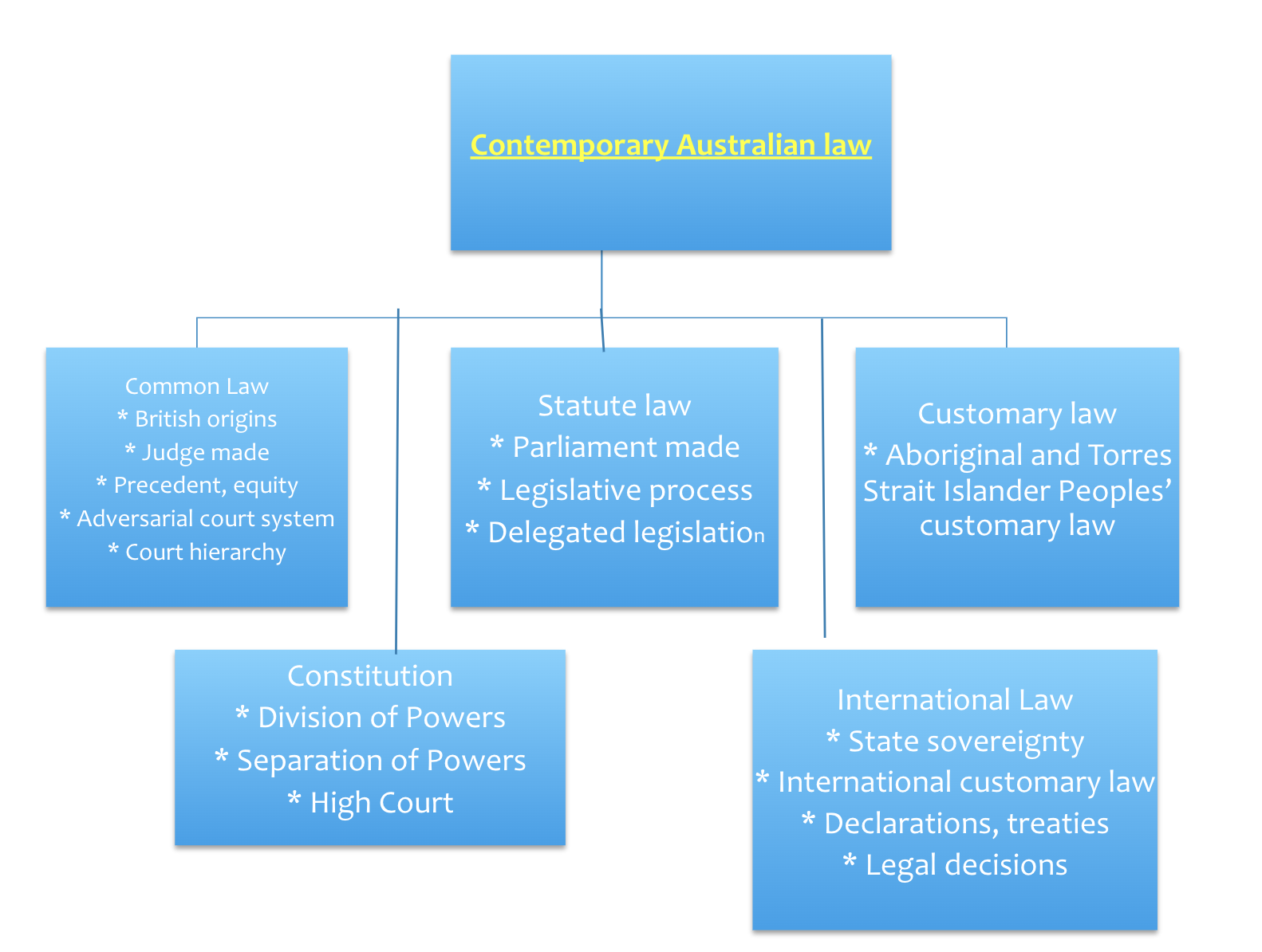
Contemporary Australian law has evolved from both common law and statute law. Legal processes and practices used in Australia today are based on the model developed in England.
Common Law: Laws made by judges according to the doctrine of precedent. An authoritative (high, supreme) court can create common law when they interpret and apply existing law or if the case requires new law to be made.
Customary Law: Law based on custom and tradition specifically based on the long-term practices of the group
Before 1066 AD: Each village had its own laws developed from customs and traditions based on long-term patterned behaviour. This was known as customary law. Most laws were transmitted orally and authorities of the village enforced the law when necessary.
1066 AD: The Norman invasion of England from France (The Norman Conquest) occurred. Following their influence, a centralised government was first established. Known as the feudal system. A hierarchical political system led by the King.
Committing a crime = crime against the King. Thus tried in the King’s courts.
System of travelling courts and judges emerged to enforce and apply the same laws to other areas of England. When a situation arose where no law existed, judges would make their own laws.
Judges met regularly to compare decisions, most appropriate decisions were then selected to apply in similar cases in the future. The doctrine of precedent was developed through this.
Judges continuously travelled around England to ensure the court of law was held in a fair fashion. Judges ensured that there was a common set of laws for everyone to follow — origin of the term,’common law’
Principles of Equity
1066 AD - c. 1300 AD: Common law was very rigid and inflexible. Many individuals thus turned to the King to have their disputes heard. The King had the power to overrule any court-made decision, guided by the concept of equity (fairness) — NOT common law.
1300 AD - c. 1873 AD: By the 14th century, the Court of Chancery of law was established. The case was looked over and a decision was made based on the set of rules developed by the court. To the most fair and just extent. These rules are still utilised today and are known as the — rules of equity.
Court of Chancery: A court established to deal with injustices that were involved with the inflexibility of common law.
Equity Law: The body of law that supplements the common laws and corrects injustices by judging each case on its merits and principles of fairness.
Courts of Equity: historically, courts whose decisions were more discretionary and based on moral principles, and which served as an antidote to the inflexibility of the common law
Over time, two types of judge-made law developed: common law & equity law. If the rules of equity and common law clashed, rules of equity applied and overruled.
Example (Equity Law): Court-provided remedies. Common law usually requires an individual to pay for damages to another party. Equity law provides remedies, injunctions or specific performance orders in appropriate response.
Damages: Sum of money paid to the injured party.
Injunctions: Court order that stops a person from doing something
Specific Performance Orders: Court order requiring a person to do something.
The Doctrine of Precedent
Common law works according to the doctrine of ‘precedent’- If a current case is similar to a case in the past and if the circumstances are similar, the decision in the new case should follow the previous decision. If the circumstances are different, then the decision may be different, with the new decision becoming a precedent for the next similar case.
Precedent: A judgement that is authority for a legal principle, and that serves to provide guidance for deciding cases that have similar facts
Doctrine of Precedent: The rule that a legal principle that has been established by a superior court should be followed in other similar cases by that court and other courts.
Also known as ‘stare decisis’ – Latin for: ‘the decision stands’
Aim of Doctrine of Precedent:
Ensure people are treated fairly
Law develops in a consistent and coherent fashion
Old cases retain authority and decisions apply to modern court cases
Limits a judge’s ability to be creative when finalising a verdict
If there is no previous decision/precedent – A new decision is made based on existing common laws and statute laws which then a decision is made, becoming the precedent for future cases.
Judge’s Decision
A judge’s decision is usually based off two parts:
ratio decidendi – The essential legal reason why a judge came to a particular decision. A ratio decidendi in a higher court will set a binding precedent on lower courts.
obiter dicta – Comments or remarks from a judge in a case that are not directly relevant to the case and, therefore, not legally binding (precedent NOT set)
When precedent does not have to be followed:
If the facts or relevant points of law are significantly different from a previous case, the case may be distinguished from the earlier one and its ratio decidendi will not have to be followed.
When a higher court upholds an appeal against a lower court’s decision, the decision of the lower court is reversed.
A court may refuse to follow a decision of another court that is at a lower or equal level in the hierarchy. This refusal is called overruling the decision of the lower court.
Two Major Rules of Precedent
BINDING precedent – Lower courts are bound to follow the decision of superior courts, regardless of whether the judge believes a decision of the higher court is correct (except in circumstances seen before this slide).
PERSUASIVE precedent – Superior courts, including those international courts, do not have to follow decisions made in lower courts. They may, however, use them to help make a decision. This is called “persuasive precedent”. It may also include obiter dicta of a judge in a higher court.
If decisions were made at the same level of court, the judge must consider that decision strongly in the interests of consistency.
Examine the hierarchy and jurisdiction of state and federal courts
Court Hierarchy & The Adversarial System
As a result of the influence of the English legal system, Australia uses the adversarial system of trial.
Inquisitorial System: A legal system in which the court, or a part of the court, is actively involved in investigating the facts of the case
Adversarial System: System of trial used to resolve disputes, used in common law countries such as Australia and England, Where two opposing parties to a legal matter make arguments to an impartial decision-maker, supporting their own claims. (judicial umpires: judges, magistrates etc.)
Features of the Adversarial System
Each party is represented by a barrister or a solicitor who presents evidence to support their case.
Barrister: Lawyers who specialise in appearing in higher courts, additionally giving legal advice
Solicitor: A qualified legal practitioner who advises clients on legal matters, prepares legal documents for clients and helps barristers represent clients in court.
Both parties have the opportunity to test the evidence of the opposing side by questioning their witnesses — known as ‘cross examination’
Judge cannot cross examine witnesses, or conduct its own investigation
Outcome of the case is decided by a judge/magistrate or jury
If a jury is present, they will decide issues of fact and the verdict and the judge will decide matters of law.
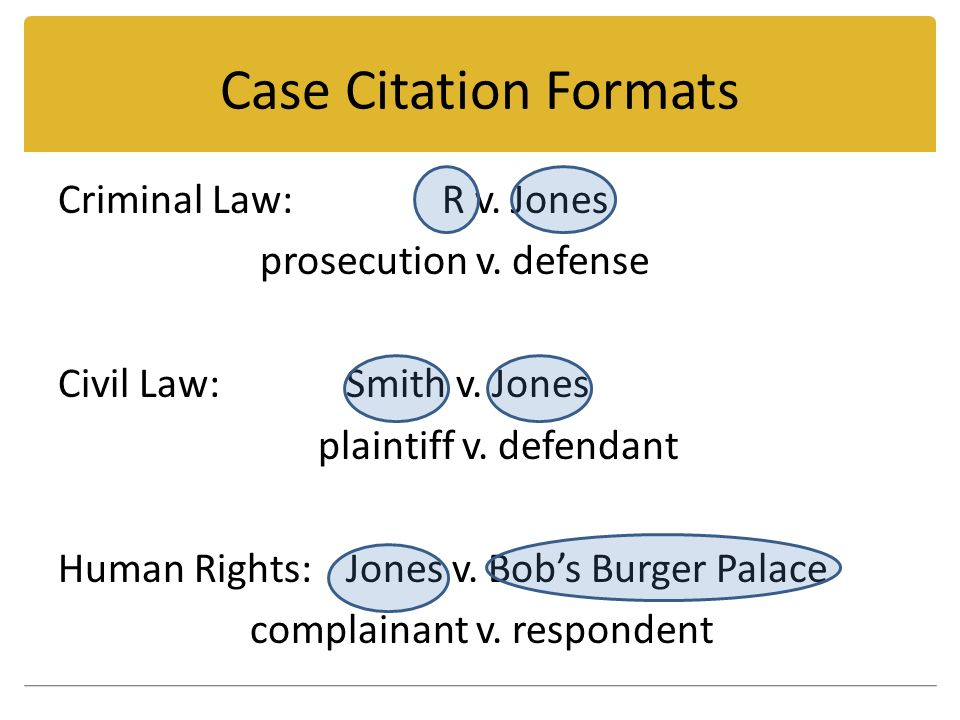
Criminal Cases: Brought by the state to protect the community from law breakers e.g. murder, theft. The crime is committed against the state, so public lawyers commence legal proceedings on behalf of the victims.
The Prosecution (The Crown): The prosecution proves guilt and secures a punishment appropriate for the offence.
The Defence (The Defendant): The one being accused. The defendant proves their innocence or provides a defence for their crimes.
Overseen by a judicial umpire such as a Judge or Magistrate who sides with the prosecution or defence, if the defendant is found guilty, the umpire would proceed with a punishment fitting for the offence severity.
Civil Cases: Brought by individuals seeking compensation for wrongs committed against them. e.g neighbours, consumers and businesses.
The Plaintiff (Claimant): The plaintiff proves guilt and requests damages to remedy the harm caused. Usually monetary compensation.
The Defence (The Defendant): The one being accused. The defendant proves their innocence to the claim.
Overseen by a judicial umpire such as a Judge or Magistrate who sides with the plaintiff or defence, if the defendant is found guilty, the umpire would proceed to set compensation the defendant would have to pay or undertake as punishment.
Two Main Laws Heard in Court
Civil Law: The system of law concerned with private relations between members of a community. Brought by individuals seeking compensation for wrongs committed against them. (Dispute Resolution)
Criminal Law: The body of regulations under which certain acts or omissions are punished by the state. Its function is to maintain public safety and order for the whole of society.
NSW Court System
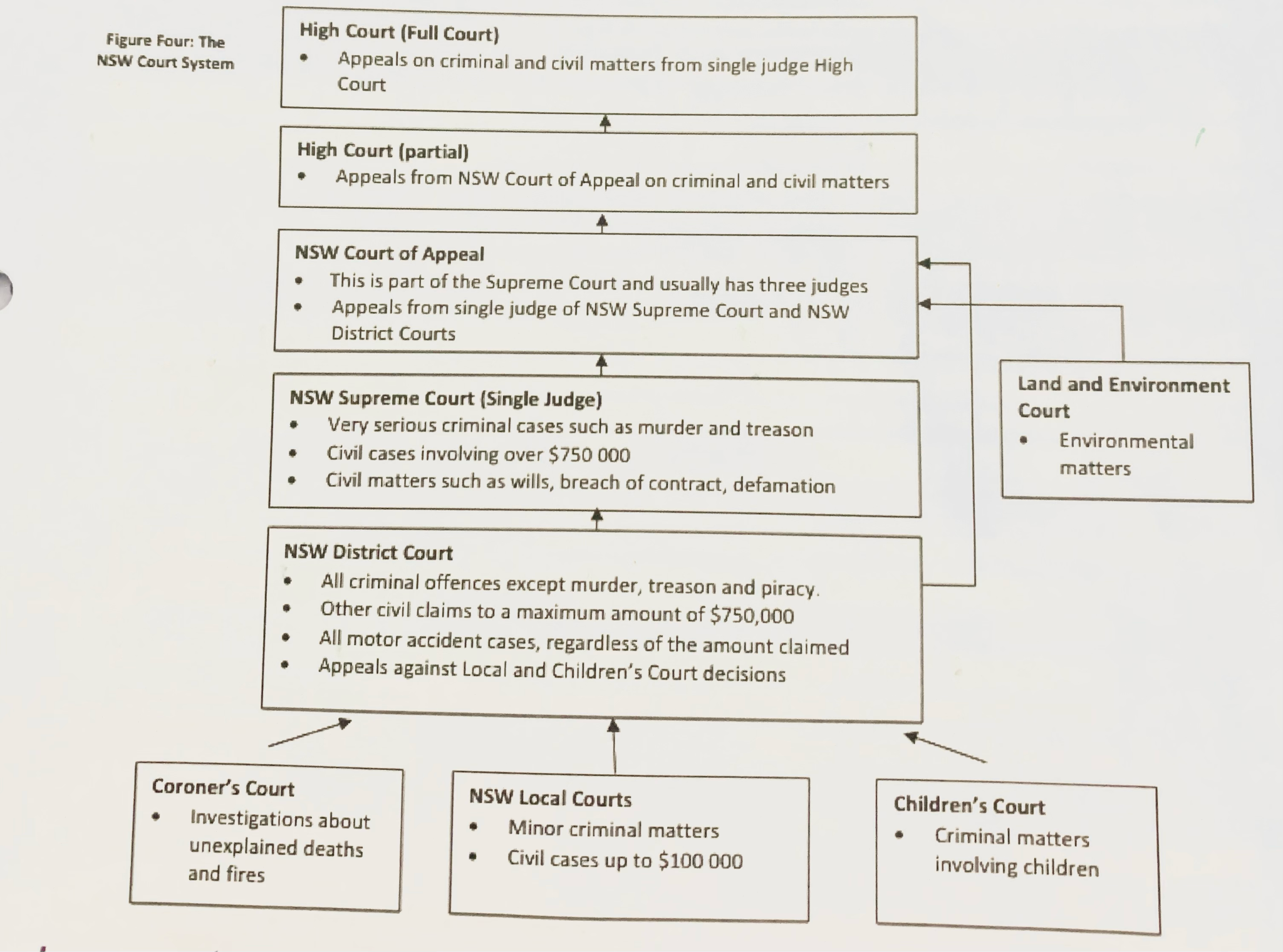
Key Legal Personnel: The court typically consists of a judicial umpire, an opposing counsel and court support staff working together to foster an environment appropriate for serving justice.
Judicial Umpires:
Magistrate: A qualified legal practitioner who oversees the Local Court. Since there’s no jury, they decide the verdict of guilt or innocence and the sentence for criminal cases and compensation for civil cases.
Judge: A qualified legal practitioner who oversees intermediate and higher courts (e.g. District Court, Supreme Court). Jury decides the verdict. So, the judge decides the exact punishment and sentence for criminal cases, and compensation for civil cases. Maintains order in the court and clarifies points of the argument to the jury.
LOCAL COURTS
Local Court - Lowest on the hierarchy. 98% of cases are finalised in the Local Court.
A magistrate conducts proceedings in the Local Court. They will hear and decide the case, and will determine guilt and impose the punishment for the criminal offences.
Most criminal matters are heard in the Local Court. Local Courts hear cases relating to:
Minor criminal matters (or summary offences e.g. drink driving, shoplifting)
Civil matters involving up to $100 000 (e.g. loan agreements, unpaid bills)
Limited family law matters (e.g. property settlements)
Committal hearings
Committal Hearing: Inquiry held in the Local or Magistrates’ Court to determine whether there is enough evidence against the defendant to warrant a trial in a higher court (this is called establishing a prima facie case)
Summary Offences: Criminal offence that can be dealt with by a single judge without a jury and do not require a preliminary hearing
The Coroner’s Court - The role of the Coroner's Court is to ensure that unexplained or suspicious deaths, fires, and explosions are properly investigated. If necessary, cases are handed to a higher court for trial.
Coronial Inquest: Investigation into a death that has occurred in unusual circumstances, held in the Coroner’s Court and overseen by a magistrate called the Coroner
Children’s Court - This court deals with any matters involving people under the age of 18 at the time of offence, or under the age of 21 when charged with a crime committed while under 18.
Land and Environment Court - This court is responsible for the application of environmental law in NSW. It deals with environmental planning, land compensation and appeals in relation to local decisions.
INTERMEDIATE COURTS
District Court - Deals with more serious criminal offences and more complex or expensive civil matters than the Lower Court.
A judge conducts the proceedings in cases in the District Court. Criminal cases are generally heard by a judge and a jury of 12 people.
District courts hear cases involving:
Indictable offences, such as robbery or assault, manslaughter and drug offences
Civil matters involving between $100 000 - $750 000
Claims for damages for personal injuries due to a car accident
Appeals from lower courts (appellate jurisdiction)
Appellate Jurisdiction: The ability or power of a court to hear appeals of the decisions of lower courts and to reject, affirm or modify those decisions. Occurs when the losing party believes there has been an error in the lower court’s legal reasoning.
Indictable Offences: Serious criminal offence that requires an indictment (a formal, written charge) and a preliminary hearing; it is typically tried before a judge and jury and is subject to a
greater penalty.
SUPERIOR COURTS
The Supreme Court - The highest court in the state hierarchy. It deals with major civil cases and serious criminal cases. Cases are heard before a judge and jury.
The Supreme Court hears cases involving:
Most serious indictable offences e.g. murder, kidnapping.
Civil matters involving more than $750 000
Appeals from lower courts in the state hierarchy. (Dealt by the NSW Court of Appeal – still a part of the Supreme Court.)
Federal Court System
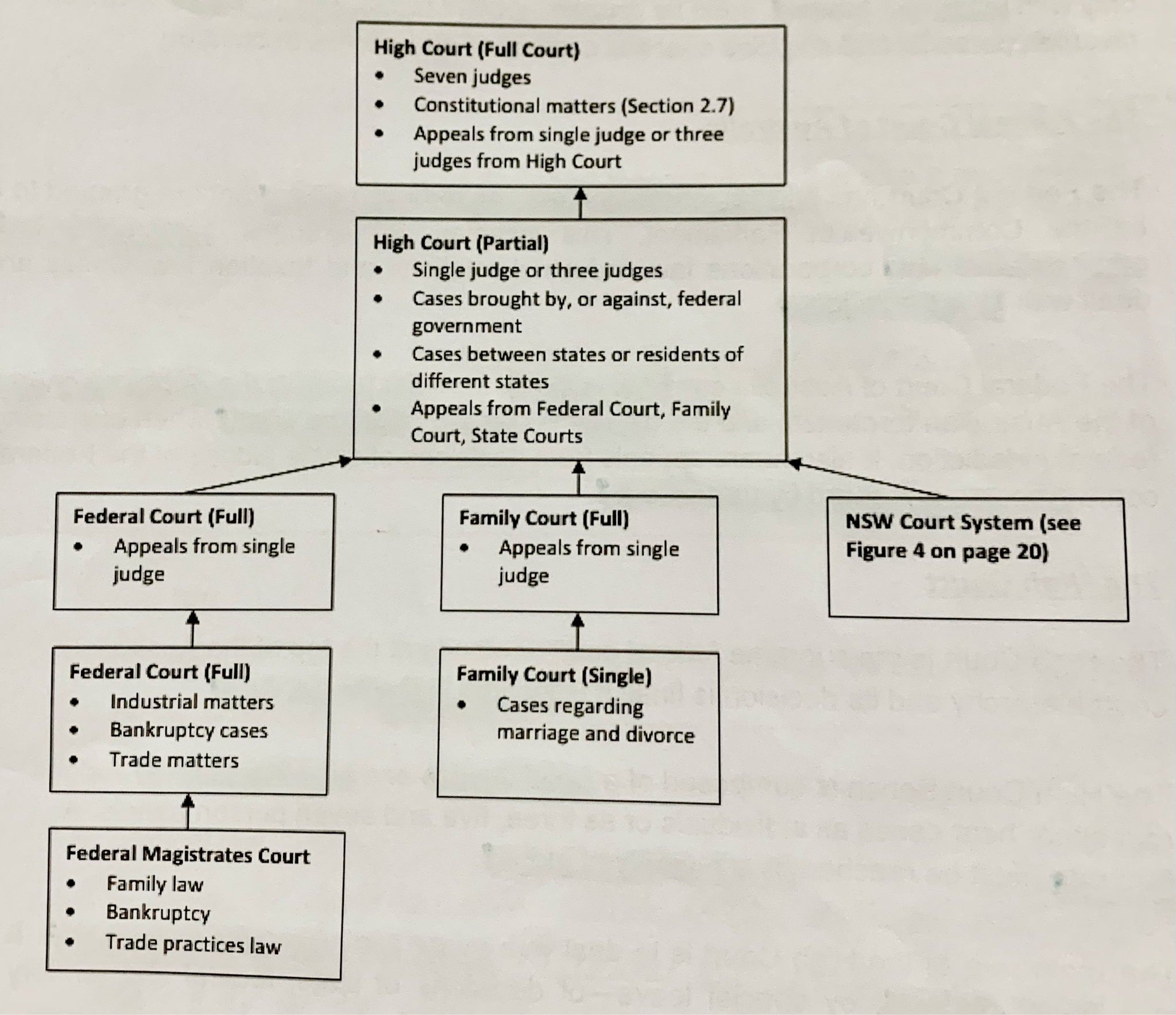
Federal Magistrates Court - This court was created in 2000 with the aim of providing faster and cheaper legal outcomes.
Some of the areas the Federal Magistrate Court deals with:
Family law matters
Bankruptcy cases
Consumer protection cases
Appeals from Commonwealth tribunals
This court does NOT deal with CRIMINAL CASES
Federal Circuit & Family Court of Australia - A specialist court dealing only with family law matters e.g. divorce, property settling disputes between divorcees, and disputes over the custody of and access to children.
l
Federal Court of Australia - Maintains original jurisdiction over all federal matters. E.g. bankruptcy, administrative, corporations, industrial relations and taxation law. Cases conducted by a single judge.
Jurisdiction: The powers of a court, depending on its geographic area, the type of matters that it can decide and the type of remedy that it can attend.
State/Territory Supreme court decision appeals → Appeals heard by Federal Court which utilise federal jurisdiction to finalise decision.
Additionally hears appeals from decisions of single judges of the Federal Court. Appeals are heard by three judges.
The High Court - The High Court is the supreme federal court. It stands at the top of the Australian court hierarchy. Its decision is final.
The High Court bench is composed of a Chief Justice and six other judges (justices). Judges either hear cases as individuals or three, five, and up to seven. A decision must be reached by a majority of judges.
Deals with matters involving the Constitution. It reads, interprets and applies the Constitution.It additionally hears appeals from the Federal Court of Australia, the Family Court of Australia, and the state and territory Supreme Courts.
The High Court has both original and appellate jurisdiction. The original jurisdiction of the High Court is outlined in Sections 75 and 76.
Original Jurisdiction: The ability or power of a court to hear a case in the first
instance
Outline the role and structure of parliament and the legislative process
Role & Structure of Parliament
Statute Law: Law made by the Parliament. The State, territory and federal (Commonwealth) governments all have the right to make laws.
Parliament: A body of elected representatives that are responsible for making statute law and delegating law-making powers to other authorities.
Statute law is superior to common law. Legislation has the power to alter common law, and in a conflict, statute law has precedence. (applies)
Federal
The Federal Government is split into two houses of Parliament, a cabinet, and the Governor-General, and handles matters affecting Australians generally (Exclusive Powers). For example, immigration, taxation, define, and foreign affairs. Due to affecting all Australians, not exactly directly.
The Structure of the Federal Government
Cabinet - Made up of the Prime Minister, and other senior ministers (Minister of Defence)
Enforces the law through policies and programs.
Upper House (Senate)
Lower House (House of Representatives)
Both responsible for passing laws which apply to all Australians
The Governor-General: The representative of the current British monarch.
State
The State Government is split into two Houses of Parliament, a cabinet, the Premier, and the Governor, and deals with non-federal matters and some federal matters. (Residual Powers). E.g. community services, industrial relations, and housing.
The Structure of the State Government
Upper House - Legislative Council
Lower House - Legislative Assembly
Both responsible for passing laws which apply to all the State's residents
Cabinet - state department ministers
Premier - head of government
Governor - head of state
Enforces the law through practical policies and programs
Local
The Local Government is made up of a Mayor and around 15 Councillors, and handles matters that are too varied and local for the State Government. Deals with local matters passed down from the State Government. E.g. maintenance of public facilities and rubbish disposal. Individuals mostly interact with the Local Government
The Structure of the Local Government.
Councillors
Mayor
Both responsible for the bylaws to be created and how it would be enforced, Must ensure that all decisions are approved by the State Government.
All elected by the people being governed and the responsibilities are divided between these divisions. The Constitution elects certain areas of governance to the three separate branches of government.
ALL STATE AND FEDERAL PARLIAMENTS ARE BICAMERAL. (EXCEPT QLD)
Bicameral Parliament: A parliament which has an upper and lower house.
The government is formed by the political party which has majority seats in the lower house
Political party/ies who have the remaining seats in the lower house form the opposition.
Electorate: A geographical area containing a certain number of people who vote for someone to represent them in a state or federal government.
Parliamentary Functions:
Amending Laws
Create/Repeal Laws
Debating bills
Applying Laws (The Cabinet, Governor-General)
Pass/Reject potential laws (bills)
The Legislative Process
Constitution: a set of principles that applies to the entire nation which provides the framework, and guidelines to how the government should be formed and organised, how powers are separated, and which areas of law each level of government can make laws about.
Ministers: Members of government who are given responsibility for various government departments. E.g. defence, immigration. These are the individuals who normally propose bills.
Bills: A drafted law that has not yet been passed by parliament. Usually proposed by ministers, but can be proposed by backbenchers as well. (known as ‘private members bills’)
Federal Houses of Parliament:
House of Representatives Senate |
|
Parliamentary Committees: Established by both houses of parliament to examine ways of
addressing flaws in legislation or simplifying the effectiveness of a law, or to examine more closely legislation that is particularly complex.
Making Laws
A proposed new law, or changed law, is discussed in Cabinet. Often, people in Australia put pressure on the government to change something. A decision is then made on what to do.
If the government decides to proceed, government lawyers are asked to draft a bill. A bill is basically a ‘first draft’ of an Act of Parliament.
Copies of the bill are given to all members of the House of Representatives. The members read the material in their own time. This is known as the ‘first reading’.
The bill goes through a ‘second reading’. During this stage, the responsible minister (for example, the Minister for Immigration if the bill is to do with migrants) describes the main purpose and likely benefits of the bill. Speakers from the Government and Opposition say what they think about it. Debates may take weeks. Then there is a vote. If the majority vote in favour, the bill moves to the next stage.
The bill is debated again, this time bit by bit. This stage is known as the committee stage, as the debate occurs in parliamentary committees. Changes to the bill may be made.
The bill, including any changes made during step 5, goes through a ‘third reading’ in the house. A vote is taken. If the majority vote for it, the bill is passed through to the Senate.
Similar processes to those outlined in steps 3 to 6 occur in the Senate. If the Senate decides to change something, the bill is referred back to the House of Representatives for another debate and vote. Sometimes the Senate may refuse to approve a bill. If it is a money supply bill, the Governor-General calls for a double dissolution of parliament (as the government cannot govern without money). If the Senate votes to approve the bill, it is sent to the Governor-General for royal assent.
The Governor-General meets with a select number of government ministers in a meeting of the Executive Council. If he or she approves and signs the bill, it becomes an Act of Parliament. It is now legally binding on all citizens and all courts.
Describe the function of delegated legislation
Delegated Legislation
Delegated Legislation: Legislation made by non-parliamentary bodies (aka specific government bodies). Concerns laws that are considered ‘less important’ which parliament does not have time to draft, consider and pass.
Parliament delegates their authority to subordinate bodies. E.g. government departments, local councils.
Non-parliamentary bodies make delegated legislation about a vast number of specific issues that affect them daily. E.g. local councils determine rules and regulations relating to — maximum building heights, dog licence fees, etc.
Delegated Legislation Examples
Ordinances — Made for Australian territories.
By-Laws — Made in accordance with Local Government Act 1993 (give Councils autonomy, responsibility and accountability).
Regulation — Made by the executive or a minister and applied to the general population.
Rules — Made for government departments.
Advantages Disadvantages |
|
The Australian Constitution
Controls power, authority and operation of the organisation/body
The Australian Constitution: The set of legal principles Australia is governed by. Established on January 1st 1901. Outlines the legal framework and rules that apply to the governance of Australia.128 Sections make up the Australian Constitution.
Federation: Process of uniting several states to form a single national government.
Important Sections of the Constitution
Section 128: Provides that any change to the Constitution must be approved by the people of Australia. (REFERENDUMS)
Section 51: The area in which the Federal Parliament can make laws. Areas include taxes, defence, trade etc.
Section 109: States that if Federal and State Parliaments both make laws on the same subject (and especially if there are contradictions between them), Federal law always prevails.
Purpose: Establish a federal system of government. E.g. one central government and state governments. Each state has their own constitution. The Australian Constitution governs the Federal Parliament.
Federal System: A system of government that has one central government to deal with matters relating to the whole nation, as well as state governments to deal with matters relating to each state.
FEDERAL LAW STATE LAW |
Australian Constitution ↓ Acts/Laws of Australian Parliament State Constitution ↓ Acts/Laws of State Parliament ↓ Ordinances & Regulations of Local Councils |
The Constitution can only be changed by a referendum
Referendum: A nationwide vote to pass changes in the Australian Constitution. Used on an ad-hoc basis (when needed). Each eligible Australian over the age of 18 votes on a specified change to the Constitution. Ballot papers allow voters to pick either ‘YES’ or ‘NO’ to the proposed changes.
All acts of Parliament must conform to the requirements of the Constitution If believed that an Act of Parliament is unconstitutional, individuals can take the Federal Government to the High Court of Australia.
Explain the difference between division and separation of powers
The Division of Powers
The Constitution allocates what powers can be exercised by the Federal Government and what powers remain with the state governments. — known as the division of powers.
POWER DEFINITION GOVERNMENT EXAMPLES |
Exclusive Powers Areas of the law which the federal government has specialised power over. FEDERAL Immigration Marriage Currency Military |
Residual Powers Powers that were retained by the states which weren’t mentioned in the Constitution. STATE Agriculture Mining Utilities |
Concurrent Powers Powers that are shared between the federal and state governments FEDERAL & STATE Environment Health Education |
The Separation of Powers
The Constitution ensures that no one group within the government can dominate.
The three arms are independent, and each arm ensures that no other branch abuses or exceeds their power.
The separation of powers = No individual in one of these arms shouldn’t control the other two arms (excepting the Prime Minister and Ministers who work in legislative and executive branches)
Legislative Arm: The legislative arm is the parliament. It has the power to make new laws and to change or repeal existing laws. It consists of two separate ‘houses’; the House of Representatives and the Senate, together with the Governor-General as the representative of the Queen.
Executive Arm: The executive is the arm of government with the responsibility of putting the laws into action. Executive power officially lies with the Governor-General, but it is usually exercised by government ministers. These are members of parliament who have special responsibility for particular areas of government.
Judicial Arm: The judicial arm includes the judiciary and the courts, which are responsible for enforcing, interpreting and applying the law, settling disputes that might arise under the law. The courts can also ensure that the law is applied fairly and equally to everyone, so they are a safeguard for our rights and freedoms.
Example:
Legislative Arm: Parliament passes a law prohibiting travellers from taking Australian flora on aeroplanes
↓
Executive Arm: Exercise the law by searching travellers’ belongings, detaining and punishing offenders
↓
Judicial Arm: Reads the act and examines the process of detaining the offender. The judge determines whether or not the law has been broken.
Examine the role of the High Court in the interpretation of the constitution
Detailed Role of The High Court
Australia’s highest court (no fucking shit). It has two main roles:
To exercise Original Jurisdiction
(Refers to cases heard in the High Court for the first time) In cases involving interpretation and protection of the Constitution. The court is also called upon issues between states and the Commonwealth involving the Constitution.
To act as the Final Court of Appeal
Within the Australian legal system. Referred to as its appellate jurisdiction. The High Court can hear an appeal from any state Supreme Court or from the Federal Court. Its decision is final.
The High Court has the power to consider federal laws and decide whether the Constitution gives the Australian Parliament the power to make that law. The High Court can invalidate/repeal any law or a part of a law it finds to be unconstitutional.
Examine the characteristics of Aboriginal and Torres Strait Islander People’s customary laws
Characteristics of Aboriginal Customary Law
There is no single system of Aboriginal law in Australia. In each Aboriginal nation (500 known), there existed a number of clans. → Each Clan: Distinct territory, traditions, rituals
Clans: Extended family groups of blood relatives who belong to the same language group
Not possible to view Aboriginal customary law as one entity
Authority came from within the clans
The group accepted associated authority, and obeyed laws expected of them
Common Aspects of Aboriginal Customary Law
Orally based and passed down (Elders told through stories, dances, stories to aid in remembering): No formally written laws, but communicated, interpreted and applied with word of mouth.
Disadvantages: Can be forgotten or misinterpreted. Advantages: Flexible
Kinship Ties: Refers to familial relationships and extended family ties. It is an important feature of Indigenous Australian Society and overrides almost all other duties. Agreement on law throughout the community. Kinship rules affected marriage, food gathering, trade etc. Governed daily life and personal relationships.
Based on ritual and traditions: (Ritual: A regular and stereotyped behaviour)
Land Ownership: individual land ownership does not exist, instead land belongs to the groups or tribe. Loss of land means losing the tribe’s culture and history. Differs from European law with one's right to possess property.
Spiritual Nature of Aboriginal Customary Law
The Dreaming: The basis of majority of Aboriginal law It is the source of Aboriginal peoples’ customary law. The history of the Aboriginal peoples, explaining how the land, animals, plants and sky were created.
Dreaming stories pass on important knowledge, cultural values and belief systems. Aboriginals have a strong link with the Dreaming, creating a rich cultural heritage.
The land and bodies of water are central to all Aboriginal peoples’ culture, forming the basis of religious beliefs and laws.
Mediation and Sanctions
When disputes arise or laws are broken the community and family are involved. Elders played an important role in enforcing the law.
Settled disputes with discussion instead of traditional punishments (unless it's like murder or smth)
Mediation: All parties involved in the dispute discussing their issues and trying to resolve the problem. The role of the mediator was to encourage both parties to listen to what the other person had to say.
Conciliation: Elders of the tribe would meet with the people in conflict and assist them to reach a resolution to their dispute. The conciliator would offer suggestions to both parties to try and resolve the matter.
Enforcement and Sanctions
Punishments were opposed for very serious offences e.g. breach of religious laws, disobeying rules about sacred sites.
Sanctions: A penalty or punishment imposed for breaking the law
Death
Social Ridicule and Isolation
Fighting & Insulting
Trial by Ordeal:
The offender and their relatives running past the victim and their relatives, being verbally abused and having bladeless spears thrown at them
The offender and their relatives are required to run past the victim and their relatives for a second. The main difference is that the spears did have blades
The offender would dance around the victim and their relatives. If the offender is speared in the thigh, the ordeal is over and everyone joins in to dance. If they were not speared it meant they were not forgiven and another ordeal was required.
Revenge: Often used when the offender had committed murder. Family of the victim had the right to take out their revenge on the offender. This could lead to long-lasting feuds between clans.
Inquest: After a person was murdered an inquiry was held. The main similarities between different clan inquest procedures were the elements of magic and supernatural power. The tribal doctor attempted to find the cause of death and identify the person who committed the murder.
Example: Port Stephens area clans required two people to hold the corpse while the third beat it with a stick as they called out the name of suspects. If the body shakes when a person is named, this indicates the person’s guilt.
Outline the extent to which Aboriginal and Torres Strait Islander People’s customary laws have been integrated into Australian Law
Relevance Today:
Main Features of Each Law
Aboriginal peoples’ Customary Law Australian Law |
|
Aspects of Aboriginal Customary Law Incorporated in Australian Law
Use of conciliation and mediation – Increasingly used in a number of areas of law, including family law, consumer disputes and increasingly, in criminal law, where young offenders are involved.
Circle Sentencing – A process by which sentencing is taken to the local community. It is characterised by the magistrate and community members sitting in a circle where they discuss the matter and impose a sentence that is appropriate to the offence and which has community support. Circle sentencing courts are collaborative involving:
Magistrate, prosecutor, defence lawyer, victim offender and four elders from the offender's community (to decide sentence)
In arriving at an appropriate sentence, the group considers:
Effect of crime on the victim and community
Circumstances of the offender
Address issues that may have contributed to the crime. E.g. crimes prompted by alcoholism may be required to undertake alcohol counselling.
Circle sentencing was introduced to tackle the overrepresentation of Indigenous people in jails.
Example: 24% of the prison population in NSW were of Aboriginal descent.
Aims of Circle Sentencing: (u prolly dont have to remember all this)
Include members of Aboriginal communities in the sentencing processes
Increase confidence of Aboriginals in the sentencing processes
Reduce barriers between Aboriginal communities and courts
Provide more appropriate sentence options for Aboriginal offenders
Provide support to victims of offences by Aboriginal offenders
Allows greater participation for Aboriginal offenders and their victims in the sentencing
Increases awareness amongst Aboriginal offenders on the consequences of their actions
Reduce recidivism (re-offending) in Aboriginal communities
Circle Sentencing Process:
Magistrate welcomes everyone to the circle and participants introduce themselves
Magistrate explains functions of the circle and guidelines of the system
Defendant and victim both have a chance to comment before the circle begins discussion
The circle discusses the offence, its impact, what can be done to remedy the damage, and the support available to the victim and defendant.
Magistrate summarises what has been said during the time and then determines the sentence. Support groups for both victim and offender are established.
Review date is set before the circle is formally closed.
Circle sentencing is only available to those within the NSW court system for Aboriginal Australians who plead guilty. → Led to the concerns that some would plead guilty even if they weren't just so that they could have access to the program.
The circle can impose jail terms, but magistrates attempt to keep offenders out, substituting prison time with e.g. community service or home detention.
Application of Customary Law – Customary laws are taken into account when an ATSI person is charged with a crime. Judges consider factors such as:
Offender committed the offence because Aboriginal Customary law required it
Victim provoke offender to commit offence because they broke a customary law
Traditional punishment for offence is also considered
International Law
Distinguish between domestic and international law and examine the impact of state sovereignty
Domestic Law: Refers to the legislation of a nation (state in international law).
International Law: refers to the body of law that governs the relationship between states. (nations)
State: A politically independent country. Defined territory, a permanent population, an effective government and the ability to enter international relations
Lack of International Law:
States would be unable to participate in trade and commerce
Greater likelihood of conflict between nations
Focus of International Law
Regulation of behaviour between states
Applications to individuals involved in international transactions (trade and commerce)
Address areas of conflict between states
Covers fundamental human rights → Illegal to torture political prisoners, commit genocide etc.
AUSTRALIAN DOMESTIC LAW VS INTERNATIONAL LAW
AUSTRALIAN LAW INTERNATIONAL LAW |
Constitutional Basis: Australia’s legal system is based on Australian and state constitutions. Establishes law system Consensual Basis: No binding constitution. Relies on agreement (consensus) between nations |
Law Making: Statute law, common law, delegated legislation Law Making: Through treaties, conventions, declarations, resolutions of the UN, customary international law, legal decisions and legal writings. Complex process of negotiation between states. |
Dispute Resolution: Criminal and civil federal and state court systems. Dispute Resolution: International Court of Justice (Hague, NL) Specialised courts and temporary tribunals Diplomatic negotiations and conferences Mediation and conciliation using the UN. Broken treaty → Neutral nation/respected mediator |
Enforcement: Laws must be abided by otherwise punishments will be imposed. Enforced through police, private prosecutions and government officials. Enforcement: NO SOVEREIGN NATION STATE CAN BE FORCED TO OBEY AN INTERNATIONAL LAW. → Difficult to enforce (no world government) Obedience to the law based on:
Attempted enforcement is through the mechanisms of the United Nations (UN) e.g. Security Council |
Domestic Law – Made for all citizens ‘No one is above the law’
/\/\/\/\/\/\/\/\/\/\/\/\/\/\/\/\/\/\/\/\/\/\/\/\/\/\/\/\/\/\/\/\/\/\/\/\/\/\/\/\/\/\/\/\/\/\/\/\/\/\/\/\/\/\/\/\/\/\/\/\/\/\/\/\/\/\/\/\/\/\/\/\/\/\/\/\
International Law – Based on ‘state sovereignty’ Allows nations to decide the laws by which they will agree to be bound
State Sovereignty
State Sovereignty: The state has the authority to make laws for its population and the powers to enforce these rules.
To be Considered a State;
A defined territory
A permanent population
An effective government
The capacity to enter into international negotiations.
Impacts of State Sovereignty: The international community is made of nation states which are very protective of their independence and sovereignty, and they've never agreed to establish proper enforcement procedures.
Human rights protection relies heavily on the will of the nation state to enact appropriate legislation.
Sources of International Law
Examine the sources of international law
The main source of international law if the United Nations (Which are responsible for the creation of treaties)
Steps To Legally Enforce International Law In a State
Sign: A representative of the state signs the treaty/agreement on behalf of their government.
Ratify: The state formally approves the terms of the treaty
Enact: The state introduces domestic legislation (reflects terms of the treaty). → The international agreement is legally enforceable within that state.
Main Sources of International Law
Source Definition Main Points |
Customary International Law Law based on established traditions followed by many states to the point where they’re accepted as being equitable and just by the international community. E.g. the prevention of genocide, slavery, torture E.g. the prevention of genocide, slavery, torture (NOT considered a law unless states accept the practice binding on them) |
Declarations A formal statement of a party’s position on a particular issue. E.g. UDHR Clarifies a state’s position on a particular issue A declaration is not legally binding under international law. |
Treaties An international instrument or law that governs relations between two or more nations. E.g. SEATO, ANZUS Most commonly used source
|
Legal Decisions Decisions made by judicial bodies based on international law. E.g. International Court of Justice (ICJ)
Involved specialised international courts for specific laws e.g. International Crime Tribunal |
Legal Writings Writings of respected lawyers, judges and academics. E.g. idkk Drawn upon to interpret treaties or applications of international disputes. |
Describe the role of the various organisations involved in international law.
International Organisations
The United Nations: the chief organisation involved in international law. 193 members.
General Assembly
Secretariat
Security Council
International Court of Justice
Economic and Social Council
ROLE:
Maintain global peace and security
Develop good relations between states based on recognition of equal rights and each state’s right to govern its own political, economic and social development
Promote cooperation in solving international problems.
Protection of human rights and to developing a legal framework
ACHIEVEMENTS
1. Helped form a peaceful democracy in many nations.
2. Protects the natural environment (1992 Earth Summit, Rio de Janeiro) – climate control etc.
3. Controls the nuclear weapons of countries. (International Atomic Energy Agency, UN)
4. Aided over 50 million refugees
5. Monetary aid to African countries
UN PEACEKEEPING FORCE
A group of soldiers from several different countries who are sent by the UN to areas where war has occurred to prevent the conflict from arising again.
Currently 11 peacekeeping operations – (Led by Department of Peacekeeping Operations). Over 100 000 troops, police, and civilian members
The UN does not have its own military force → depends on nations’ contributions.
Involves: Creating conditions for peace, provides security, political and peacebuilding support
Principles:
Consent of the parties
Impartiality
Non-use of force except in self defence
The International Court of Justice
The International Court of Justice is the main judicial organ of the United Nations established in 1946. The ICj consists of 15 judges, representing a different geographical region.
Two Main Functions of the ICJ
Decides on disputes brought before it by member nations
Offers legal advice on international law when a state requests it.
The international community’s permanent court.
It’s powers are limited:
This court can only hear cases involving countries rather than individuals. (states can bring a case on behalf of a citizen, though.)
Countries must agree to voluntarily to submit disputes to the Court (only if nation accepts jurisdiction of the court)
Other Courts
Several other specialised international courts and tribunals which establish aspects of international law. E.g. cases on war crimes heard in ad hoc tribunals
ad hoc: When necessary or needed.
ad hoc tribunal: Temporary tribunal set up for a specific purpose and disbanded once the purpose is fulfilled. Example: International Crime Tribunal 1993 - 2017, dealt with war crimes occurring in the Balkans.
Jurisdiction of the ICJ
All 193 member states of the United Nations are entitled to take matters to the ICJ. (Non-Members access under special circumstances)
How States Recognize the ICJ’s Right to Settle Disputes
Special Agreement: Given in relation to a specific dispute
Clause in a Treaty: When a state signs a treaty which involves the recognition of ICJ’s powers, states agree to accept jurisdiction of the ICJ in related disputes.
Unilateral Declaration: Where some states have agreed to accept the jurisdiction in all matters. (may be time limited, may have exception clauses) 63 has made this declaration.
The principle that states must first agree to accept the authority of the ICJ, significantly reduces its effectiveness in resolving international law disputes. States can simply refuse to participate. Even when the state has agreed to accept, the ICJ can do little to enforce its rulings
Intergovernmental Organisations
An intergovernmental organisation (IGO) is a body which states belong to. E.g. the United Nations.
Intergovernmental organisations are usually subsidiaries (parts) of the UN. E.g. the Human Rights Council
Some IGOs are regionally based. E.g. The European Union (EU)
Other IGOs are established to meet and decide on certain international issues. E.g. refugees, tariffs and wealth.
ROLE: The main purposes of IGOs were to create a mechanism for the world's inhabitants to work more successfully together in the areas of peace and security, and also to deal with economic and social questions.
Non-Government Organisations
A non-government organisation (NGO) unofficially contributes to the promotion of human rights and has been established by private citizens, not governments.
Through means such as:
Lobbying Organisations
Informing the global public on infringement of rights and environmental concerns.
E.g. Red Cross, Amnesty International, World Wildlife Fund
Relevance of International Law to Contemporary Australian Law
Examine how international law impacts on and is incorporated into Australian law.
Unlike some other nations, Australia must ratify the international agreement for it to be incorporated into domestic law.
Treaties influence Australian law in the development of common law, in judicial review of decisions and in the judicial interpretation of statutes.
For some treaties:
For some conventions/treaties, legislation must be altered (or created) to give them legal force in Australia.
For some, existing federal or state legislation is sufficient for the convention/treaty to apply
Convention: Procedures that people are expected to follow, a general agreement between nations.
Classification of Law
Outline different types of law
Public Law
Public law is the body of law that deals with relationships between individuals and the state. This includes the 3 branches- Administrative Law, Criminal Law and Constitutional Law.
Criminal Law
The function of criminal law is to maintain public safety and order for the whole of society.
An offence is seen as being an offence against a whole community even if only one individual is affected.
Criminal laws are usually established by statute (laws made by Parliament)
CITATION- R v. Peterson [1984] NSWDC➡️ Regina (King or Queen) v. Peterson (accused) [year] STATE, LEVEL OF COURT.
7 Classifications of Criminal Law
Crimes against persons- Injury or threat of injury, assault, homicide, manslaughter, grievous bodily harm💗
Crimes against property- Theft or damage to another person’s property, Larceny, Robbery
Crimes against the state or sovereign- Sedition (encouraging hatred of the country), Treason
Public order offences- Crimes that disrupt the activity of society e.g. Drunk in public, Swearing in a public place
Traffic Offences- Speeding, drunk driving etc.
White-collar crimes- Tax evasion, fraud
Drug Offences- Use of illegal drugs, possession, trafficking, distribution, manufacturing, importation
Constitutional Law
Constitutional law is the branch of public law that focuses on the rules governing the executive, legislative and judicial functions of government
Administrative Law
Administrative law looks after government powers and the decisions of government organisations. It is based on the English model.
The purpose of administrative law is to ensure there is no abuse of power within government
Private Law
Private law (also referred to as civil law)
Compare the purpose of different types of law
Distinguish between civil and criminal court procedures
Identify the role of legal personnel involved in the court process
Compare and contrast common and civil law systems