(Lecture 6) Genetic Risk Assessment for Single Gene Disorders
Course Overview & Learning Objectives
- Course Identification: IBSSD 1520 & 1521, Module 3, Lecture 6
- Instructor: Dr. Susan Viselli
- Topic: Genetic Risk Assessment For Single Gene Disorders
- Terminal Objective:
- Understand the central tenets of modern medical genetics.
- Enabling Objectives:
- Distinguish phenotypic and genotypic ratios from each other and use Punnett squares to diagram monohybrid and dihybrid crosses.
- Describe the principles of segregation and independent assortment, and determine when to apply the multiplication and addition rules.
- Use the Hardy-Weinberg principle to calculate genotype and phenotype frequencies from allele frequencies.
- Perform precise probability and genetic risk calculations to answer clinical study questions.
Historical Foundation & Principles of Mendelian Genetics
Johan "Gregor" Mendel (1822–1884):
- Born in 1822 as Johann; entered the Augustinian St. Thomas Abbey in Staré Brno in 1843, taking the name Gregor.
- Conducted plant hybridization and meteorology research across a 42-year career; eventually served as Abbot.
- Mendel Museum Exhibition at Masaryk University: Gregor Johann Mendel: The Story of a Humble Genius (Author: Ondřej Dostál; Architect: Zdeněk Fránek; Design: Marek Nedělka, Ondřej BÁcher; Graphic design: Hrdina Pavlík; Translations: Drew Barry, Adam Prentis; Editing/presentation: Dominik Krajíček; Realization: LIKO-S, a.s., MIVIS-CZ, s.r.o.).
Mendelian Inheritance:
- Defined as the pattern of inheritance where a phenotype is caused by the inheritance of a single mutant allele.
Mendel's Seven Pea Traits in Garden Peas ():
- Seed shape: Round vs. Wrinkled
- Seed color: Yellow vs. Green
- Seed coat color: Gray vs. White
- Pod shape: Inflated (Smooth) vs. Constricted
- Pod color: Green vs. Yellow
- Flower position: Axial vs. Terminal
- Plant height: Tall vs. Short (Dwarf)

Core Mendelian Principles:
Principle of Segregation:
Sexually reproducing organisms possess paired genes (alleles) for each locus; during gamete development (meiosis), these two copies segregate so that each gamete receives only one factor.
Directly refutes the 19th-century "blending theory" of inheritance.

Principle of Independent Assortment:
Genes located at different genetic loci are transmitted to offspring independently of one another.
Exception/Caveat: Does not hold true when genes are located close to each other on the same chromosome (genetic linkage).
Dominant and Recessive Alleles:
Alleles are alternative forms of a gene located on autosomal chromosomes (2 copies per gene).
Dominant Allele (): Usual form that masks the phenotypic expression of a recessive allele.
Recessive Allele (): Form whose expression is masked in the presence of a dominant allele.
Monohybrid Crosses and Genotype-Phenotype Relationships
- Genotype Definitions:
- Homozygous Dominant ( or ): Carrying two identical dominant alleles.
- Homozygous Recessive ( or ): Carrying two identical recessive alleles.
- Heterozygous ( or ): Carrying two different alleles.
- Expression Rules:
- Dominant traits are observed in both homozygous dominant () and heterozygous () states.
- Recessive traits are observed exclusively in the homozygous recessive () state.
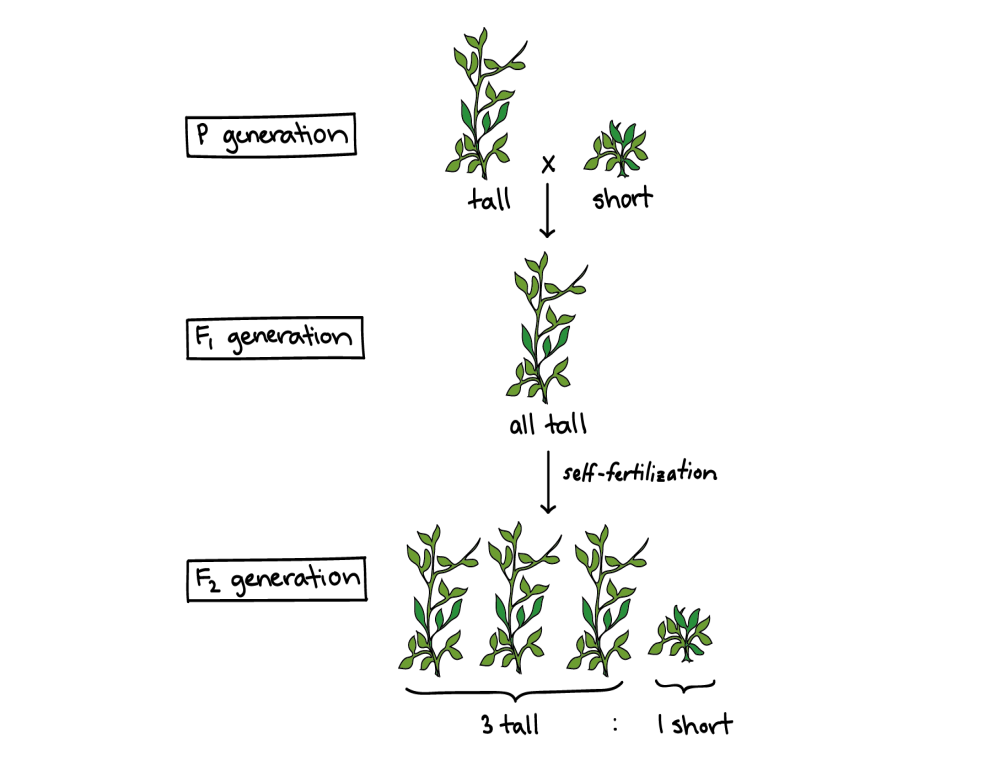
- Monohybrid Cross Example ():
- Parental Cross (): Homozygous tall () Homozygous short () produces an generation of all heterozygous tall () plants.
- Self-Fertilization of () yields the generation:
- Gametes: () and () from each parent.
- Punnett Square Outcomes:
- (Tall)
- (Tall)
- (Tall)
- (Short)
- Genotypic Ratio: ().
- Phenotypic Ratio: ().
Mendelian Traits in Humans & Pedigrees
- Human Mendelian Traits:
- Principles derived from pea plants apply directly to human traits and single-gene inherited disorders.
- Examples of Single-Gene Autosomal Human Traits:
- Mid-digital hair (Dominant)
- Tongue rolling ability (Dominant)
- Widow's peak hairline (Dominant) vs. Straight hairline (Recessive)
- Free earlobes (Dominant) vs. Attached earlobes (Recessive)

- Phenotype Concept & Modifiers:
- Phenotype is the observed physical, biochemical, or clinical manifestation of an organism.
- Two distinct genotypes can yield identical phenotypes (e.g., homozygous dominant and heterozygous carrier for cystic fibrosis are both clinically unaffected).
- Environmental Influence: The same genotype can produce different phenotypes depending on the external or internal/genetic environment (e.g., Phenylketonuria / PKU clinical severity is modified by dietary phenylalanine intake).
- Formula: .

Dihybrid Crosses & Probability Analysis
- Definition: A cross between two individuals who are both heterozygous for two independent autosomal recessive loci located on different chromosomes ().
- Example Model: Dual carrier cross for Pigmentation ( = normal, = albinism) and Hearing ( = normal, = deafness).
- Gamete Generation: Each dual heterozygote produces 4 distinct gametes in equal proportions: , , , .
- 16-Square Punnett Grid Breakdown:
- 9 Unique Genotypes:
- Genotypic Probabilities:
- (or )
- (or )
- (or )
- (or )
- (or )
- Phenotypic Ratio ():
- Normal pigment, normal hearing ()
- Normal pigment, deaf ()
- Albinism, normal hearing ()
- Albinism, deaf ()
- Dihybrid Risk Calculation Example (Study Question 4):
- Scenario: Both members of a couple are dual carriers for Cystic Fibrosis (CF) and Sickle Cell Disease (SCD).
- Question: What is the probability that they will have a child with EITHER Cystic Fibrosis OR Sickle Cell Disease, but NOT BOTH?
- Solution: Based on the phenotypic ratio, the two "" classes represent offspring affected by one disease but not the other.
- Formula:
- Answer: C. 37.5%.
Rules of Probability for Genetic Assessment
- Fundamental Definition: Probability is the proportion of times a specific outcome occurs in a series of independent events. Probabilities range from (impossible) to (certain).
- Summation Law: The probabilities of all mutually exclusive possible outcomes must add up to ().
- Basic Formula:
- Multiplication Rule ("AND" Rule):
- Used to calculate the probability of two or more independent events occurring simultaneously or sequentially.
- Example: Probability of tossing two heads in a row with a fair coin:
- Addition Rule ("OR" Rule):
- Used to calculate the probability of obtaining either one outcome OR another mutually exclusive outcome.
- Example: Probability of tossing two heads in a row () OR two tails in a row ():
- Clinical Risk Assessment Principles:
- Always BEGIN with the MOST LIKELY situation.
- Consider the most common inheritance mechanism and dominant population factors first before evaluating rare exceptions.
Hardy-Weinberg Principle & Population Genetics
Purpose: Relates gene (allele) frequencies to genotype frequencies in a population under equilibrium.
Allele Frequencies:
- = frequency of dominant allele ( or )
- = frequency of recessive allele ( or )
- Equation: ()
Genotype Frequencies:
- = frequency of homozygous dominant genotype ( or )
- = frequency of heterozygous carrier genotype ( or )
- = frequency of homozygous recessive affected genotype ( or )
- Expansion Equation:
Five Population Requirements for Hardy-Weinberg Equilibrium:
- Large population size.
- Absence of natural selection for or against any genotype.
- Random mating (panmixia) with respect to the locus of interest.
- Negligible rate of new mutations.
- Absence of migration or gene flow.
Worked Application 1: Sickle Cell Disease (SCD):
- Prevalence: births in African Americans; virtually non-existent in Northern European populations.
- Inheritance: Autosomal recessive ().
- Calculation Steps for Carrier Frequency ():
- Set affected genotype frequency:
- Calculate recessive allele frequency :
- Calculate dominant allele frequency :
- Calculate carrier frequency ():
- Clinical Interpretation: Approximately in every African Americans is a carrier () of Sickle Cell Disease. Universal newborn screening detects carriers and affected individuals.
Decimal to Fraction Conversion Method:
- Step 1: Write decimal over 1 (e.g., ).
- Step 2: Multiply numerator and denominator by based on decimal places ( for 2 digits: ).
- Step 3: Simplify fraction:
Worked Application 2: Cystic Fibrosis (CF):
- Prevalence Variations:
- European populations: births.
- Asian populations: births.
- United States overall: in people.
- Calculation Steps for European Carrier Frequency ():
- Set affected genotype frequency:
- Calculate recessive allele frequency :
- Calculate dominant allele frequency :
- Calculate carrier frequency ():
- Clinical Interpretation: Approximately in every individuals of European descent is a carrier () of Cystic Fibrosis.
Molecular Pathophysiology & Genetics of Cystic Fibrosis
- Gene Locus & Function:
- Caused by mutations in the CFTR gene encoding an ATP-Binding Cassette (ABC) transporter.
- Functions as a low-conductance selective channel gated by ATP binding and hydrolysis at nucleotide-binding domains (NBDs) and regulated by cyclic AMP (cAMP)-dependent phosphorylation of its regulatory domain.
- Pathophysiological Mechanics:
- Defective chloride ion transport across mucosal surfaces leads to cell dehydration, hyper-thickening of mucus, and pathognomonic "salty" sweat.
- Multisystem Clinical Spectrum:
- Respiratory & Pancreatic Systems (Primary targets):
- Recurrent, life-threatening respiratory infections and pneumonia.
- Pancreatic exocrine insufficiency, resulting in severe malabsorption, malnutrition, and failure to thrive.
- Gastrointestinal System:
- Severe constipation, intestinal obstruction, and meconium ileus in neonates.
- Genitourinary System (Biological Males):
- Congenital bilateral absence of the vas deferens leading to azoospermia and infertility.
- Prognosis & Survival Trends:
- Historical median survival: years.
- Modern median survival: Increased to or years (depending on reference registry data), with children born today expected to live significantly longer due to targeted therapies.

- CFTR Mutation Classes (Over 2,000 specific mutations identified):
- Class I: Protein Production Mutations (No functional CFTR created).
- Mechanism: Nonsense, splice site, or frameshift deletions leading to unstable, shortened RNA.
- Examples: , , .
- Prevalence: of CF patients.
- Therapies: Read-through compounds allowing full-length translation.
- Class II: Protein Processing Mutations (CFTR misfolds).
- Mechanism: Protein misfolding prevents trafficking to the apical plasma membrane.
- Examples: (most prevalent globally), , .
- Prevalence: of CF patients.
- Therapies: Correctors (e.g., lumacaftor, tezacaftor) to assist proper folding.
- Class III: Gating Mutations (Channel gate fails to open).
- Mechanism: Protein reaches cell surface, but channel gate opening is severely impaired.
- Examples: , .
- Prevalence: of CF patients.
- Therapies: Potentiators (e.g., ivacaftor) to keep the channel gate open.
- Class IV: Conduction Mutations (Faulty channel conductance).
- Mechanism: Protein reaches surface with functional gate, but ion transit rate is reduced.
- Examples: , , .
- Prevalence: of CF patients.
- Therapies: Potentiators (e.g., ivacaftor) to increase ion conductance.
- Class V: Insufficient Protein Mutations (Reduced quantity of normal protein).
- Mechanism: Splicing or promoter defects cause reduced synthesis of functional CFTR.
- Examples: , , .
- Prevalence: of CF patients.
- Refined Classification System: Class 1A (no mRNA produced) and Class 1B (no protein produced).

- Screening Guidelines & Diagnostic Evolution:
- Historical Guidelines (ACOG, October 2001, ~25 years ago): Recommended carrier screening for individuals with a family history of CF, partners of individuals with CF, and Caucasian couples of European or Ashkenazi Jewish descent.
- Modern Practice: Mandatory universal newborn screening in all 50 US states. Direct gene sequencing is used to eliminate low detection rates associated with targeted mutation panels.
Practice Genetic Risk Calculations
Practice Problem 1:
- Question: What is the probability that a European couple of unknown genotypes will have a child with cystic fibrosis?
- Step 1: Probability father is a carrier () = .
- Step 2: Probability mother is a carrier () = .
- Step 3: Probability two carriers pass on recessive alleles () = .
- Calculation:
Practice Problem 2:
- Question: What is the probability that a man known to be a carrier of cystic fibrosis, and his wife of European descent with unknown genotype, will have a child with cystic fibrosis?
- Step 1: Probability father is a carrier = ( confirmed).
- Step 2: Probability mother is a carrier = .
- Step 3: Probability two carriers pass on recessive alleles () = .
- Calculation:
Practice Problem 3:
- Question: What is the probability that a healthy sibling of a person with severe cystic fibrosis is a carrier of cystic fibrosis? (Both parents are healthy).
- Step 1: Since healthy parents produced an affected offspring (), both parents are obligate carriers ().
- Step 2: Standard offspring probabilities for are 1\text{ }AA : 2\text{ }Aa : 1\text{ }aa$.\n * *Step 3*: Since the sibling is explicitly stated to be **healthy**, the homozygous recessive (aa) genotype is completely eliminated.\n * *Step 4*: The remaining sample space consists of 3 equal possibilities (1\text{ }AA2\text{ }Aa).\n * *Calculation*:\n P(\text{Carrier} \mid \text{Healthy}) = \frac{2}{3} \approx 66.7\%$$