Pre-class 3: Chemistry
Question: Matter is defined as anything that takes up space and
contains positively charged atoms.
has mass.
has weight.
contains negatively charged atoms.
Book: Matter refers to anything that takes up space and has mass
Question: All matter is composed of various basic substances that cannot be broken down into simpler substances by ordinary means. These substances are called Elements.
Book: All matter, both nonliving, is composed of basic substances called elements.
Question: Atoms with the same chemical properties make up a(n)
cell.
compound.
element.
nucleus.
Book: In the early 1800s, the English scientist John Dalton developed the atomic theory, which says that elements consist of tiny particles called atoms (Gk. atomos, "uncut, indivisible"). An atom is the smallest part of an element that displays the properties of the element. An element and its atoms share the same name.
> Question: Identify which of the following are atomic symbols.
PhD
Na
S
O
Book: atomic symbol
One or two letters that represent the name of an element (e.g., H stands for a hydrogen atom, and Na stands for a sodium atom).
One or two letters create the atomic symbol that stands for this name. For example, the symbol H means a hydrogen atom, the symbol Rn stands for radon, and the symbol Na( L.natrium) is used for a sodium atom.
Question: Determine what the numbers and letters represent in this image.
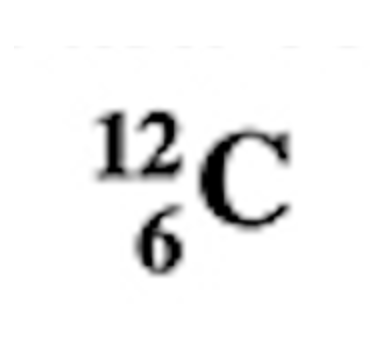
12 = Mass number
6 = Atomic number
C = Atomic symbol.
Options: Atomic number, Mass number, Atomic symbol
Book: Atoms have not only an atomic symbol but also an atomic number and a mass number. All the atoms of an element have the same number of protons housed in the nucleus. This is called the atomic number, which accounts for the unique properties of this type of atom.
Book/ notes:
Atomic number: the number of protons in the nucleus
All the atoms of the same element have the same atomic number.
Electrically neutral atoms: The atomic number also indicates the number of electrons.
Mass number: the number of protons plus neutrons in the nucleus
Protons and neutrons have a similar weight, one atomic mass unit (AMU) each.
Electrons are so small that their weight is considered zero.

Atomic and mass number for an atom of carbon with 6 protons and 6 neutrons in the nucleus.
Question: What two features are associated with all matter?
It is in liquid form
It has a boiling point of 110 ° Celsius
It has mass
It takes up space
Book: Matter refers to anything that takes up space and has mass
Question: Every atom has its own atomic number, which represents the number of protons in its nucleus, as well as its own mass number, which represents
the sum of the protons and neutrons in the nucleus.
the sum of the protons, neutrons, and electrons.
the sum of the protons and electrons.
Book: Mass number: the number of protons plus neutrons in the nucleus
Protons and neutrons have a similar weight, one atomic mass unit (AMU) each.
Electrons are so small that their weight is considered zero.
Question:
A substance that cannot be broken down into simpler substances by ordinary chemical means is called a(n) Blank______.
compound
molecule
element
Book: All matter, both nonliving and living, is composed of basic substances called elements. An element is a substance that cannot be broken down into simpler substances by ordinary chemical means.
Question: The atomic mass refers to the average mass for all the Blank______ of that atom.
electrons
protons
isotopes
neutrons
Book: The term atomic mass refers to the average mass for all the isotopes of that atom. Because the majority of carbon 12, the atomic mass of carbon is closer to 12 than to 13 or 14.
Question: The smallest part of an element that still retains the properties of that element is called an atom.
Book: In the early 1800s, the English scientist John Dalton developed the atomic theory, which says that elements consist of tiny particles called atoms (Gk. atomos, "uncut, indivisible").
Question: In the periodic table, horizontal rows are called periods, while vertical columns are called groups
Book: Figure 2.3 is a portion of the periodic table, which is shown in total in Appendix A. In the periodic table, the horizontal rows are called periods, and the vertical columns are called groups.
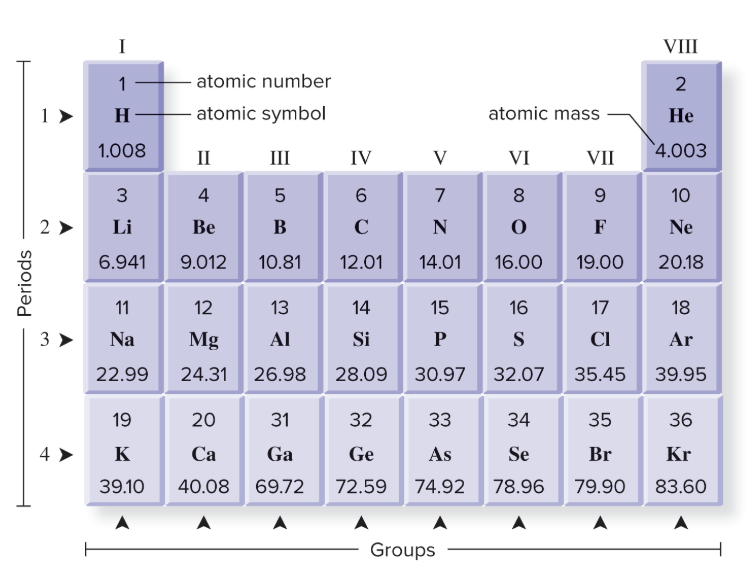
A portion of the periodic table. In the periodic table, elements are listed in the order of their atomic numbers but are arranged so each element is placed in a group (vertical column) and period (horizontal row). All the atoms in a particular group have the same number of valence electrons and therefore share common chemical characteristics. Each period shows the number of electron shells for an element. This abbreviated periodic table contains the elements most important in biology. (The complete periodic table is in Appendix A.)
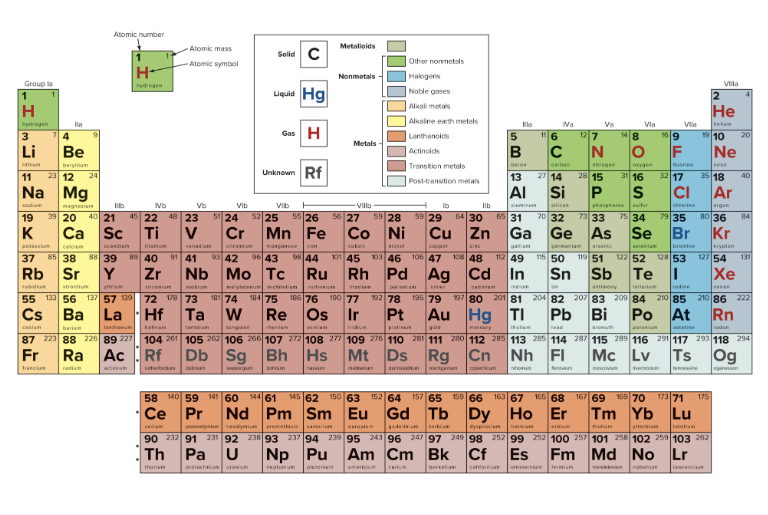
Question: The one- or two-letter abbreviation that stands for an element is known as its atomic
sign.
symbol.
shorthand.
standard.
Book: An element and its atoms share the same name. One or two letters create the atomic symbol that stand for this name
Ex: The symbol H means hydrogen atom, the sybol Rn stands for radon, and the symbol Na is used for sodium atom.
Question: The number of protons in the nucleus of an atom is represented by its atomic
number.
mass.
mass number.
Book: Atomic number: the number of protons in the nucleus
All the atoms of the same element have the same atomic number.
Electrically neutral atoms: The atomic number also indicates the number of electrons.
Question: How are low levels of radiation from radioactive isotopes used in medicine?
Tracers used in imaging
Labels for glucose or thallium prior to PET scans
Killing cancer cells
Sterilization of equipment
Tracers that detect molecular changes
Book: The chemical behavior of a radioactive isotope is essentially the same as that of the stable isotopes of an element. This means you can put a small amount of radioactive isotope in a sample and it becomes a tracer by which to detect molecular changes. Melvin Calvin and his co-workers used carbon 14 to detect all the various reactions that occur during the process of photosynthesis (see Section 7.2).
The importance of chemistry to medicine is nowhere more evident than in the many medical uses of radioactive isotopes. Specific tracers are used in imaging the body's organs and tissues
Question: The mass of an atom, represented by its atomic mass number, is equal to the number of Protons plus the number of neutrons within the nucleus.
Book: Each atom also has its own mass number, which is the sum of the protons and neutrons in the nucleus.
Question: The majority of carbon atoms have a mass of 12, though some have a mass of 13 or 14. When the average of the mass of all isotopes of carbon is calculated, we get the atomic mass of carbon: 12.01.
Book: The term atomic mass refers to the average mass for all the isotopes of that atom. Because the majority of carbon is carbon 12, the atomic mass of carbon is closer to 12 than to 13 or 14
Question: A Russian chemist developed the periodic table as a way to group elements and atoms according to
how many isotopes are present for each one.
their common characteristics.
the order in which they were discovered.
Book: Once chemists discovered a number of the elements, they began to realize that even though each element consists of a different atom, certain chemical and physical characteristics recur. The periodic table, developed by the nineteenth-century Russian chemist Dmitri Mendeleev, was constructed as a way to group the elements, and therefore atoms, according to these characteristics.
> Question: What is the correct description of an atom that contains 6 electrons?
The first electron shell will be filled with 2 electrons and the second shell will have 4 electrons in it.
The first electron shell will be filled with 8 electrons and the second shell will have 2 electrons in it.
The first electron shell will be filled with 4 electrons and the second shell will have 2 electrons in it.
The first electron shell will be filled with 2 electrons and the second shell will have 6 electrons in it.
Book: Let’s take a more detailed look at the a Bohr models depicted in figure 2.6 . The first shell is closest to the nucleus and can contain two electrons; the second shell can contain eight electrons. In all atoms, the lower shells are filled with electrons before the next higher level contains any electrons.
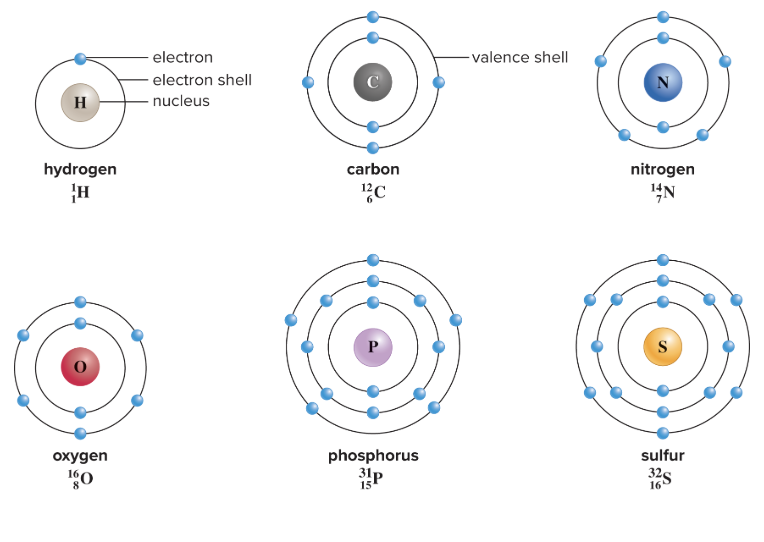
Bohr models of atoms. Electrons orbit the nucleus at particular energy levels (electron shells). The first shell contains up to two electrons, and thereafter each shell is most stable when it contains eight electrons. Atoms with an atomic number above 20 may have more electrons in their outer shells. The outermost, or valence, shell helps determine the atom's chemical properties and how many other elements it can interact with.
Question: Which electron shell of an atom is called the valence shell?
The outermost shell
The innermost shell
The most stable shell
Book: Bohr models of atoms. Electrons orbit the nucleus at particular energy levels (electron shells). The first shell contains up to two electrons, and thereafter each shell is most stable when it contains eight electrons. Atoms with an atomic number above 20 may have more electrons in their outer shells. The outermost, or valence, shell helps determine the atom's chemical properties and how many other elements it can interact with.
Question: The main reason for putting a small amount of radioactive isotope in a sample to serve as a tracer is to
detect molecular changes.
destroy infected cells.
cause molecular changes in cells.
Book: The chemical behavior of a radioactive isotope is essentially the same as that of the stable isotopes of an element. This means you can put a small amount of radioactive isotope in a sample and it becomes a tracer by which to detect molecular changes. Melvin Calvin and his co-workers used carbon 14 to detect all the various reactions that occur during the process of photosynthesis.
Question: What is the term for the smallest component of a compound that retains the chemical properties of the compound?
Atom
Solute
Element
Molecule
Book: A molecule exists when two or more of the same type of atoms bond together; it is the smallest part of a compound that retains its chemical properties.
Questions: The combination of which two subatomic particles creates the atomic mass number?
electron shells
neutrons
protons
electrons
Book: Each atom also has its own mass number, which is the sun of the protons and neutrons in the nucleus.
>Questions: Charged particles called ions are created when
protons are transferred between two atoms.
neutrons are transferred between two atoms.
electrons are transferred between two atoms.
Book: This electron transfer, however, causes a charge imbalance in each atom. After giving up an electron, the sodium atom has one more proton than it has electrons; therefore, it has a net charge of +1 (symbolized by Na+). After accepting an electron, the chlorine atom has one more electron than it has protons; therefore, it has a net charge of -1 (symbolized by C-). These charged particles are called ions. Sodium (Na) and chAride (CI) are not the only biologically important ions.
Questions: The atomic mass refers to the average mass for all the Blank______ of that atom.
protons
neutrons
electrons
isotopes
Book: The term atomic mass refers to the average mass for all the isotpes of the atom. because the mojority of carbon 12, the atomic mass of carbon is closer to 12 than to 13 or 14.
> Questions: An atom with the first two electron shells filled would contain how many electrons?
34
18
8
10
2
Book: Figure 2.6 : The first shell is closest to the nucleus and can contain two electrons; the second shell can contain eight electrons. In all atoms, the lower shells are filled with electrons before the next higher level contains any electrons.
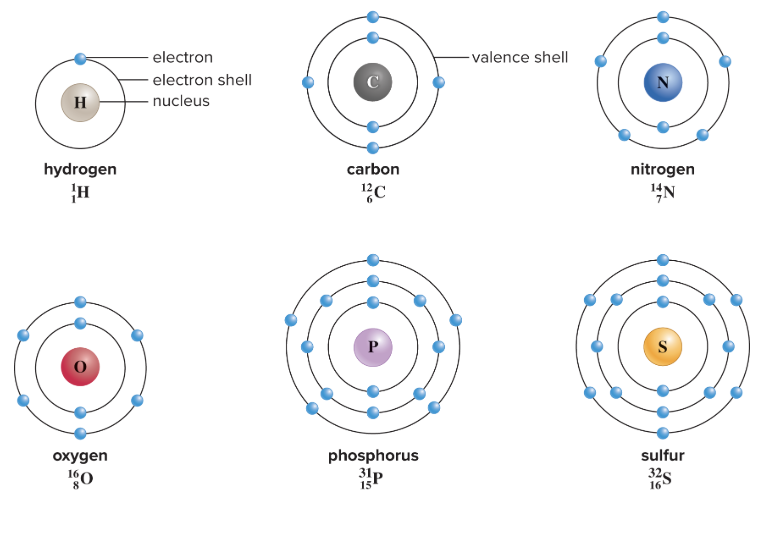
Questions: The outermost electron shell of an atom is called its Valence shell.
Book: Regardless of how many shells an atom has, the outermost shell is called the valence shell. The valence shell is important, because it determines many of an atom's chemical properties.
Questions: When two or more of the same type of atoms bond together, which of these is formed?
A chemical
A molecule
A compound
Book: A molecule exists when two or more of the same type of atoms bond together; it is the smallest part of a compound that retains its chemical properties.
Questions: Which combination of ions will form an ionic bond?
Na+ and Na+
O− and O−
Na+ and Cl−
Book: Ionic compounds are held together by an attraction between negatively and positively charged ions, called an ionic bond.
Other: In a sodium chloride crystal, ionic bonding between Na+ and CI causes the atoms to assume a three-dimensional lattice in which each sodium ion is surrounded by six chloride ions, and each chloride ion is surrounded by six sodium ions.
Questions: Which of these are examples of ions?
Cl-
H20
K+
O2
Cl2
Na+
Book: After accepting an electron, the chlorine atom has one more electron than it has protons; therefore, it has a net charge of -1 (symbolized by C-). These charged particles are called ions. Sodium (Na+) and chloride (CI-) are not the only biologically important ions. Some, such as potassium (K+), are formed by the transfer of a single electron to another atom; others, such as calcium (Ca²+) and magnesium (Mg²+), are formed by the transfer of two electrons.
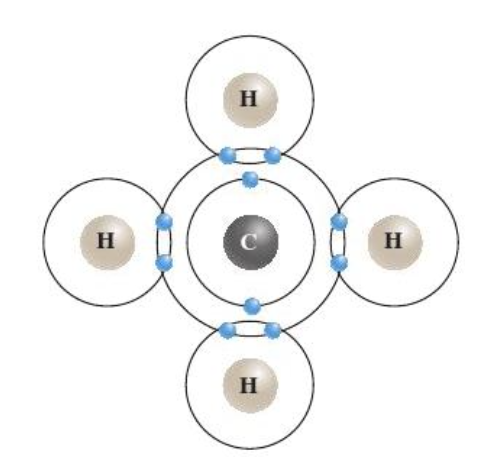
Questions:The molecule shown here is held together by which type of bonds?
Hydrogen bonds
Covalent bonds
Ionic bonds
Book: Covalent Bonding
A covalent bond results when two atoms share electrons in such a way that each atom has an octet of electrons in the outer shell (or two electrons, in the case of hydrogen). In a hydrogen atom, the outer shell is complete when it contains two electrons. If hydrogen is in the presence of a strong electron acceptor, it gives up its electron to become a hydrogen ion (H+). But if this is not possible, hydrogen can share with another atom and thereby have a completed outer shell. For example, one hydrogen atom will share with another hydrogen atom. Their two electron shells overlap, and the electrons are shared between them Fig. 2.8). Because they form a covalent bond and share the electron pair, each atom has a completed outer shell.
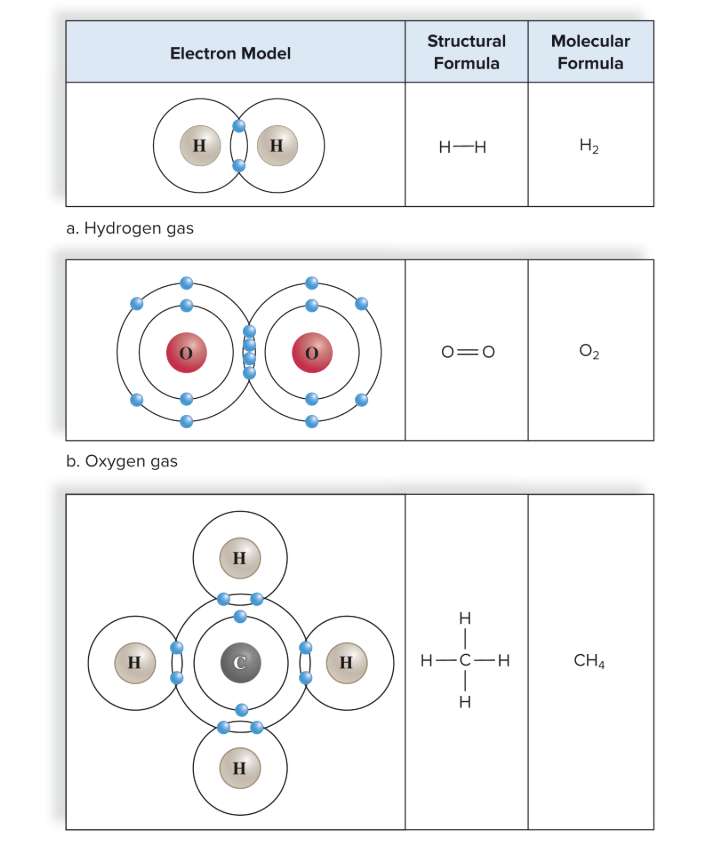
Covalently bonded molecules. In a covalent bond, atoms share electrons, allowing each atom to have a completed outer shell. a. A molecule of hydrogen (H2) contains two hydrogen atoms sharing a pair of electrons. This single covalent bond can be represented in any of the three ways shown. b. A molecule of oxygen (O2) contains two oxygen atoms sharing two pairs of electrons. This results in a double covalent bond. c. A molecule of methane (CH4) contains one carbon atom bonded to four hydrogen atoms.
Questions: Which term refers to the average mass for all the isotopes of an atom?
Mass number
Atomic number
Atomic mass
Book: The term atomic mass refers to the average mass for all the isotopes of that atom. Because the majority of carbon 12, the atomic mass of carbon is closer to 12 than to 13 or 14.
Questions:Match the following bonds with the correct description:
Polar covalent bond. <——→
Nonpolar covalent bond. <——→
Example of polar molecule <——→
Example of a nonpolar molecule <——→
options:
Bond in which electrons between atoms are unequally shared
CH4 (methane)
Bond in which electrons between atoms are equally shared
H2O (water)
Book: When the sharing of electrons between two atoms is equal, the covalent bond is said to be a nonpolar covalent bond. However, in some cases, one atom is able to attract electrons to a greater degree than the other atom. In this case, we say that the atom that has a greater attraction for a shared pair of electrons has a greater electronegativity. When electrons are not shared equally, the covalent bond is a polar covalent bond
Nonpolar covalent bonds: sharing of electrons is mostly equal
Atoms exert a fairly equal pull on the electrons.
Example: C-H bonds in a methane molecule
Polar covalent bonds: electrons are not shared equally
• One atom attracts electrons more strongly and has a greater
electronegativity.
Atom with greater electronegativity has a slightly negative charge; the other atom has slightly positive charge.
The bond and molecule are polar, with slightly positive and negative ends.
Example: O-H bonds in a water molecule, oxygen atom has a slightly negative charge
Covalent bond: forms when two atoms share electrons
Single covalent bond - two atoms share one pair of electrons
Double covalent bond - two atoms share two pairs of electrons
Triple covalent bond - two atoms share three pairs of electrons
Questions: The first electron shell contains up to 2 electrons, while the second shell may contain up to 8 electrons.
Book: figure 2.6 Bohr models of atoms. Electrons orbit the nucleus at particular energy levels (electron shells). The first shell contains up to two electrons, and thereafter each shell is most stable when it contains eight electrons.
Questions: Which electron shell of an atom is called the valence shell?
The most stable shell
The innermost shell
The outermost shell
Book: Regardless of how many shells an atom has, the outermost shell is called the valence shell. The valence shell is important, because it determines many of an atom's chemical properties.
Questions: Some compounds are held together by an attraction between negatively and positively charged ions held in an ionic bond.
Book: Ionic compounds are held together by an attraction between negatively and positively charged ions, called an ionic bond.
> Questions: Which of these are examples of molecules formed by covalent bonds?
Multiple select question.
O2
N2
NaCl
CH4
H2O
Book: A covalent bond results when two atoms share electrons in such a way that each atom has an octet of electrons in the outer shell (or two electrons, in the case of hydrogen). In a hydrogen atom, the outer shell is complete when it contains two electrons. If hydrogen is in the presence of a strong electron acceptor, it gives up its electron to become a hydrogen ion (H+). But if this is not possible, hydrogen can share with another atom and thereby have a completed outer shell. For example, one hydrogen atom will share with another hydrogen atom. Their two electron shells overlap, and the electrons are shared between them Fig. 2.8). Because they form a covalent bond and share the electron pair, each atom has a completed outer shell.
Covalently bonded molecules. In a covalent bond, atoms share electrons, allowing each atom to have a completed outer shell. a. A molecule of hydrogen (H2) contains two hydrogen atoms sharing a pair of electrons. This single covalent bond can be represented in any of the three ways shown. b. A molecule of oxygen (O2) contains two oxygen atoms sharing two pairs of electrons. This results in a double covalent bond. c. A molecule of methane (CH4) contains one carbon atom bonded to four hydrogen atoms.
Question: Electrons are shared equally in a Blank______ covalent bond, while they are not shared equally in a Blank______ covalent bond.
polar/nonpolar
nonpolar/polar
Book:
Nonpolar covalent bonds: sharing of electrons is mostly equal
Atoms exert a fairly equal pull on the electrons.
Polar covalent bonds: electrons are not shared equally
• One atom attracts electrons more strongly and has a greater
Question: When atoms share electrons, a(n) Blank______ bond is formed.
covalent
ionic
polar
hydrogen
Book: A covalent bond results when two atoms share electrons in such a way that each atom has an octet of electrons in the outer shell (or two electrons, in the case of hydrogen).
Pre-class 4: Water & pH
Question: The structure and polarity of the water molecule results in a Blank______ bond.
ionic
double covalent
hydrogen
covalent
Book: The shape of water molecule and its polarity results in the formation of hydrogen bonds, A hydrogen bond is caused by the attraction of a slightly poisitve hydrogen to a slightly negative atom in the vicinity.
Question: Which of the following molecules can contain hydrogen bonds or form hydrogen bonds with other molecules?
Hydrogen gas
Table salt
DNA
Water
Book: Hydrogen bonding is not unique to water. other biological molecules, such as DNA, have polar covalent bonds involving an electronegative oxygen or nitrogen. In these instances, a hydrogen bond can occur within the same molecule or between nearby molecules.
Question: Hydrogen bonding is a characteristic that is unique to water molecules.
True false question.
True
False
Book: Hydrogen bonding is not unique to water. Other biological molecules, such as DNA, have polar covalent bonds involving an electronegative oxygen or nitrogen.
Question: Which of these results from hydrogen bonding? More than one answer may be correct.
A DNA molecule has added stability.
Neighboring water molecules are attracted to each other.
The shape of a protein molecule is maintained.
Attraction between oxygen and hydrogen atoms in a single water molecule
Book: Although a single hydrogen bond is more easily broken than a single covalent bond, multiple hydrogen bonds are collectively quite strong. Hydrogen bonds between cellular molecules help maintain their proper structure and function. For example, hydrogen bonds hold the two strands of DNA together (see Section 3.5). When DNA makes a copy of itself, hydrogen bonds easily break, allowing DNA to unzip. But normally, the hydrogen bonds add stability to the DNA molecule. Similarly, the shape of protein molecules is often maintained by hydrogen bonding between different parts of the same molecule. As we will see, many of the important properties of water are the result of hydrogen bonding.
Question: Which properties contribute to water's property of being a solvent?
Water is polar
Water forms hydrogen bonds
Water forms ionic bonds
Book: Water Is a Solvent
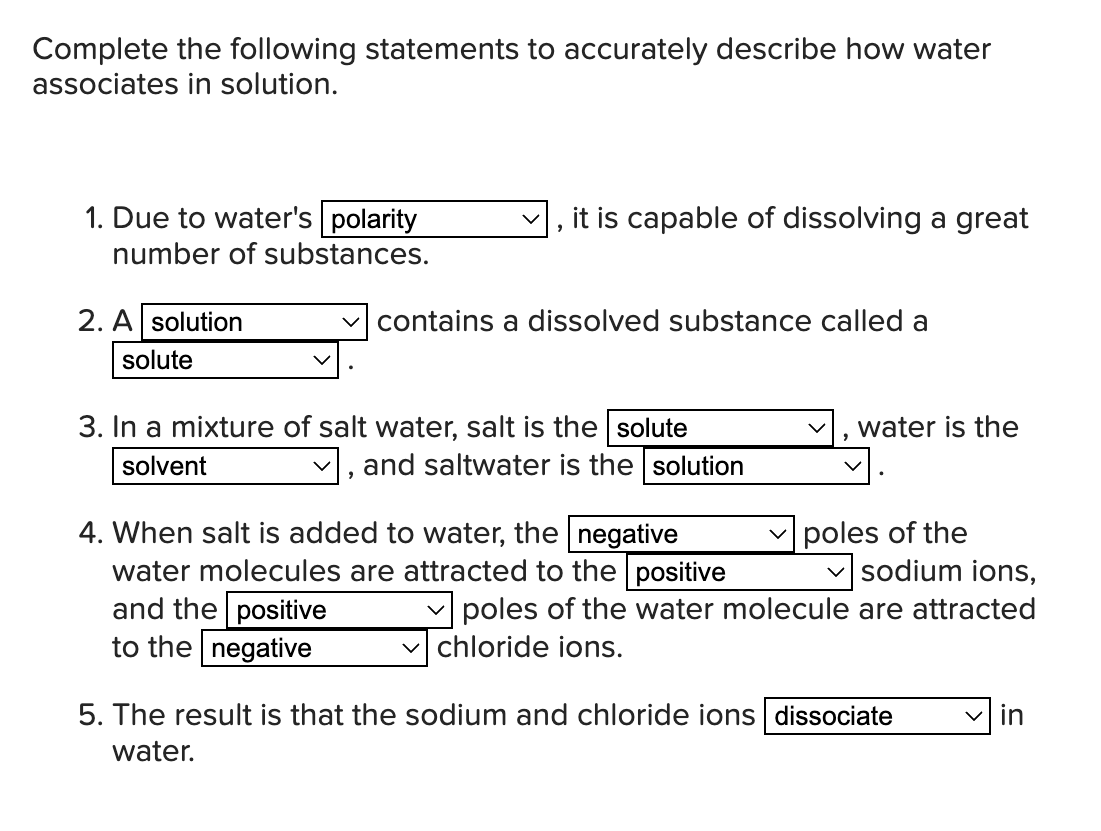
Due to its polarity, water facilitates chemical reactions, both outside and within living systems. As a solvent, it dissolves a great number of substances, especially those that are also polar.
Question:A solution contains dissolved substances called solutes
Book: A solution contains dissolved substances, which are then called solutes.
Question: The attraction between a hydrogen atom and an electronegative atom in another molecule results in a(n) Hydrogen bond.
Book: The shape of water molecules and its plarity results in the formation of hydroge bonds. A hydrogen bond is caused by the attraction of a slightly positive hydrogen to a slightly negative atom in the vicinity.
Question: Ice floats because it is less dense than liquid water due to more rigid hydrogen bonding between water molecules.
True
False
Book: As liquid water cools, the molecules come closer together. water is most dense at 4 c, but the water molecules are still moving about ( figure 2.12) At temperatures below 4 c, only vibrational movement occurs and hydrogen bonding becomes more rigid but also more open. This means that water expands as it reaches 0 c and freezes, which is why cans of soda burst when placed in a freezer, or why frost heaves make northern roads bumpy in the winter. it also means that ice is less dense than liquid water, and therefore ice floats on liquid.
Question: Which of the following would have the greatest stability due to their bonds?
a single hydrogen bond
multiple hydrogen bonds
a single covalent bond
Book: Although a single hydrogen bond is more easily broken than a single covalent bond, multiple hydrogen bonds are collectively quite strong. Hydrogen bonds between cellular molecules help maintain their proper structure and function.
Question: Water's solvent properties result from polarity and its ability to form hydrogen bonds.
True
False
Book: Due to its polarity, water facilitates chemical reactions, both outside and within living system. As a solvent, it dissolves a great number of substances, especially those are also polar.
Question: The salt within sea water is considered the solute within the solution.
Book: A solution contains dissolved substances, which are then called solutes.
Question: At what temperature are water molecules reduced to vibrational movements and the hydrogen bonding becomes more open?
below 4o Celsius
below 2o Celsius
at 0o Celsius
above 3o Celsius
Book: As liquid water cools, the molecules come closer together. Water is most dense at 4 c, but the water molecules are still moving about (fig.2.12). At temperature below 4 c, only vibrational movement occurs, and hydrogen bonding be
Question:Which of these results from hydrogen bonding? More than one answer may be correct.
Neighboring water molecules are attracted to each other.
Attraction between oxygen and hydrogen atoms in a single water molecule
A DNA molecule has added stability.
The shape of a protein molecule is maintained.
Book: Although a single hydrogen bond is more easily broken than a single covalent bond, multiple hydrogen bonds are collectively quite strong. Hydrogen bonds between cellular molecules help maintain their proper structure and function. For example, hydrogen bonds hold the two strands of DNA together (see Section 3.5). When DNA makes a copy of itself, hydrogen bonds easily break, allowing DNA to unzip. But normally, the hydrogen bonds add stability to the DNA molecule. Similarly, the shape of protein molecules is often maintained by hydrogen bonding between different parts of the same molecule. As we will see, many of the important properties of water are the result of hydrogen bonding.
Question: Which properties contribute to water's property of being a solvent?
Water forms ionic bonds
Water forms hydrogen bonds
Water is polar
Book: Due to its polarity, water facilitates chemical reactions, both outside and within living systems. As a solvent, it dissolves a great number of substances, especially those that are also polar.
Question: A solution contains dissolved substances called solute.
Book: A solution contains dissolved substances, which are then called solutes.
Question: Which statement about the ionization of water is correct?
More hydrogen ions are released than hydroxide ions.
Only hydrogen ions are released.
An equal number of hydrogen an hydroxide ions are released.
Fewer hydrogen ions are released than hydroxide ions.
Book: When water ionizes, it releases an equal number of hydrogen ions
(H+) ( sometimes just called protons because hydrogen consists of only a single proton and electron) and hydroxide ions (OH-)
Question: Ice floats because it is less dense than liquid water due to more rigid hydrogen bonding between water molecules.
True
False
Book: As liquid water cools, the molecules come closer together. water is most dense at 4 c, but the water molecules are still moving about ( figure 2.12) At temperatures below 4 c, only vibrational movement occurs and hydrogen bonding becomes more rigid but also more open. This means that water expands as it reaches 0 c and freezes, which is why cans of soda burst when placed in a freezer, or why frost heaves make northern roads bumpy in the winter. it also means that ice is less dense than liquid water, and therefore ice floats on liquid.
Question: The more fully an acid dissociates in water, the Blank______ the acid.
weaker
stronger
more polar
more neutral
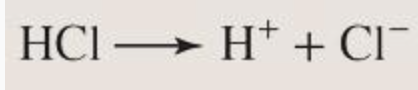
Book: What do they have in common? Acids are substances that dissociate in water releasing hydrogen ion (H+). The acidity of substance depends on how fully it dissociates in water. For example, hydrochloric acid (HCT) is a strong acid that dissociates almost completely in this manner.
Question: Which of the following molecules can contain hydrogen bonds or form hydrogen bonds with other molecules?
Water
Table salt
Hydrogen gas
DNA
Book: Hydrogen bonding is not unique to water. other biological molecules, such as DNA, have polar covalent bonds involving an electronegative oxygen or nitrogen. In these instances, a hydrogen bond can occur within the same molecule or between nearby molecules.
Question: What will bases do in a solution?
Take up hydrogen ions
Release hydroxide ions
Take up hydroxide ions
Release hydrogen ions
Book: Bases are substance that either take up hydrogen ions(H+) or release hydroxide ions ( OH-). for exmaple, sodium hydroxide (NaOH) Is a strong base that dissociates almost completely in this manner.
The concentration of Ht affects cells and molecules.
• Hydrogen ions (H*) are also called protons.
Acids: substances that add Ht to a solution
• Examples: hydrochloric acid (HCI), lemon juice, stomach acid
Bases: substances that either take up Ht from or release hydroxide ions (OH) into a solution
• Examples: soap, bleach, sodium hydroxide (NaOH)

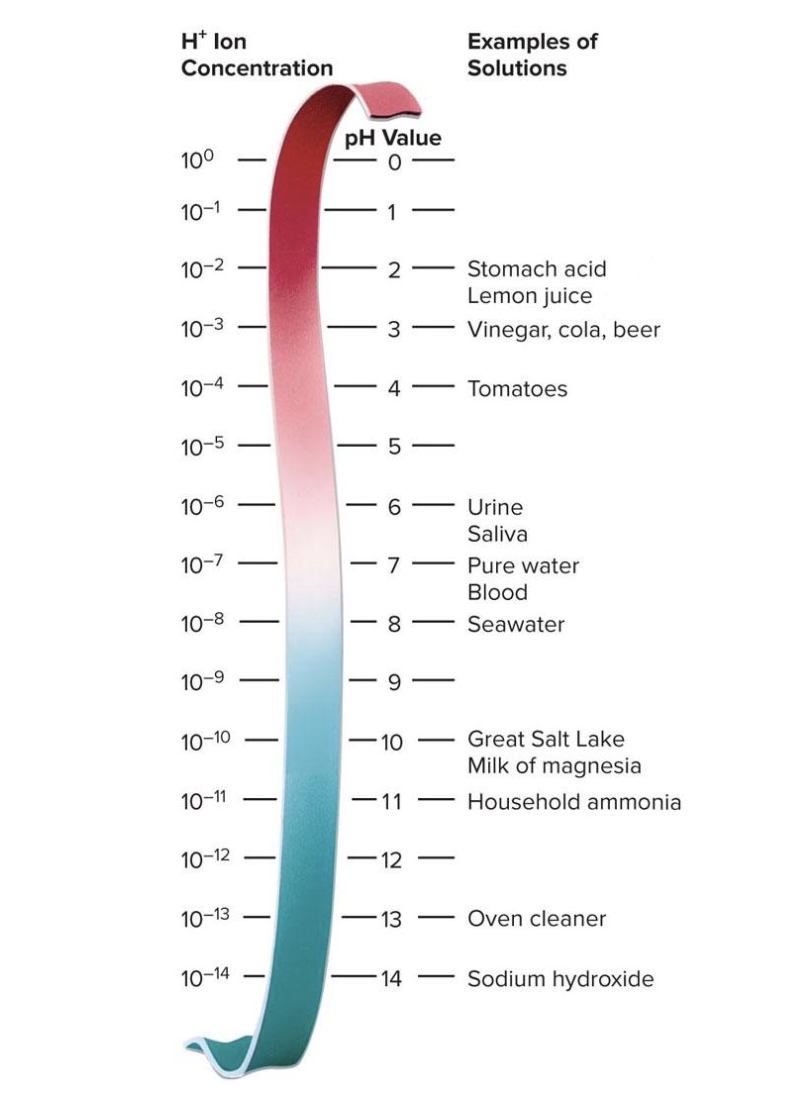
pH scale: indicates the H+ concentration of a solution
Examples of Solutions
• Scale ranges from 0 to 14
• Value determined by H+
concentration
Acidic solution: pH < 7
Neutral solution: pH = 7
• Pure water has a pH of 7
Basic solution: pH > 7
Optimum pH: pH value or range at which a molecule, cell, or
tissue functions best
Question: Which type of bond breaks when a DNA molecule "unzips" when DNA is being copied?
nonpolar covalent
hydrogen
polar covalent
ionic
Book:Although a single hydrogen bond is more easily broken than a single covalent bond, multiple hydrogen bonds are collectively quite strong. Hydrogen bonds between cellular molecules help maintain their proper structure and function. For example, hydrogen bonds hold the two strands of DNA together (see Section 3.5). When DNA makes a copy of itself, hydrogen bonds easily break, allowing DNA to unzip. But normally, the hydrogen bonds add stability to the DNA molecule. Similarly, the shape of protein molecules is often maintained by hydrogen bonding between different parts of the same molecule. As we will see, many of the important properties of water are the result of hydrogen bonding.
Question: The ability of water to dissolve a large number of different substances relates to which of the following characteristics?
Water has a high heat of evaporation
Water is cohesive
Water is a solvent
Water has a high heat capacity
Book: Due to its polarity, water facilitates chemical reactions, both outside and within living systems. As a solvent, it dissolves a great number of substances, especially those that are also polar.
Question: Any substance that has a a pH over 7.0 is considered Blank______.
acidic
neutral
basic
Book: The pH scale is used to indicate the acidity or basicity (alkalinity) of a solution. The pH scale (Fig. 2.13) ranges from 0 to 14. A pH of 7 represents a neutral state in which the hydrogen ion and hydroxide ion concentrations are equal. A pH below 7 is an acidic solution, because the hydrogen ion concentration is greater than the hydroxide concentration. A pH above 7 is basic, because the [ OH- ] is greater than the [H+].
> Question: Considering the ionization of water,match each of the following terms with the correct description.
Hydroxide ion ←————→
Hydroxide ion drop zone empty. ←————→
Ionization ←————→
The ion that has gained an electron and will have a negative charge.
The ion that has lost an electron and will have a positive charge.
The disassociation of water into hydrogen ions and hydroxide ions.
Book:
Question: A chemical or combination of chemicals that keeps pH within normal limits is called a(n) Buffer.
Book: A buffer is a chemical or a combination of chemicals that keeps pH within normal limits
Question: When dissociated in water, which of these is released by acids?
Water molecules
Oxygen atoms
Hydrogen ions
Hydroxide ions
Book: What do they have in common? Acids are substances that dissociate in water releasing hydrogen ion (H+). The acidity of substance depends on how fully it dissociates in water. For example, hydrochloric acid (HCT) is a strong acid that dissociates almost completely in this manner.
> Question: Molecules that take up hydrogen ions in a solution as well as raise the pH level are called
acids.
neutral molecules.
bases.
Book:
Question: Which of the following would have the greatest stability due to their bonds?
a single covalent bond
a single hydrogen bond
multiple hydrogen bonds
Book: Although a single hydrogen bond is more easily broken than a single covalent bond, multiple hydrogen bonds are collectively quite strong. Hydrogen bonds between cellular molecules help maintain their proper structure and function. For example, hydrogen bonds hold the two strands of DNA together (see Section 3.5). When DNA makes a copy of itself, hydrogen bonds easily break, allowing DNA to unzip. But normally, the hydrogen bonds add stability to the DNA molecule. Similarly, the shape of protein molecules is often maintained by hydrogen bonding between different parts of the same molecule. As we will see, many of the important properties of water are the result of hydrogen bonding.
Question: Match the pH value on the left with the correct description on the right.
pH 7 ←————→ neutral
pH 3 ←————→ acidic
pH 11 ←————→ basic (alkaline)
options:
neutral
acidic
basic (alkaline)
Book:
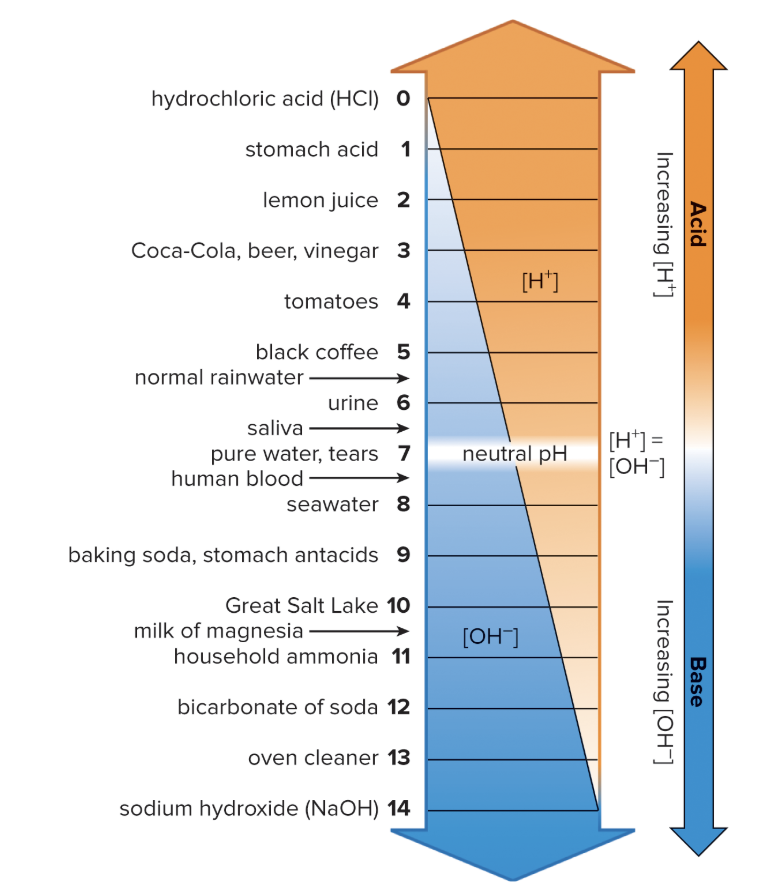
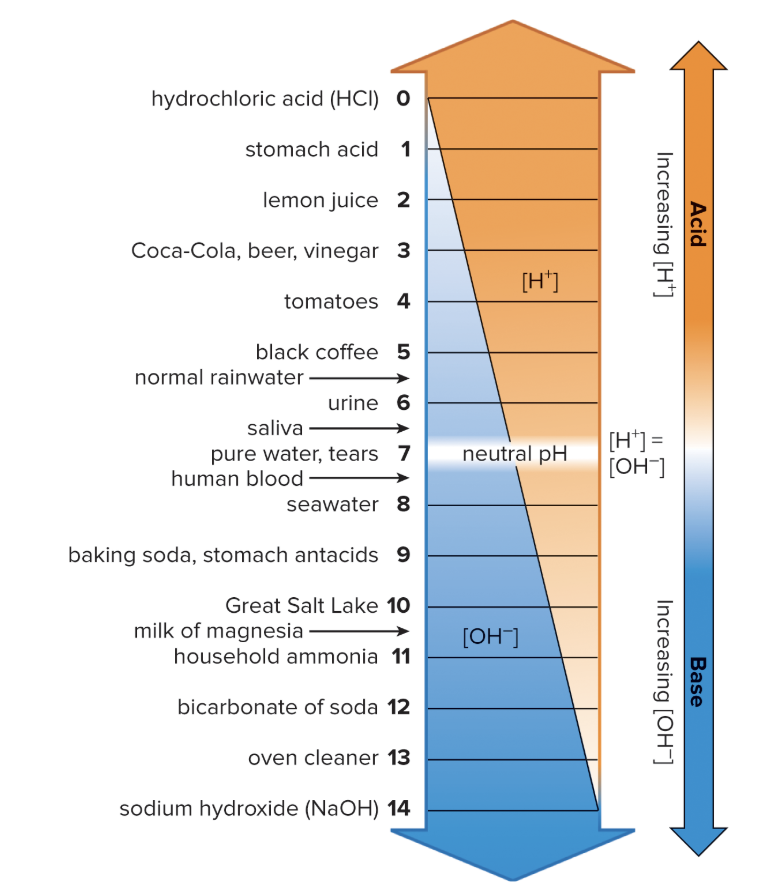
The pH scale. The pH scale ranges from 0 to 14, with O being the most acidic and 14 being the most basic. pH 7 (neutral pH) has equal amounts of hydrogen ions (H+) and hydroxide ions (OH-). An acidic pH has more H+ than OH- and a basic pH has more OH- than H+
Question: A substance or group of substances that help prevent changes to the pH of a solution are called Blank______.
bases
acids
buffers
Book: A buffer is a chemical or a combination of chemicals that keeps pH within normal limits
Post-class week 2
Question 1 : Drag the appropriate descriptions of the subatomic particles into the following boxes. Labels may be used more than once.
Protons: +1 , found in the nucleus
Neutrons: Electrically neutral, found in the nucleus
Electrons: Found in orbitals surrounding the nucleus, -1
Labels:
+1
found in the nucleus
Found in orbitals surrounding the nucleus
Electrically neutral
-1
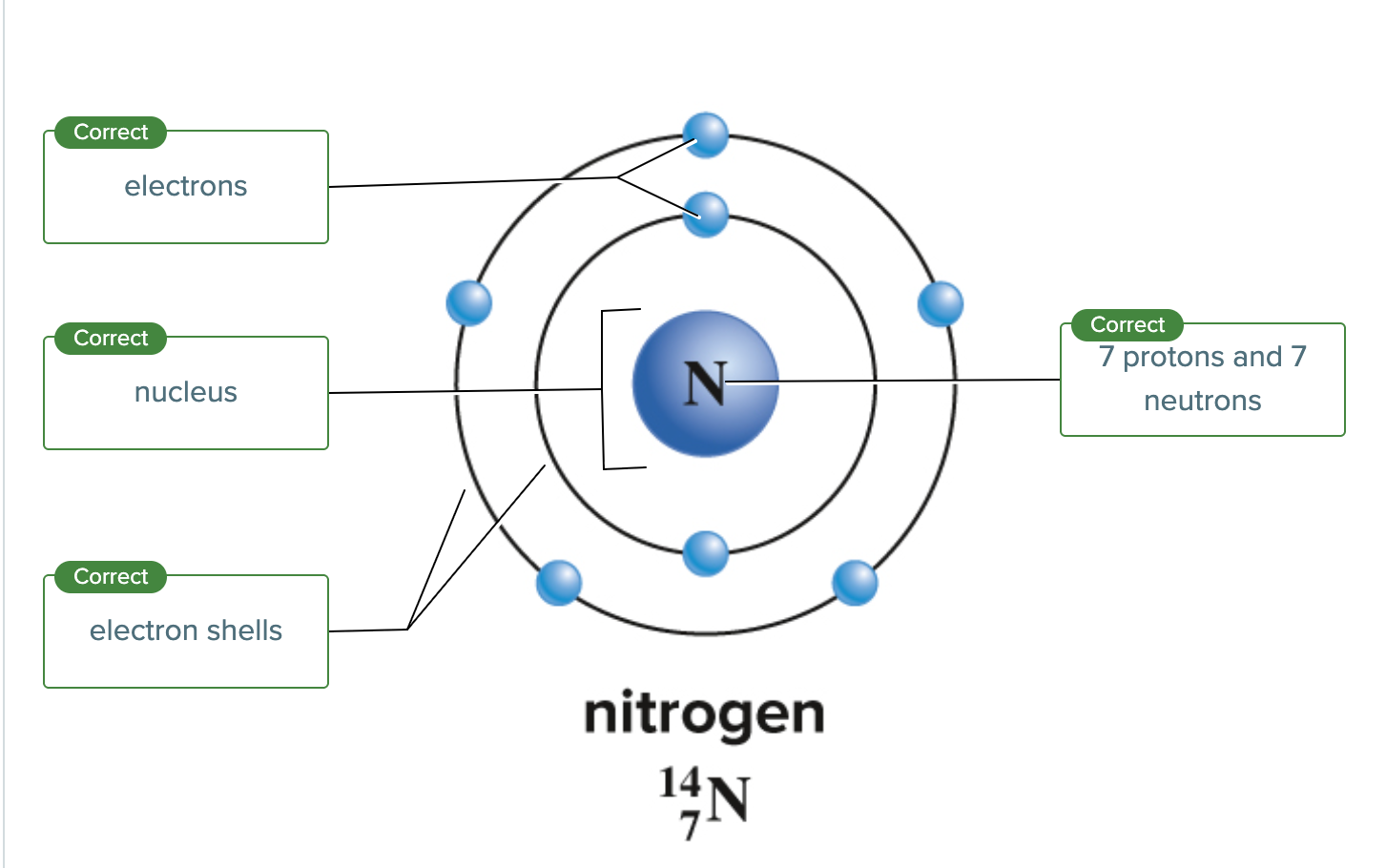
Question 2: Use your knowledge of atomic structure to label this diagram of a nitrogen atom.
Question 3: Label each model of an atom with its appropriate information.
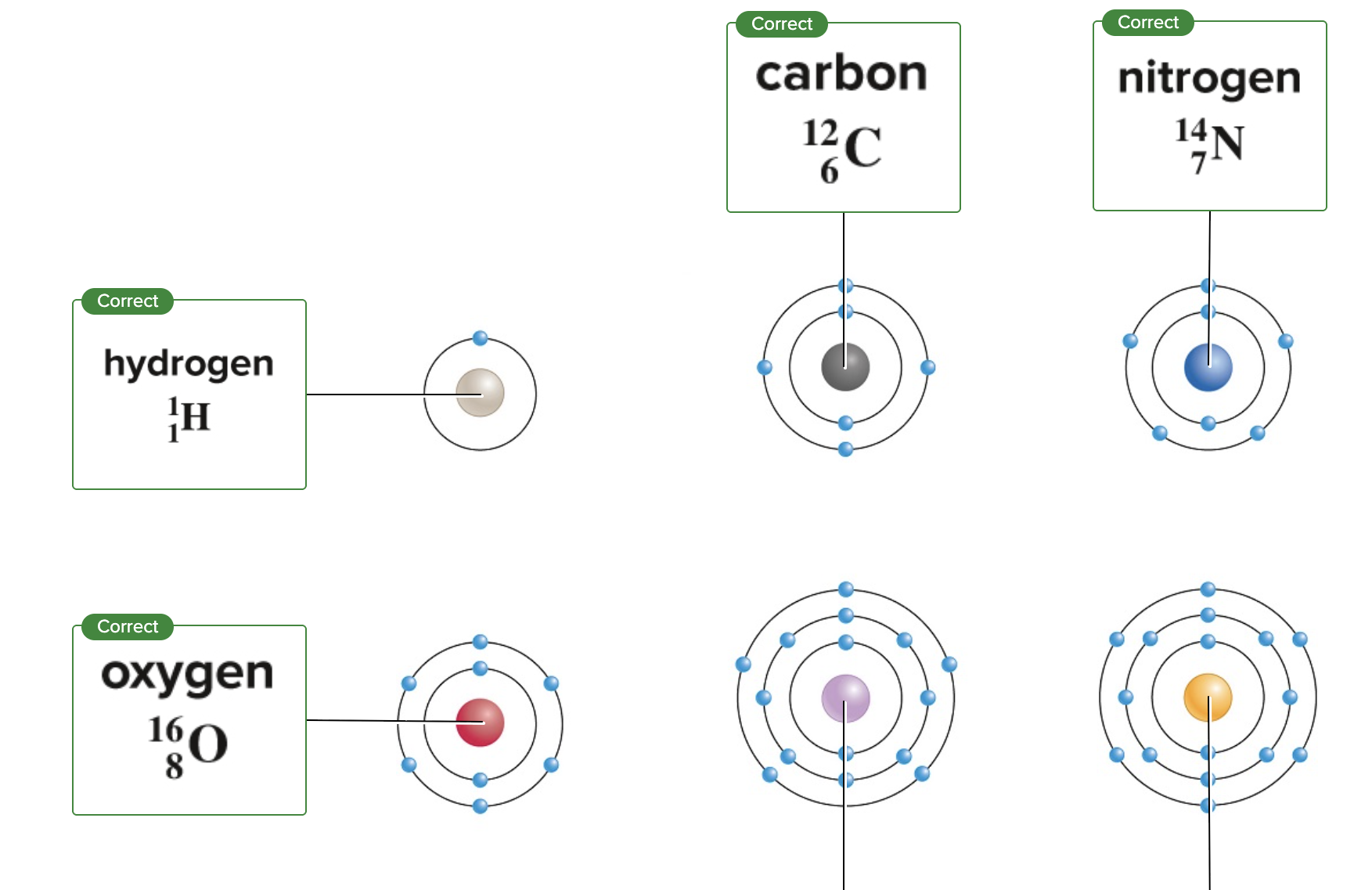
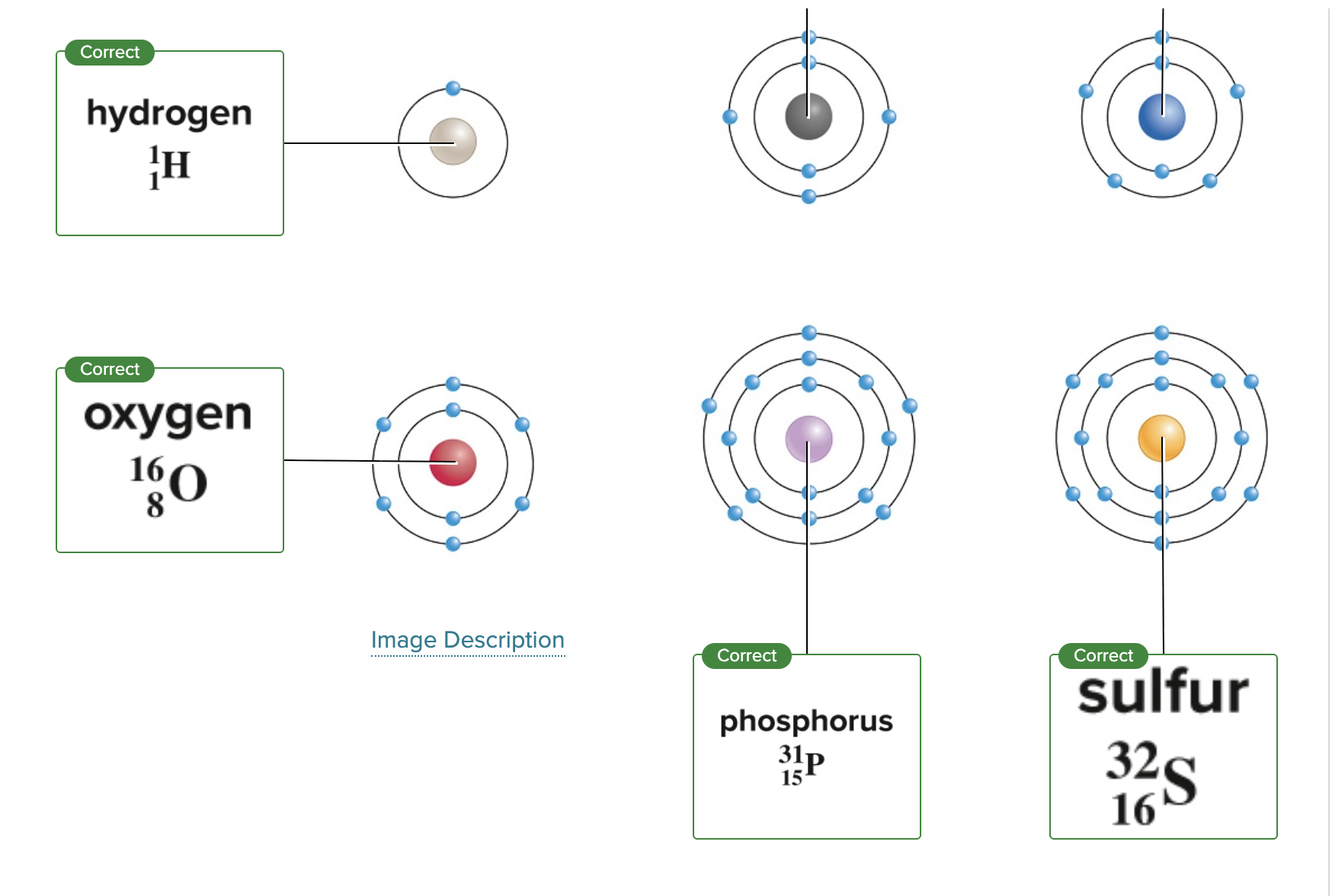
Question 4: Classify the bond(s) within each substance as either hydrogen, covalent, or ionic.
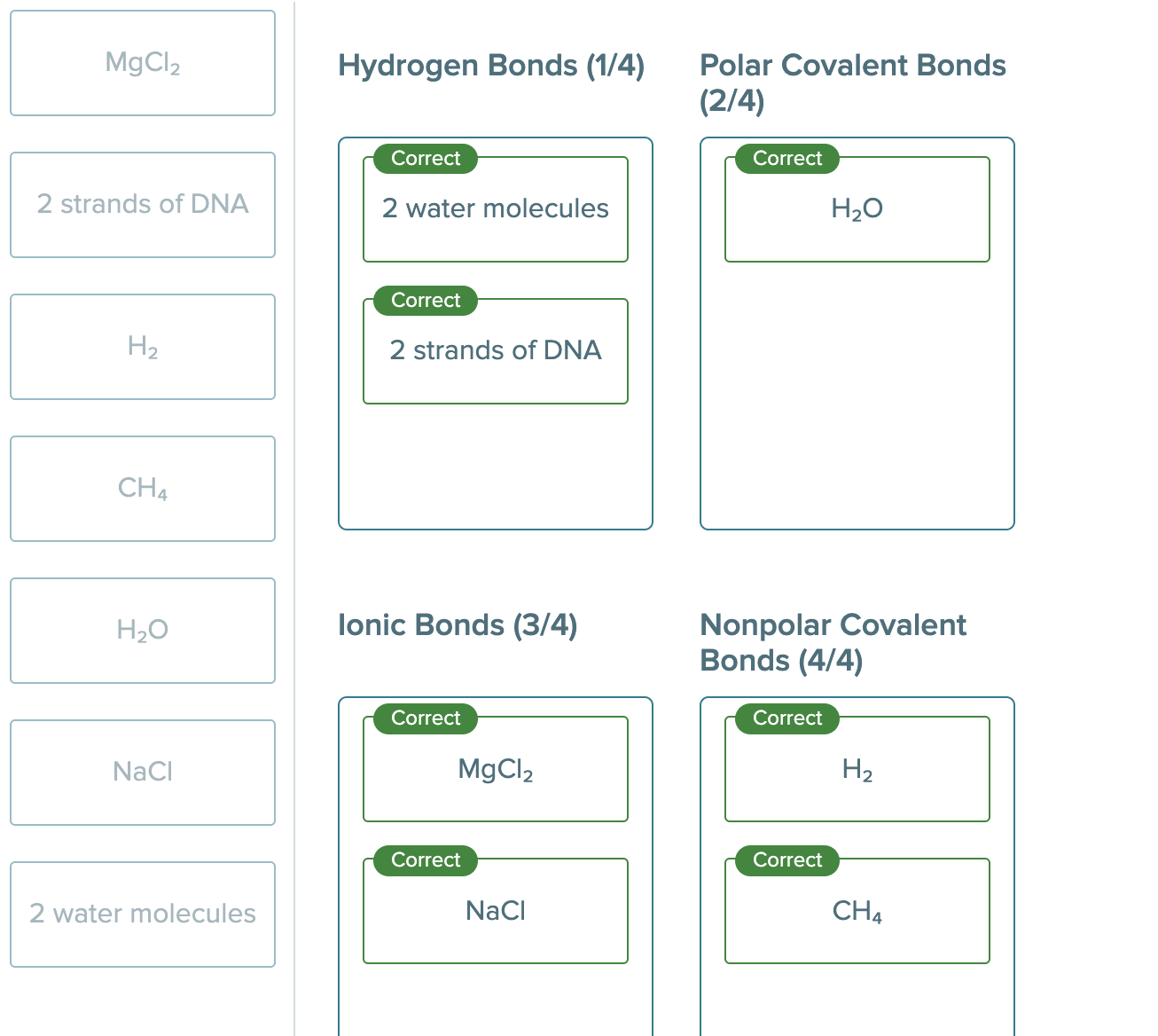
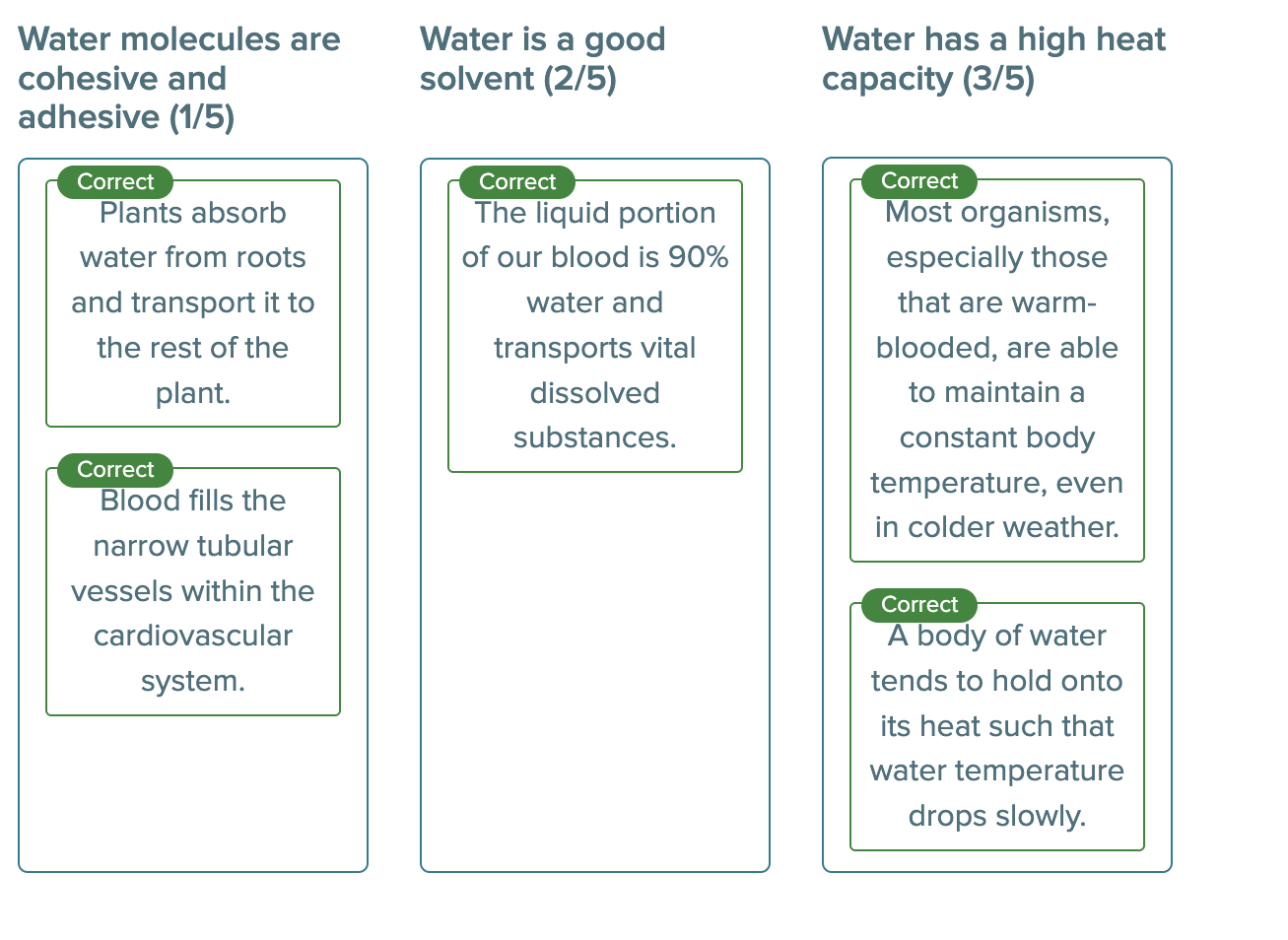
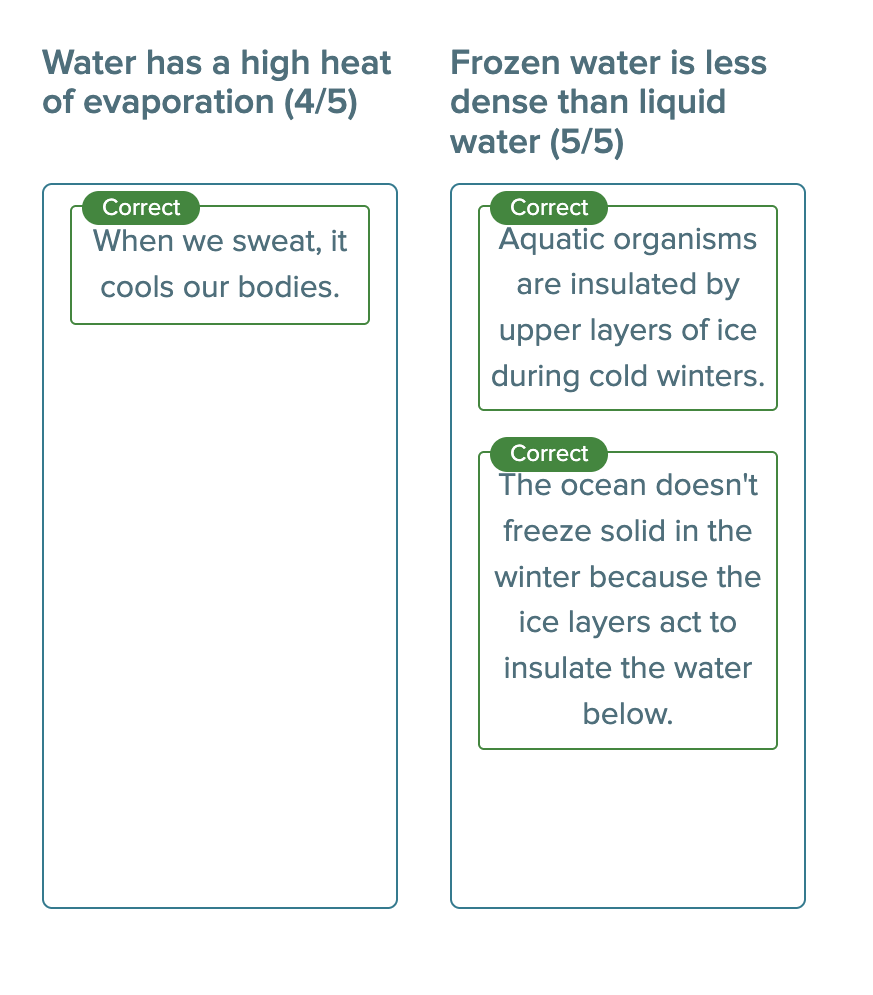
Question 5 : Water properties
Classify each of the following scenarios based on which attribute of water is responsible.
Question 6: A polar covalent bond can best be described as
a bond where electrons are equally shared, resulting in equal numbers of electrons orbiting each atom.
a bond where electrons are transferred from one atom to another, resulting in charge imbalance in each atom.
a bond where there are electronegativity differences between the atoms within a molecule, resulting in the partially positive atoms of one molecule attracting the partially negative atoms of other molecules.
a bond where electrons are unequally shared, resulting in more electrons orbiting certain atoms than others.
Question 7 : Electrons possess a negative charge. So, within a molecule of water, if more electrons are orbiting the oxygen atom than the two hydrogen atoms, the oxygen atom will have a slightly more negative charge than the hydrogen atoms.
True Or False
Question 8 : When water molecules are combined, which of the following is the most likely orientation of oxygen and hydrogen atoms of different molecules?
Oxygen atoms of one molecule attract hydrogen atoms of other molecules, so that each oxygen atom is opposite the two hydrogen atoms from nearby molecules.
Hydrogen atoms of one molecule attract hydrogen atoms of other molecules, so that each hydrogen atom is opposite the hydrogen atoms from nearby molecules.
There is no pattern to the orientation of water molecules when they are added together. They randomly orient themselves.
Question 9 : Bonding water molecules together
The weak attractive forces that hold water molecules together are called
hydrogen bonds.
polar covalent bonds.
nonpolar covalent bonds.
ionic bonds.
Question 10 : Hydrogen bond strength
Compared to the polar covalent bonds that hold the oxygen and hydrogen atoms together within a molecule of water, the hydrogen bonds that hold multiple water molecules together are much stronger.
True or false
Question 11 : Polar covalent bonds
A polar covalent bond can best be described as
a bond where electrons are transferred from one atom to another, resulting in charge imbalance in each atom.
a bond where electrons are unequally shared, resulting in more electrons orbiting certain atoms than others.
a bond where there are electronegativity differences between the atoms within a molecule, resulting in the partially positive atoms of one molecule attracting the partially negative atoms of other molecules.
a bond where electrons are equally shared, resulting in equal numbers of electrons orbiting each atom.
Book:
Question 12 : Distribution of electrons
Electrons possess a negative charge. So, within a molecule of water, if more electrons are orbiting the oxygen atom than the two hydrogen atoms, the oxygen atom will have a slightly more negative charge than the hydrogen atoms.
True or False
Question 13 : Orientation of water molecules
When water molecules are combined, which of the following is the most likely orientation of oxygen and hydrogen atoms of different molecules?
Oxygen atoms of one molecule attract hydrogen atoms of other molecules, so that each oxygen atom is opposite the two hydrogen atoms from nearby molecules.
There is no pattern to the orientation of water molecules when they are added together. They randomly orient themselves.
Hydrogen atoms of one molecule attract hydrogen atoms of other molecules, so that each hydrogen atom is opposite the hydrogen atoms from nearby molecules.
Question 14 : The weak attractive forces that hold water molecules together are called
hydrogen bonds.
nonpolar covalent bonds.
ionic bonds.
polar covalent bonds.
Book:
Question 15 : Compared to the polar covalent bonds that hold the oxygen and hydrogen atoms together within a molecule of water, the hydrogen bonds that hold multiple water molecules together are much stronger.
True or False
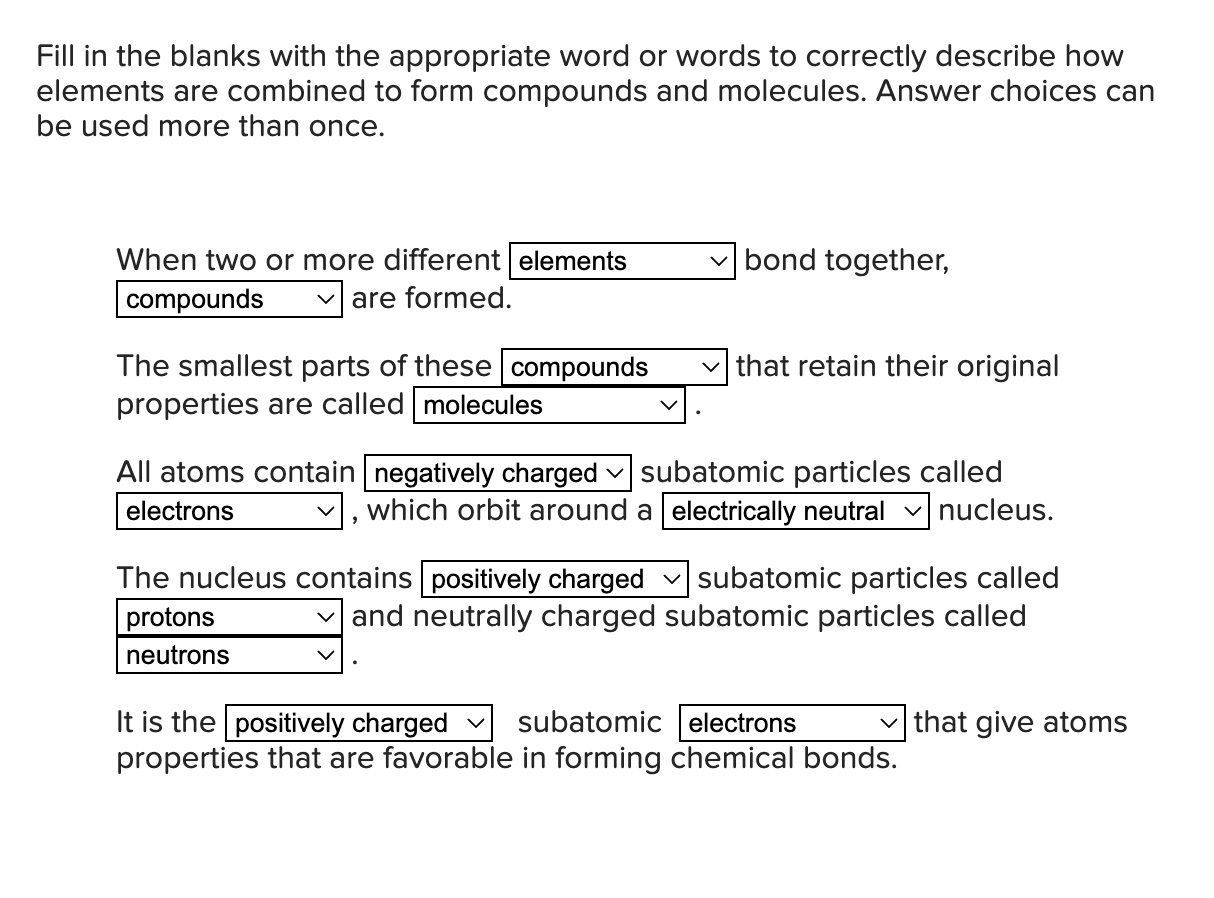
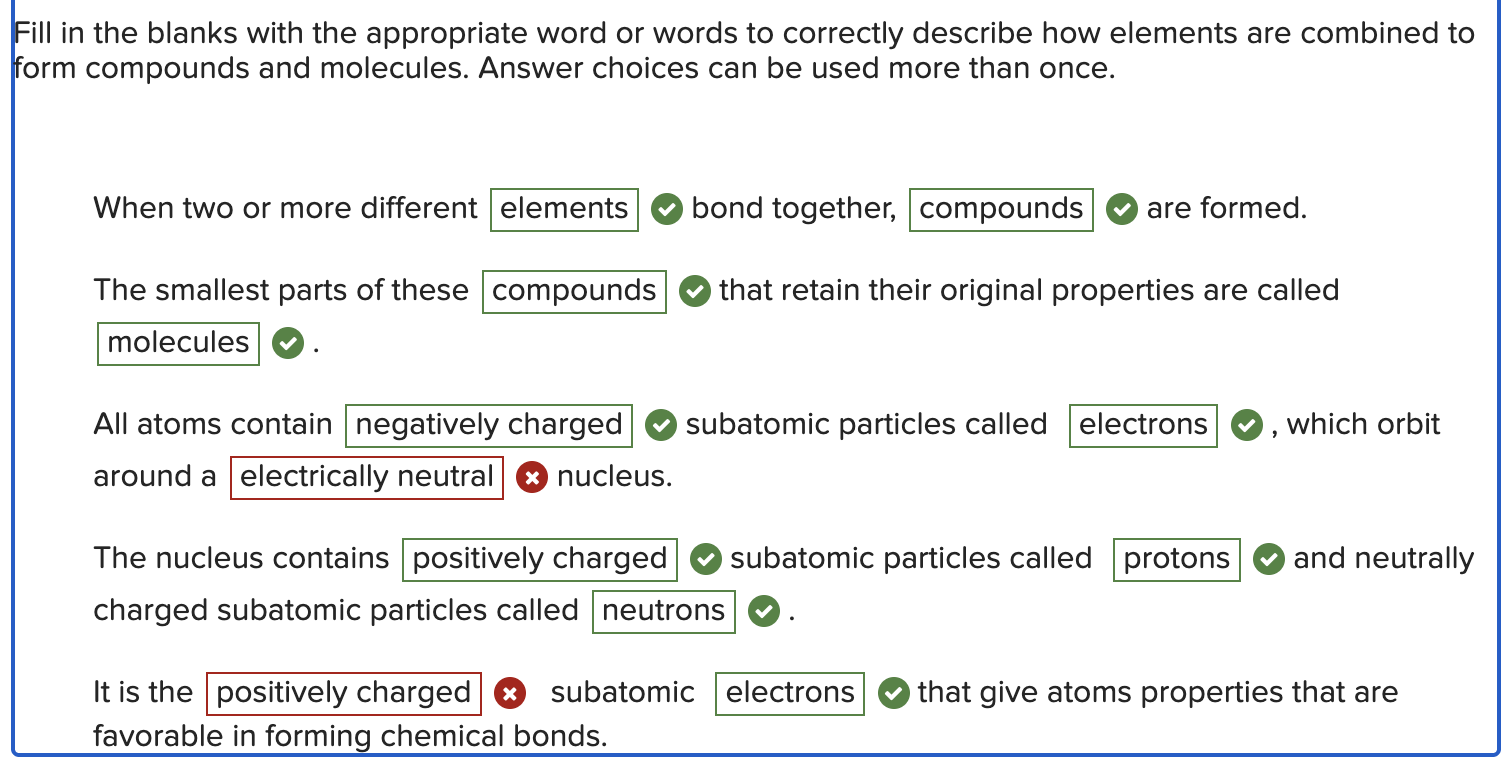
Question 16 : Compounds and molecules
Question 17 :
Select all of the following that are true about the structure of water molecules.
Water is an atom.Water is an atom.
A water molecule has one oxygen atom and two hydrogen atoms.
The bonds of a water molecule are polar.
Hydrogen atoms in a water molecule have a slight negative charge.
The oxygen atom in a water molecule has a slight positive charge
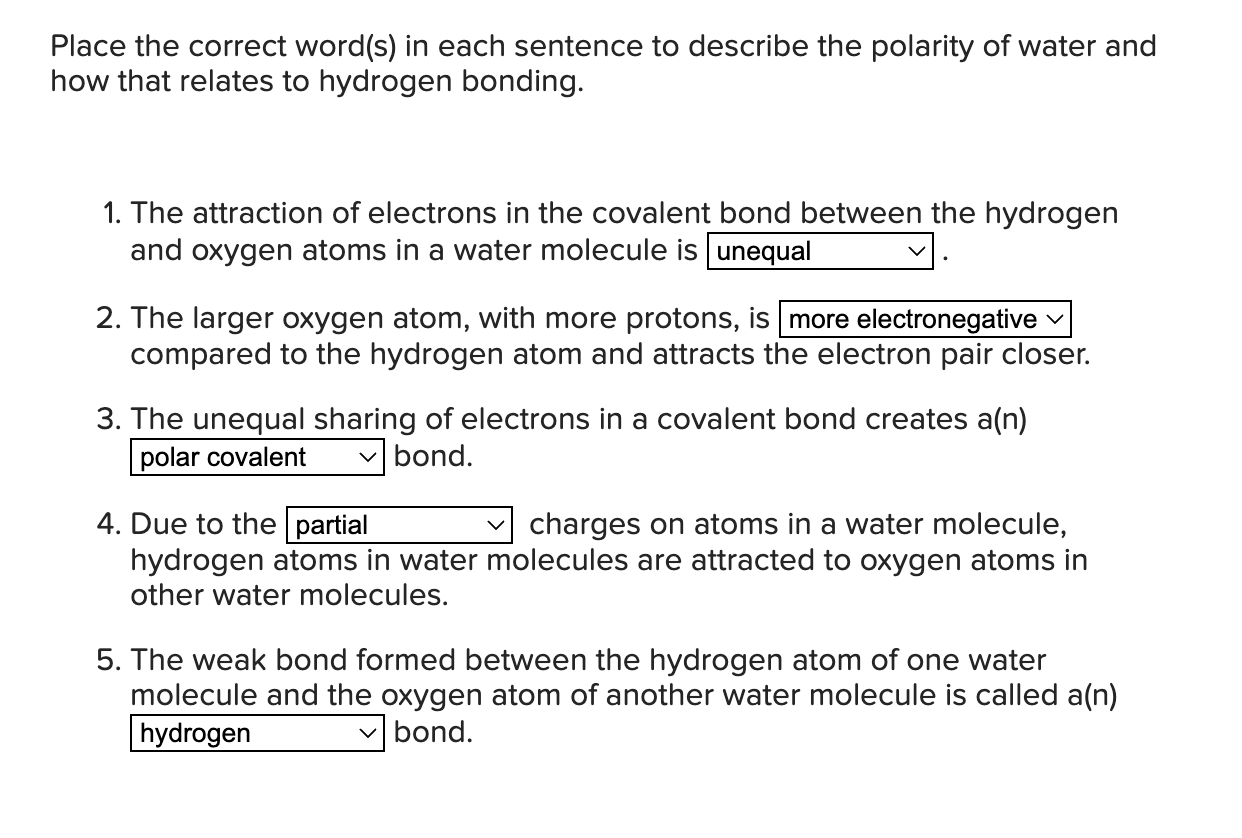
Question 18 : Polar molecules and hydrogen bonds
Question: Water and solutions
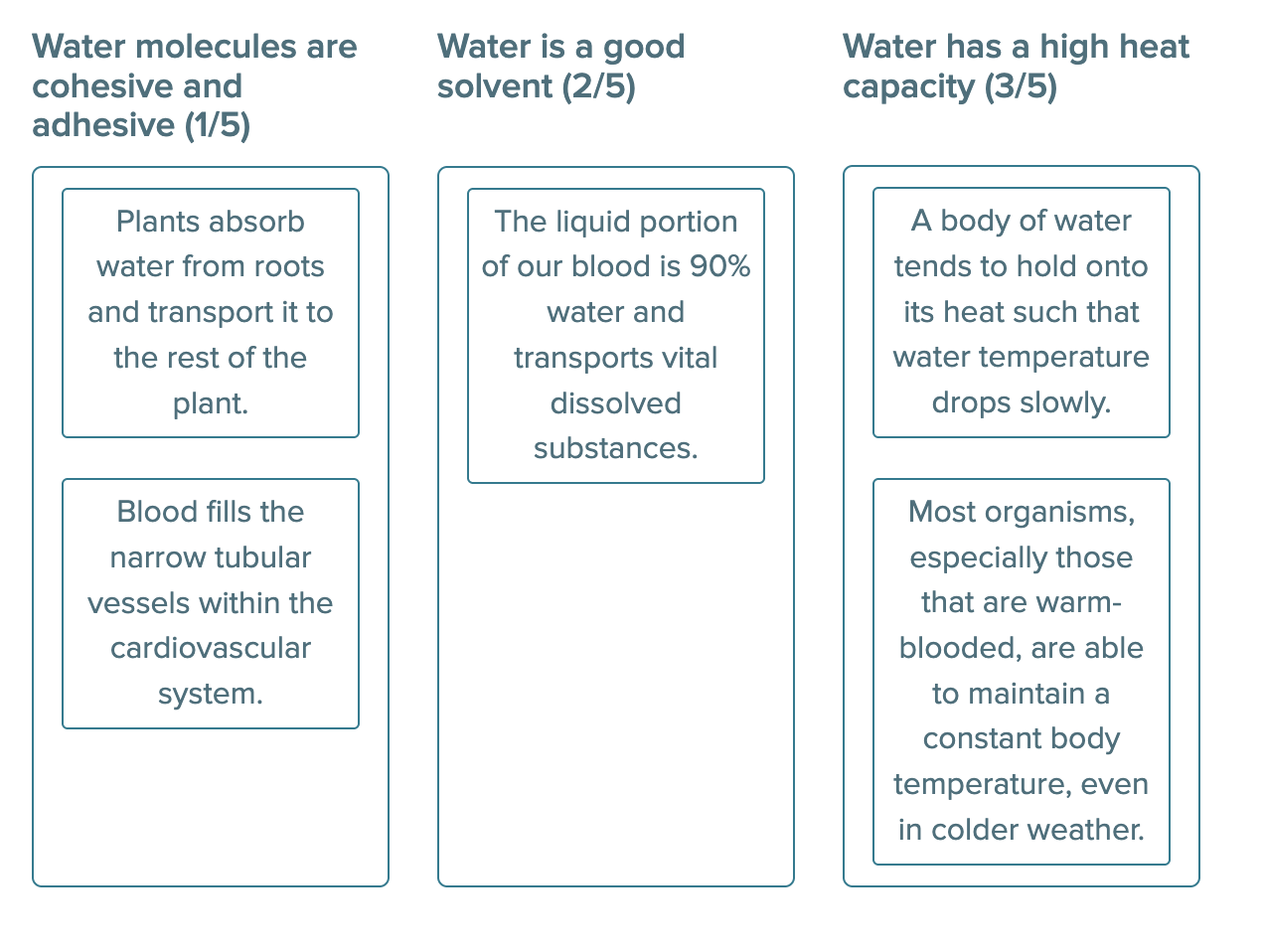
Question 20: Water properties
Classify each of the following scenarios based on which attribute of water is responsible
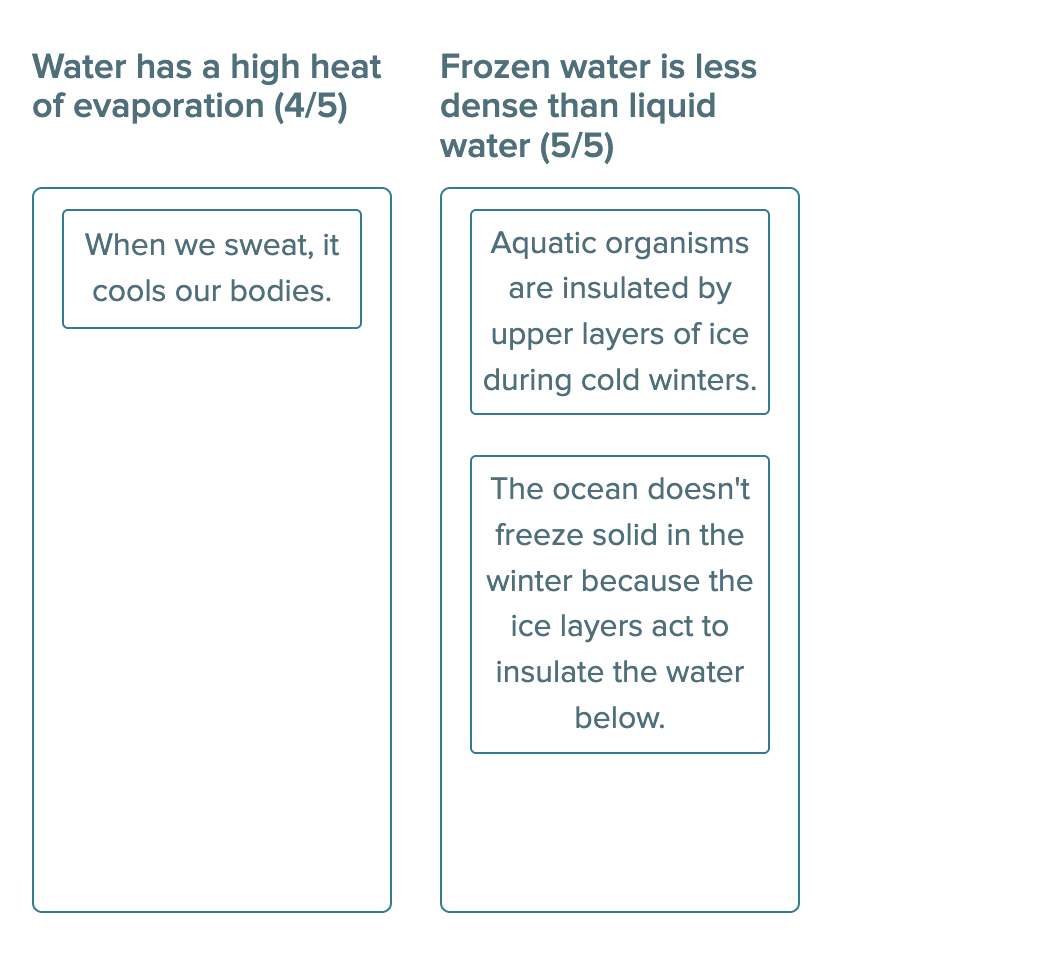
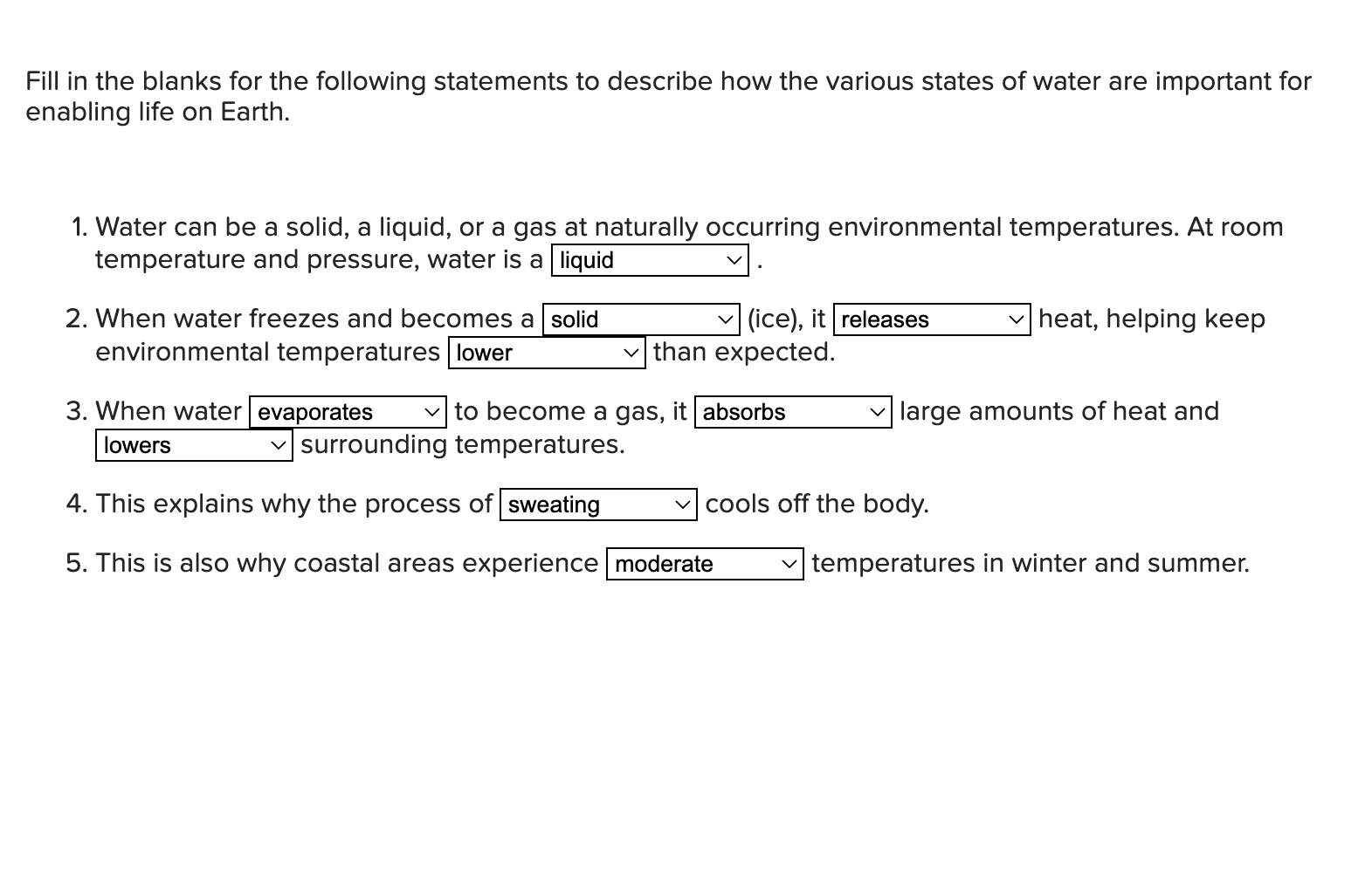
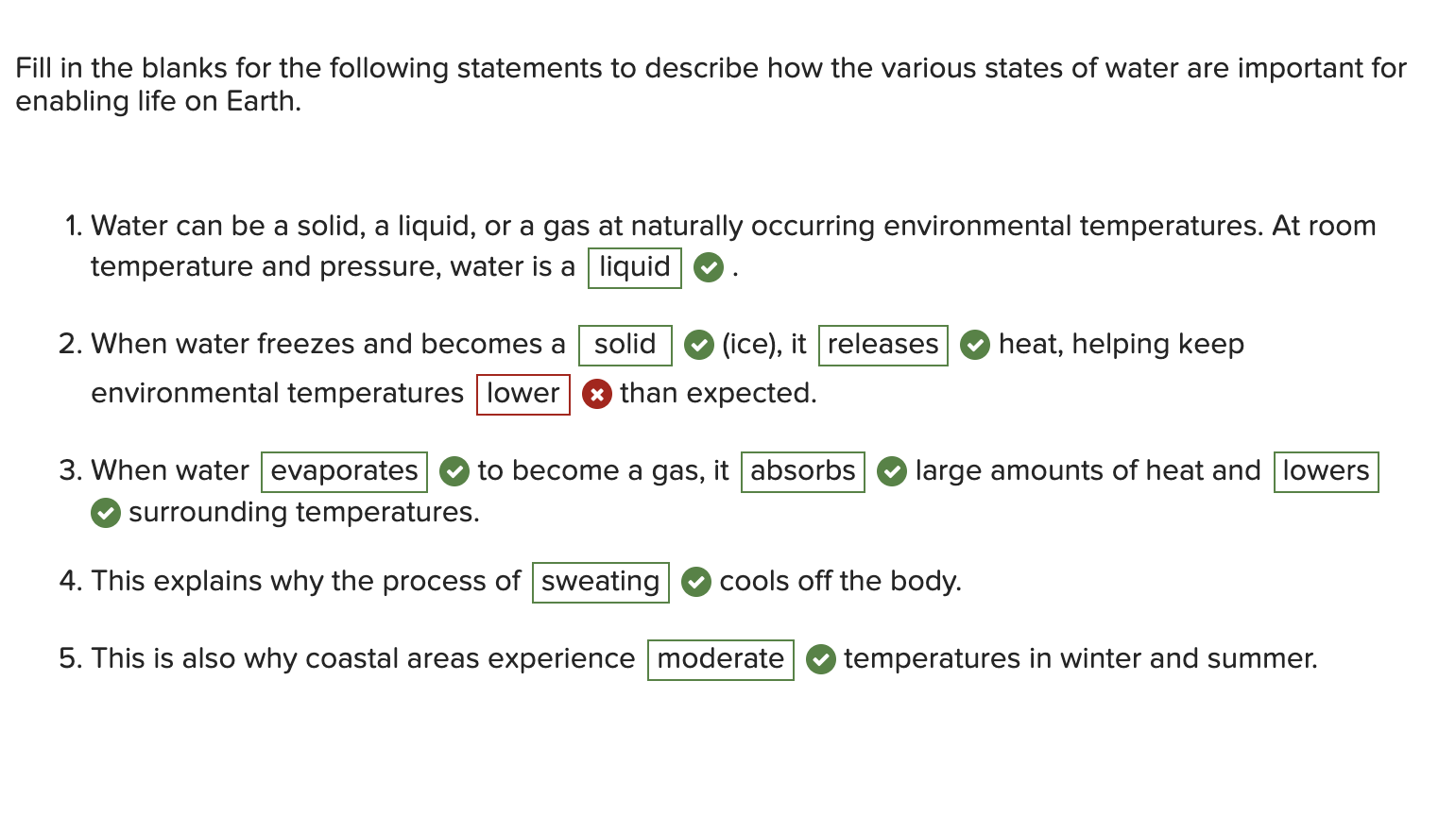
Question 21: The three states of water
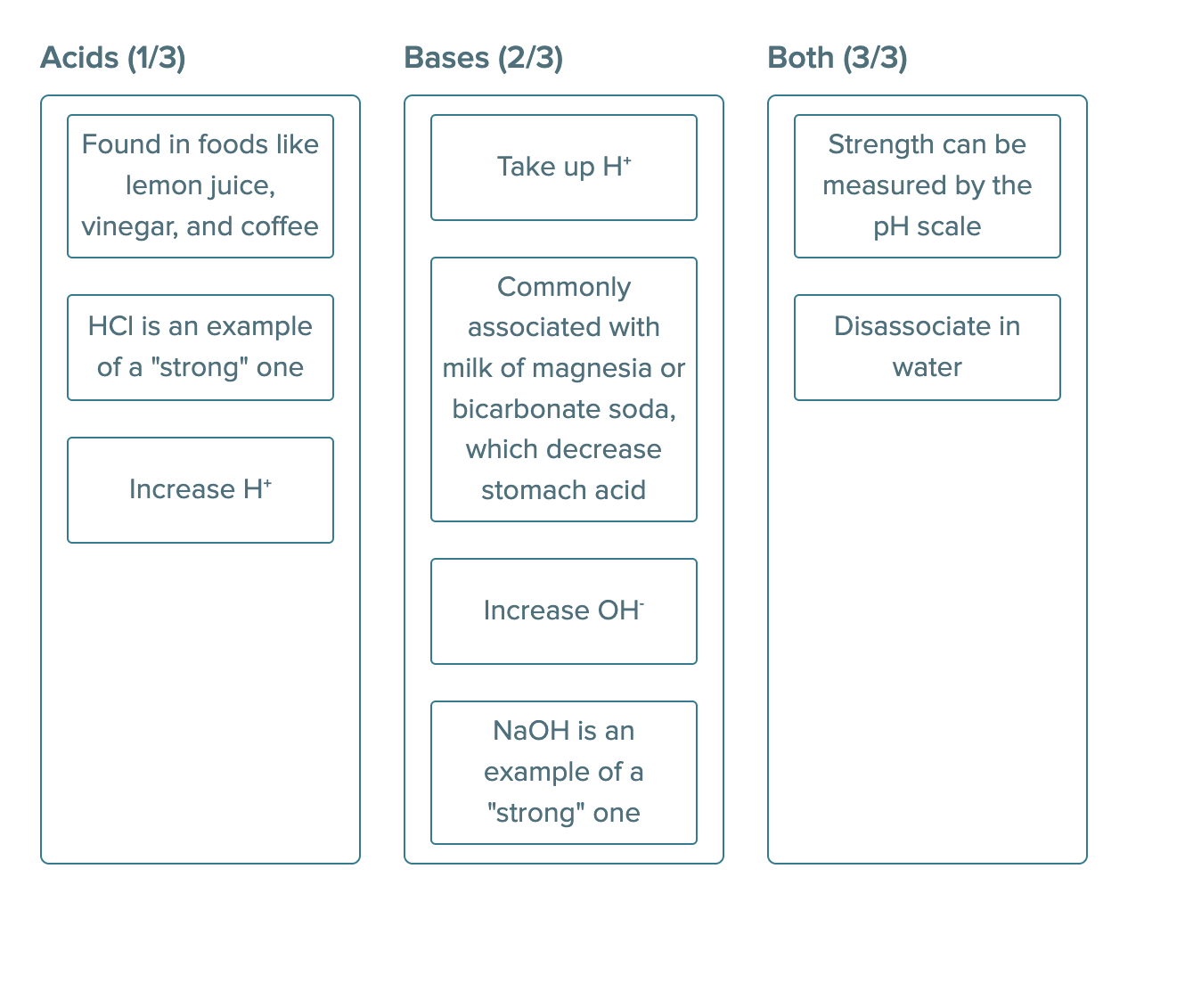
Question 22: Acids and bases
Classify the following as descriptive of either acids, bases, or both by dragging each of the characteristics into the appropriate box.
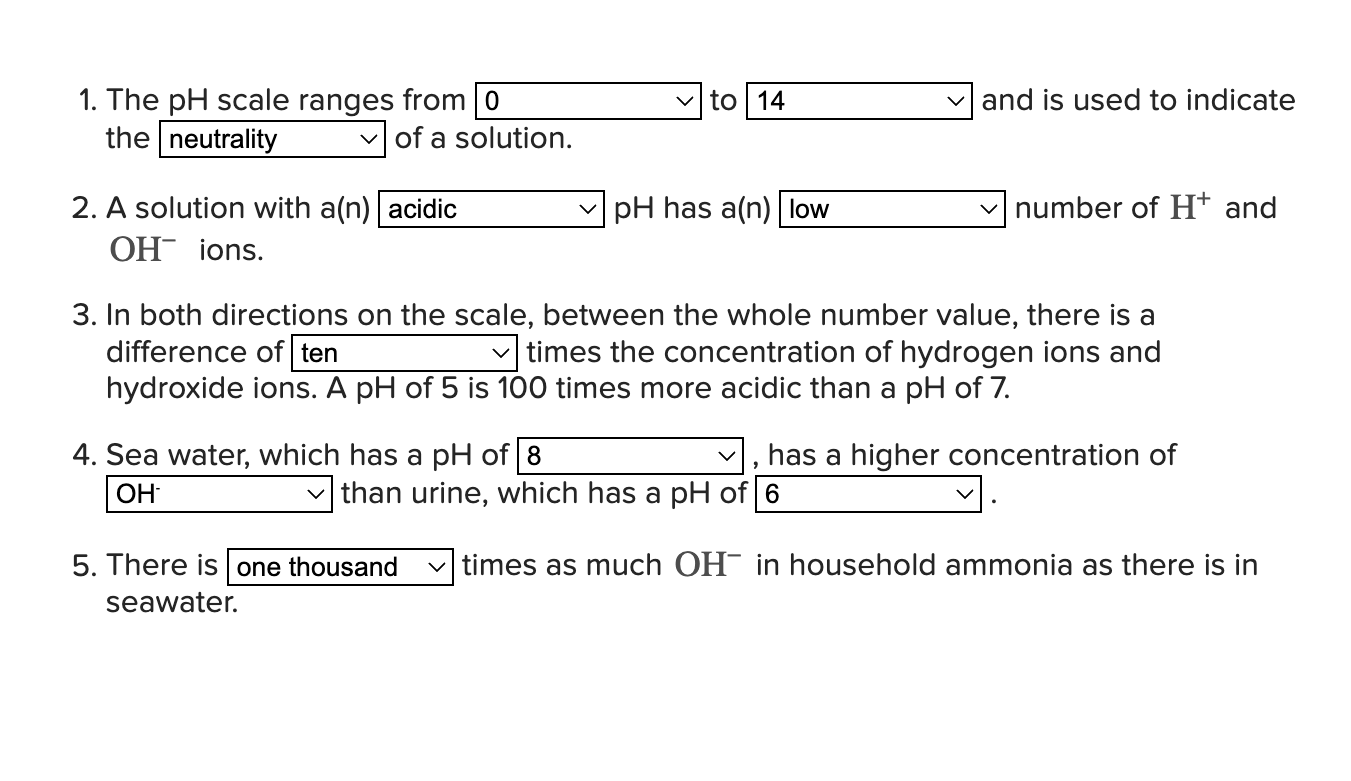
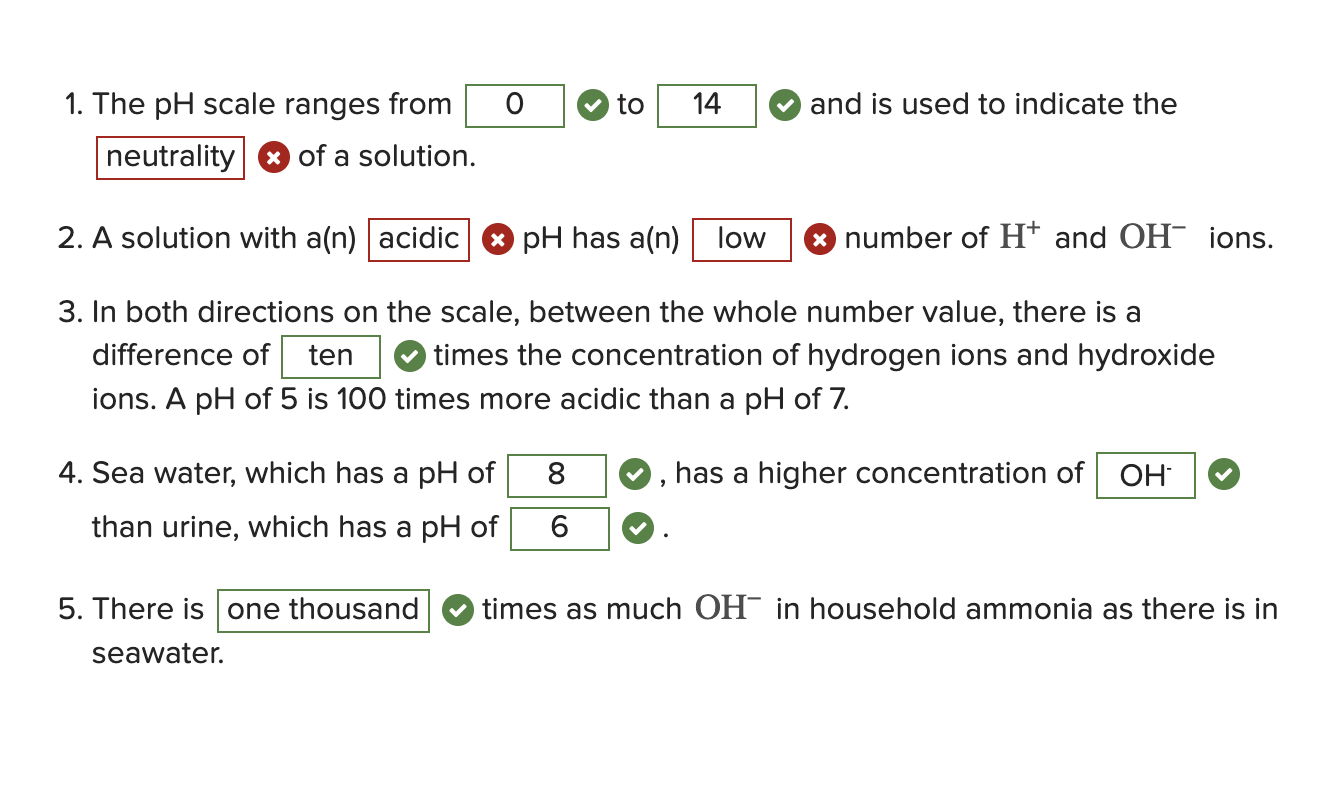
Question 23: The pH scale
Complete the following statements using the pH scale provided when necessary.
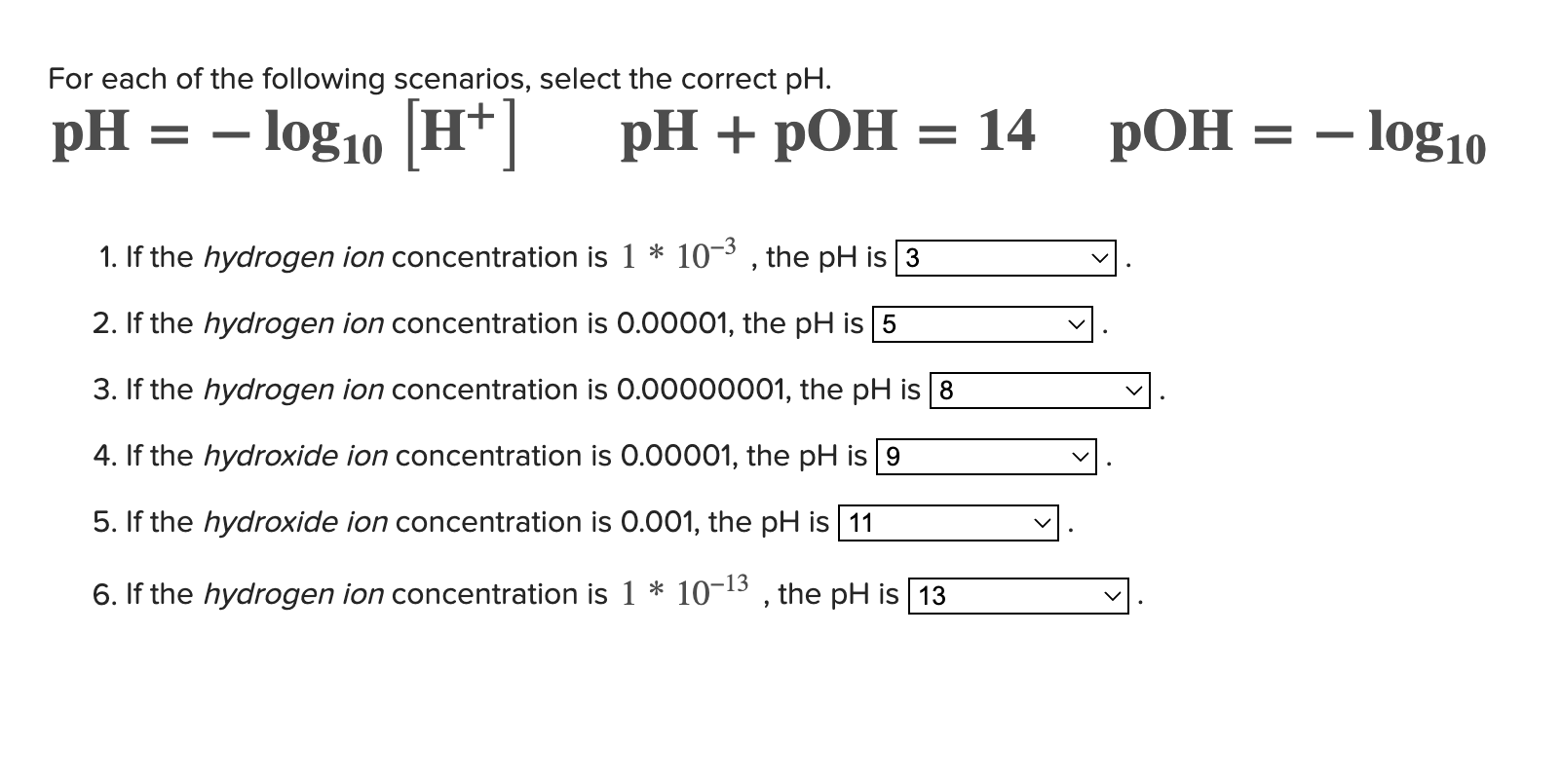
Question 24: Determining pH
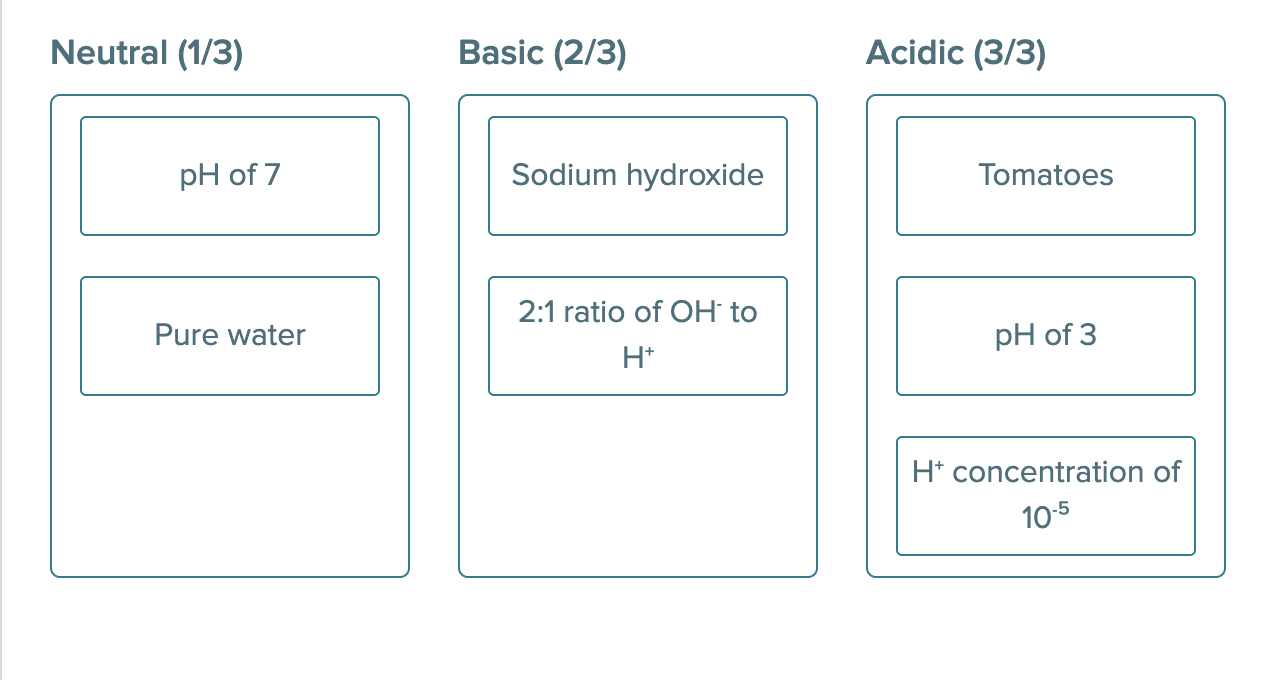
Question 25: Acidic, basic, or neutral
Classify each of the following as acidic, basic, or neutral.