Electrophoresis Overview
Introduction to Electrophoresis
Definition: Electrophoresis is a technique used to separate molecules based on their size and charge by applying an electrical field.
Origin: The term is derived from Greek, where "phoresis" means "to carry across".
Principles of Electrophoresis
Electrical Field: Migration of ions occurs from anode (+) to cathode (-).
Charges: Anions (negatively charged) move towards the anode; cations (positively charged) move towards the cathode.
Anions to anode, cations to cathode
Neutrals remain mostly stationary.
Medium: Electrophoresis is typically performed on gels (agarose or polyacrylamide) or paper.
Gels: Used for separating macromolecules like nucleic acids and proteins.
Separation Mechanism
Factors: Separation is based on three main parameters:
Size of the molecules
Charge of the molecules
Physical properties of the molecules (possession of ionizable groups that may gain a charge at a given pH)
Process: DNA separation involves applying electrical potential, causing molecules to migrate through the gel.
Electrodes: Activated electrodes at each end of the gel facilitate the movement of molecules.
Gel Types
Agarose Gel: Commonly used for DNA separation, composed of linear polysaccharides from red algae.
Can vary in concentration (typically 1% for most applications)
Concentrations:
1%: for MW of 500bp-10kb
1.2%: for MW 350-7kb
1.5%: 250bp-2kb
Up to 3% can be used (separating very tiny fragments)
Lower, down to 0.7% are very weak and breakable
Polyacrylamide Gel: Preferred for protein separation due to smaller pore sizes, better variety of pore sizes, and greater stability.
Concentration can range from 5% to 20% by weight.
Detergent denatures proteins and disrupts interactions, which can enhance separation by allowing better resolution of individual protein components.
Experimental Procedure of Gel Electrophoresis
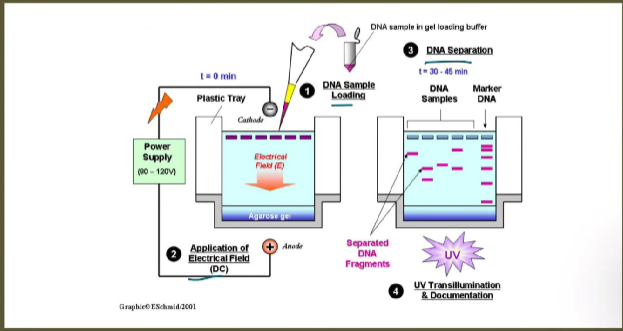
Sample Loading: DNA samples are loaded into wells of the gel.
Application of Electrical Field: DC current is applied.
DNA Separation: After 30 to 45 minutes, fragments separate according to size.
Detection: UV transillumination is used for visualization of bands, often labeled with fluorescent dyes.
Concept of Isolectric Focusing
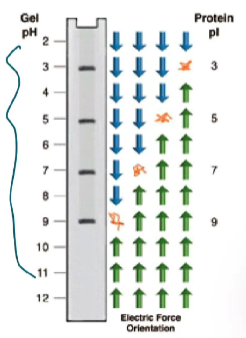
Charge: Proteins vary in charge based on pH, affecting their migration in an electric field. Proteins will migrate until they reach their isoelectric point (pI) where they have no net charge.
pH Gradient: A gradient of pH is established in the gel, allowing proteins to migrate until they reach their pI.
2D gel electrophoresis
Calculating Electrophoretic Mobility
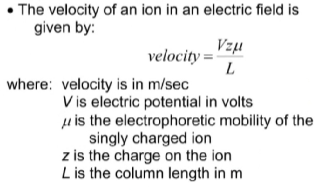
Velocity Equation: The velocity of migration can be determined using:
Factors Influencing Mobility: Several factors can influence electrophoretic mobility, including the size and shape of the protein, temperature, and the viscosity of the medium.
Differences in u (electrophoretic mobility) or z (charge) lead to a separation
Velocity of ions increase linearly with voltage
Normally you expect cations to migrate towards the cathode and vice versa, however in CE, cations, anions, and neutrals are all swept to one end of the capillary
Because of electrical force
Capillary Electrophoresis
Utilizes narrow capillaries filled with buffer solutions.
Glass or silica
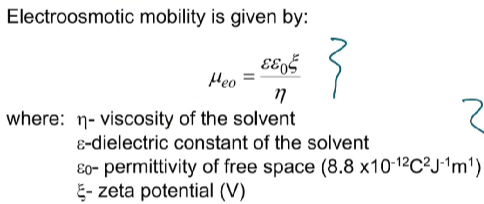
Silanol (Si-OH) groups are on capillary walls and amphiprotic (can accept or donate protons), which can lead to pH-dependent electroosmotic flow.
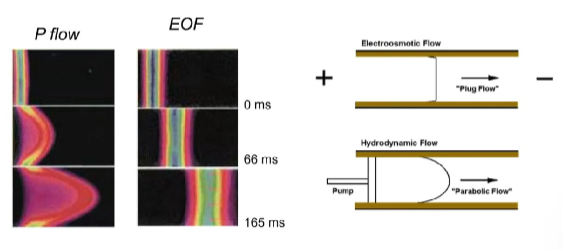
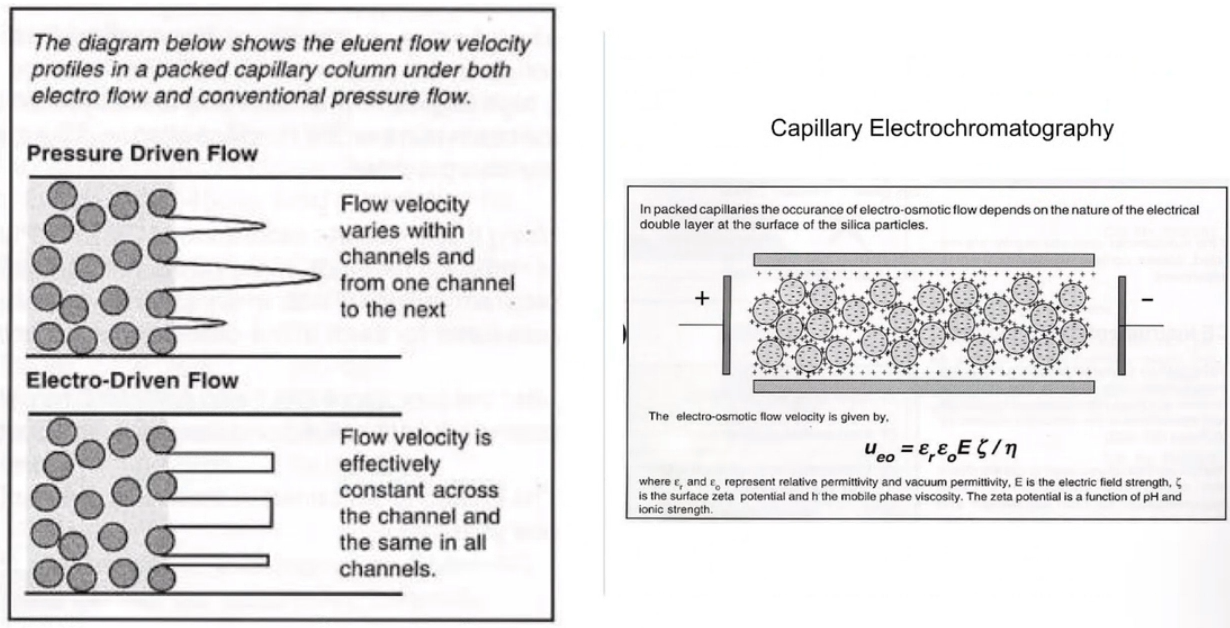
Electroosmotic Flow: The movement of liquid through a capillary under the influence of an applied electric field.
Very different from hydrodynamic flow profile (i.e., HPLC) because it is driven by the walls of the capillary
Current: Generally low (in microamps); buffers in millimolar range with pH levels from 4 to 10.
Increasing flow decreases resolution as it can lead to broader peaks and overlapping signals, ultimately affecting the separation efficiency of the analytes.
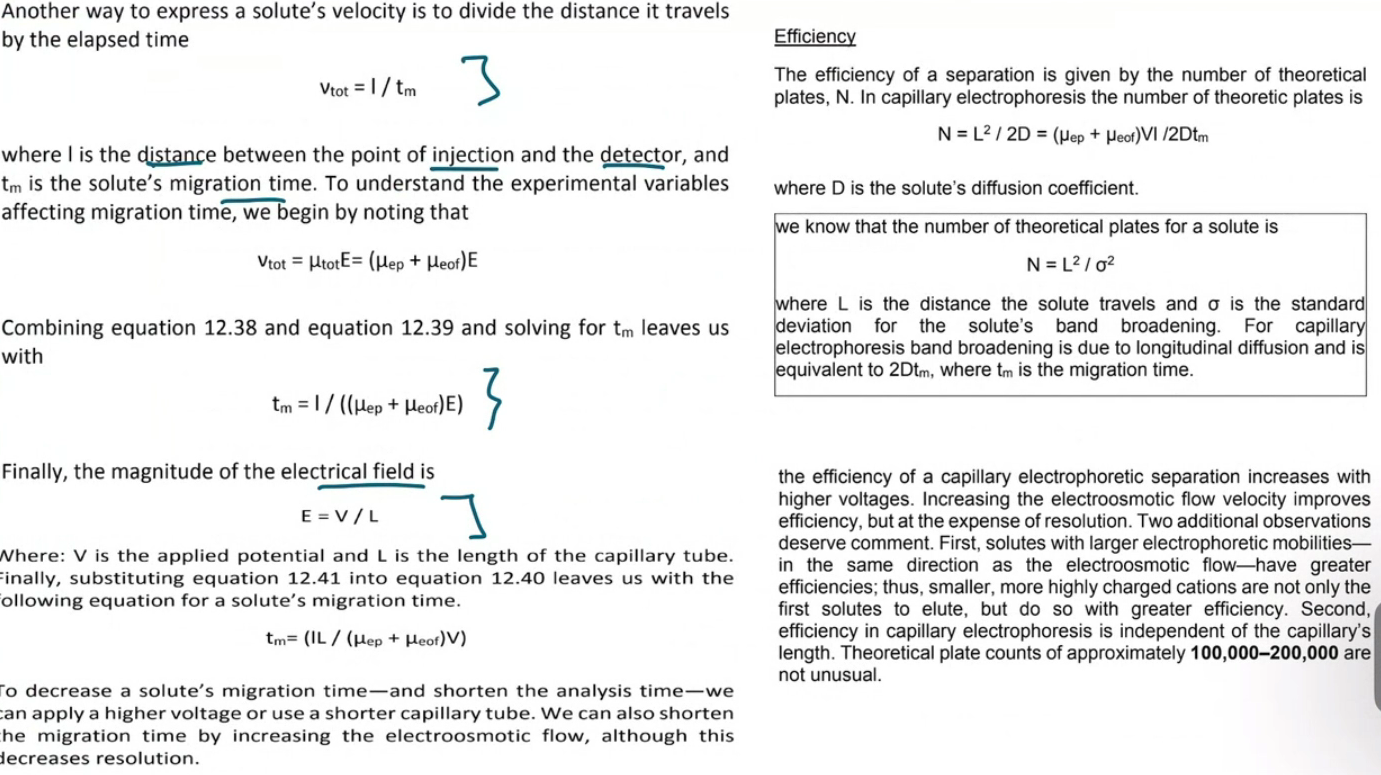
Efficiency is independent of capillary length,
As a result, theoretical plate counts are MASSIVE: 100,000-200,000
Detection Methods
Common Techniques:
UV-Vis detection
Laser-induced fluorescence (LIF)
Mass spectrometry (MS)
Detection is critical for analyzing separated components and their quantities.
How can neutrals be separated with CE?
This can be achieved by employing techniques such as micellar electrokinetic capillary chromatography (MECC), which utilizes surfactants to form micelles that interact differently with neutral analytes, allowing for their separation during capillary electrophoresis.
Common complexing agents include the borate ion, cyclodextrins, SDS, and other surfactants
Applications and Importance of Electrophoresis
Used in genetics for DNA analysis and sequencing,
Protein purification and analysis in biochemistry.
Micellar Electrokinetic Capillary Chromatography: Application of electrophoresis for non-ionic compound separation by complexing with charged ligands.
Microfluidics is a technology that deals with the manipulation of fluids at the microscale, typically in channels with dimensions ranging from tens to hundreds of micrometers. It offers several key advantages:
Precise Control: Ability to control fluid flow, mixing, and reaction conditions with high precision.
Reduced Sample and Reagent Volumes: Uses significantly smaller quantities of samples and reagents compared to traditional methods, which lowers costs and waste.
Integration: Facilitates the integration of multiple laboratory functions on a single chip, allowing for complex analyses and experiments to be conducted in a compact, automated format.
Real-time Analysis: Enables real-time monitoring and analysis of chemical reactions and biological processes, contributing to rapid data acquisition and feedback.
Applications of microfluidics span a wide range of fields, including:
Biomedicine: For point-of-care diagnostics, drug delivery systems, and personalized medicine.
Chemical Analysis: In chemical synthesis and analysis for more efficient reaction processes.
Environmental Monitoring: For detecting contaminants and analyzing environmental samples.
Cell Biology: In studies of cell interactions, cell sorting, and cell behavior under various conditions.
In microfluidic systems, various techniques, such as electrokinetic and pressure-driven flows, are employed to manipulate fluids. The design of microfluidic devices can utilize various materials, including polymers, glass, and silicon, each offering unique properties that can be exploited in specific applications.
Challenges in Electrophoresis
Joule Heating: Heat generated due to electrical current flow can alter viscosity and affect separation efficiency.
Efficiency Considerations: Aim for high efficiency while maintaining resolution. Increasing voltage can decrease analysis time but may affect resolution.
Conclusion and Exam Preparation
Prepare for discussions about applications of electrophoresis in your upcoming presentations and exams. Review textbooks and notes for thorough preparation. Seek clarifications on any misunderstood topics.
Final thoughts: Electrophoresis encompasses vital techniques in biochemical analysis and maintains relevance in various scientific fields. Keep reviewing core principles and methodologies.