Chapter 6 - Separation Methods and Minima (PANS ATM Doc 4444, AIP, India)
Page 1: General Provisions for Separation
Purpose: Procedures and minima for separating aircraft during en-route, arrival, and departure phases.
Vertical or Horizontal Separation Required:
Between all flights in Class A and B airspaces.
Between IFR flights in Class C, D, and E airspaces.
Between IFR and VFR flights in Class C airspace.
Between IFR and special VFR flights.
Between special VFR flights when specified by ATS authority.
Exception: In Class D and E airspaces during daylight, IFR flights can maintain own separation in VMC if cleared.
Composite Separation:
Combination of vertical and horizontal separation, with minima lower but not less than half of individual standards
Is applied via regional air nav. agreements.
Exam Tip: Memorize the airspace classes (A, B, C, D, E) where separation is mandatory and the VMC exception for D and E.
Page 2: Vertical Separation
Vertical Separation Minima:
Below FL290: 1000 feet.
At or above FL290: 2000 feet (except 1000 feet if both aircraft are RVSM compliant in designated RVSM airspace).
Cruise Climb: Cruise climb is a fuel-efficient technique where an aircraft gradually increases altitude as it burns fuel and becomes lighter, instead of maintaining a fixed altitude.
Not permitted in Indian FIRs.
Climb/Descent Rules:
Aircraft can be cleared to a level after another aircraft reports vacating it, except:
Severe turbulence exists.
Aircraft are in the same holding pattern. (it means they are following the same designated racetrack-shaped flight path while waiting for clearance to proceed.)
Aircraft performance degrades risking reduction of separation below minima.
Pilots in direct communication can agree to maintain specified vertical separation during climb/descent.
VMC Climb/Descent in Class D/E:
Allowed below 10,000 feet during daylight if pilots agree to maintain own separation and stay in VMC.
Clearances shall be provided for the specified portion of the flight at or below 10,000ft during climb and descent.
ATC must provide essential traffic info
Alternative instructions for a IFR flight shall be provided if VMC becomes impracticable.
Exam Tip: Focus on 1000 ft vs. 2000 ft minima, RVSM exception, and VMC conditions for Class D/E.
Page 3: Horizontal Separation (Lateral)
Types of Horizontal Separation:
Lateral separation. - aircrafts are kept apart based on geographical location or specific navigation aids, ensuring they follow distinct paths.
Longitudinal separation. - aircraft are kept apart based on relative position along the same flight path. It is determined using time or distance intervals.
Separation minima based on ATS surveillance systems-aircraft are kept separated - Using RADAR, ADS-B etc.
Lateral Separation Methods: Laternal seperation can be confirmed by below :
Geographic Locations: Separation confirmed by position reports over different locations (visually or via nav aids).
by uwing VOR, NDB, GNSS on intersecting tracks or ATS Route):
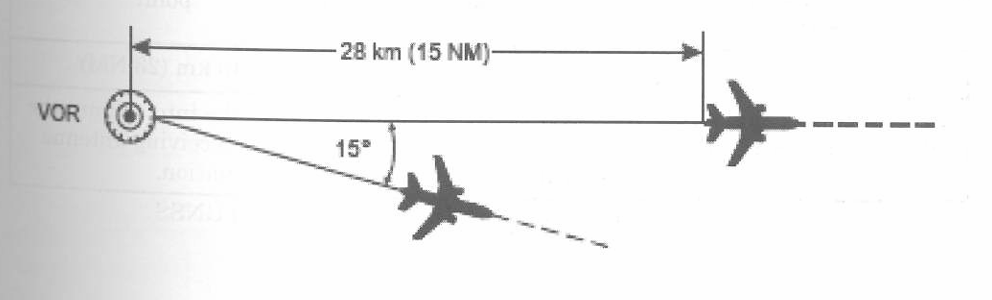
VOR: Both aircraft on radials diverging by ≥15° and at least \one of the aircraft is ≥15 NM from the facility.
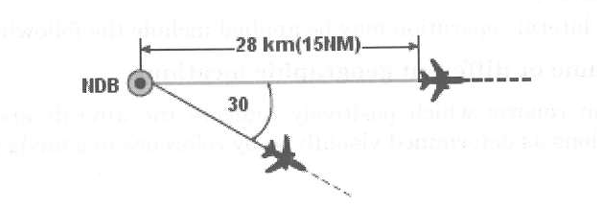
NDB: Both aircraft on tracks diverging by ≥30° and one is ≥15 NM from the facility at least 20° from the radical of first aircraft.
GNSS/GNSS (Global Navigation Satellite Syystem) : Both aircraft on tracks with zero offset, one at least at specified distance from a common point (see table).
VOR/GNSS: VOR aircraft on radial, GNSS aircraft on track with zero offset, one at specified distance from a common point.
Table (Lateral Separation Distances):
Angular difference 15°–135°:
FL010–FL190: 15 NM.
FL200–FL600: 23 NM.
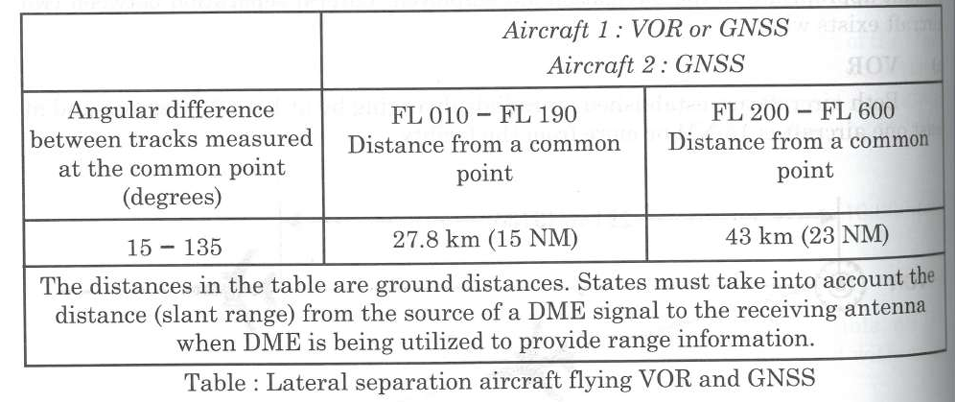
before applying GNSS-Based Track Separation, controller should :
Confirm aircraft is navigating using GNSS
no lateral offset is applied.
Not used if pilot reports Receiver Autonomous Integrity Monitoring (RAIM) outages.
by using diff navigation aids or methods : Ensuring that derived protected airspaces for nav aids or RNP (Required Nav Performance) do not overlap.
Page 5: Horizontal Separation (Longitudinal - Dist Based)
Longitudinal Separation:
Ensures spacing between estimated aircraft positions is never less than the prescribed minimum.
Track Definitions:
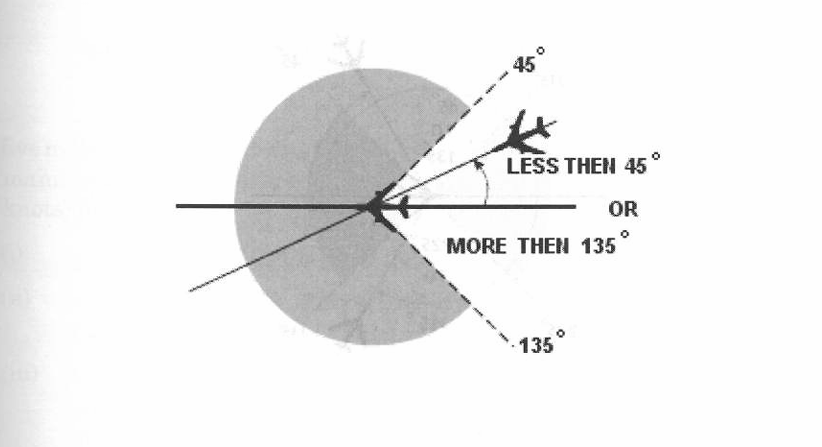
Same Track: When angular difference is less than <45° or >315°, protection areas overlap, and is called to be on the same track.
Reciprocal Tracks: Tracks with 135°–225° difference, protection areas overlap.
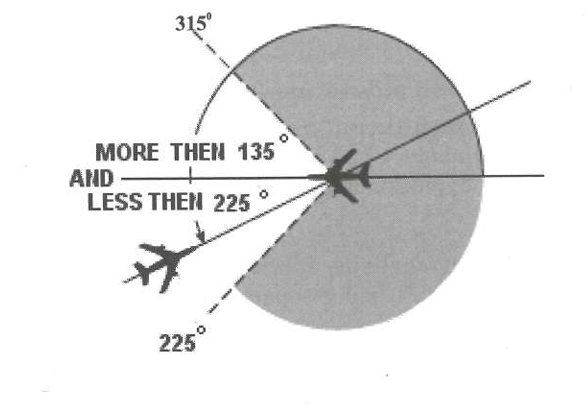
Crossing Tracks: Tracks not fitting same or reciprocal definitions.
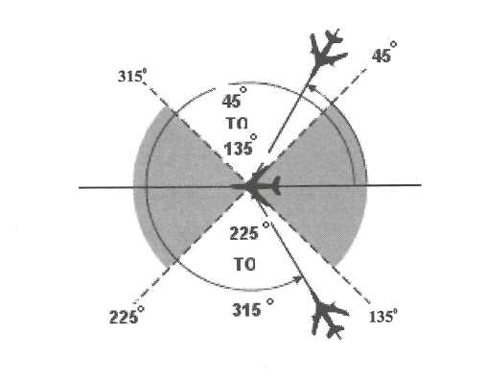
Exam Tip: Memorize track definitions (angles for same, reciprocal, crossing) and GNSS conditions.
Page 6: Track Definitions (Continued)
Track Definitions (Restated):
Same Track: <45° or >315°, overlapping protection areas.
Reciprocal Tracks: 135°–225°, overlapping protection areas.
Crossing Tracks: All other intersecting tracks.
Exam Tip: Reinforce track angle definitions for quick recall in questions.
Page 7: Longitudinal Separation (Time-Based)
Cross-Check:
Separation requirement shall be cross checked to ensure integrity of calculations.
Cross check is to validate the initial calculations and confirm that the calculations are consistent with the traffic disposition.
Aircraft at Same Cruising Level (Same Track):
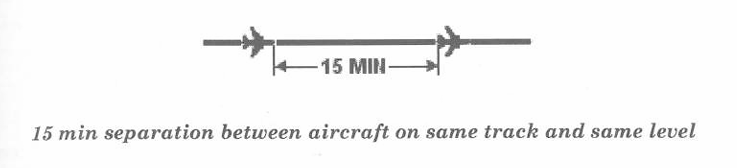
15 minutes (default).
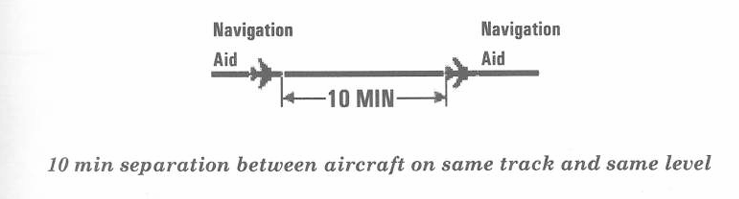
10 minutes if navigation aids allow frequent position/speed checks.
5 minutes if:
Preceding aircraft has a true airspeed ≥20 knots (37kmph) faster.
Both departed same aerodrome, reported over same point, or departing aircraft joins route with 5-min separation assured.
3 minutes if preceding aircraft is ≥40 knots (74kmph) faster (same conditions as 5-min rule).
Exam Tip: Memorize time-based minima (15, 10, 5, 3 minutes) and speed differences (20 kt, 40 kt).
Aircraft at Same Level (Crossing Tracks):
15 minutes (default).
10 minutes if navigation aids allow frequent position/speed checks.
Diagram Notes:
5-min separation: Preceding aircraft ≥20 knots faster.
3-min separation: Preceding aircraft ≥40 knots faster.
Exam Tip: Focus on crossing track minima (15, 10 minutes) and link speed differences to same track rules.
Page 9: Longitudinal Separation (Climbing/Descending)
Climbing/Descending on Same Track:
15 minutes while vertical separation does not exist.
10 minutes if navigation aids allow frequent position/speed checks.
5 minutes if level change starts within 10 minutes of second aircraft reporting over a common point.
Exam Tip: Memorize the 15, 10, 5-minute rules for climbing/descending and the 10-minute condition for common point.
Page 10: Longitudinal Separation (Climbing/Descending, Continued)
Crossing Tracks (Climbing/Descending):
15 minutes while vertical separation does not exist.
10 minutes if navigation aids or GNSS allow frequent position/speed checks.
5 minutes if:
Level change starts within 10 minutes of second aircraft reporting over a common point (via nav aids/GNSS).
Clearance via CPDLC includes a 10-minute restriction.
Exam Tip: Reinforce the 5-minute rule conditions (10-minute start, common point).
Page 11: Longitudinal Separation (Descending/Crossing Tracks)
Descending on Crossing Tracks:
15 minutes (default).
10 minutes with navigation aids for frequent position/speed checks.
Exam Tip: Focus on consistency of 15, 10-minute rules across climbing/descending scenarios.
Page 12: Longitudinal Separation (Distance-Based, DME/GNSS)
Distance-Based Separation:
Uses DME or GNSS, with direct controller-pilot VHF communication.
Both aircraft must reference the same DME station or collocated waypoint.
Same Track (Same Level):
20 NM (default).
10 NM if leading aircraft is ≥20 knots faster, with frequent DME/GNSS checks.
Reciprocal Tracks:
Aircraft can climb/descend through levels if confirmed ≥10 NM apart after passing.
Exam Tip: Memorize 20 NM and 10 NM rules, and the 10 NM reciprocal track condition.
Page 13: Longitudinal Separation (Distance-Based, Crossing Tracks)
Crossing Tracks (Same Level):
20 NM if tracks cross at <90° and aircraft report distances from same point, with frequent checks.
10 NM if leading aircraft is ≥20 knots faster, with same conditions.
Exam Tip: Link crossing track distances (20 NM, 10 NM) to same track rules and note the <90° angle requirement.
Page 14: Longitudinal Separation (Climbing/Descending, Distance-Based)
Same Track (Climbing/Descending):
10 NM while vertical separation does not exist, with:
Same DME station or collocated waypoint used.
One aircraft maintains level.
Frequent DME/GNSS checks.
Exam Tip: Focus on 10 NM rule for climbing/descending and the level maintenance condition.
Page 15: Separation Using ATS Surveillance Systems
Minima:
5 NM within 60 NM of radar head or ADS-B station (non-radar).
10 NM beyond 60 NM of radar head or ADS-B station.
3 NM where specifically authorized (radar head).
Reciprocal Tracks:
10 NM after aircraft have passed each other (DME/GNSS).
Exam Tip: Memorize 5 NM, 10 NM, and 3 NM surveillance-based minima and distances from radar/ADS-B.
Page 16: Summary of Longitudinal Separation
Time-Based:
15 min: Same level or climbing/descending (same/crossing tracks, no frequent nav aid checks).
10 min: Same level or climbing/descending (same/crossing tracks, with nav aids).
5 min: Same level (20 kt faster, common reference) or climbing/descending (level change within 10 min of common point).
3 min: Same level (40 kt faster, common reference).
Distance-Based (DME/GNSS):
20 NM: Same level (same/crossing tracks).
10 NM: Same level (20 kt faster), climbing/descending (same track), or reciprocal tracks.
Exam Tip: Use this page as a quick reference for all longitudinal separation minima.
Page 17: Mach Number and Performance-Based Navigation
Mach Number Technique:
10 minutes or differential Mach number minima on ATS routes.
80 NM RNAV distance-based separation (same-direction tracks) instead of 10 minutes.
Required Navigation Performance (RNP):
RNP types for en-route: 1, 4, 10, 12.6, 20.
Performance-Based Navigation (PBN):
Navigation specs match airspace communication/navigation/ATS requirements.
Required Communication Performance (RCP):
Transaction time (seconds) for instruction and acknowledgment (e.g., RCP 10, 60, 120, 240, 400).
Required Surveillance Performance (RSP):
Time (seconds) for surveillance data delivery (e.g., RSP 180, 240, 400).
Exam Tip: Understand Mach number (10 min/80 NM), RNP types, and RCP/RSP definitions.
Page 18: Performance-Based Separation and FMS/RNAV
Performance-Based Longitudinal Separation:
Same or crossing tracks (<90°):
50 NM: RNP 10 (RCP 240, RSP 180, 27 min ADS-C).
50 NM: RNP 4 (RCP 240, RSP 180, 32 min ADS-C).
30 NM: RNP 2/4 (RCP 240, RSP 180, 12 min ADS-C).
5 min: RNP 2/4/10 (RCP 240, RSP 180, 14 min ADS-C).
FMS/RNAV in Conventional Procedures:
Allowed if AFM permits, with monitoring using basic display and raw data tolerances.
Essential Traffic:
Controlled traffic requiring separation but not separated by minima; info must be provided to affected flights.
Exam Tip: Memorize the table for performance-based minima and FMS/RNAV conditions.
Pages 19–23: Questions
Key Question Topics:
Vertical separation (e.g., turbulence, FL290 rules).
Longitudinal separation (time/distance, speed differences).
Lateral separation (VOR, NDB, GNSS angles and distances).
Essential traffic, VMC clearances, ATS surveillance, and performance-based navigation.
Exam Tip: Practice questions to reinforce minima (e.g., 1000 ft/2000 ft, 15/10/5/3 min, 20/10 NM) and specific conditions (e.g., RAIM outages, AFM for FMS).
Page 24: Answers
Key Answers for Memorization:
Q1: C (turbulence → wait until FL130).
Q2: A (5 min, 20 kt faster).
Q3: B (3 min, 40 kt faster).
Q4: C (5 min, 20 kt faster, nav aids).
Q5: A (10 min, nav aids).
Q6: C (3 min, 40 kt faster).
Q7: B (20 NM, DME).
Q8: B (15 min, level crossing).
Q10: B (2000 ft above FL290).
Q11: A (30° NDB, 15 NM).
Exam Tip: Use answers to cross-check understanding of separation minima and rules.