Reflection of Light from Spherical Mirrors
Concave and Convex Mirrors
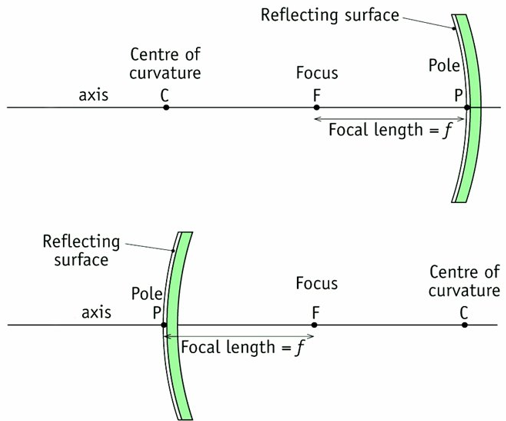
The reflecting surface of a concave mirror caves in at the centre.
The reflecting surface of a convex mirror bulges out at the centre.
Describing Concave and Convex Mirrors
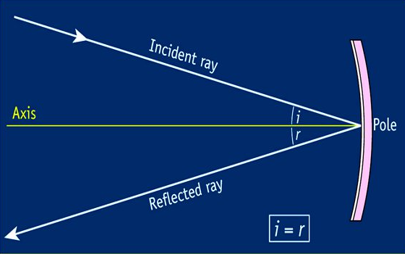
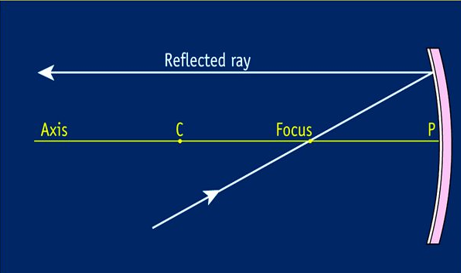
1. When a ray strikes the pole of a concave
mirror it is reflected at an equal angle with the axis.
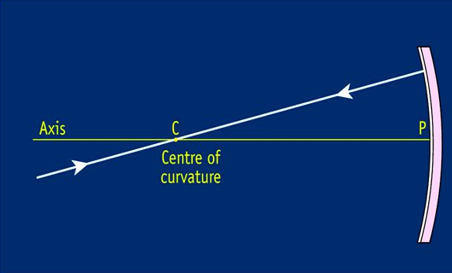
2. When a ray passes through the centre of curvature
of a concave mirror it is reflected back along its on path.
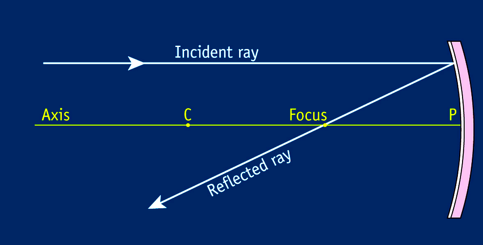
3. When a ray comes parallel to the axis and strikes
a concave mirror it passes through the focus after reflection.
4. When a ray passes through the focus and strikes
a concave mirror it is relfected out parallel to the axis.
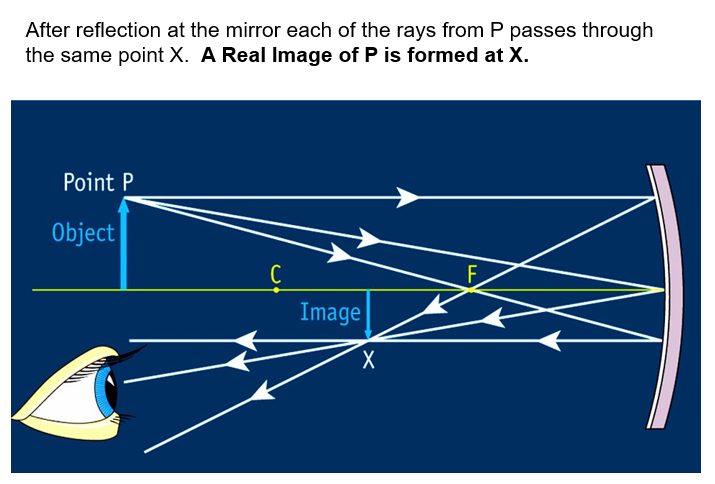
Real Image
An image formed by the actual intersection of rays.
A real image can be formed on a screen.
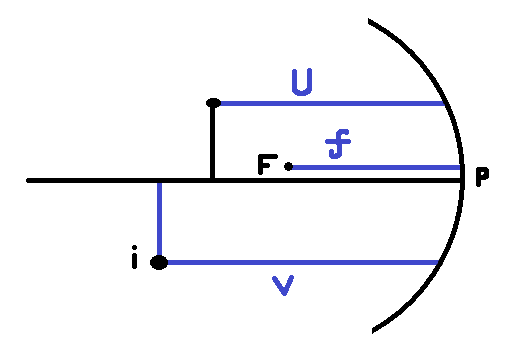
u = object distance to mirror
v = image distance to the mirror
f = focal length
Uses of a Concave Mirror
Dentist’s Mirror
Floodlights
Projector
Torch
Solar Furnace
Cosmetics Mirror
Formulae for Concave Mirrors
Real Image
Formula for real images
Virtual Image
Formula for virtual images
Magnification
Formula for magnification
Focal Length from Radius
Formula to find focal length from radius
Qualities of Images Formed by a Concave Mirror
Outside Focus:
Image = Real, Magnified, Upside Down
On Focus:
Image = Formed at infinity
Inside Focus:
Image = Virtual, Magnified, Upright
Outside Centre of Curvature:
Image = Real, Diminshed, Upside Down
Convex Mirrors
In a convex mirror, the image is always virtual.
Formulae for Convex Mirrors
Virtual Image
Formula for virtual images in a Convex mirror
Magnification
Formula for magnification
Focal Length from Radius
Formula to find focal length from radius
Rules for Convex Mirrors
Rule 1
Ray that strikes the pole is reflected at an equal angle with the axis.
Rule 2
Ray that is heading for the centre of curvature is reflected along back its own path.
Rule 3
If a ray is parallel to the axis then it reflects as if it came from the focus behind the mirror.
Rule 4
A ray that is heading for the focus and strikes the mirror is reflected out parallel to the axis.