Population Genetics 🌾
Natural selection impacts an allele’s frequency during evolution. An allele’s frequency determines an allele’s presence within a given population.
Many random occurrences modify an allele’s frequency.
Mutations
Generation of new allele combinations, usually in asexually reproductive organisms. Overall this encourages diversity. Mutations contribute to diversifying new phenotypes.
Advantageous Mutations: beneficial alleles issued by mutations are more likely to appear in later generations, increasing that allele’s frequency (Chosen by natural selection).
Disadvantageous Mutations: non-beneficial alleles that alter survival and reproduction are unlikely to be available in other generations, decreasing these alleles’ frequency (Not chosen by natural selection).
Mutations are rare but steady, factors like radiation, chemical composition and infections stimulate mutations.
Genetic Drift
Non-selective randomized inheritance of certain alleles. Genetic drift decreases an allele’s frequency. Smaller populations are more susceptible to genetic drift because of its proportional impact regarding the population’s size.
Bottleneck Effect

Happens when a population reduces drastically due to natural disasters, the remaining survivors tend to share very similar alleles and as they reproduce, they’re likely to form almost identical offspring which lowers genetic variation. Populations that had undergone a bottleneck effect are more vulnerable to genetic disorders.

— Example: northern elephant seals were hunted to near extinction, where about 20-30 individuals survived. As of now, they had rebounded to approximately 30,000 individuals.
Founder Effect
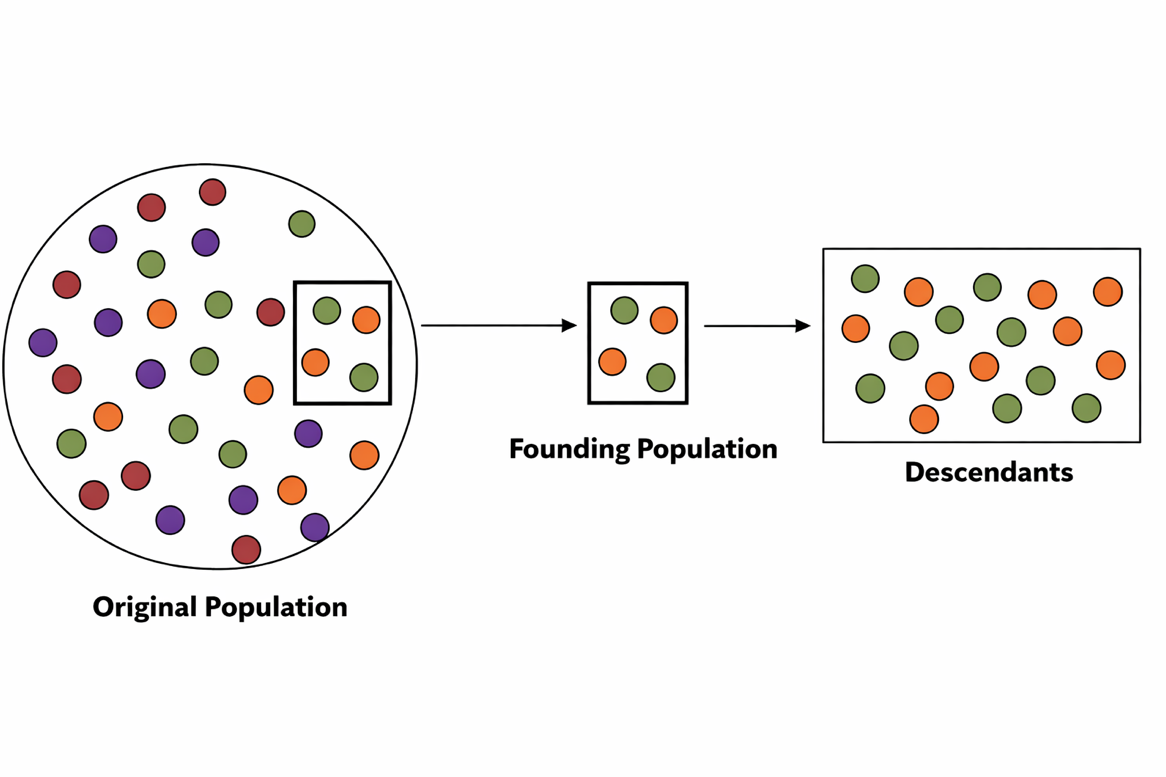
When a group unintentionally separates from a population by chance into a different territory enabling the minority’s allele to increase in frequency..
— Example: a small number of birds carrying a rare allele colonize an island, resulting in the establishment of a new, isolated population. In this founding population, the frequency of the allele becomes significantly higher than in the original mainland population, where it was previously uncommon.
Migration and Gene Flow
Alleles migrate to other populations via individuals or gametes. Generally, migration preserves diversity and prohibits genetic differences, keeping populations of similar species connected.
Migration and gene flow depends on:
Geographic distance between populations
Physical barriers (e.g., mountains, rivers and oceans)
Behavior (e.g., mating preferences, territorial activities)
Differences in breeding times (seasonal)
Migration and Gene Flow Through Individuals
A group of individuals intentionally secede from the primary population to an other population, where they reproduce and expand.

— Example: some butterflies from a mainland population heads to a nearby island where a preexisting population settles and successfully reproduces there.
Migration and Gene Flow Through Gametes
When a gamete moves from a population to reach another.

— Example: a pollen is carried by a pollinator (bee) to mate with a flower originating from a different population.