Period 3: 1754-1800
 3.2 The Seven Years’ War
Late 17th century: wars broke out involving Great Britain, France, & Spain
Stakes for control of colonies & their trading
North America had sugar-producing islands in the Caribbean & fur-trading w/ American Indians
The Decisive Conflict
Great Britain & France recognized the value of the colonies for their raw materials
British colonies more densely populated — fueled British industry by producing fish, grain, & tobacco
French and Indian War
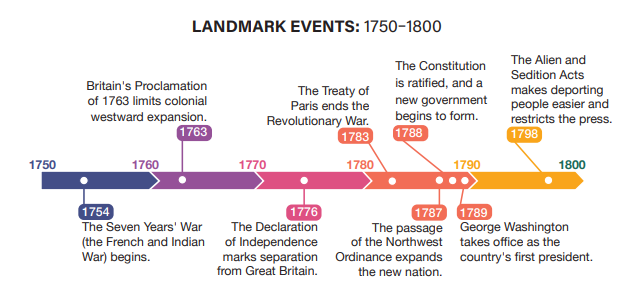
1754-1763
British POV: France provoked by building a chain of forts on the Ohio River Valley
Governor of Virginia sent G. Washington w/ troops to stop France from building a fort, but this force ultimately surrendered to Frenchmen
War initially went poorly for GB
Albany Plan of Union: created by Ben Franklin to organize an intercolonial government - including a system to collect taxes & recruit troops → never took effect
British prime minister focused on conquering Canada
British victories → Peace of Paris (1763): GB acquired Spanish FL & French Canada
France ceded the Louisiana Territory to Spain
Britain’s unchallenged supremacy in North America & challenged autonomy of Native Americans
British view: colonists were unable and unwilling to defend the new frontiers
Colonial view: unimpressed w/ British leadership & confident in their own troops
Reorganization of the British Empire
Salutary neglect was abandoned → Britain adopted more forceful policies in the colonies
Costly wars + British troops in NA = more taxes for Americans
Pontiac’s Rebellion: attack against colonial settlements on the W. frontier
French had respected traditions & provided them with guns; Britain didn’t
Alliance of American Indians in Ohio River Valley destroyed forts & settlements
British troops put down the uprising
Proclamation of 1763: prohibited colonists from settling west of the Appalachian Mountains
Infuriated colonists → thousands streamed westward
3.3 Taxation without Representation
Colonial discontent arose as Britain asserted its power in the colonies by collecting taxes + enforcing trade laws
British Actions and Colonial Reactions
Colonists wanted to defend: long-term practices of British self government, local self-rule, and individual rights
Colonists were unable to directly elect representatives to Parliament
New Revenues and Regulations
King George III’s chancellor pushed 3 measures:
Sugar Act (1764): duties on foreign + certain luxuries — stricter enforcement of Navigation Acts to stop smuggling
Quartering Act (1765): colonists had to provide British soldiers w/ food & shelter
Stamp Act (1765): revenue stamps were placed on most printed paper in the colonies (e.g. legal documents & newspapers) — 1st direct tax paid by people in colonies
Reaction to the Stamp Act
Patrick Henry demanded the king’s gov’t recognize the rights of citizens (e.g. no taxation without representation)
Stamp Act Congress: reps. from 9 colonies resolved that only elected representatives had legal authority to approve taxes
Sons and Daughters of Liberty: secret society that intimidated tax agent & protested
Boycotts against British imports were a common form of protest → put pressure on Parliament to repeal
Declaratory Act (1766): repealed the Stamp Act, BUT Parliament had the right to tax and make laws for the colonies
Second Phase of the Crisis, 1767-1773
Townshend Acts: duties collected on imports of tea, glass, and paper
Paid crown official in the colonies
Allowed for the search of private homes for smuggled goods - writ of assistance was needed
Initially, many colonists accepted taxes, since they were indirect & merchants paid them
Leaders accepted Parliament’s right to regulate trade, but rejected taxation w/o representation
e.g) Letter From a Farmer in Pennsylvania: argued taxation had to be approved by assemblies that included colonial representatives
Massachusetts Circular Letter: urged colonies to petition Parliament to repeal the Townshend Acts → Colonists boycotted British goods & merchant smuggled goods
Townshend Acts were repealed in 1770 & colonists entered a period of economic prosperity
Parliament retained a small tax on tea to show its right to tax the colonies
Boston Massacre: a crowd of colonists harassed British guards → the guards fired into the crowd & killed 5
Renewal of the Conflict
Committees of Correspondence: regularly exchanged letters about suspicious/threatening British activities
The Gaspee: A British customs ship caught several smugglers → a group of colonists disguised as American Indians set fire to the ship (often discussed in their letters)
Tea Act (1773): made the price of East India Company tea cheaper, but it had a tax
Many refused to buy it as it recognized Parliament’s right to tax the colonies
Boston Tea Party: a group of Bostonians dumped chests of tea into the harbor
Intolerable Acts
Passed in response to the Boston Tea Party
Coercive Acts (1774): mainly punished people of Boston + MA
Port Act: closed Boston port until the tea was paid for
Administration of Justice Act: royal officials accused of crimes could be tried in GB
Quartering Act expanded
Quebec Act (1774): resented in the 13 colonies as it took away lands that various states claimed on the Ohio River & increased fears of the Britain taking away representative gov’t
The Demand for Independence
Supporters of the British: wealthy merchants in NY and Philly + planters in the South
Opponents: Virginia to Mass. & challenged the British w/ criticism
3.4 Philosophical Foundations of the American Revolution
Enlightenment Ideas
Deism: believed in God, but one who had established natural laws when creating the universe & rarely directly intervened in human affairs
Contrasted beliefs held by most Christians at the time
Rationalism: trusted human reason to understand the natural world & respond to societal problems — emphasized studying science and human behavior
Social Contract: agreement among people to form a government to promote liberty + equality
Derived from John Locke & believed power came from “below”
Thomas Paine’s Argument for Independence
Common Sense: argued clearly that the colonies should become independent states and break all political ties with the British monarchy
This pamphlet spread rapidly throughout the colonies & ignited public demands for independence
Directly attacked King George III
3.5 The American Revolution
Intolerable Acts intensified tensions b/t the colonies and GB
The First Continental Congress
All colonies except for GA sent delegates in 1774
Wealthy White men w/ diverse views (e.g. radical John Adams & moderate George Washington)
Aimed to protest parliamentary infringements of their rights + restore relationship w/ GB
Endorsed the Suffolk Resolves: called for immediate repeal of the Intolerable Acts & for colonies to resist them
Passed the Declaration and Resolves: urged the king to redress colonial grievances + restore colonial rights
Fighting Begins
Lexington and Concord: Paul Revere + William Dawes warned the Minutemen of British troops coming to seize military supplies in Concord
Bunker Hill: colonial militia of farmers vs. British troops (1k+ deaths)
The Second Continental Congress
Divided: one group (mostly New England) believed in declaring independence, the other (mainly Middle) hoped to negotiate a new relationship w/ GB
Adopted a declaration that on the colonies to provide troops
Olive Branch Petition: pledged their loyalty & asked King George III to secure peace + protection of colonial rights
Parliament passed the Prohibitory Act & declared the colonies in rebellion
Passed the Declaration of Independence on July 4, 1776
The Competing Sides
~40% of Colonists joined the struggle — American Patriots
Most from New England + Virginia — often served for short periods of time
Washington’s army never had more than 20k regular troops at one time
~25% of Colonists sided with Britain — Loyalists
Britain had promised freedom to enslaved people who joined their side
Washington + the congress made the same offer → ~5k African Americans fought as Patriots
Tories: those who maintained allegiance to the king
~60k American Tories fought next to British soldiers & supplied the troops
Strongest in major port cities (e.g. New York & New Jersey)
American Indians supported the British, who promised to limit colonial expansion westward
Initial American Losses and Hardships
First 3 years of war went poorly for Washington’s army
Suffered through a severe winter (1777-78) at Valley Forge
British occupation of American ports → economic trouble (e.g. scarcity + inflation)
Alliance with France
Battle of Saratoga: blocked British forces from cutting off New England from the rest of the colonies → British surrender
Persuaded France to join the war against Britain
Victory
1778-79: Patriots led by George Clark captured British forts in Illinois County
1780: Britain concentrated its military campaigns in the South (where Loyalists were)
Yorktown (1781): Washington’s army forced British general Cornwallis to surrender
Treaty of Paris: peace treaty where Britain recognized the U.S. as an independent nation
3.6 The Influence of Revolutionary Ideals
Women in the Revolutionary Era
Groups of women (e.g. Daughters of Liberty): opposed British actions
Boycotted British goods & supplied fighting forces
Some fought in war (e.g. Molly Pitcher took her husband’s place)
Maintained the colonial economy — they ran farms & businesses while men fought + provided necessities for war effort
Republican Motherhood: educating women, so they could teach their children the values of the new republic + roles as citizens
Women had a more active role in politics
The Status of Enslaved African Americans
Continental Congress abolished importing enslaved people & most states followed
Some Northern states ended slavery, while some S. owners voluntarily freed their slaves
Slavery was in decline
Eli Whitney’s cotton gin (1793) made cotton production more efficient & increased the demand for slavery
Native Americans and Independence
Native Americans sided with the British — didn’t benefit from colonial independence
Many colonists viewed American Indians as obstacles to settlement
International Impact of the American Revolution
Self-government & equality ideals had a wide appeal — many cited the Declaration of Independence
e.g) French Revolution & Haitian Revolution
3.7 The Articles of Confederation
State Governments
Leaders of the 13 colonies worked to change them into independently governed states each with their own constitution
1777: 10 former colonies had written new constitutions
Conservatives = law and order
Liberals = protecting individual rights & preventing future tyrannies
Most constitutions included:
List of rights, separation of powers, voting, and office-holding
The Articles of Confederation
Modified version of John Dickinson’s Constitution
Approval was delayed over a dispute over claims to western lands
Ratified in March 1781
Central government — unicameral legislature where each state was getting one vote (9/13 required to pass important laws)
Amending the articles needed to be unanimous
Congress could: wage war, make treaties, send diplomatic representatives, and borrow money
Couldn’t collect taxes — relied on states to do so
Accomplishments
Land Ordinance (1785): a policy for surveying & selling western lands
NW Ordinance (1787): set the rules for creating new states → limited self-government to the developing territory & prohibited slavery in the territory b/t the Great Lakes & Ohio River
Weaknesses
European nations had little respect for the U.S. that couldn’t pay its debts nor take united action in a crisis
e.g) Couldn’t enforce the Treaty of Paris — U.S. gov’t was too weak to stop Britain from maintaining military outposts in the west
Congress didn’t have a dependable source of money to repay the money it borrow to fight the war + states had many unpaid debts
13 states treated each other as rivals — placed tariffs + restricted the movement of goods
Nat’l government couldn’t settle these disputes
Shays’s Rebellion: A MA farmer led other farmers in an uprising against high state taxes, imprisonment for debt, lack of paper money
Stopped the collection of taxes + forced the closing of the debtors’ courts
State militia of MA broke Shays’s rebellion
3.8 The Constitutional Convention and Debates Over Ratification
The Annapolis Convention
5 states sent delegates → J. Madison + A. Hamilton persuaded others another convention was needed to revise the Articles of Confederation
Congress gave approval to a meeting in Philadelphia to revise the AOC
The Delegates
George Washington = presiding officer; meeting conducted in secret
All 55 delegates were white men — most were college-educated and wealthy
Key Issues at the Convention
Strong nationalists (e.g. Madison + Hamilton) wanted to draft an entirely new document
Believed in federalism, with a strong but limited central government
Americans in the 1780s didn’t strongly trust the gov’t → Madison + other delegates believed in separation of powers
Wanted Constitution to be based on a system of checks and balances
Connecticut Plan: two-house Congress, where states would have equal representation in the Senate, but representation based on population in the HOR
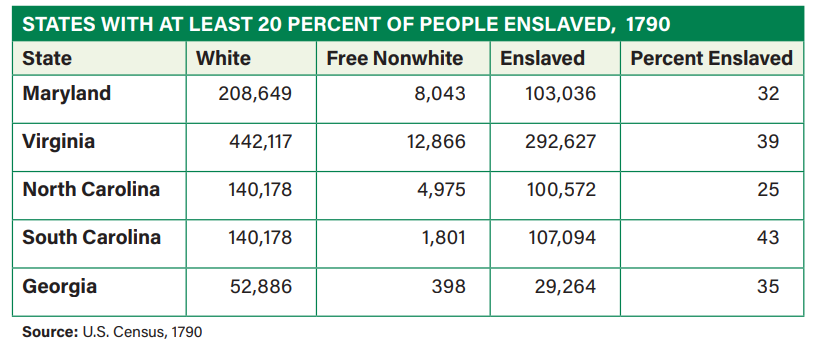
Three-Fifths Compromise: each enslaved individual counted as 3/5 of a person for determining a state’s level of taxation & representation
Guaranteed enslaved ppl could be imported until 1808 — Congress could later abolish this practice after the date if it wanted
Commercial Compromise: Congress could regulate interstate & foreign commerce (e.g. tariffs on foreign imports), but couldn’t place taxes on exports
4 year long terms for a president, but no limit on the # of terms
Electoral College to elect president: each state had a # of electors based on a state’s representative and senate
President could veto acts of Congress
Only 9/13 states were required to ratify the Constitution
Federalists and Anti-Federalists
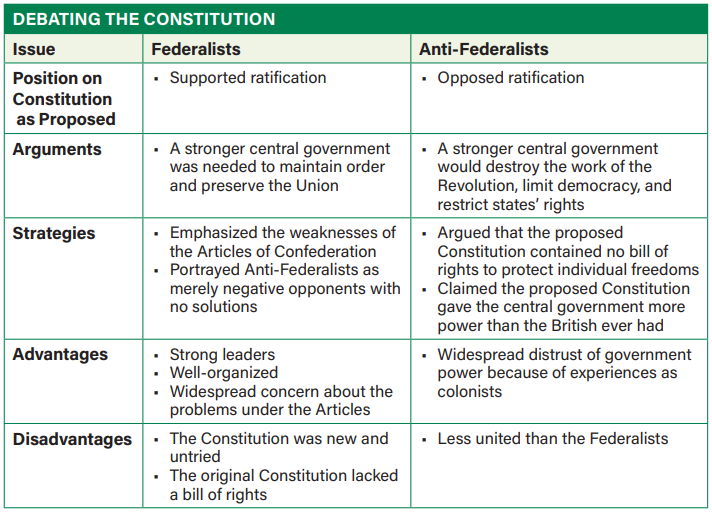
Federalists: supported the Constitution + its strong federal gov’t
Anti-Federalists: feared the new gov’t being too strong
The Federalist Papers
Highly persuasive essays by James Madison, Alexander Hamilton, & John Jay
The Path to Ratification
Anti-Federalists wanted a Bill of Rights (a list of specific rights that federal gov’t couldn’t violate)
Federalists promised to add a BOR as the first order of business for a new congress
All 13 states ratified the Constitution by 1790
3.9 The Constitution
Federalism
Power was divided between federal gov’t and state governments
Federal = issues that affected the entire country
States = state issues
Separation of Powers
Legislative: Congress makes laws, passes taxes, & allocates spending
Ratifies treaties
Executive: Led by president - recommends + carries out laws and federal programs
Can veto laws & appoint new justices
Judicial: Supreme + all lower courts; interprets laws + the Constitution
Can rule laws unconstitutional, can stop presidential enforcement of laws if its unconstitutional
Bill of Rights
Mainly drafted by James Madison & protect against abuses from the federal gov’t
1st: free speech, religion, press, assembly, & petitions
4th: People are protected from unreasonable search + seizure: a warrant is needed
5th: Right to due process of law, freedom from self-incrimination, double jeopardy
6th: Rights of accused persons, e.g. speedy and public trial
7th: Right of trial by jury in civil cases
8th: Freedom from excessive bail, cruel and unusual punishments
10th: Powers reserved to the states
3.10 Shaping a New Republic
Organizing the Federal Government
Judiciary Act of 1789: established a Supreme Court w/ one chief justice & 5 associate judges
Created a system of 13 district courts + 3 courts of appeals
Hamilton’s Financial Program
Pay off nat’l debt + federal gov’t assumes war debts of the states
Protect the nation’s new industries → high tariffs on imported goods
National bank for a stable U.S. currency
Anti-Federalists opposed because they feared states would lose power → Congress adopted a modified plan
Jefferson + his supporters agreed to #1 → Hamilton agreed to Jefferson’s idea of making the nation’s capital Washington D.C.
Foreign Affairs Under Washington
French Revolution
Jefferson + his supporters (Anti-Feds) sympathized with the revolution
Proclamation of Neutrality (1793): Jefferson resigned from the cabinet in disagreement
“Citizen” Genet: The French minister to the U.S. appealed directly to Americans to support the French cause → recalled by French gov’t
The Jay Treaty (1794) w/ Great Britain
John Jay negotiated Britain evacuating its posts on the W. frontier, but nothing about impressment
Pinckney Treaty (1795) w/ Spain
Spain opened lower part of the Miss. river + New Orleans for U.S. trade
Right of deposit: Americans could transfer cargoes in New Orleans w/o paying duties to the Spanish gov’t
FL’s N. boundary should be at the 31st parallel
Domestic Concerns under Washington
As Americans pushed westward into the Ohio Valley, many American Indians were upset + revolted
U.S. army defeated NW Confederacy tribes at the Battle of Fallen Timbers
Treaty of Greenville: American Indians surrendered claims to the Ohio territory
Whiskey Rebellion (1794): Congress raised taxes on the sale of whiskey
Farmers in PA rebelled & attacked revenue collectors → Washington sent thousand of troops, which solidified the authority of the federal gov’t
Public Lands Act (1796): orderly procedures for dividing + selling federal lands
The First Political Parties
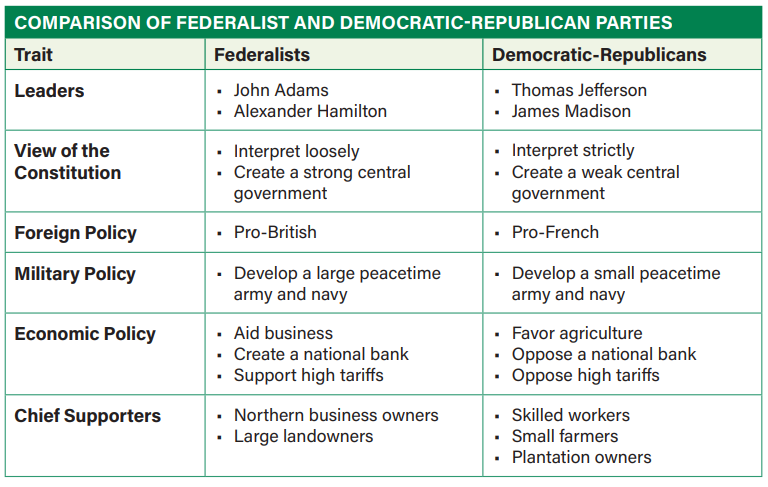
Federalists: supported Hamilton + his financial program
Growth of federal power & strong in NE states
Democratic-Republicans: supported Jefferson + elected candidates who opposed Hamilton’s program
States’ rights + strong in Southern states
Washington’s Farewell Address
Emphasized to not: get involved in European affairs, make “permanent alliances” in foreign affairs, form political parties, & fall into sectionalism
John Adams’ Presidency
Thomas Jefferson was his vice president — original Constitution made VP person in 2nd place
XYZ Affair: Adams sought peaceful settlement over French warships seizing U.S. merchant ships → French ministers called X, Y, & Z requested bribes for negotiation
Federalist majority in Congress → laws to restrict Democratic Republicans
Alien Acts: president could deport aliens considered dangerous + detain enemy aliens in times of war
Sedition Acts: illegal for newspaper editors to criticize the president/Congress
Kentucky + Virginia Resolutions: challenged the Alien & Sedition Acts by enacting nullifying laws in state legislatures
3.11 Developing an American Identity
Social Change
No legislature could grant titles of nobility + many large estates owned by Loyalists were divided and sold for money in war
Most states adopted separation of church and state — refused to give financial support to any religious group
South vs. North → South was became more reliant on slavery
Cultural Change
National identity slowly evolved
e.g) Gilbert Stuart painted the nation’s leaders
3.12 Movement in the Early Republic
American Indians
Indian Intercourse Act: federal gov’t was in control of all legal action w/ Native Americans
The Spanish allowed Native Americans more freedom because they were concerned with stopping settlers from the USA
Population Change
Europeans continued to immigrate to the US, enslaved Africans were continually brought into the country, & a high birth rate → increased population
Slavery
Quakers + others motivated by Christian faith opposed slavery
Many slaveowners (e.g. James Madison) hoped slavery would fade away like it did in Europe + increasing immigration would replace enslaved labor
Eli Whitney’s Cotton Gin made growing cotton extremely profitable + increased demand for slave labor
Mechanization of the textile industry increased the value of cotton
Many plantation owners settled in Alabama + Mississippi
Desire for lands further west + north would face resistance due to a growing # of northerners who opposed slavery
Chesapeake area planters had more slaves than they needed → sell slaves to cotton planters in the south