Purposive Communication
COMMUNICATION
- Communication is the transfer of message
- Systematic process in which people interact with and through symbols to create and interpret meanings
- Verbal & Non-verbal
- Sender, message, receivers, and feedbacks
- Process
- Communication requires continuity -> continuously changes and moves
- Communication is an activity in itself
- Symbols
- Used to concretize abstract ideas
- System
- Interrelated parts that offer one another
- It operates within a system
- Meaning/s
- communication is “end in itself”
- the meaning is embedded in message
- shared meanings
Misinterpretation happens when:
- There’ unnecessary noise
- Language barrier
- Speaker’s misleading tone
- Disrupted channel
2 Levels of meaning (this also affects communication)
- Denotative
- Direct
- Content
- Connotative
- Relationship
- Associates
- Attitude
- Affective
- could be positive, negative, or neutral
- Courageous, Conceited, Confident
Example: Hostess
Denotative - female host
Connotative - girl in a bar
ELEMENTS OF COMMUNICATION
- Sender/People
- Message
- Channel
- Feedback
- Code/Language
- Encoding and Decoding
- Noise Barrier
MODELS OF COMMUNICATION
- Linear by Harold Laswell
- one way communication
- sender, message, channel, receiver (by Aristotle)
- Interactive by Wilbur Schramm
- Circular/ two way communication
- Sender to receiver and vise versa
- Shannon-Weaver by Claude Shannon and Warren Weaver
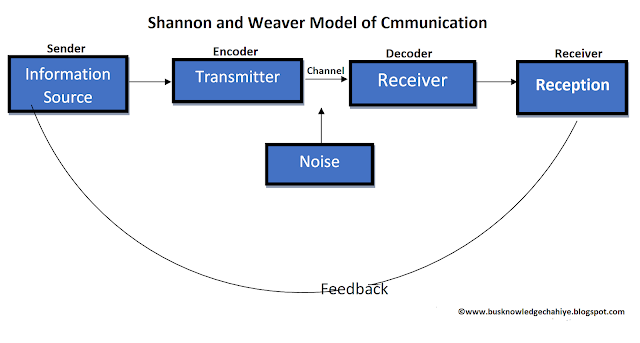
- Mother of all models
- Concept of noise
- Social Scientists use the term to refer to an integrated model of the concepts of information source, message, transmitter, signal, channel, noise, receiver, information destination, probability of error, encoding, decoding, etc.
- Transactional by Wood
- all can be a sender and receiver
- no more labels (no name for sender and receiver)
- regardless of culture, age, and gender
- dynamic
Types of noise
A. Physical
B. Mental
C. Physiological
D. Semantic
E. Linguistic/Cultural
F. Mechanical
*Communication is largely contextual
Principles of communication
- Transactional
- Inevitable
- Goal-oriented
- Has various levels
- Complex
- Can be learned
- Relational
- Guided by culture
Ethics in communication all boils down to respect to one another regardless of an individual's race, gender, ethnicity, religious beliefs, political affiliation or a person's totality.
According to National Communication Arts in America:
• Ethical communication is fundamental to responsible thinking, decision-making and the development of relationships of communities within or across cultures;
• Ethical communication enhances human worth and dignity by fostering truthfulness, fairness, responsibility, personal integrity, and respect for self and others. It is a belief that an unethical communication threatens the quality of the communication and consequently, the well-being of the humans and the society that we live in.
4 Ethical Principles or characteristics of an ethical communication according to ^^National Communication Arts in America^^
1. Honest
- to prevent misinformation
- Truthfulness, Accuracy and Reason
- Awareness of consequences of their thoughts and actions
- Value Diversity and respect other's opinion
- there is a difference in opinion and you have to be able to tolerate that
- Freedom of expression, Diversity of perspective, Tolerance of Dissent
4. Just and fair
- Condemn communication that degrades individuals and humanity through distortion, violence, racism, sexism
- We are who we are because of our culture
- Accept that you have to be responsible for the long-term and short-term consequences of your actions and decisions
"We agree to disagree" \n - we can debate but we have to listen to each other and agree for the common good
Positive, neutral, negative \n Maneuver, Handle, Manipulate \n Selfless, generous, Showy \n Honest, Truthful, Frank \n Peculiar, Different, Odd \n Fearless, Courageous, Violent \n Serious, Intimidating, Arrogant
“ No matter the manager’s job is engineering, accounting or selling, his effectiveness depends on his ability to speak and write. He needs skills in getting his thinking across to other people.” (Peter F. Ducher)
Of similar importance is the discussion of Organizational Communication-which is primarily concerned with how communication principles and skills can be used to help a person succeed in an organization setting.
2 Functions of Organizational Communication:
To give and receive directions
To give and receive information
2 Structures of Organizational Communication:
Formal-follows the same lines and pattern as that of an organizational chart
Informal- “Grapevine”- lines and route change as rapidly as personal relationships between organization members change.
Formal Communication Channels:
Downward- top-to-bottom communication in an organization
Upward- bottom-to-top
Horizontal- intra-company communication between sections, divisions, departments of the same level
- Downward Communication Tools:
Memo
Circular
Letters
Manuals
Handbook
Annual Report
Bulletin board
Open house
Public Address Announcement
Human channels
- Upward Communication Tools:
- Memorandum
- Suggestion system
- Reports
- Surveys
- Bulletins
- Unions or Employees Councils
- Counsellors
- Open Door Policy
- Human channels Horizontal/Lateral Communication Tools:
- Meetings
- Seminars/Workshops
- Conferences
- Telephones
- Computers
- Socials
Communication therefore goes beyond the printed media, other multi-media platforms and their contents. It runs the entire gamut of human relationships within and outside the company. Fear ,ambitions, ego, rivalries, status, biases and personal interests may block the free flow of communication. Hence, the need to study/understand how communication goes about in an organization. In addition, it is important that business should evolve, plan, practice a definite philosophy and policy of communication. Communication is most vital to any organization’s success.