BehindTheGraph: Ozone Formation by Altitude
Discuss why ozone forms a layer in the stratosphere. Describe how the plot of the rate of ozone formation illustrates why the Chapman Cycle does not form ozone above or below the stratosphere.
Ozone forms a layer in the stratosphere due to the highrest rate formation of ozone at 25kilom which is the altitude of the stratopsher at 210 nanometer radiation. The highest rate formation of ozone is at 25kilom from the combined data of Radiation and concentration of air. The Chapman Cycle does not form ozone above or below the stratosphere because the ozone formation illustrates that ozone and oxygen atoms are meeting and changing to another state such as the breakdown of O3 to O2 with help of photolyzation from the prozimity of solar UVs.
Give an example of why the ozone layer is important for your life.
Ozone is important in my life because every day after school theres cross country practice. Its about a full 1 to 2 hours fully outsdie in the sun, so the ozone layer that protects from harmful UV’s is important because I can perform atheltics without heavy protection, just a light easy layer of suncreen.
Based on Chapter 2 from The Forgiving Air, explain why the ozone hole formed and what was done to stop it. Describe what makes this history surprising to you, and give an example of how it differs from another environmental problem that has not been solved.
The ozone hole formed by calaysit contribution suchs as CFC industy, Montreal protoco was adopted to stop production of CFC that depletes ozone. What makes the hisotry surpiing to me is how only about 60 years later form the invention of CFC in 1920 to the 1980’s is the the depletion of ozone was 50% meaning CFC was bigger problem than Rowland and Molinas theroy. This differns form anothe enviromenal problem such as several factories produce chorline and bromine that omtinues to depletes the ozone layer.
Ozone Formation by Altitude
radiation is high high in atmo
concentration of aire is high at surface
thats why ozone forms in higher in the atmo
Radiation
I of Z
highest at top and stays until it gets below 5,000 meter
then decreases
then at surface no more short wave radiation (destorys cells0
highest at top of atmo
Concentration of Air
Isa parameter (mod 1)
Air concetnration is highest at the surcace but its continuing decreasing
highest at suface
Plot of Rate (combines)
ozone is highest where 25km
radiation + concentration hasnt dropped too much
highest rate of formation of ozone 210 nanometer = 25km
The place where ozone forms and heats up temp makes up the stratopsher
Why does ozone form in a layer rather than mixed throughout the atmosphere?
It mostly forms near 25 km because above that there is not enough oxygen and below that there is not enough radiation.
Why is there more oxygen at the surface than above the stratopause?
Oxygen constitutes 21% of air for the first 100 km of the atmosphere, but there is a much higher air concentration at the surface than above the stratopause.
How does the heat from the breakdown of O3 to O2 affect the stratospheric temperature?
It causes the stratosphere to warm as you go up in altitude.
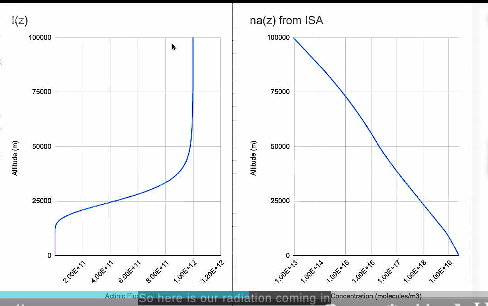
(bright music) - This look behind the graph at ozone formation illustrates why the ozone layer forms in the stratosphere. There are two reasons for this: One is that radiation is high at the top of the atmosphere but the concentration of air is high at the surface. Combining these two effects, you get the highest rate of ozone formation at about 25 kilometers, which is why the ozone layer forms at the level of the stratosphere. Understanding where the ozone layer forms is part of the learning objective, to review the ways in which humans changed the ozone layer. Opening up the Google Sheets, we see on the Ozone Layer tab the calculation of the amount of incoming radiation in column B. I have done this calculation for 210 nanometer incoming ultraviolet radiation based on measurements of radiation up at 50 kilometers and then done the calculation for how it decreases as you go down in altitude. But you can take these values as approximating observed radiation as it is not important to know the equation. What is important is that if we plot the amount of radiation coming in, the I of z, we can see that it's highest at the top of the atmosphere and stays pretty high until you get a little below 50,000 meters, and then it starts to decrease. By the time you reach the surface, there's no more short wave ultraviolet radiation left, which is good because it destroys living cells. Now let's look at the plot of the concentration of air, which we get from the Atmospheric Structure tab, which is the same as the one that we looked at in module one, and it uses the ISA parameters from module one, as well. The plot labeled na of z shows the air concentration from column H versus column A and here at the bottom is the concentration and it's plotted against altitude on the Y axis. You can see that air concentration is highest at the surface, and above that it's continually decreasing. Now I've just copied this plot into the Ozone Layer tab so I can compare it side by side with the incident radiation, I of z. So here is our radiation coming in that's highest at the top and here is our concentration that's highest at the bottom. The rate of ozone formation depends on both the concentration of air because it's what has the oxygen in it that gets photolyzed and the incident radiation because it's what provides the photons to do the photolysis. But concentration is highest at the surface and radiation is highest at the top of the atmosphere. So how do we know where the rate of ozone formation will be the highest? We get the rate of ozone formation essentially by multiplying the plot of radiation by the plot of concentration at each altitude and applying a few mathematical corrections and using the constants over here in column E. And that gives me the rates calculated in column C as a function of altitude. The plot of rate shows us essentially where we have the best of both worlds. So ozone formation is highest near the 25-kilometer mark in the middle of the graph where both radiation hasn't dropped too much from above and concentration hasn't dropped too much from a below. And so we get the highest radiation and concentration combined at about 25 kilometers. What the numbers behind the graph show is that the highest rate of formation of ozone from 210 nanometer radiation is at approximately 25 kilometers because this is where the air concentration and incident radiation are both relatively high. Now, the super interesting thing is that we often say that the ozone is in the stratosphere, which implies there is something about the stratosphere that makes the ozone, but it actually turns out it's the opposite. The stratosphere, which is the only atmospheric layer that actually warms up as you go up in altitude, is where it is because that's where ozone forms and absorbs radiation to cause that warming. So really it's the ozone that makes the stratosphere rather than the other way around. Understanding where the ozone layer forms is part of the learning objective, to review the ways in which humans have changed the ozone layer.