UWEC Communications Exam: 3
Lesson 1: Interpersonal Conflict
Conflict is necessary for an effective interpersonal relationship
Interpersonal Conflict: an expressed struggles between two interdependent parties who perceive incompatible goals, scarce resources and interference from the other party in achieving their goals
You manage your conflicts because of misattribution
Conflict can be:
- Real
- Perceived conflict: Conflict in your mind
Myths about Conflict
Natural Harmony exists between all individuals
Misunderstanding is always the cause of conflict
Conflict can’t be resolved
- You can manage conflicts
- You can’t resolve conflicts because that would mean that there aren’t any residual affects
Conflict represents a breakdown in the relationship
Conflict represents a breakdown in the communication
Conflict is a good thing!
Absence of Conflict
- Groupthink (due to apathy)
- Risky Shift Phenomenon (due to conformity)
- Abilene Theory: A lack of conflict due to misattribution
Conflict Issues
Intimacy
- Showing affection/relating to one another
- Integration vs separation
Power
- Struggle for influence
Personal Flaws
- Attribution Theory
Social Issues
- Don’t see eye to eye
Distrust Issues
- Privacy vs expression
Conflict Styles
- Avoiding/Withdrawing
- Accommodating/Smoothing
- Competing/Forcing
- Compromising: I win I lose & you win you lose
- Collaborating/Negotiating: We both win
Toxic Conflict: Gottman’s Four Horsemen
Criticism (Behavior)
Defensiveness
- Denying responsibility/Counterattacking
Contempt (Person)
- Belittle and demean
Stonewalling
- Shutting down the dialogue
Conflict Managment Stages
Define the Conflict
- Define you needs
- Don’t Gunnysack: bringing in all of your baggage
- Avoid mindreading
- No Belt lining: Attacking at a phycological or emotional level at which the other person cannot withstand the blow
Examine Possible Solutions (brainstorm)
Test the solution (out loud)
Evaluate the Solutions
Reject/accept solutions
Advantages of managing Conflict
- Diffuses more serious conflict
- Leads us to acquire new information
- Increases intimacy
- Provides opportunity to measure power and strength
Guidelines for managing conflicts
- Take your time
- Remain issue-oriented
- Establish common ground
- Listen and respond more effectively
- Don’t be afraid to admit that you are wrong
- Assess the outcome
Lesson 2: Interpersonal Power
Who has the power in the relationship?
Interpersonal Power: the person who has the power in the relationship is the person who cares least
What we know about power
- You can’t take power it has to be given
- It can switch in a heartbeat
- It can be used to take advantage of another
Six Types of Power
The power you are most influenced by us the power you use to try and influence others
Referent Power: You are influenced because you like the person and who they are
- You’re personable
Expert Power: You are influenced because of their experience and who they are
- You’re rational
Reward Power: You are influenced because of the rewards you would receive and what they have
- You’re realistic
Coercive Power: You are influenced because they would hurt you and you are scared
- Lack of self confidence
Legitimate Power: You are influenced by people of authority and who they are
- You’re submissive
Informative Power: You are influenced because of the information and what they know
- You’re logical
Six Types of Powerplays
Powerplays: mind games
- Bullying: an abusive act committed by one person to another, and it’s mostly patterned
- Nobody upstairs: when you act dumb or that you don’t understand
- You owe me: A guilt trip
- You got to be kidding me (Gaslighting): You make the person doubt
- Metaphors: comparing things/ people
- Thought stoppers (mansplaining): when you yell, scream, and talk so they can’t speak
Lesson 3: Relationship Models
Relationship Developemnt models:
- Platonic
- Familial
- Intimate
- Work
All relationships move through same steps
All relationships are compared to climbing up and down a staircase
Hopefully you are on the same step as the other person in the relationship
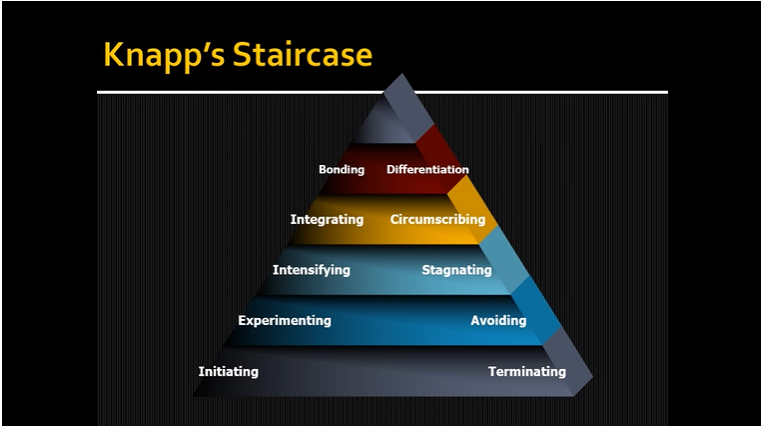
Knapp’s Staircase
Most popular
Two Components of Knapp’s Staircase
1.) Coming together steps
2.) Coming apart steps
The 5 Coming Together Stages
Initiating
- Phatic Communication: small talk
Experimenting: is when you Self-Disclose
- You can choose to leave the relationship
Intensifying: When a relationship is established
- You can skip this step
Integrating: When others can see that there is a relationship
- You can skip to this step
Bonding: when you have a social outward commitment to be together
- Society decides when you are bonded
- Marriage
The 5 Coming Apart Stages
Differentiating: when you realize that you have different likes and beliefs
Circumscribing: when you have different activities
Stagnating: when nothing happens in the relationship because no one cares
Avoiding
Terminating: when you stop thinking about the other person and the relationship is over
Wood Model
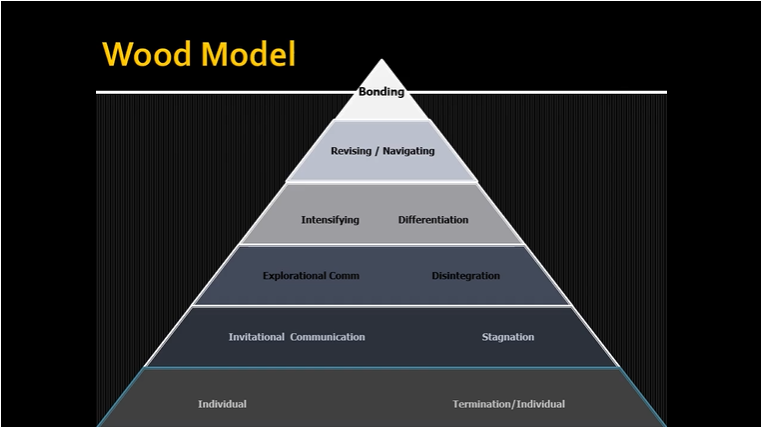
6 Coming together steps
- Individual
- Invitational Communication: Which is the same as initiating
- Explorational Communication: the same as experimenting
- Intensifying: Intensifying and integrating
- Revising: getting ready to make to social commitment of bonding
- Bonding
6 Coming Apart Steps
- Bonding
- Navigating:
- Differentiation: Circumscribing and Differentiation
- Disintegration: Avoiding
- Stagnation
- Termination/Individual: when you are okay with being by yourself
Lesson 4: Beginning and Ending Relationships
We begin and end relationships for the same reasons
Attraction Theory: We want to be with those we are drawn/attracted to
3 Factors that draw us to people
- Attractiveness: physicality & personality
- Proximity: People who are close to you in time or space
- Similarity: You have something in common
Reinforcement Theory: we want to be with those who reward us
- Rewards doesn’t have to be tangible
Social Exchange Theory: takes into account the pros and cons of a relationship
Rewards - Costs = Profit
- As long as there continues to be a profit, you will stay into the relationship
Equity Theory: Takes into account the pros and cons of both parties
If you are not both getting the same amount of rewards in the relationship, then you will leave the relationship
How do we start a relationship?
3 Steps to the First Encounter
- Examine Qualifiers: Looking at their qualities
- Determine Clearance: seeing if they are available
- Communicate Contact: starting communication
Beginning relationships are a whole lot easier than ending them
5 Disengagement Strategies
- Positive Emotion: Let’s just be friends
- Negative Identity Management: Blaming the other person for the breakup
- Justification: Give logical Reasons for the breakup
- Behavioral De-Escalation: reduce the intensity
- De-escalation: reduce the inclusivity and eventually the intensity of the relationship
Why specifically do relationship dissolve?
7 Common Reasons Relationships ends
Unrealistic Beliefs about the relationship
Excessive intimacy claims: Jealousy
Third-party
- Can be cheating
- Can also be your mother or best friends’ disapproval
Relationship Changes
Sex-related problems
Work-related problems
Financial Difficulties
How can you tell is someone is going to leave you?
- Withdrawal
- Decline in self-disclosure
- Deception
- Evaluative Behaviors: when you stop being nice
Lesson 5a: Communication Climate
Climate: Emotional tone of the relationship
How do communication climates develop?
Climate is determined by the degree to which people see themselves as valued
2 Forms of Communication which Establish Climates
Supportive climate
- Confirming communication: direct or indirect messages that convey value
Defensive Climate
- Disconfirming Communication: Messages that signal lack of regard
Three types of Messages that Establish Climate
Confirming Messages
- Endorsement
- Acknowledgement
- Recognition
Disagreeing messages
- Argumentativeness
- Complaining
Disconfirming Messages
- Aggressiveness
- Ostracism
Levels of Message Confirmation
Valuing - Non-valuing
Creating Support Climates
Gibbs Categories
- Defense-Provoking
- Evaluation
- Control
- Strategy
- Neutrality
- Superiority
- Certainty
- Supportive Behaviors
- Description
- Problem Orientation: Focusing on the problem not the person
- Spontaneity
- Empathy
- Equality
- Provisionals
Lesson 5b: Relational Maintenace
Relational Maintenance: Communication that keeps relationships running smoothly and satisfactorily
5 Strategies for Satisfying Interactions
These Strategies pertain to nurturing the relationship
- Positivity
- Openness
- Assurances: Verbal and nonverbal statements of commitment
- Social Networks: Being invested in the friends and family
- Sharing Tasks
Social Support: Helping others during challenging times by providing emotional, informational, and instrumental resources
Three types of Social Support
- Emotional: Being empathic
- Informational: Informational Sources
- Instrumental: Physical Help
Relational Transgressions: Where one partner violates the explicit or implicit terms of the relationship lettering the other person down in some important way
Types of relational Transgressions
- Minor vs. Significant
- Social vs. Relational
- Deliberate vs. Unintentional
- One-time vs. Incremental
Relational Reconciliation
Apology: to admit wrongdoing and take responsibility for your own role in the conflict
Forgiveness: an emotional Transformation in which you let for and move on beyond the wrong you perceive the other has done for you
Relational Repair
Three parts to a good apology
- Acknowledgement of responsibility
- Offer a repair
- Expression of regret
Lesson 6: Friendship & Love
Friendships
3 Types of Friendships
- Reciprocity (Equality)
- Receptivity (Imbalance)
- Association (Passing)
In order for a friendship to last you must have trust
Trust: no matter the relationship, we must trust that the status quo remains the same
Friendship Values
We seek friendships based on what we think others can give us
5 Values of Friendship
- Utility Value (Talent/Skills)
- Affirmation Value (See Ourselves Clearly)
- Ego-Support Value (Encourages Us)
- Stimulation Value (See New Ideas)
- Security Value (They Won’t Hurt Us)
Love
7 Different Types of Love
Eros: Love of Beauty and Sexuality
Ludus: Fun Love, the person makes you happy
Storge: Companionship
Pragma: Practical Love, you love them because they’re your family
Mania: Extreme Love, Celebrity obsessions
- You want a little bit of Mania love in intimate relationships, but it shouldn’t be the main love
Agape: Selfless love/Mother’s love
Phileo: Brotherly, love for other individuals & the world
Love Languages
- Physical Touch
- Words of Affirmation
- Quality Time
- Acts of Service
- Receiving Gifts
3 Components to True Love
- Intimacy: Emotional Attachment
- Passion: Physical Attraction
- Commitment: Longevity
Lesson 7: Family
Family: a group of intimates that establish a sense of home and belongingness
Characteristics of a Family
Defined Roles
- 27 different roles
Recognition of Responsibility
Shared History and Future
Shared Living Space
Established Rules
Primaries: the couple that raised you
Types of Primaries
- Traditional Primaries: two individuals that share everything
- Separates: They have different activities
- Independents: the only thing that they have in common are you
Communication Patterns of Primaries
- Equality: Every decision is made together
- Balanced Split: Both make equal separate decisions
- Unbalanced Split: One is making more decisions than the other
- Monopoly: One person makes all of the decisions
Communication Improvement for Families
- Empathy
- Self-Disclosure
- Openness to Change
- Fair Fighting
- Reasonableness