Equilibrium in the AD/AS Model
To ACE a graph, you must include:
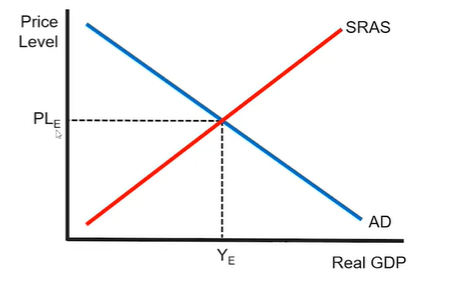
Axes: In a AD/AS model the y-axis is price level (labeled as aggregate price level, GDP deflator), and the x-axis is real GDP
Curves: You need a downward sloping aggregate demand curve, and an upward sloping Short run aggregate supply curve
Equilibrium points: short run equilibrium is found at intersection at the equilibrium price level and equilibrium income
If price level is higher than equilibrium price level, then there will be a surplus of goods in the economy, leading to downward pressure on prices as suppliers try to sell their excess inventory.
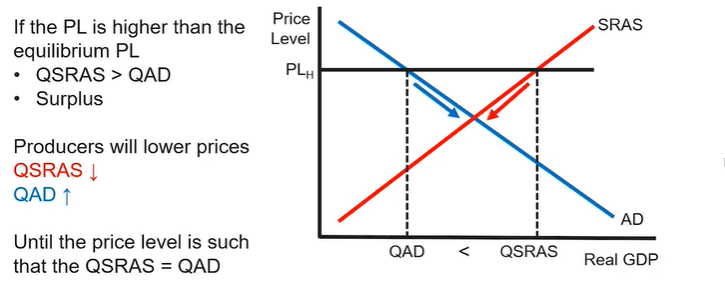
The real GDP of QSRAS is higher than that of QAD, indicating that the economy is producing beyond its potential output.
If the price level is lower than the equilibrium price level, there will be a shortage of goods, resulting in upward pressure on prices as consumers compete for the limited supply available. In this scenario, the real GDP of QAD is lower than that of QSRAS, signifying that the economy is not fully utilizing its resources and is operating below its potential output.
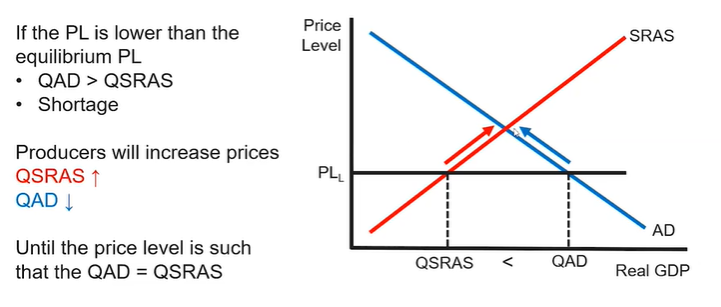
The changes in aggregate demand and SRAS lead to a change in price level and unemployment rate, because that change in AD will produce a shortage, or a change in aggregate supply will produce a surplus.
LRAS Equilibrium in AD/AS Model
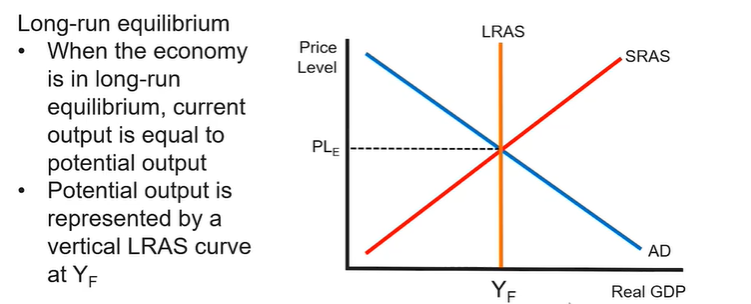
When the economy is in long-run equilibrium, current output is equal to potential output.
Current output is found where SRAS equals AD.
When current output equals potential output, it is in the long-run, at full employment levels.
AD-AS Model in Recession and Inflation
Short Run Output Gaps
When current output is equal to potential output (YF), the economy is in long-run macroeconomic equilibrium (exemplified by top image).
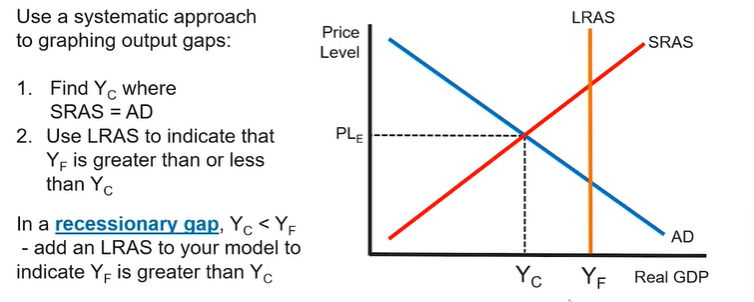
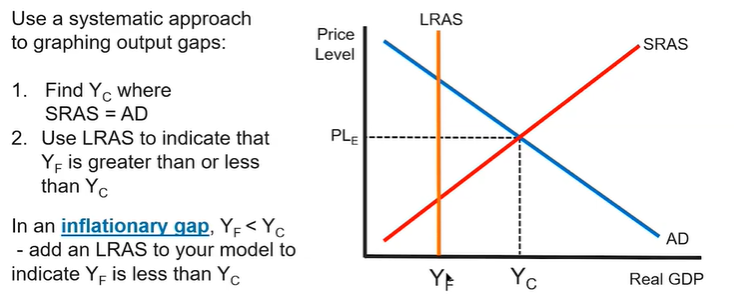
Output gap exists when current output ( Y[sub]c )does not equal potential output ( Y[sub]f ).
When Yc < Yf the economy is in a recessionary gap.
When Yc > Yf the economy is in a inflationary gap.
When you increase SRAS, price level falls in the short run, but because current output is greater than the potential output that is what makes it an inflationary gap.
Don’t use price level to determine inflation or recession, use the horizontal axis.
Short-Run Recessionary Gap Model
Short-Run Inflationary Gap Model
In a recessionary gap, the unemployment rate (U[sub]R) is higher than the natural rate of unemployment (NRU), indicating that resources are underutilized and output is below potential.
In an inflationary gap, the unemployment rate (U[sub]R) falls below the natural rate of unemployment (NRU), suggesting that resources are overutilized, leading to increased output beyond the economy's potential.
In long-run equilibrium, unemployment rate equals NRU.