Diffraction
Diffraction is the spreading out of waves when they meet obstacles such as the edges of a slit. Some of the waves energy travels into the geometrical shadows of the obstacle.
We need to understand the fundamentals of diffraction to learn about experiments/phenomena such as Young’s double slit.
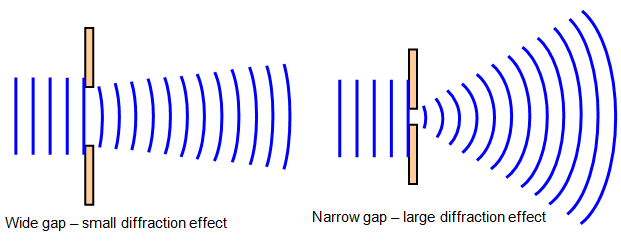
Diffraction becomes more significant when the size of the gap or obstacle is reduced compared to the wavelength λ of the wave.
Aperture smaller than λ = larger spread.
Aperture larger than λ = smaller spread.
Double slit Interference with light:
Light was proven to be a wave source (em radiation) by this experiment as it showed interference effects.
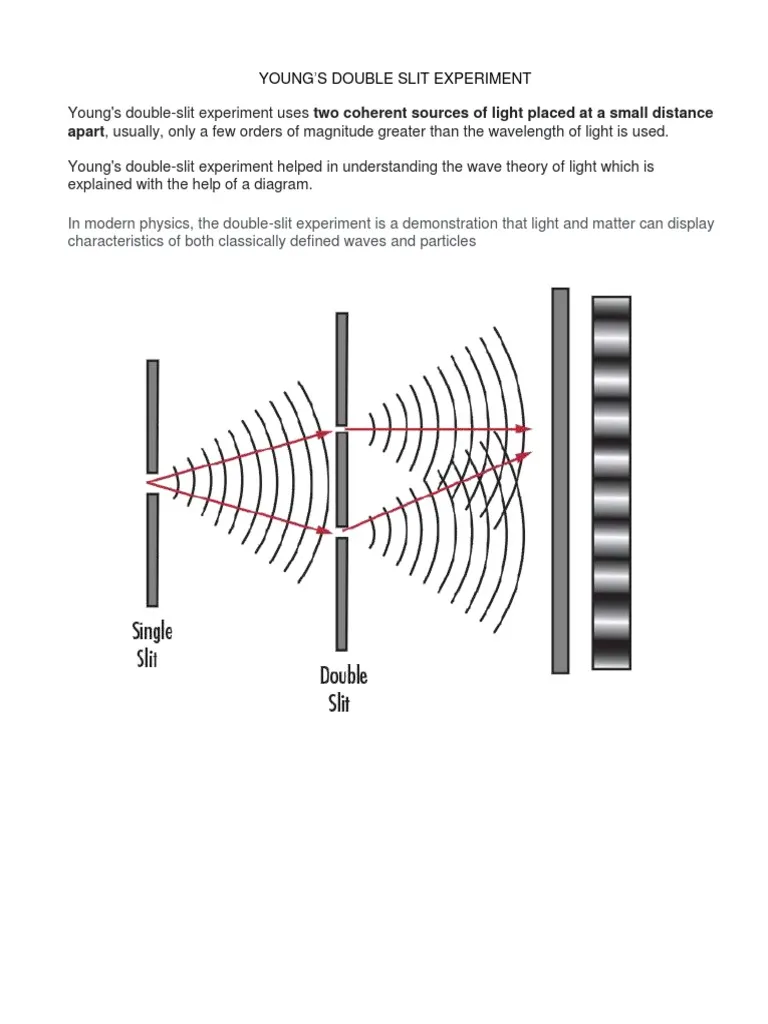
When carrying out experiment:
Light source = must be a monochromatic light source, this can be achieved by using a colour filter. Or a laser or sodium lamp.
Single slit = this is used to obtain a coherent light source. Not needed is a laser is used.
Double slit = Width- 0.1mm, seperation - 0.5mm.
Interference Fringes:
Interference fringes are made where the two diffracted light beams from the double slit overlap.
A bright fringe is formed when the light from one slit adds to the light of another slit. The waves are in phase, constructive interference causes this. They have path differences equal to a whole number of wavelengths.
A dark fringe is caused by two waves cancelling each other out, the light from the slits is 180º out of phase. This is caused by destructive interference, they have path differences of ½λ, 3/2λ…
Dark spots = λ/n
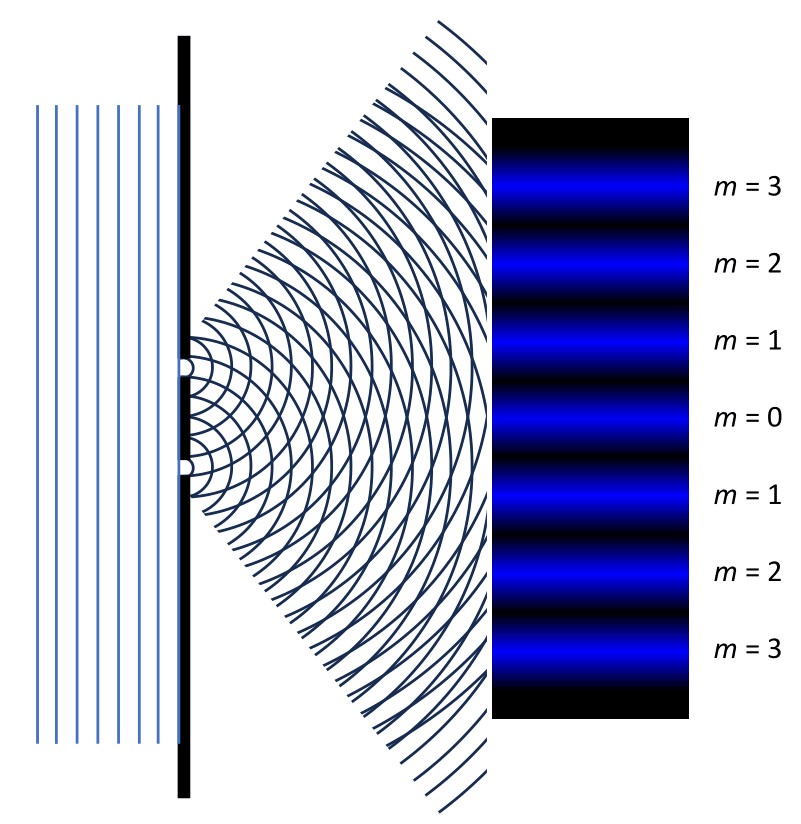
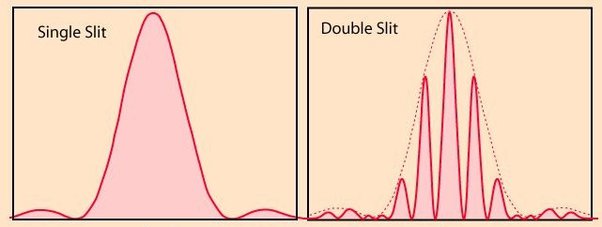
Double slit pattern with a slit diffraction
A single slit also produces a fringe pattern. However, the central fringe is much brighter and twice the width of the others.
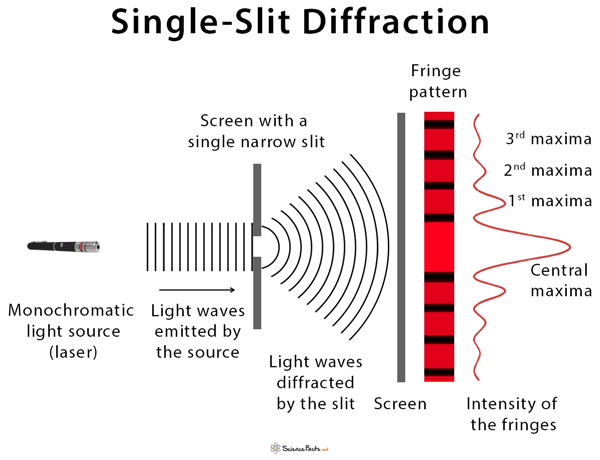
The intensity of these fringes varies symmetrically about the centre. The double slit pattern fits inside the envelope of the single slit pattern, which is determined by slit width.
Diffraction grating equation:
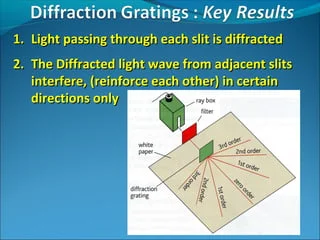
When monochromatic light passes through a diffraction grating, it undergoes diffraction and interference. The path difference between waves emerging from adjacent slits leads to constructive and destructive interference, forming bright and dark fringes.
The angle of a beam is measured from the zero order beam.
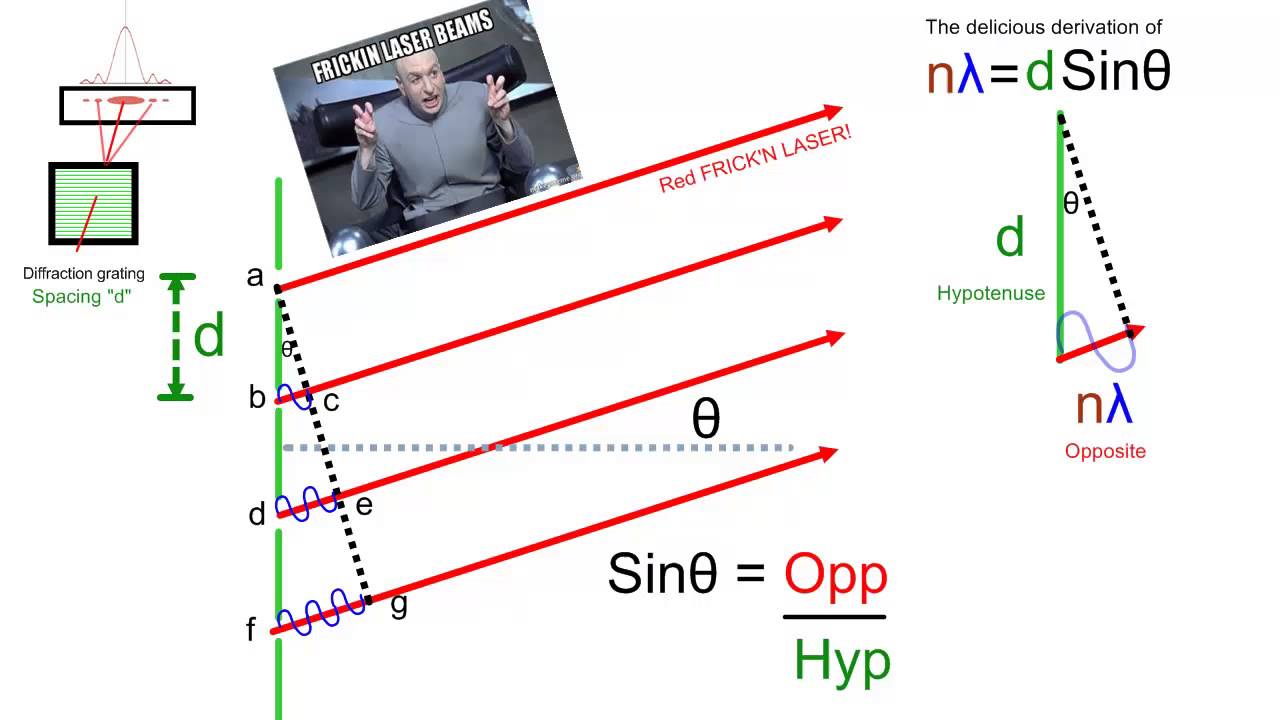
Deriving grating equation derivation:
Here is a simple visualisation of the derivation of dSin(ø) = nλ
Applications of diffraction gratings
Can be used to identify components of gas by using a spectrometer (see Chemistry Unit 1.2) (emissions spectra)
Star spectra - can be analysed to identify chemical compositions of stars. (Absorption spectra)