EXAM PREP:

define what is locus of control. pick one life domain - advantages and disadvantages:
PLAN:
Rotter (1950s)
definition = the belief of the amount of power or control you have over events that occur in your life
internal = believes that they are the cause for events in their life
e.g. i got a bad grade because i didn’t study hard enough
external = believes that the environment, fate or others are the cause for events in their life
e.g. i got a bad grade because my teacher was bad
most people are not one or the other, and fall somewhere in the middle of the scale
affects how people cope with challenges, make decisions, and maintain mental health
internal is linked to confidence and persistent
external is linked to helplessness and anxiety
life domain: school
like in the examples given, locus of control on either extreme can have varying effects
advantages:
with an internal loc, you may instead study much harder for the next exam since you took responsibility of your grade. this can lead to better grades, a higher work morale, more positive outlook, higher motivation
better self regulated learning
with an external loc, you don’t put as much stress on yourself when things don’t go as planned. instead of blaming yourself, you can recognise that you did your best and that it is out of your hands
recognition of environmental factors
disadvantages:
with an external loc, you blame others and therefore probably wouldn’t work harder on the next exam. it may relate to a lack of effort, and consequently a lack of results,
lower motivation
an internal loc may place a lot of personal stress on the self
unrealistic sense of control
ESSAY:
Locus of control was first developed and defined by Rotter in the 1950s. It describes the belief concerning the amount of power one has over the events that occur in their life. It has two types, that exist on opposite ends of a scale. An internal LOC is the belief that one has power over everything that occurs in their life, taking total responsibility for what happens. On the other hand, an external LOC is the belief that one does not have any power over things that occur in their life, instead assigning fate and chance responsible for what happens. Most people exist somewhere in between these two extremes, lying at varying points on the scale. It affects how one deals with the events that happen in their life, how they react to those challenges. Consequently, it also has quite a large affect on one’s mental health. A high internal LOC has been related to success, grit and perserverance while a high internal LOC has been correlated to anxiety and helplessness.
One domain where locus of control has a large effect is in educational settings, such as school. An example of an internal LOC for a student is receiving a bad grade, and then believing it was because they did not study hard enough. A student with a external LOC would instead blame outside causes, like the teacher not being good at their job.
There are positives and negatives to both these types. An advantage of an internal LOC is that next time, the student may study much harder or learn better methods, which could increase their grade. This can continue on throughout life, having a higher work morale and a more positive outlook. In extreme cases, they may have a better future. However, a disadvantage of an internal LOC is that it can create a lot of personal stress when things continue to go not according to plan. Say is the student studied much harder on the next few exams, but still got bad grades. They may take that personally, becoming stressed on why they cannot do well. This could damage their mental health.
An advantage of an external LOC is that they will not feel as stressed when things go wrong, like an internal LOC student might. They can recognise when they did their best, and it is out of their hands. Instead of harshly blaming themselves, they may have a more relaxed attitude which could be more helpful in the long term, as it is rare that things always go according to plan. A disadvantage is that they may give up easier. Like in the example, if the student did badly, they may just give up in that subject.
elm & hsm
PLAN:
ELM = elaboration likelihood model
how likely the persuasion will work depends on how much the listener is engaged with the elaboration of arguments involved
central = messages that have scientific backing and need processing
processing that message when people have motivation and evaluate and attend to the message
peripheral = messages that have slogans, models etc that don’t need much processing
processing that message when people have no motivation and don’t evaluate it or attend to the message
HSM = heuristic systematic model
same principle
systematic = careful, analytical evaluation of the message
heuristic = automatic use of mental shortcuts to process the message
used when the message is too difficult
in ELM, there is a continuum of elaboration
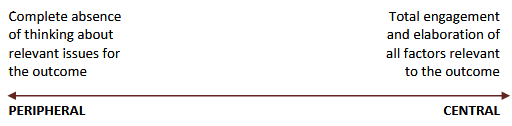
in HSM, the systematic route involves being analytical to judge all information to make a judgement
the heuristic route involves being less analytical and relying on shortcuts to make a judgement
ELM is quantity, HSM is quality
ELM doesn’t allow for two processes, either one or the other
HSM allows for two processes to clash
There are two main models of persuasion that show how people respond to different cues, and how they process them. The first model is known as the elaboration likelihood model (ELM) which explores how likely it is that the persuasion will work based on two things: how engaged the listener is, and how elaborate the argument or message is. There are two types of cues and processes. The first type is central, which involves cues that are very scientific, evidence based and require the individual to have the ability to be motivated and engaged with the message, otherwise it will fail. The other type is peripheral, which involves cues that are more catchy, like slogans, that do not require much ability to be motivated or engaged.
Another model of persuasion is the heuristic-systematic model, which follows the same principles as the ELM. Instead, the high engagement message and processing are coined as systematic, and the low engagement message and processing are coined as heuristic, due to the nature of heuristics being mental shortcuts that allow for decisions without overthinking.
While these two models are incredibly similar, there are a few key differences between them. The main difference between the models is whether the two types of processing can happen at the same time. With ELM, central and peripheral are at two opposite ends of a continuum. More of one usually means less of the other. Alternatively, with HSM, systematic and heuristic can be used at the same time. One may be convinced by evidence provided by a professional, thinking it is reasonable but then also trust them because they are an expert.
attriubtional style
PLAN:
attribution definition: theory that deals with how the social perceiver uses information to arrive at casual explanations for events - casual judgement
casual attribution
internal = cause of a person’s behaviour is their internal disposition
external = cause of a person’s behaviour is the situation or external factors
covariation model (Kelley) = how people attribute cause to behaviour, making casual inferences, the tendency to attribute an effect to a cause that is not present when behaviours occurs
three factors:
consensus = extent to which other people behave in the same manner towards the same stimulus
can be high or low, e.g. high = everyone in a theatre laughing at a comedian (large group shows behaviour)
distinctiveness = how the individual responds to different stimulus
can be high or low, e.g. high = person laughing at only one comedian (behaviour in one context)
consistency = the frequency with which the behaviour occurs between the same person and stim over time
can be high or low, e.g. high = person laughing at one comedian, every time (behaviour happens reliably over time)
actor-observer bias = tendency to attribute one’s own actions to external causes by other’s to internal causes
self-enhancing biases
self-serving bias = take full credit for success (internal), but blame failure on external factors
false consensus bias = overestimating how much others share their beliefs and values
false uniqueness bias = underestimating how much others share their beliefs and values
Social attribution refers to how a social perceiver may use information to come to a conclusion about events, often a casual judgement regarding people in the scenario. There are two main types, internal and external. Someone making an internal attribution may believe that the cause of a person’s behaviour is due to their internal disposition, like their personality. Someone making an external attribution may believe that the cause of a person’s behaviour is due to external factors, like the surrounding environment.
One model based in attribution was developed by Kelley, coined the covariation model. It captures how people try to attribute an individuals behaviour to different causes. This model involves three factors, the first of which is consensus. It describes the extent to which other people behave in the same way towards the same stimulus. The second is distinctiveness, which is how the individual may react to a different stimulus. The final one is consistency, which is the frequency with which the individual will react in the same way to the same stimulus. All three factors can be high or low.
There is also a concept known as the self-enhancing biases, which has three sub components. It captures the tendency to describe oneself more positively than they may actually be. One factor is the self-serving bias, where people take full accountability for successful events in their lives, saying the cause is internal and their disposition, but then blaming their failure on external factors. Another factor is the false consensus bias, where one overestimates how much others share their beliefs and values. Contrastingly, the false uniqueness bias underestimates how much others share their beliefs and values.
flynn effect
PLAN:
flynn effect = documented phenomenon that average iq test scores have significantly increased over the past century
discovered by James Flynn in 1984
seen in fluid intelligence (ability to reason, think abstractly) rather than crystallised intelligence (ability to accumulate knowledge)
very large group differences in iq between generations
increases observed across the world in 6 continents
fluid iq increase > crystallised iq increase
rates are not uniform across time periods or location
adults iq increase greater than children
evidence & explanation:
Lynn (1990, 1998) general height has increased by about 1.2cm per decade over the last century due to nutrition
technology/cognitive stimulation
access to education, length in education and quality of education
much better nutrition → e.g. better prenatal care, support of healthy brain development
reduced family size on average → allows parents to devote more resources to their children
IQ has often been measured by intelligence tests, such as the Binet-Simon test. These tests produce a tangible number score, which the average of seems to be increasing over the past century. This effect is known as the Flynn effect, coined by James Flynn in 1984. It is the documented phenomenon where average IQ scores have significantly increased, most notably in fluid intelligence which is the ability to reason and think abstractly, compared to crystallised intelligence which is the ability to recall accumulated knowledge. Flynn noticed that there were very large group differences in IQ between generations, observed in 6 continents. It raises the question: why is IQ increasing? Is it because we as humans have become smarter, and those of the past were dumber?
There are many explanations behind this effect, and evidence to back them up. Rather than current humans simply being smarter, there are many environmental and situational factors that have effected our overall intelligence. For example, there is much better nutrition in the current times for children, which supports healthy brain development. Compared to the past, with general struggles for food and such during times like war, children now have much better eating habits and more importantly, enough to eat. One researcher named Lynn (1990, 1998) showed how general height had increased by 1.2cm per decade over the last century due to better nutrition, supporting how current nutrition is much more satisfactory. Similarly, the access to education is much greater now than ever before. Not only does every child have to be in education until 18, but the education they receive is of much higher quality compared to a century ago. Another factor to consider is family size. Many more people have much smaller families, with most having only two or three. This means that parents no longer have to stretch their resources over a large amount of children, which often resulted in less for each child. Now, parents can truly devote themselves to each child and help them learn in a much more concentrated way.