Human Development and the Human Development Index (HDI)
What is human development?=
-Human development is about creating an environment in which people can develop to their full potential and lead productive, creative lives according to their needs and interests. It is about expanding people’s choices and enhancing their capabilities, having access to knowledge, health and a decent standard of living and participating in the life of their community and decisions affecting their lives.
(Human development is a command term, if it gets asked I need to include elements/aspects of human development.)
Human development is about creating an evironment in which people can:
-Lead long and healthy lives.
-Participate in the decisions that affect their lives.
-Participate in the life of the community.
-Access resources needed for a decent standard of living, such as housing and a reliable food and water supply.
-Access knowledge and expand their choices and capabilities.
-Lead productive and creative lives according to their needs and interests.
What is HDI (Human Development Index)?=
-HDI is a measuring tool that attempts to reflect the level of human development being experiences in different countries (need to add indicators and dimensions in a definition).
-It uses three dimensions and four indicators to create an index.
-HDI is a number between zero and one.
-The closer to one a country’s score is, the greater the level of development experienced is.
Dimensions=
A long and healthy life:
-Indicators- Life expectancy at birth.
Knowledge:
Indicators- Many years of schooling, expected years of schooling.
A decent standard of living:
Indicators- Gross National Income per capita.
(When a question asks about HDI, I need to use HDI indicators.)
What are the four indicators?=
Life expectancy at birth- the number of years of life, on average, remaining to an individual at a particlar age if death rates do not change.
Mean years of schooling- the average number of years of formal education achieved by those aged 25 and over.
Expected years of schooling- the number of years of formal education expected for a child of school entrance age.
Gross National Income (GNI)= the overall income of a country after expenses owing to other countries have been paid, divided by the population of the country.
Advantages of the HDI=
-HDI is a composite statistics (various information combined into a single statistic, must explain this) makes comparisons easier.
-Considers more than just incomes, so provides a more comprehensive representation of the level of human development experienced.
Disadvantages of the HDI=
-No survey data collected so people’s feelings about wellbeing, issues and safety are not considered.
-Collecting data is complex and the reliability of data for reassuring human development remains a challenge. Comparisons between countries are often difficut because of the different definitions and methods used in measuring key components of the HDI.
Gross National Income (GNI) per capita= refers to the income of all residents from a country divided by its population, giving an average income for a single person of that country.
High Income Countries=
Australia- $62,920
Upper middle Income=
China- $13,390
Lower middle Income=
India- $2203.99
Low Income=
Uganda- $935.41
Economic Characteristics=
-A range of factors relating to the financial or economic state of a country.
-This consists of: high average income, opportunities for global trade, lower levels of poverty, wide range of industries.
Lower levels of poverty
-Extreme poverty is known as living on less than USS$2.15 per day.
Wide range of industries
High-income countries: wide range of industries (e.g. mining, manufacturing, education, healthcare).
Low-income countries: often have a limited range of industries (e.g. Agriculture).
Opportunities for global trade
Low-income countries: reduced range of industries limits ability to provide goods and services to other countries require.
High-income countries: often have access to infrastructure (roads, ports, airports), knowledge and experience needed for buying from and selling to other countries.
Social Characteristics=
-Social characteristics refer to the collective conditions and values that people maintain in the country.
-This consists of: access to technology, develop legal systems, high level of gender equality, developed social security systems, developed health systems, low birth rates and population growth, high levels of employment, high levels of education.
Gender equality
High-income countries: higher levels of gender equality with both males and females having the opportunities and choices in education, employment and communication participation.
Birth and population rates
Low-income countries: high birth rates (having many children) can make it difficult for parents to care for all their children.
Education and employment levels
Low-income countries: many do not have a developed education system and parents often have to pay for education which makes it restrictive.
Environmental Characteristics
-Environmental characteristics refer to the conditions of the physical surroundings that people inhabit.
-This consists of: high levels of carbon dioxide emissions, adequate infrastructure, adequate housing, food security, access to safe water and sanitation.
Food security
-Low-income countries: often less food available and also more affected by natural disasters which can impact on food availability.
Adequate housing
-Low-income countries: more likely to experience poor ventilation, lack of heating/cooling, lack of cooking facilities.
Adequate infrastructure
-High-income countries: quality roads, piped water, sewerage systems, electricity grids, and telecommunication systems.
Exam Tip:
-Middle-income countries are often in the process of transitioning from low to high income. For example, most middle-income countries have a proportion of residents living in poverty and a proportion with high average incomes.
Similarities and differences in health status and burden of disease
Double burden of disease= refers to the coexistence of communiable diseases associated with poverty aand non-communicable diseases associated with wealth.
Comparing Health Status between countries
Factors that contribute to similarities and differences in health status and human development: sanitation, poverty, discrimination, safe water.
Safe water= refers to water that is not contaminated with disease-causing pathogens and viruses.
Purpose of safe water:
-Consumption.
-Food preparation and cooking.
-Washing and hygiene.
-Agriculture and production.
Low and middle-income countries:
Less likely to have access to infrastructure to supply clean drinking water effectively.
-Governments often lack strict controls on water control and monitoring.
Water-borne diseases:
-Gastroenteritis, diarrohea and cholera.
-Easily transmitted to people, especially children.
-Causes loss of education due to days absent from school.
-Often women have to walk long distances to collect water.
-Makes it hard to look after children.
-Leads to musculoskeletal conditions.
> Safe water sources often require infrastructure such as tanks. and wells to safely store water. Without this infrastructure, water is unable to flow and can become stagnant and contaminated. Drinking this water can transmit diseases such as diarrhoea, cholera, dysentery, typhoid. and polio (WHO). In fact, it is estimated that contaminated drinking water leads to 485,000 diarrhoeal deaths per year.
How does access to safe water impact health status?
>Access to safe water decreases mortality rates associated with diarrhoeal disease, cholera, dysentery, typhoid, and polio. This, in turn, ensures that less people are dying prematurely from these diseases, increasing life expectancy.
>Women who walk long distances to collect water may develop musculoskeletal conditions.
>Diarrhoea (1.1 million preventable child deaths annually) - caused by malnutrition.
-Lack of safe water causes children to miss school days (collecting water or ill health).
Sanitation= Refers to the provision of facilities and services for the safe disposal of human urine and faeces, but can also refer to the maintenance of hygenic conditions through services such as garbage collection and wastewater disposal.
>Inadequate sanitation is one of the main causes of contaminated water supplies.
>Many low-income schools do not have toilet facilities which means girls often don’t attend, especially when they are menstruating.
A link to health status should include:
A reference to the factor, a statement that clarifies the similarity or difference, how the factor contributes to disease or inury and a specific link to an aspect of health status.
E.g.
>Lack of access to safe water.
>Is more common in low-income countries compared to high-income countries.
>This means that people are more likely to consume contaminated water and contract conditions such as cholera.
>This increases the risk of premature mortality and contributes to rates of morbidity.
Poverty= refers to deprivation which is caused by a lack of income.
A lack of poverty influences: Food shelter, clean water, healthcare, social inclusion and education.
-Extreme poverty is living on less than US$2.15 a day.
-Low-income countries have lower GNI which means the government can’t collect as much tax to spend on providing clean water, sanitation, health services, public education and social security measures (welfare, pension, disability payments).
Nutrition
>Malnutrition is often the result of an inability to afford nutritious food.
>Increases the risk of premature death, especially among children and pregnant mothers.
Education
>Low levels of education cause low employment rates.
>This reduces the opportunities for global trade.
>This includes lower levels of health-literacy, which is a risk factor for mortality and morbidity from HIV/AIDS.
>In many countries low-income countries families have to pay for eduation which only the wealthy can afford for their children to be educated.
Healthcare
>Few countries have a universal healthcare scheme like Medicare so only those who can afford to pay for healthcare can receive treatment.
Housing
>Low-income countries: many houses use solid fuels like coal and wood for indoor heating but do not have adequate ventilation which causes indoor aid pollution.
>This increases the risk of pneumonia, chronic respiratory disease and lung cancer.
>There is also soemtimes a lack of protection from the environment so mosquitoes can easily spread malaria.
>More exposed to the cold/heat which can cause pre-existing conditions to become more fatal (e.g. heart or lung conditons).
( Remember the cycle of poverty )
Inequality and Discrimination
Inequality= Refers to an uneven distribution of resources or differing circumstances.
Discrimination= Refers to the unjust treatment of people due to their membership within a certain social category.
Race- Inequality and discrimination often occur due to racial differences within a population group.
Religion- Inequality and discrimination can be experienced by people of a particular religious orientation within a population group.
Sex- Inequality and discrimination can be targeted towards people of a particular sex.
Sexual orientation- Refer to the preference for a romantic or sexual partner of a gender identity or sex.
Gender identity- Refers to an individual’s own understanding of their gender as masculine, feminine or other.
Race
-Indigenous people suffer higher rates of ill health, disability and mortality.
-A lack of cultural understanding and sensitivity prevent access to healthcare for many Indigeous people.
-Victims of racial discrimination can become displaced from their homes and be forced to live as refugees.
Religion
-This often results in an inability to participate in the community, such as accessing public education, health services and employment.
Sex
-Females often have less access and control over resources than men in low-income countries, e.g. far less women involved in politics.
Sustainability
What is it?= Defined as meeting the needs of the present without compromising the ability of future generations to meet their own needs. This refers to meeting today’s needs and planning the country’s growth without creating problems or depleting resources for future generations.
Dimensions of sustainability- environmental, social, economic.
What is Economic Sustainability?= Means ensuring that average incomes in all countries are adequate to sustain a decent standard of living and continue to rise in line with inflation and living costs in the future.
Some Examples Include:
Ensuring that all people can earn a decent income- this allows people to purchae health-promoting resources including food, shelter, education and basic healthcare.
Ensuring children can stay in school- economic sustainability means children will not be forced into labour due to poverty; instead they may remain at school, increasing their ability to lead lives they value in accordance with their needs and interests.
The social dimensions of sustainability
What is social sustainability?= is about ensuring an equitable society in which all people have access to social resources both today and in the future.
Considerations for achieving social sustainability= promote equality through the elimination of poverty and the provision of social protection systems, gender equality, peace and security, promotion of political and legal rights, access to safe and decent working conditions.
Social protection= assistance provided by governements to vulnerable people to meet basic needs such as income, food and housing.
Gender equality= means more educated people working productively, whhich promotes economic sustainability, an essential coomponent of overall sustainability.
-An estimate of 150 children work in agriculture, fishing, manufacturing, mining and domestic servicee. Some children work in illicitt activities such as the drug trade and prostitution.
The environmental dimension of sustainability
What is environmental sustainability?= ensruign the natural environment is used in a way that will preserve resources into the future.
What are the considerations for achieving environmental sustainability?= biodiversity, climate change, waste removal and pollution, use of natural resources.
What is biodiversity?= the variety of different plants, animals and microorganisms, their genes and the ecosystems of which they form a part.
What are renewable resources?= resources that are replenished naturally and over a relatively short period; includes crops, water, oxygen, forests and fish stocks.
What are non-renewable resources?= resources that arre not replenished in a short period, so once they are used they are not available for future generations; includes coal, natural gas, petroleum and nuclear substances.
What is waste removal and polution?= Maintaining clean ecosystems is important in maintaining environmental sustainability. They are responsible for producing clean water and air. Industry, agriculture and human waste can degrade the quality of these resources by contaminating the ecosystems that produce them.
What are the impacts of climate change?= The global average surfacce temperature has increased by approximately 1.1 degrees Celsuis since 1880, with the past nine years being the hottest since modern records began in 1880.
Relationships between the three dimensions of sustainability
-E.g. equal access to safe water is an aspect of social sustainability but relies heavily on environmental sustainability to ensure clean water is available.
-Because they are related, failure to consider one dimension will affect the others.
-For example, a country might have a high income due to the oil reserves they are mining. However, oil reserves deplete (reduced environmental sustainability), so this source of income will shrink in the future (reduced economic sustainability). Reduced income could lead to fewer economic resources available for public education, which has an impact on economic sustainability.
-The environmental aspect of sustainability is considered the largest dimension of sustainability because social and economic sustainability depend on it.
-Without access to natural resources, humans cannot survive, let alone earn an income.
Global Trends- Climate Change
-Global trends are patterns of social, environmental and economic activity that affect many countries and require action to be taken at a global level.
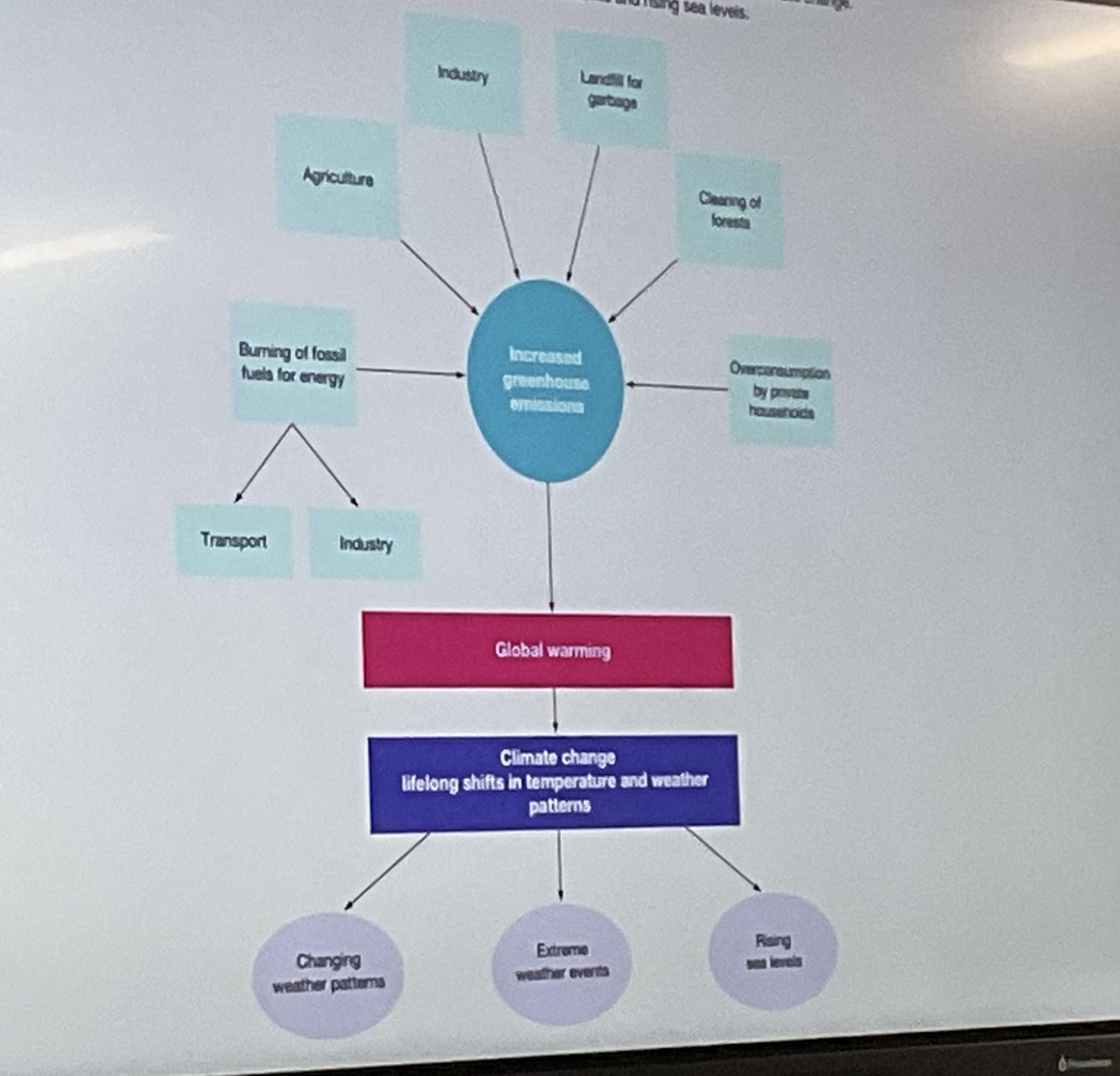
-Climate change is about long-term shifts in temperature and weather patterns.
-Greenhouses gases trap heat that is radiated from the sun (this acts as a blanket wrapped around the earth) resulting in global warming.
-Global warming is causing the melting of glaciers and ice sheets that cover Antarctica and Greenland. This has led to:
-Rising sea levels, changing weather patterns, more intense and frequent extreme weather events such as floods, cyclones and heat waves.
-Climate change leads to an increase in mortality rates of diarrhoea.
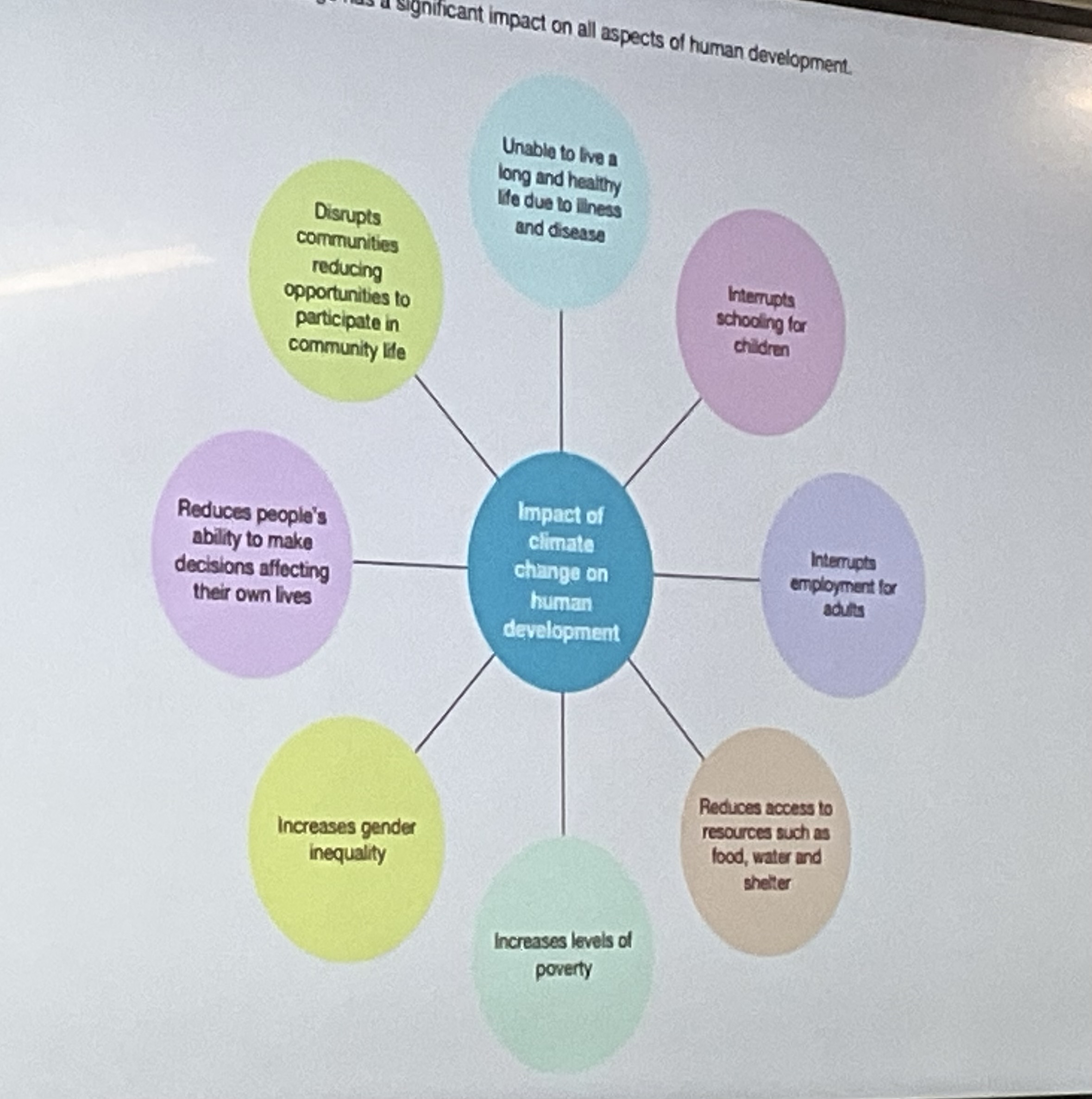
Impact of rising sea levels
Relocation of people living in coastal areas:
-Results in loss of housing, villages, communities and farmlands.
Less Availability of Fresh Water:
-As sea levels increase, saltwater seeps into fresh undergroundd water source known as aquifers (freshwater springs).
Reduced Ability to Grow Food:
-Salt water is unsuitable for most trees, plants and crops.
-Seeds, grains, fruit and vegetables that we currently grow will no longer be aable to grow in many areas.
-As oceans get warmer, they aalso become more acidic. This reduces food supply for those who rely on fish and seafood as their main source.
Changes in Biodiversity:
-Rising sea levels and salinity interrupt the ecosystem and threaten the many systems that sustain life.
Changing Weather Patterns: when weather stays the same for days or weeks at a time.
Changing weather patterns consist of: rainfall changes, changing seasonal patterns, temperature changes.
Extreme weather events consist of: storms and cyclones, extreme heat, floods, droughts, fires.
Conflict and Mass Migration
Displacement= displaced people are those who are forced to leave their home because of war or persecution.
Persecution= Hostility or ill-treatment on the basis of religion, political beliefs, sexual orientation, etc.
Conflicts Impact on Health Status
-Armed conflict directly kills, injures and traumatises, women and children.
-Reduces Life expectancy and HALE, contributes to high mortality and morbidity.
-High maternal mortality, high levels of malnutrition, high rates of communicable diseases, high infant and U5 mortality rates, high rates of mental illness, high injury burden of disease.
-This all stems from armed conflict, laying of landminds, investment in defence rather than health, welfare and education, destruction of infrastructure: health facilities, water and sanitation, electricity, etc.
-The burden of disease associated with injuries is high; young adult males are often overrepresented among those killed or permanently disabled.
-Destroyed/damaged healthcare facilities leads to injuries and diseases being left untreated.
-Crops are destroyed by landmines, which leads to high BOD due to malnutrition.
Physical health and wellbeing is impacted through:
-Destruction of physical environmental and infrastructure; limited access to food, water, shelter, and health services.
-Increase risk of hunger, poor immune system functioning.
-Rape, sexual violence, sexual exploitation, trafficking and sexual slavery of women and girls are more common in times of conflict.
-Personal injuries.
(Decent standard of living: housing, healthcare facilities, etc. Must be specific)
Mass Migration
-The movement of large groups of people from one geographical area to another in response to a crisis.
-Mass migration is when people are forced to leave their home due to a crisis, such as conflict, persecution (often based on race), violations of their human rights and issues relating to climate change.
Types of people that are migrating: refugees, asylum seekers, internally displalced persons, stateless persons.
(explanation not needed)
Refugees- people who have fled their country and crossed an international border in order to find safety in another country.
Asylum seekers- people who have fled their country but for whom their request for protection in another country has yet to be processed.
Internally displaced persons- Forced to leave their home but have not crossed a border to find safety, on the run in their own country.
Stateless persons- Do not have the nationality of any country and therefore are not protected.
-Mass migration is associated with poorer health status.
-Refugees are often forced into crowded and unclean living conditions in refugee camps, with a lack of health services, shortages of food and water.
-Long-term impact of the trauma and fear associated results in high BOD due to depression, anxiety and PTSD.
-As access to health services are limited, chronic disease prevention and treatment are unavailable or not to be accessed.
-This increaes the incidence and prevalence of non-communicable diseases.
Global Trends - Increased World Trade
Globalisation is the process in which boundaries between countries are reduced or eliminated allowing individuals, groups and companies to act on a global scale.
-It can be described as transforming into a global society.
-Cigarettes, e-cigs, processed foods are global trends.
-Since cigarette sales have fallen, tobacco companies are aggressively marketing e-cigarette products and lobbying governments to limit their regulation.
-The aerosol that users inhale includes a range of metals and substances that can increase the incidence and prevalence of diseases, such as: cardiovascular disease, cancer (particularly lung cancer) and diseases of the nervous system and respiratory system.
-Processed foods are any food item that have been deliberately changed before being made available to eat.
-Others contain significant amounts of added salt, sugar, and/or fat that should only be consumed sometimes, these are referred to as ultra proccessed foods.
-Ultra processed foods are designed for maximum profit, are quick and convenient and have long shelf lives.
-They contain cheap ingredients are energy dense and high in sugars, refined starches, unhealthy fats and sodium.
Tourism= refers to activities that people get involved in when they travel to stay in places they do not normally live.
-Visiting tourist attractions, engaging in cultural experiences, exploring new places.
-It is one of the worlds fastest growing industries.
-Tourism includes accomodation, sightseeing, entertainment and experiencing the local culture, food and traditions.
Advantages of tourism=
Economic- Plays a key role in developing jobs for local people and improves living standards.
Social- Promotes mutual understanding, peace and security by breaking down barriers that exist between cultures, and provides opportunities to build trust and peace.
Environmental- Can promote environmental protection- tourism is effective in raising money for the conservation of wildlife and the environment.
Disadvantages of tourism=
-Environmental risks, pressure on local infrastructure and services, increased global emissions, spreading of diseases within and between countries. (aspects)
Digital Technologies
-Digital health technologies are the use of digital tools, platforms and devices in healthcare.
-Wearable health devices such as smart watches, which can monitor vital health signs and other health indicators.
-Telehealth services.
-Mobile health apps.
-AI.
-Robotics.
-Digital health platforms.