Nervous system 1
[[How do messages go from one cell to another?[[
Chemical communication: an action potential passes from 1 neuron (presynaptic) to a second neuron (postsynaptic) at a synapse via chemical messengers called neurotransmitter- neurotransmission
[[2 types of synapses[[
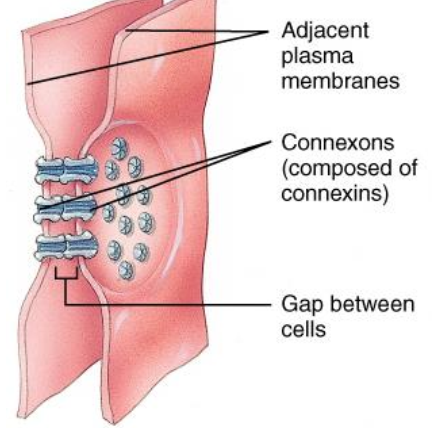
- %%electrical%%
- direct physical contact between 2 cells at gap junctions
- action potential is transmitted quickly and efficiently
- located in the central and peripheral nervous system but rare
- %%chemical%%
- most common type of synapse
- cells are not in contact
- communication between neuron-neuron and neuron-other cell
- information is transmitted by chemicals called neurotransmitter
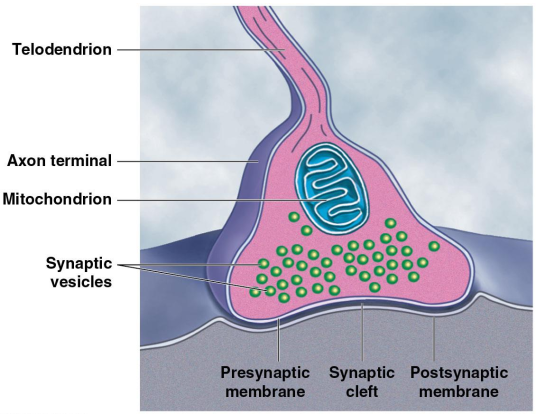
}}neurotransmission}}
- action potential arrives at axon terminal
- voltage-gated Ca2+ channels open and Ca2+ enters the axon terminal
- Ca2+ entry causes neurotransmitter- containing synaptic vesicles to release their contents by exocytosis
- Neurotransmitter diffuses across the synaptic cleft and binds to specific receptors on the postsynaptic membrane
nction
- The neuromuscular junction is a specialized synapse that connects a motor neuron to a skeletal muscle fiber.
involves the arrival of an action potential at the motor neuron, which triggers the opening of calcium channels. This causes acetylcholine to be released into the synaptic cleft, which then binds to receptors on the muscle fiber, leading to muscle contraction. The enzyme acetylcholinesterase breaks down acetylcholine, terminating neurotransmission.
^^Norepinephrine(NE):^^ excitatory and depolarising, wdiely distributed in brain and ANS
^^Dopamine:^^ CNS neurotransmitter, excitatory or inhibitory, involved in Parkinson disease and cocaine use
^^Serotonin:^^ CNS neurotransmitter that affects attention and emotional state
@@Excitatory neurotransmitter@@ e.g acetylcholine
- causes the membrane potential to become positive (depolarisation)
- promotes the generation of an action potential in the postsynaptic cell
@@Inhibitory neurotransmitter@@ e.g gamma-aminobutyric acid- GABA
- causes the membrane potential to become more negatove than the resting membrane potential (hyperpolarization)
- inhibits the generation of an action potential in the post synaptic cell
?
- Postsynaptic potentials: graded potentials developed in a postsynaptic cell in response to neurotransmitters
- Excitatory Post Synaptic Potential (EPSP): depolarises postsynaptic membrane bringing closer to firing threshold ex: -60mV
- Inhibitory Post Synaptic Potential (IPSP): hyperpolarises postsynaptic membrane moving further away from firing threshold ex: -90mV
==Summation==: a process where the effects of all graded potentials are integrated at one region of the plasma membrane i.e. all excitatory, all inhibitory or both excitatory and inhibitory
- Temporal Summation: occurs on a membrane that receives 2 depolarizing stimuli fromt he same source in rapid succession. The effects of the second stimulus are added to those of the first
- Spatial Summation: occurs when sources of stimulation arrive simultaneously, but at different locations. Local currents spread the depolarizing effects, and areas of overlap experience the combined effects
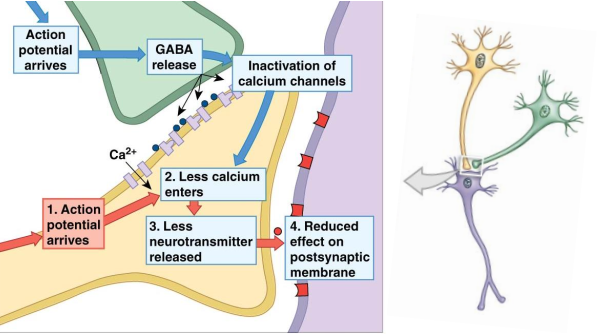
<<Presynaptic Modulation<<
^^Presynaptic excitation:^^ increase neurotransmitter release from the pre-synaptic neuron
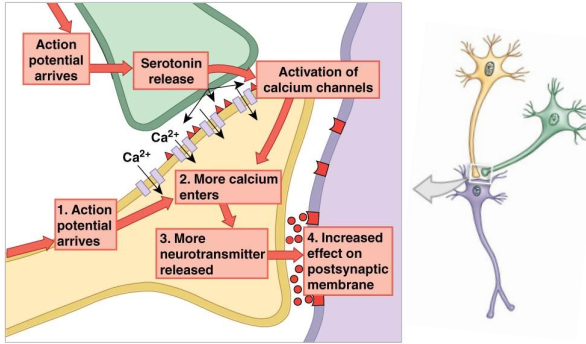
^^Presynaptic Inhibition:^^ decreases neurotransmitter release from the pre-synaptic neuron