Are Viruses Alive Notes
Are Viruses Alive? \n
http://www.beyondbooks.com/lif72/2c.asp (Edited by: Ms.Holt)

Are viruses alive?
Anyone with a cold or the flu virus feels as if they are under attack by some organism. But in the scientific community it's still an open-ended question. This is why viruses do not belong to a kingdom of living things. Just because a virus seems alive doesn't mean it is alive. After all, it's not even a single-celled organism.
A virus is little more than a strand of DNA or RNA covered by a protein coating. Viruses are a thousand times smaller than bacteria and come in a wide range of shapes. Some look like weird, tall spiders whereas others look like prickly porcupines like soccer balls.
One thing is for sure; viruses are very much a part of life on Earth and the human experience. Viruses infect animals, plants, and even bacteria. Humans are in a constant battle with viruses. HIV (the virus that causes AIDS), the Ebola virus, and the West Nile virus continue to make headlines and take millions of lives.
Other maladies, such as colds, the flu, chicken pox, measles, and hepatitis, are more common, but sometimes just as deadly. Symptoms vary depending on which kind of cell is under attack. Cold viruses attack the nose and throat, the rabies virus attacks the brain and nervous system, and the human immunodeficiency virus (HIV) attacks white blood cells in the bloodstream. Viruses can even cause some kinds of cancers and leukemia.
Live and Let Die
To determine whether a virus is alive or not, we could compare the virus's characteristics to what many biologists consider the requirements of life. All living things have several common characteristics.
Viruses do have DNA or RNA, and DNA is the code for life. DNA controls the evolution of the cell and the organism. Viruses evolve through time and thus can adapt to their environment. Viruses cannot use their genetic material by themselves. They need a living cell in order to function and reproduce; otherwise they are playing dead.
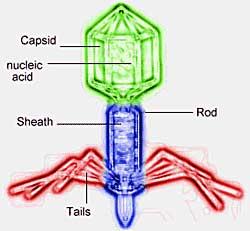 |
|---|
| This may look like a space capsule, but it's actually a virus. The top part is the capsid, the body is the sheath, and the tails at the bottom help the virus attach to its host. |
Because viruses are not cells, they can't divide by binary
fission like bacteria. Yet they do reproduce themselves in
an extraordinary way. Their structure enables viruses to
attack a plant or animal cell called a HOST CELL. The
protein shell protecting the virus's DNA is covered with
spikelike protrusions. These spikes allow the virus to
latch onto the cells they infect. Once hooked on, the virus
injects its genetic material into the host cell.
The virus's DNA takes control of the cell once it's within the cytoplasm and begins to make the cell produce virus DNA and other parts of viruses. The host cell is forced to expend all of its energy and resources to help the virus replicate and make hundreds more viruses. The poor, weak cell usually bursts like an overinflated balloon from all the viruses and is destroyed in the process. Then, the replicated virus attaches itself to a new, unaffected host cell, and the viral infection continues.
Living things do more than just reproduce. They also must obtain food to fuel the cell's metabolic activity. Some organisms, such as animals, eat other living things for energy. Other organisms, such as plants, harness the Sun's energy to make their own food. Because viruses aren't cells and have no activity within it, it has no need for food. However, the virus-controlled host cell needs material and energy to reproduce the viruses. Maybe viruses can fit the requirement that life forms need to obtain and use energy.
All other living things also grow or get bigger. A virus does nothing inside its protein coat; therefore it does not grow. But some scientists argue that a virus's growth occurs inside the host cell where parts of viruses are built during reproduction.
What is your final answer? Is a virus living or nonliving?
Name:__________________________________ Date:______________________ Pd:__
Is A Virus Living or Nonliving?
(http://www.nburlington.com/ourpages/users/alanoue/Bio_handouts.htm)
Scientists debate whether or not viruses are living. Use the article, Are Viruses Alive? to complete the following chart.
| EVIDENCE FOR LIVING | EVIDENCE FOR NONLIVING |
|---|---|
| Reproduce using cells Have DNA which they use to attack cellsAdapt to their surroundings Viruses evolve to attack hosts better | Can not process their own energy.Do not have cellsDo not self regulate or maintain homeostasis |
Do you think viruses are living or non-living? Below, write 1-2 paragraphs stating your position. Support your opinion with specific information from the chart above along with information from your characteristics of life notes.
Viruses are non-living. They can not process their own energy, they have to use the host cell to actually process it. They also do not have cells of their own, which is a necessary trait of life. Viruses are also incapable of homeostasis. Since life needs to have all of these traits, they are not actually living.