2.5 - Determination of the speed of sound using stationary waves
Definition of a stationary wave and the speed of sound:
Stationary wave: A stationary wave is a pattern of disturbances in a medium, in which energy is not propagated. The amplitude of particle oscillations is zero at equally-spaced nodes, rising to maxima at antinodes, midway between the nodes.
Speed of sound: The speed of sound is defined as the distance through which a sound wave’s point, such as a compression or a rarefaction, travels per unit of time.
Theory:
When resonance first occurs the length of air in the tube, l, plus a small end correction, e (to account for the position of the tuning fork above the tube) will be equal to a quarter of a wavelength. Hence:
l + e = λ/4 but λ = c/f
so l = c/4f – e
If a graph is plotted of l (y-axis) against 1/f (x-axis) it should be a straight line with a small negative y-intercept. The gradient of the graph equals c/4, and so the speed of sound, c, can be found. The small negative intercept will give the end correction.
Apparatus/Diagram:
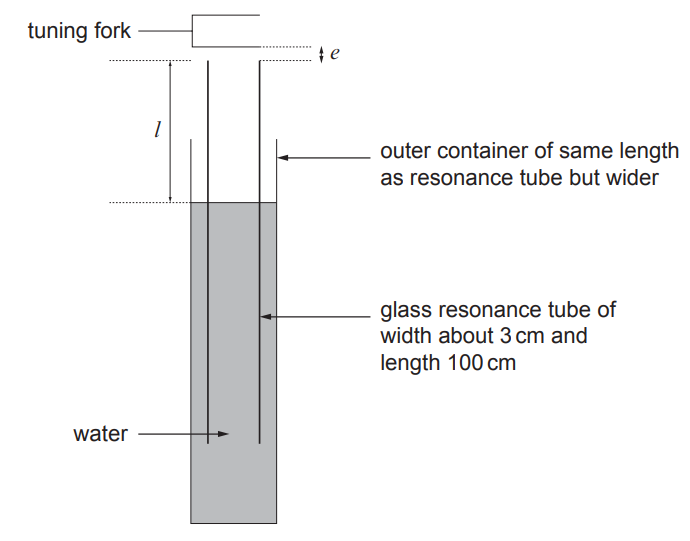
A range of at least five different tuning forks will be needed along with a metre ruler of resolution ± 0.001 m.
Experimental Method:
Initially place the resonance tube as deep as possible into the water. Then gradually raise it. As this is being done hold a vibrating tuning fork over the top. When resonance occurs (a loud sound will be heard) measure the length of the tube above the water level.
Repeat the above for each of the tuning forks. Plot a graph of length (y-axis) against 1/frequency (x-axis). Use the gradient to determine a value for the speed of sound.