9th Grade Physics - Color
COLOR IN OUR WORLD
Color depends on Frequency → lowest is red vs. highest is violet
SELECTIVE REFLECTION
We see the color of something by the light it reflects, and its color depends on it’s natural frequency.
Objects reflect some frequencies and absorb others. Red objects absorb all but red. Objects that reflect no light appear black, and objects that reflect all light appear white.
SELECTIVE TRANSMISSION
The color of glass depends on the color it transmits. The color it transmits is the color it appears. Colored glass is warmed due to energy of absorbed light illuminating the glass.
MIXING COLORED LIGHT
SOLAR RADIATION CURVE: The graphical distribution of brightness vs Frequency. It’s distribution is uneven, and the yellow-green area is where our eyes are the most sensitive.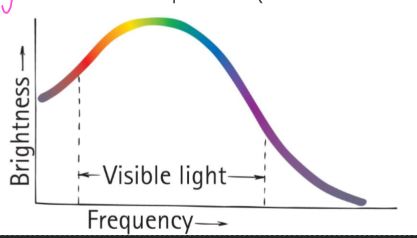 MIXING COLORED LIGHT
Additive Primary Colors: Red, Green, Blue. Produces any color in the spectrum. When two overlap, a new color is produced.
MIXING COLORED PIGMENTS
Subtractive Primary Colors: Cyan, Magenta, Yellow. Called Subtractive because pigments in paints and dyes absorb or “subtract.” Combination of two of the primary colors.
Complimentary/Opposite Colors: A subtractive and additive primary that add together to produce white. Called complementary and opposite.
Only three colors of ink (plus black) are used to print photographs. The colors are the subtractive primaries.
Pigment: Tiny particles that absorb specific colors. EX: Pigments that produce red absorb cyan.
When white light passes through overlapping sheets of the subtractive primaries, black is created. When only two subtractives add together, and they share one color, the color they share is subtracted (EX: yellow + cyan = magenta).
BLUE SKY? WHY
Results of SELECTIVE SCATTERING of smaller particles than the wavelength of the light shone upon it, and it resonates at frequencies higher than scattered light. The tinier the particle, the higher the frequency of the light it will re-emit.
The light shone upon the sky is sunlight. Blue scattered light predominates our vision.
Varies in different locations under various conditions:
Dry days - deep blue
Humid days - beautiful skies
Days with more airborne particles - whitish skies
After heavy rain - deeper blue sky (washing away of airborne particles)
RED SUNSETS? WHY
Light that is least scattered is light of low frequencies (red, orange, yellow), which best travel through air. 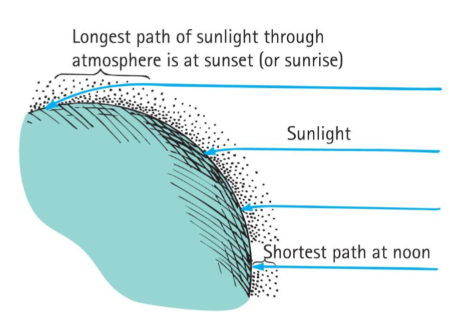 CLOUDS WHITE? WHY
Clouds are clusters of various sizes of water droplets
Size of clusters determine scattered cloud color:
Tiny - bluish
Slightly large - greenish
Larger - Red
Overall Result → White
Slightly larger - deep gray
EVEN LARGER - rain
GREENISH BLUE WATER? WHY
Water molecules resonate in the visible red, which causes red light to be absorbed. Red’s removal causes cyan (green + blue)
Vivid Blue Lakes: fine particles of silt/rock flour remain suspended in the water. Light scatters from these particles and gives the water its color.