Romantic Classicism II: England and America - Lecture Notes
The English
17th Century as Precursor to Romantic Classicism
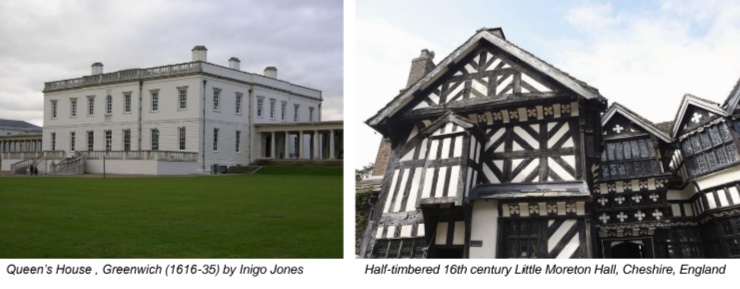
England lagged behind Europe in art and architecture, remaining in the Elizabethan style until Inigo Jones introduced classical architecture in the early 17th century.
Inigo Jones's style remained a rarefied taste, limited to the court.
Inigo Jones
Jones was a Platonist who believed architecture should embody perfect geometrical forms to reflect the cosmos.
His design method was strictly rational and mathematical.
Queen’s House, Greenwich (1616-35) exemplifies Jones's classicism.
17th Century: English Baroque
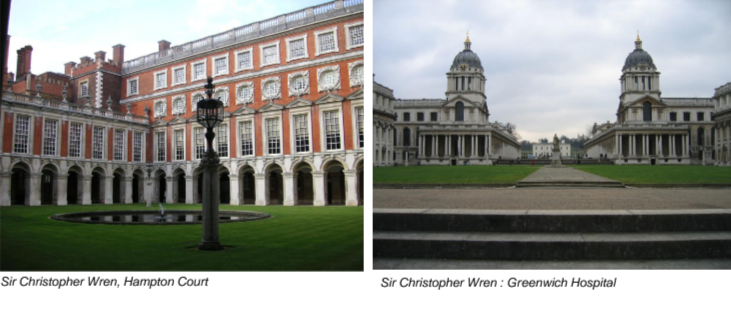
Following Jones, Christopher Wren popularized classical architecture, seen in Hampton Court, Greenwich Hospital, and St Paul’s Cathedral.
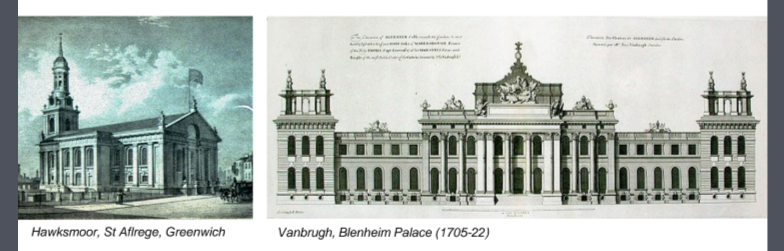
Nicholas Hawksmoor and John Vanbrugh represented the height of English Baroque classicism.
English Romantic Classicism
After Queen Anne's death in 1714, George I brought the Whigs to power, leading to a new taste direction led by Richard Boyle, Third Earl of Burlington.
Burlington shifted architecture back to Inigo Jones and Andrea Palladio.
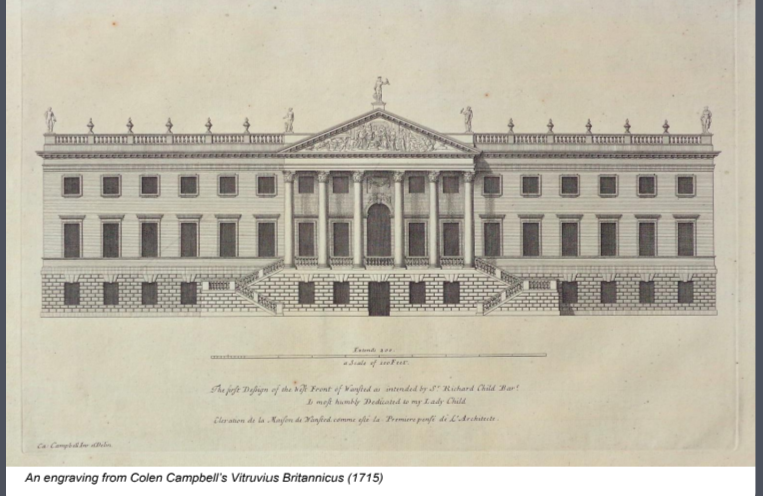
The English edition of Palladio's Four Books of Architecture and Colen Campbell's Vitruvius Britannicus (1715) re-familiarized the public with Inigo Jones's buildings.
Campbell praised Palladio and Jones, setting the stage for Neo-Palladianism in England for forty years.
English stylistic periods are named for the reigning monarch.
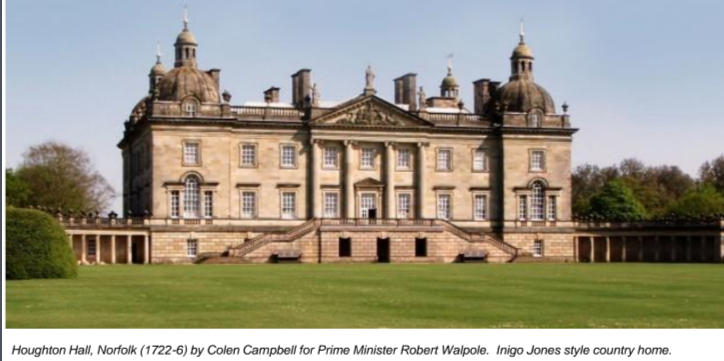
Houghton Hall, Norfolk (1722-6) by Colen Campbell exemplifies the Inigo Jones style country home.
Lord Burlington
Lord Burlington (Richard Boyle, 3rd Earl of Burlington) envisioned a universal language representing liberty and democratic society.
Inspired by Palladio's architecture during his Grand Tour in Italy in 1714, Burlington became a dictator of taste in England until his death in 1753.
He gathered architects, artists, and poets, including Colen Campbell, William Kent, and Alexander Pope, who used Palladio as their model.
The group identified as English Augustans, seeking a second Golden Age for England.
Augustus, the first emperor of Rome, transformed Rome from sun-dried bricks to marble.
Burlington aimed to reinstate Roman architecture canons as described by Vitruvius and exemplified by Palladio, Scamozzi, and Jones in eighteenth-century England.
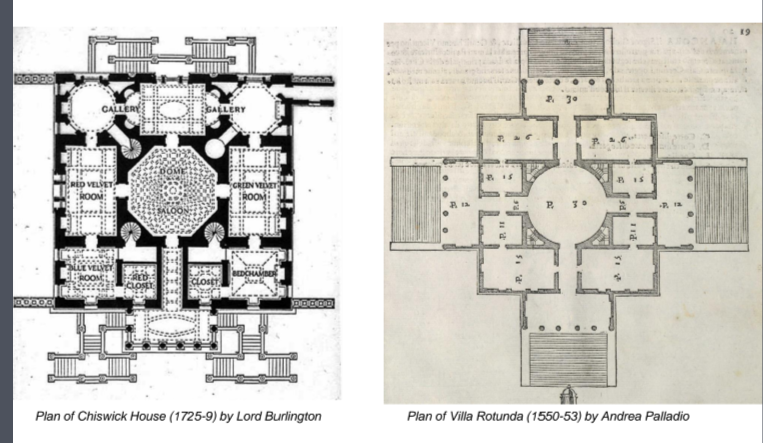
Burlington designed Chiswick House with William Kent, housing his art collection and furniture purchased during his Grand Tour of Europe in 1714.
Construction of the villa took place between 1726 and 1729.
Chiswick House (1725-1729)
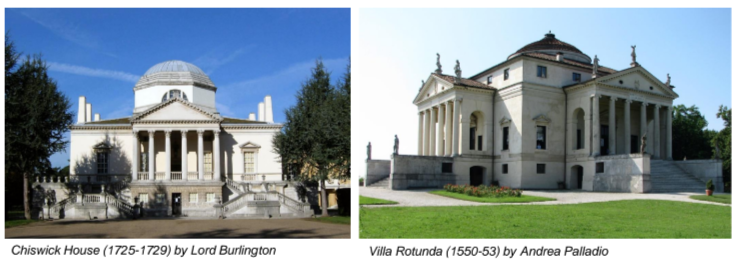
Burlington's approach to Palladian principles at Chiswick was intellectual, creating a smaller version of Palladio’s Villa Rotonda.
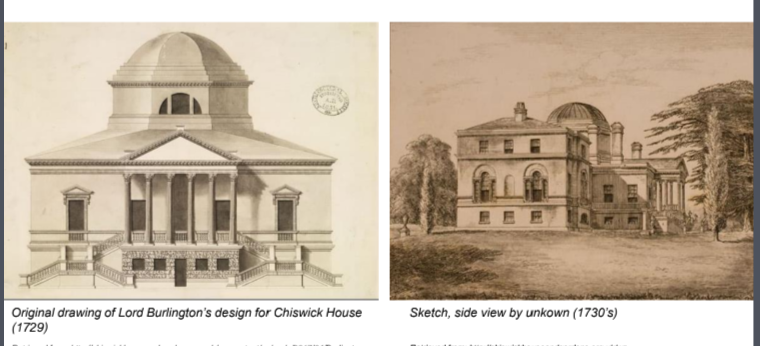
The plan includes suites of apartments around a central octagonal domed salon.
The rooms are shaped differently, including round, octagonal, and apsidal-ended forms.
The four facades are different, with a neutral wall surface punctured by purposeful openings.
Recessed Venetian windows on the rear facade became a staple in neo-Palladian buildings.
The octagonal drum with thermal windows is juxtaposed to the cubic mass.
Chiswick Gardens
The gardens surrounding Chiswick House were designed by William Kent and represent an early example of the English Landscape School.
Kent's design was modeled on Claude Lorrain’s paintings of Roman ruins amidst Arcadian landscapes.
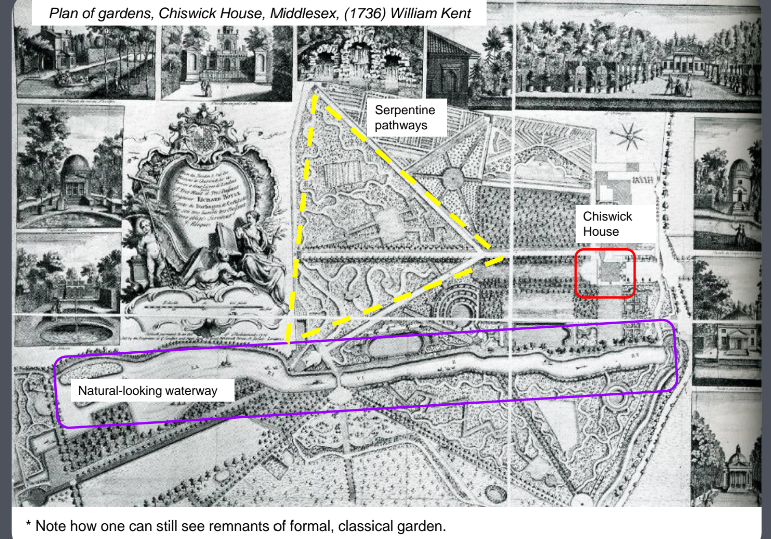
The landscape was superimposed on a formal Baroque garden.
English Landscape School
The English Landscape School originated in England, emphasizing man’s relation to nature.
Nature was viewed as an equal partner providing interest, refreshment, and moral upliftment.
Irregularity was a crucial objective.
The Enlightenment revealed that nature could harmonize with a rational Palladian mansion.
Three schools of thought intermingled to drive landscape design in the 18th-century:
Western classicism emanated from Baroque Italy and Absolute monarchy in France
Chinese approach to the landscape (chinoiserie) was first assimilated by the French court
The English revolted against classicism in landscape.
The development of the school was initiated through aspects of new ideas stemming from the Enlightenment:
Nostalgic revival of past ages [Historicism]
Powerful realisation of the beauties of wild, untamed nature [Primitivism / Back to Nature]
Intricacies [irregularities] of a new-found sense of space [landscape unfolding as you move through it / rise and fall / ‘painting’ scenes with the landscape / views toward an eye-catcher]
English gardens became conceived as natural, contrasting with the classical severity of the buildings.
These landscapes were embellished with features such as bridges, temples, and grottos, reminiscent of Arcadian scenes.
Alexander Pope
Alexander Pope influenced garden design, advocating for the simplicity of unadorned nature.
William Kent
William Kent was an architect, interior designer, gardener, and painter.
He was a Palladianism proponent and saw the creation of the informal English garden.
Kent achieved his freest design expression in garden design.
Kent saw landscapes as paintings, using perspective, light, and shade.
He incorporated winding paths, open vistas, classical temples, and natural-looking waterways.
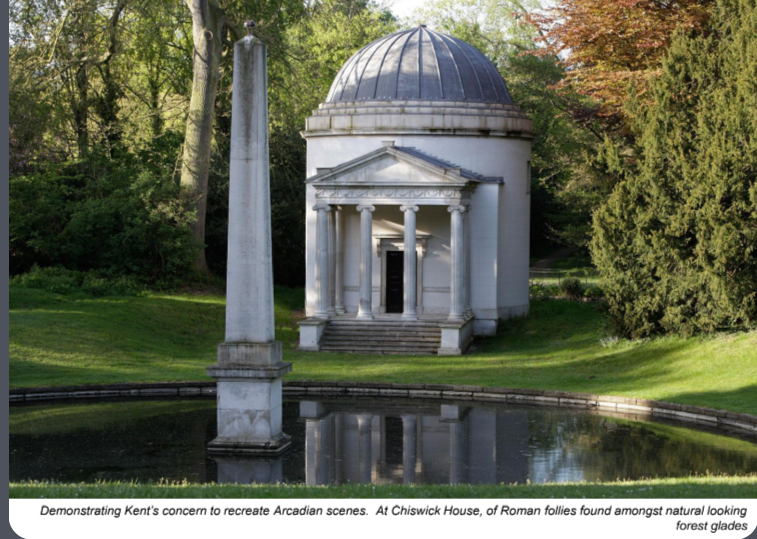
Kent’s gardens were reminiscent of Ancient times, featuring statuary, temples, grottos, and hermits’ caves.
Horace Walpole noted Kent's genius in striking out a great system from imperfect essays, appreciating the contrast of hill and valley.
Demonstrating Kent’s concern to recreate Arcadian scenes, Chiswick House of Roman follies found amongst natural looking forest glades.
Arcadian 'remnants', bridges and grottoes, at waters edge, amongst sylvan groupings of trees, Chiswick gardens
The members of the Burlington school were important pioneers of the association of architecture and its environment, which would later become part of the Romantic Movement [19th Century].
For the French Baroque, the landscape is a controlled geometry, to be apprehended in a single glance, with the Chateau inside, lavish and full of excitement. The reverse is true of English in the 18th century, where country houses had serene interiors, while outside nature is natural, unfolding naturally as you stroll through it and apprehend it.
The English: Conclusion
The period was literary, with philosophical writers influencing artistic and political movements.
Rationalism, strict classicism, and the worship of nature qualified Romantic Classicism.
The Americans: Thomas Jefferson’s Classicism
Classicism came to America in the 18th century through Thomas Jefferson (1743-1826).
Jefferson was inspired by the Palladian phase in France while serving as ambassador.
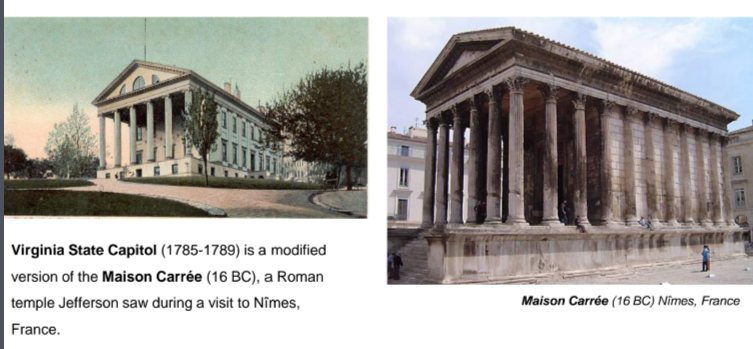
The Virginia State Capitol (1785-1789) is a modified version of the Maison Carrée (16 BC).
Jefferson never went as far as Rome, the influence that the Pantheon (125 AD) had over the design of his Rotunda (begun 1817) at the University of Virginia is evident.
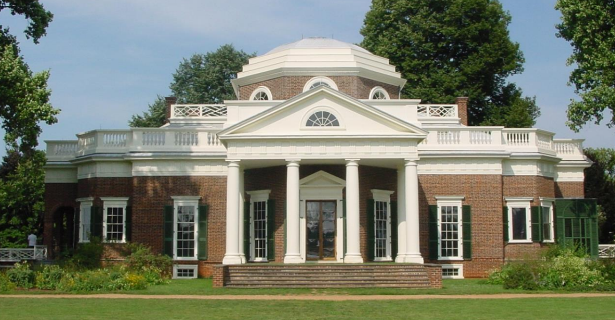
Jefferson had already built for himself a Palladian villa at Monticello, near Charlottesville, Virginia, in 1770, which owed much to Palladio’s Villa Rotonda. In 1796, after his time in France, Jefferson remodelled Monticello.
Monticello
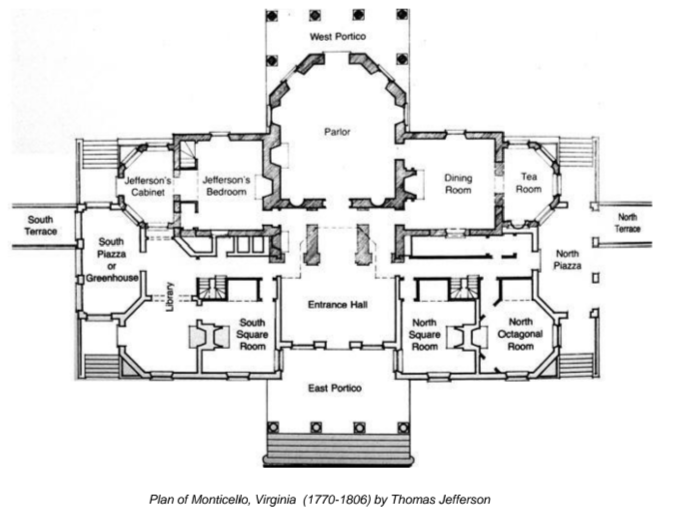
Monticello domesticates the Pantheon with a central dome and cross-axial plan.
The design stretches horizontally, acknowledging the site and burying service units underground.
Monticello, like the primordial American home, seeks stability and freedom while valuing European tradition and modern comfort.
Virginia State Capitol
The Virginia State Capitol (1785-1789) is a modified version of the Maison Carrée (16 BC).
University of Virginia
Thomas Jefferson, William Thornton, and Benjamin Latrobe planned the ‘academical village’ at Charlottesville University of Virginia 1817-1826, as a collection of different sizes and types of classical buildings.
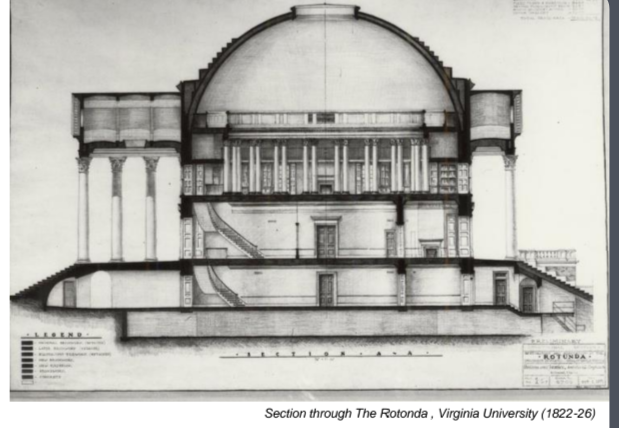
The library, known as the Rotonda, is modelled on the Pantheon, Rome.
The Rotonda (library), Virginia University (1822-26) by Thomas Jefferson
Jefferson's enthusiasm for classical architecture surpassed mere aesthetic fancy. He was expressing his admiration of the ideas set forth from the classical past: democracy, learning, and permanence.
Capitol Building
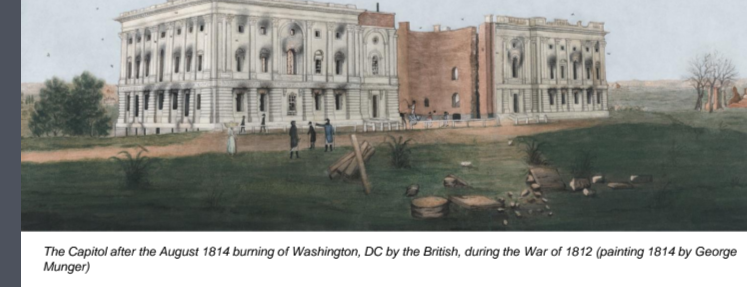
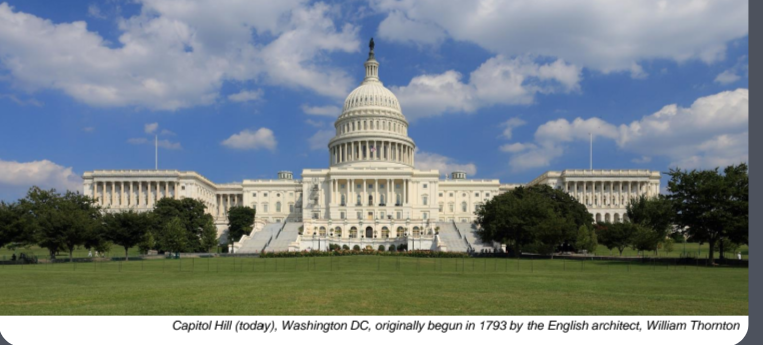
Capitol Hill (today), Washington DC, originally begun in 1793 by the English architect, William Thornton
Capitol at Washington (begun 1793) by English architect William Thornton owes much to Jefferson and his introduction of Classicism to America.
The shape is traced to the Parthenon (Greece) and Pantheon (Rome), however, the feature that gives its well-recognized silhouette: the triple tiara dome by Thomas Ustick Walter (1804-88), places the building firmly in the 19th century, when it was completed in 1867; it is made of cast iron.
After many extensions, the Capitol is the colossal it is today.