Product Design 3/4
Unit 3 Aos 1
One-off Manufacturing
Custom-made product
Usually high quality/hand-made
e.g. wedding dresses jewellery
Technologies
Hand tools, CAD, 3D printing
Low Volume Production
Number of identical products being made in a small number or batch
Usually for specialised products with a niche market
e.g. Boutique clothing, dinnerware
Can respond fast to changes in the market (can be the first on the market that meets)
Mass (High Volume) Production
Mass produced (thousands-millions of identical items)
Can be purchased in bulk at lower cost
Less flexibility - cannot respond quickly to market changes
Technologies
Automation, AI rebotics (mostly automated)
Continous Production
24/7 production (heat/time or chemical sensitive)
Used where there is high demand for products with few variations
e.g. water bottles, mining
highly automated, run by CAM, conveyerbelts
Technologies
CAD, CAM, autonomous, AI, rebotics
Quantitative
Numerical data
e.g. groups, percentages
Qualitative
Descriptive data based on characteristics
(high detail)
Traditional technologies
older designs that are still used and valued for their simplicity and reliability
eg. hand tools, hand machinery
New & emerging technologies
more sophisticted and complex, usually safer and more efficient than traditionl technologies, supersedes all previous methods of production
Automation
automated control of technologies and machines, usually controlled by computers
Most useful to eradicate any unsafe practices (human error) and repetitive tasks
Artificial Intelligence (AI)
Complex computer programming that uses machine learning (ML) that is efficeint and ecomonic with quick analisation without human interaction
e.g. creating and optimising a design in CAD, move parts around factory floor
Mostly suited to high-volume production
4IR technology
The Fourth Industrial Revolution, where technologies and data are interconnected and responsive to each other
lined to new & emerging
Laser technology
intense beam of monochromatic light concentrated through a lens
used for: rapid prototyping, cutting complex shaes accurately
GOOD FOR BRANDING
One-off, low-volume and high-volume
Robotics
processing activities
robots don’t tire - suitable for sorting (if equiped with sensors) and pick and place (PnP) processes
Suitable for both high- and low-volume
Computer-Aided Design (CAD)
virtual designs
allows 3D visualisations which reduces cost and development times, also allow for detailed simulation
CAD files are linked quickly and easily to Computer Aided Manufacturing (CAM)
One-off to High Volume
Computer-Aided Manufacturing
uses CAD to make something physical
e.g. fusion design - 3d printing
Suitable for both low- and high volume
Computer Numerical Control (CNC)
Coordinates numeric info to control position / movement / speed
used to control drilling / milling tools to reduce error and human action
Suitable for both low- and high volume
Rapid 3D Prototyping
3D printing / additive manufacturing
fast process for building physical 3D prototypes / parts
used to test feasibility, functionality, strength, ergonomics, sizing, feel and sustainability of materials
Suitable for one-off, low-high, and mass volume
Additive manufacturing
adding layers of material allows for complex geometries and customizations that traditional manufacturing methods cannot achieve
Subtractive manufacturing
removing material
Lean Manufacturing
A practice that aims for reduced cost (per unit) while keeping quality
data oriented
comanies offer one or two versions of a product but largely do not allow for customization
8 waste areas in Lean Manufacturing:
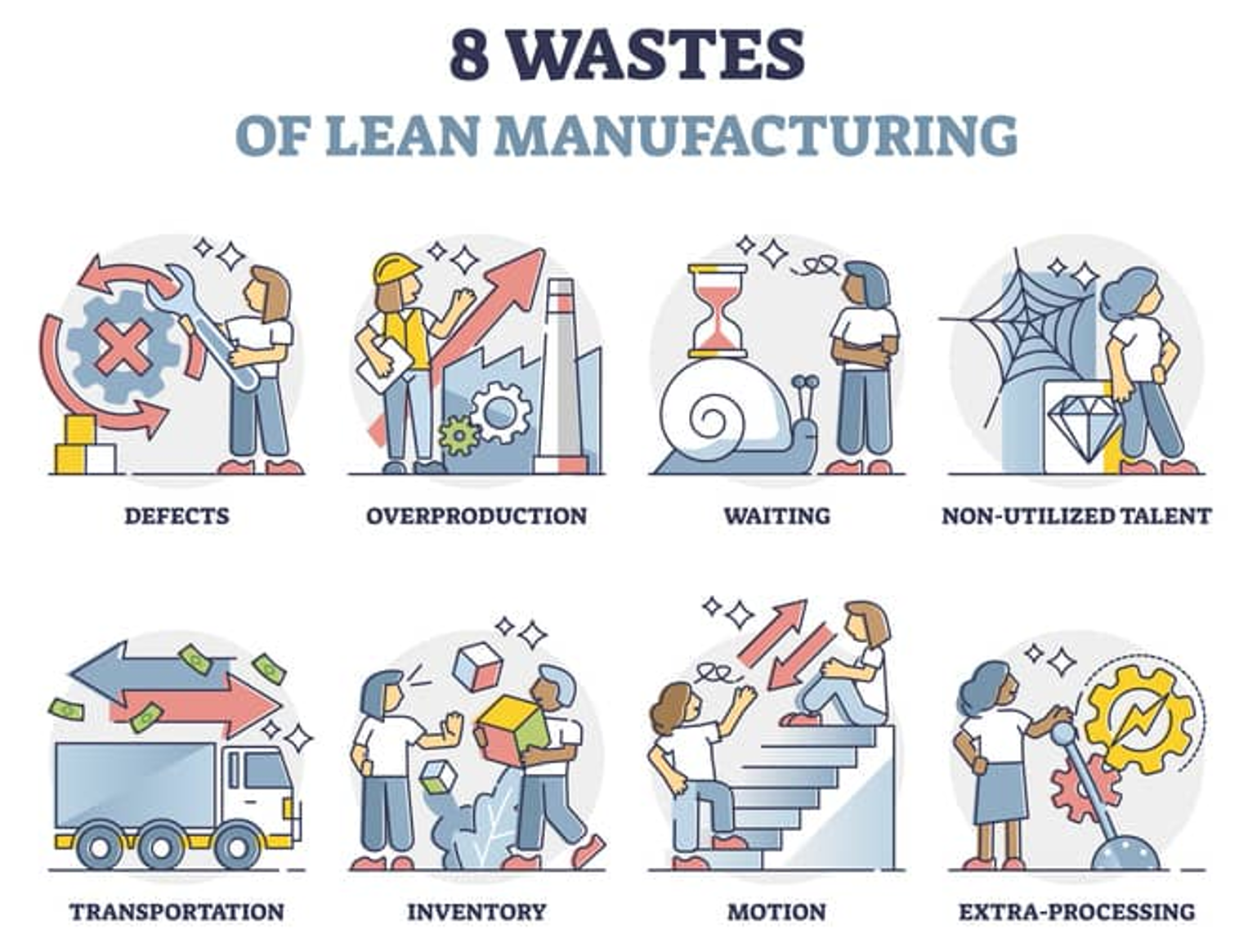
overproduction, unnecessary transport, excess inventory, motion, defects, over-processing, unutilised talent/skills (e.g. gaining input from workers), waiting times
Lean manufacturing sustainablility
lean can contribute to more sustainable manufacturing due to the elimination of waste, isn’t alwayss the case
cost of input are considered wasteful and needs to be eliminated,
smooth production that run effectively,
measurements are used to makes decisions and improvements rather than opinions,
workers are carefully trained
Flexible and Responsive Manufacturing
easily achieved through lean manufacturing and responds quikly to chanes in trends. Allows changes to production with little notice
e.g. Apple - able to make rapid adjustments to production
Suitable for both low and high volume
What is sustainability?
Meeting present needs without compromising needs of the future
Sustainibility
making the best choices for planet’s health by protecting natural environment and using resources wisely
TRIPLE BOTTOM LINE / 3 pillars of sustainability (3P’s)
People - social
Planet - environmental
Profit - economy
Terminology linked with environmental sustainability
climate change
carbon dioxide
finite resource
waste
landfill
incineration
ecological footprint
Circular Economy
3 principles
circulate products & materials, reduce waste & pollution, preserve nature
has a lot in common with C2C
aims to work with technical & biological resources
TRIPLE BOTTOM LINE (3BL)
An expression that covers the 3 pillars of sustainability / 3P’s
encourages companies to focus on profits AND consider social & environmental impacts
- how to improve people’s lives and the wellbeing of the planet
6R’s
reduce, reuse, recycle, repair, rethink, refuse
reduces use of resources y reduceing what we use/create
“how soon will this product end up in a landfill?”
Life Cycle Analysis/Assessment (LCA)
standardised technique measuring product’s impact on the environment / human health over its total life cycle
Purpose: compares impacts of 2 or more similar products over the 5 life cycle stages to find out which is more sustainable
CRADLE TO CRADLE (C2C)
encourages a circular approach & upcycling
LCA looks at cradle to grave, C2C encourages circular approach
Upcycling
producing materials or products of equal or greater quality after each round of recycling
Downcycling
creating materials or products of lower quality, which eventually end up in landfill
DESIGN FOR DISSASSEMLY (DfD)
ses the design stage to consider how parts are joined and how easily it can beseparated at end of its life
EXTENDED PRODUCER RESPONSIBILITY (EPR)
Producers are responsible for managing the environment impact of their products, particularly at the end of a product’s life
they are expected to ‘take back’ products when they are no longer useful and manufacture it into new products.
Greenwashing
when companies/organisations falsely promote products or practices as eco-friendly to mislead consumers
e.g. misleading labels (“eco-freindly”, “sustainable” without verifiable evidence), overstated claims (“100% recyclable” when only certain comonenets are recyclable)
can lead to consumer mistrust
What is Obsolescence?
when a product beocmes obsolete (no longer needed)
e.g. no longer useful, out of date, broken, incompatible with current tech
Planned Obsolescence
when a product is designed to fail within months or years, leading consumers to replace them sooner
benefits and issues:
consumers
benefits: cheap/affordable, easily replaced
issues: products don’t last, repair is difficult/expensive/impossible
producers
benefits: more products sold means economic benefits for manufactures and retailers, business can keep evolving
issues: need to invest in new technology, constant attention to the product development process
associated environmental, economic and worldview issues
benefits: increased employment and wealth for the community
issues: increase in waste, contributes o pollution of air, water and land, uses up resources, requires a lot of energy
3 ways in which a product becomes obsolete: FUNCTIONAL, TECHNICAL, STYLE
Functional obsolescence
products are intentionally made with lower quality materials and construction to limit lifespan
Technical obsolescence
products become obsolete due to advancements in technology or new design features
Style obselescene
products become outdatd due to changing trends and fashion
the impact on planned obselescence on sustainability
planned obselescence has environmental social, aad economic costs, despite its benefits
Biproducts
Impacts 3P’s
A type of material derieved from living organisms or their by-products
e.g. bioplastics from soybeans, cornstarch
Mycelium
white, thread-like root structure of fungi, mostly foun underground
Applications: leather alternatives, lightweight packaging
Positives:
✅compostable with water
✅strong yet lightweight
✅moldable into almost any shape
Negatives:
❌less durable and elastic than plastics
❌not widely available - still in early development
❌slow growth - can take weeks/months to form
Innovative polyers used for 3D printing
3D printing builds objects layer by layer using melted plastic guided by a digital file
Types of polymers for 3D printing:
biodigradable polymers, conductive polymers, shape memory polymers, self-healing polymers, polymer-bonded rare-earth magnets, bio-compatible polymers, fibre-reinforced polymers
Positives of Innovative Polymers in 3D Printing
✅ reduces material waste compared to traditional manufacturing.
✅ allows for custom, on-demand production.
✅ enables products with specialized properties (e.g., strength, conductivity, self-repair)
Negatives of Polymers in 3D Printing
❌ Sustainability concerns, PLA plastic (labeled biodegradable) decomposes very slowly and requires industrial conditions. Mixed-material filaments are non-recyclable and usually end up in landfills or incineration
Repurposed plastics
Recycled or recovered plastics squashed together used for new purposes.
Applications: Roads (mixed with bitumen), packaging, textiles, construction, and industrial products.
Requires collection, sorting, and processing; may be combined with other materials for composites.
Positives
✅ Reduces plastic waste in landfills and the environment.
✅ Lowers the demand for virgin plastic production.
Negatives
❌ Lack of infrastructure and funding for recycling programs.
❌ Only 9% of plastics are recycled globally (WWF).
❌ Poor awareness and education on plastic separation.
❌ Minimal efforts to reduce plastic use.
❌ Misconception that plastics are easily recycled leads to complacency.
❌ Weak regulations on plastic usage in businesses.
❌ Low demand and quality of recycled plastics.
❌ High energy consumption and costs in recycling.
Composite Materials (metal matrix composites)
Metal Matrix Composites (MMCs) combine two or more metals or add materials like ceramics or fibers.
Enhances properties: strength, hardness, stiffness, lower weight, wear & corrosion resistance.
Positives
✅ High strength, stiffness, and wear resistance.
✅ Lighter than solid metals, reducing structural weight.
Negatives
❌ Difficult and costly to recycle due to material separation.
❌ Very low global recycling rates; most end up in landfills.
Composite timber (engineered wood)
Positives
✅ More durable than natural timber.
✅ Resistant to moisture, rot, and insects.
✅ Requires less maintenance, making it ideal for outdoor use.
Negatives
❌ Expensive compared to natural wood.
❌ Non-biodegradable – ends up in landfills or incineration.
❌ Some binding agents (glues) may cause health issues.
Vegan Leather vs Animal Hide
Animal Hide Leather
✅ Positives
vDurable, flexible, molds to wearer.
vWater-resistant, windproof, and warm.
vBiodegradable (depending on treatment).
vOften a by-product of the meat industry.
•
❌ Negatives
vRequires animal breeding and pasture, which demands more land than crops.
vTanning process uses harsh chemicals, harming the environment and workers.
Vegan Leather
vTypes of Vegan Leather:
1.Petroleum-Based (PVC, PU) – Synthetic, highly polluting, non-biodegradable.
2.Plant-Based – More eco-friendly but often coated with plastic, reducing biodegradability.
✅ Positives
vLower environmental impact in raw material sourcing.
vOften made from plant waste.
❌ Negatives
vLess durable and comfortable than real leather.
vContains plastics (PU, PVC), making it non-biodegradable and non-recyclable.
vTakes hundreds of years to break down; ends up in landfills or incineration.
SAC Key Points
3D Prototyping
CNC
Laser
CAD-fusion
good to have in design, can change products rapidly
need to know how to adapt to market, customization
need to know types of obselecence
how do you stop something from becoming obsolete?
alternative materials