Lecture 2 - Rock & the Rock Cycle
Rock
Any naturally occurring solid mass or aggregate of minerals or mineraloid matter
It is categorized based in minerals included, chemical composition and its genesis
Generally classified into three: Igneous, Sedimentary, and Metamorphic
Rock Formation
A mappable unit of rock consisting of an initially connected volume deposited in one interval of time
A formation may contain an assortment of different kinds of rocks but there is a prevailing character in the mix of rocks.
The distinctive character of a formation may relate to the engineering properties
Soils
Formed by weathering of rocks
The soil’s physical property is dictated primarily by the minerals that consists the weathered rock
The Rock Cycle
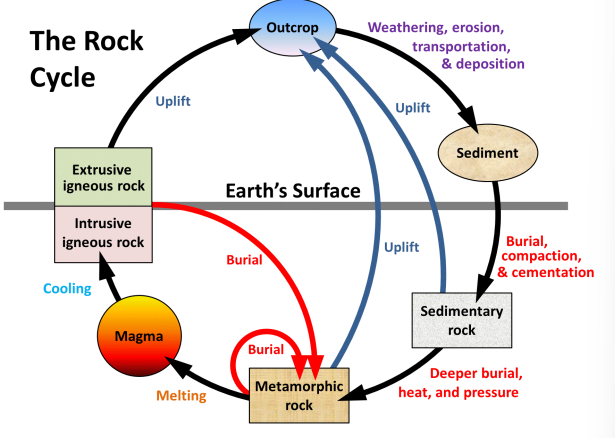
Magma is rock that is hot enough of being molten (800 - 1300°C)
Igneous rocks form from the cooling of magma
Extrusive (forms above surface; seconds to years to form)
Intrusive (forms within crust; centuries - millions of years to form)
Outcrop: Part of bedrock exposed at the surface. All exposed rocks are subject to some form of weathering (physical and chemical)
The weathering products are eroded, transported, and deposited as sediments. Sediments are the smaller particles from the rocks after weathering, erosion, transportation, and deposition process
Unless they are moved, they will be buried by more sediments or other materials
At depths of hundreds of meters, they are compressed and cemented to become sedimentary rocks
When rocks are buried deeper and heated up and squeezed, they form metamorphic rocks
Uplift - process of bringing material buried under the surface onto the surface
Burial - getting material into deeper depths
Uplift and Burial can happen to any kind of rock
Weathering, erosion, transportation, and deposition - are processes involved in breaking down rocks and transferring to another place until it settle in a place
Any rock can be brought up to the surface and part of it becomes an outcrop and be exposed to weathering and become sediments
Sedimentary rocks come from sediments which may come from any kind of rock. The rocks just need to be exposed and this usually means that these rocks are brought above the surface
Igneous rocks come from magma. Magma can form from metamorphic rocks
Metamorphic rocks can come from any kind of rock as long as they are buried deep enough to experience great temperature and pressure
Minerals
Naturally occurring inorganic compound with a definite composition
Make up rocks, although most of the rocks will have several different minerals in it
Only a small set of minerals are rock-forming: mostly silicates
Mineral Properties
Color - some minerals may have variations of color so it is not a reliable way to describe minerals by itself
Streak - color of the mineral in its powdered form
Luster - the way the mineral reflects light
Metallic
Dull
Pearly
Vitreous (glassy)
Hardness - measures the ability to scratch or be scratched
Mohs Scale of Hardness is used to determine how hard a mineral is by scratching it against reference minerals
Cleavage - The way a mineral breaks along a plane easily and smoothly based on its lattice. The plane of breakage is called the cleavage plane
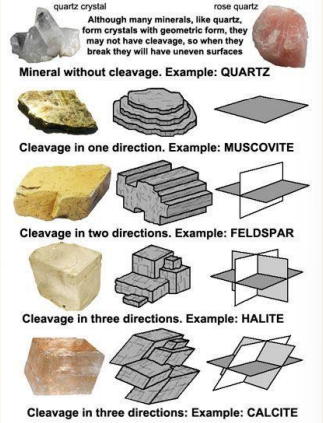
Fracture - The way a mineral breaks if there are no cleavage planes
Density - Mass/Volume of a mineral. Specific weight (Weight/Volume) is simply the density multiplied by g.
Mineral Identification - Identification of minerals contribute to identification of rocks and their properties
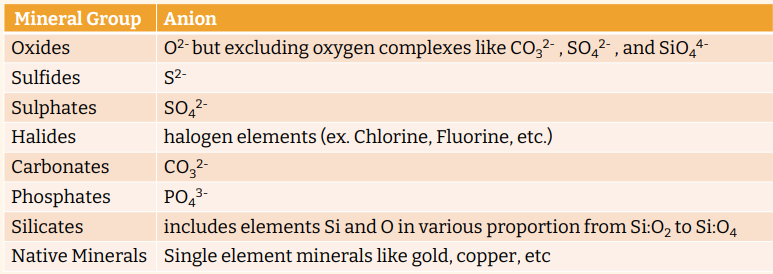
Mineral Groups - minerals are grouped based on the predominant anion or anion complex
Mineral Formation
Most minerals forming the rocks are from the process of magma cooling
As magma rises, it cools, and minerals can crystallize
If cooling is fast (minutes to years), minerals may not have time to become ordered, and only small crystals are formed
If cooling is slow (decades to millions of years), higher level of ordering may be achieved, and larger crystals can form
If cooling is too rapid (seconds), the rock will be glassy, meaning no crystals were formed.
Minerals can also be formed via:
Precipitation from aqueous solution or gaseous emanations
Metamorphism
Weathering
Organically
Use of Minerals
Since minerals are found in rocks, a lot of the characteristics of minerals matter in our usage of rocks
Some minerals are mined to be used as additives or to be processed to make construction materials like gypsum, cement, and aggregates (sand and gravel used in concrete making)
Certain minerals that decay or become weak in certain conditions may be dangerous for certain sites/projects.