chronic adaptations
Chronic adaptations:
Physiological changes of the respiratory, cardiovascular and muscular systems as a result of long-term training
Acute responses are responses of the body to exercise in the short term
Acute responses | Chronic adaptation |
|
|
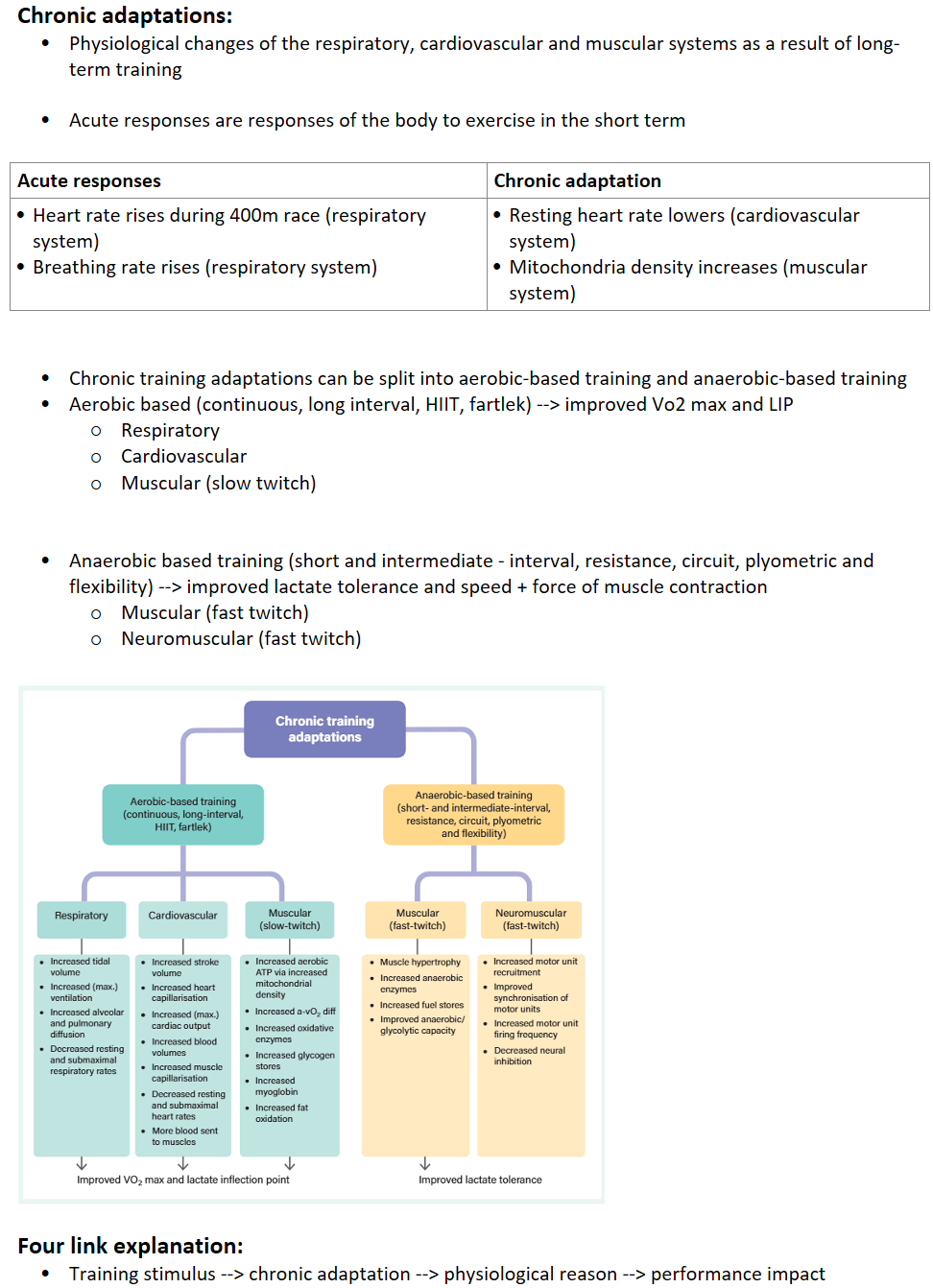
Chronic training adaptations can be split into aerobic-based training and anaerobic-based training
Aerobic based (continuous, long interval, HIIT, fartlek) --> improved Vo2 max and LIP
Respiratory
Cardiovascular
Muscular (slow twitch)
Anaerobic based training (short and intermediate - interval, resistance, circuit, plyometric and flexibility) --> improved lactate tolerance and speed + force of muscle contraction
Muscular (fast twitch)
Neuromuscular (fast twitch)
Four link explanation:
Training stimulus --> chronic adaptation --> physiological reason --> performance impact
Aerobic-based training seeks to improve the amount of ATP the aerobic energy system can produce and how efficiently it does
Respiratory adaptations occur at the lungs and aim to increase oxygen uptake to increase ATP available for working muscles
Respiratory adaptations to take in more O2 to the blood via the lungs:
Increased myoglobin
Increased mitochondria
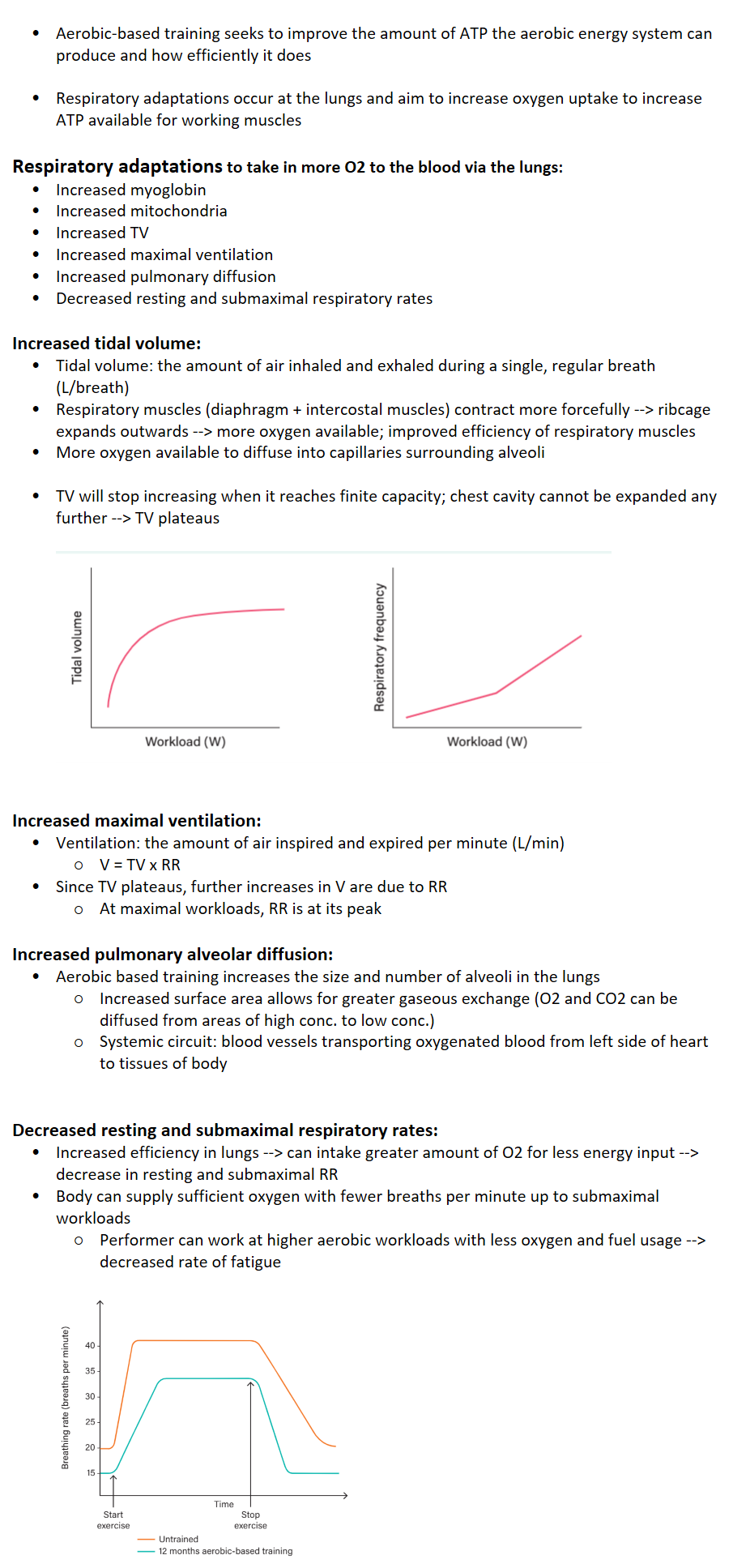
Increased TV
Increased maximal ventilation
Increased pulmonary diffusion
Decreased resting and submaximal respiratory rates
Increased tidal volume:
Tidal volume: the amount of air inhaled and exhaled during a single, regular breath (L/breath)
Respiratory muscles (diaphragm + intercostal muscles) contract more forcefully --> ribcage expands outwards --> more oxygen available; improved efficiency of respiratory muscles
More oxygen available to diffuse into capillaries surrounding alveoli
TV will stop increasing when it reaches finite capacity; chest cavity cannot be expanded any further --> TV plateaus
Increased maximal ventilation:
Ventilation: the amount of air inspired and expired per minute (L/min)
V = TV x RR
Since TV plateaus, further increases in V are due to RR
At maximal workloads, RR is at its peak
Increased pulmonary alveolar diffusion:
Aerobic based training increases the size and number of alveoli in the lungs
Increased surface area allows for greater gaseous exchange (O2 and CO2 can be diffused from areas of high conc. to low conc.)
Systemic circuit: blood vessels transporting oxygenated blood from left side of heart to tissues of body
Decreased resting and submaximal respiratory rates:
Increased efficiency in lungs --> can intake greater amount of O2 for less energy input --> decrease in resting and submaximal RR
Body can supply sufficient oxygen with fewer breaths per minute up to submaximal workloads
Performer can work at higher aerobic workloads with less oxygen and fuel usage --> decreased rate of fatigue
Cardiovascular adaptations aim to increase delivery/supply of oxygen and fuels to working muscles + improve removal of wastes and metabolic by products due to increased muscle contraction
Occurs in/to the heart, blood vessels and blood
Cardiovascular adaptations to increase oxygen delivery of oxygenated blood to working muscles:
Cardio (heart):
Increased stroke volume
Increased maximal cardiac output
Decreased resting and submaximal heart rates
Vascular (blood vessels):
Increased heart capillarisation
Increased muscle capillarisation
Increased blood (plasma and haemoglobin) volume
Reduced systolic and diastolic blood pressure
Increased stroke volume:
SV: amount of blood ejected from the left ventricle of the heart with each contraction
Aerobic based activities lead to hypertrophy of heart muscle
Hypertrophy: enlargement of organ/tissue due to increase in size of its cells
The left and right atria and ventricles will increase in size and will take in + squeeze out more blood --> better transportation of oxygen to working muscles
Heart wall will also increase in size and contract more forcefully --> increased SV
|
|
Higher SV also lets performer reach steady state faster
Increased maximal cardiac output:
Cardiac output: amount of blood ejected from the left ventricle per min
Q = SV x HR
Increased blood volumes --> higher red blood concentration (carry oxygen) and plasma volumes
Plasma reduces viscosity of blood --> blood can travel faster to working muscles
Plasma helps to remove waste products through transport to organs/skin --> aids in thermoregulation
Decreased resting and submaximal heart rates:
Cardiac hypertrophy --> pumps more blood per contraction --> does not need to pump as frequency to supply muscles with sufficient o2 to meet demands
Endurance-trained: has less rapid increase in SV, and quicker ability to plateau at submaximal intensities
Increased heart capillarisation:
Aerobic training increases cross sectional area of the coronary arteries and associated capillaries that supply to the heart --> more oxygen feeding the myocardium (muscular tissue of the heart)
Increased muscle capillarisation:
Capillaries supplying blood/oxygen to working muscles increase in size and number (particularly ST fibres)
Larger surface area for muscle to blood exchange, shorter oxygen diffusion distance and higher average red blood cell transit time --> energy supplied quicker and muscles can work at higher intensities aerobically for longer periods without accumulation of fatiguing by products
Waste product removal is faster --> repair and recovery is faster --> shorter time between training sessions
Reduced diastolic and systolic blood pressure
If higher blood volume due to plasma --> less viscous blood and more easy to be pumped by the heart
Reduces pressure on heart during contractions, lowering blood pressure during work and rest

AEROBIC
Aerobic training will allow for muscular adaptations via slow-twitch fibres --> improvement in muscular endurance
Some fast-twitch fibres can adopt ST characteristics
Aerobic muscular adaptations:
Increased mitochondrial density
Increased myoglobin
Increased arteriovenous oxygen difference
Increased oxidative enzymes
Increased glycogen stores
Increased fat oxidation
Increased mitochondrial density
Mitochondrion is responsible for the conversion of fats and carbohydrates into ATP at the muscles via aerobic or cellular respiration
Greater demands on ST fibres --> greater size and number of mitochondria to meet demands --> greater use of oxygen to produce more ATP and energy
Also increase in mitochondrial enzymes which are responsible for producing aerobic ATP at a faster rate
Increased myoglobin
Aids to transport oxygen across cell membranes to reach the mitochondria. More myoglobin = faster transfer
Increased arteriovenous oxygen difference
AV-o2 diff: difference between oxygen concentration in arterial blood and venous blood to measure the amount of oxygen taken up from blood by tissues
More myoglobin and mitochondria work to increase a-vo2 diff
Increased oxidative enzymes
Work to convert ADP and phosphate to ATP in the mitochondria
Increased glycogen stores
Aerobic training increases stores of muscle and liver glycogen, especially in ST muscle fibres
Increased fat oxidation
Increased intramuscular triglycerides and free fatty acids fuel oxidative enzymes, resulting in increased ability to oxidise fat
Fat is a major fuel source during low intensity efforts
Is advantageous as athletes can conserve glycogen stores and use fat instead in steady state; glycogen sparing
Leads to extended carbohydrate availability and use
Increased ability to use carbohydrate when working above LIP
ANAEROBIC
Muscle hypertrophy
Anaerobic training increases the cross sectional area of fast twitch fibres (both type II fibres)
Does by increasing cross-sectional area of myofibrils
And increased actin and myosin filaments (protein based filaments in muscles responsible for muscle contractions and movement)
Increased size and strength of tendons (connective tissues)
Larger myofibrils store greater amounts of anaerobic fuels (ATP, CP and glycogen) and the enzymes that help convert fuel to energy rapidly
Increased anaerobic enzymes
Enzymes increase the rate at which reactions occur in the body
ATPase and creatine kinase are important enzymes which help rapidly break ATP and CP down --> rapid production of energy
Glycolytic enzymes produce AT from ADP by using glucose as the food fuel
Aerobic glycolysis produces 20-39x more than anaerobic glycolysis which is 2-3 molecules of ATP per molecule of glucose
Increased fuel stores
Fast twitch fibres develop larger myofibrils for greater storage of CP, ATP and CHO (glucose) to produce ATP anaerobically
Improved anaerobic capacity
Ability to produce energy via the ATP-CP and anaerobic glycolysis system
Increased CP and glycogen stores + anaerobic enzyme increase the rate and duration of anaerobic energy
Neuromuscular adaptations: anaerobic-based training
Resistance and plyometric training programs increase muscular strength and power without increasing muscle fibre size/cross sectional area
Initial change in force production is due to neural adaptations
Increased motor unit recruitment
Anaerobic based training (plyometrics, short interval, resistance) targets FT fibres and enhances body's ability to recruit motor units --> greater generation of force
Improved synchronisation of motor units
According to size principle, motor units are recruited from smallest to largest, so ST--> FT
During heavy loads (weight, speed) FT fibres will take over
Anaerobic based training activates high-threshold motor units which improves ability to synchronise the activation of more motor units at the same time
This allows neuromuscular coordination to become more automatic and creates more rapid and powerful muscle contractions
Increased motor unit firing frequency
Resistance and plyometric training increase firing rate/rate coding of neural impulses
Greater the frequency, increased summation of impulses
Successive signals sent to muscle fibre before it has a chance to relax from the previous one
Directly increases the force and duration of muscle contraction
Decreased neural inhibition
A muscle strain (injury to a muscle or tendon) occur due to excessive tension in the muscles or overstretching of the tendons --> partial or complete tear of these tissues
Tendons have built in protective mechanism were receptors detect excessive tension and create a 'reflex inhibition' on the neurons supplying the muscles, causing an instantaneous drop in force output
Regular resistance training decreases inhibitory signals which allows for more powerful contraction

VO2 max = Qmax x a-vO2 difference
Absolute Vo2 max: the maximum amount of oxygen that can be inspired, transported and utilised in 1 minute (L/min)
Relative Vo2 max: the maximum amount of oxygen that a person inspires, transports and utilises in 1 min, but is measured relative to their weight (mL/min/kg)
LIP: the final point where lactate production and lactate removal are equal
Represents the final exercise intensity or oxygen uptake value at which blood lactate concentration is relatively low
Represents the maximal intensity at which blood lactate is said to be in steady state
Essentially, you LIP is the maximum intensity where the aerobic system is producing enough ATP to not have to rely on much Anaerobic contribution. Beyond LIP, the anaerobic glycolysis systems will start to increase ATP production to address the shortfall in ATP from the aerobic system at that intensity.
Lactate tolerance: the ability to buffer accumulating lactic acid so it does not interfere with muscle contractions and cause decreased force and frequency
Aerobic training and LIP
Aerobic training often improves LIP without a corresponding increase in VO2 max, LIP is the best indicator of aerobic power
Untrained athletes can start training below LIP to see improvement
55-70% VO2 max/ 70-80% HRmax
Endurance trained athletes should train at a higher level/just below the LIP to see improvement
75-90% VO2 max/ 85-95% HRmax
Alternation between continuous and HIIT training methods are most effective to improve LIP
Aerobic training increases LIP by increasing lactate clearance from muscles through:
Greater mitochondrial density --> higher aerobic ATP production and oxidisation of lactate back to pyruvate
Increased transport of lactate from muscle cells to bloodstream
Greater conversion of lactate back to glucose to produce more ATP
PPT SAYS: Aerobic training increases LIP through
Greater mitochondrial density
Increased capability to oxidise fat and carbohydrates through oxidative enzymes
Consider TAUK-TQ for graphs
Title - Blood lactate across running speed
Axes: Percentage of VO2 max/ running speed/ blood lactate concentration
Units: %/ km/h / mmol/L
Key: Untrained, Moderately trained, Highly trained
Question:
Trend: Rightward shift/increased LIP as training status increases
Answering questions for LIP:
1. Data: state the rightward shift using speed/power/intensity values
2. Adaptation: connection to the adaptations that lead to an improvement in LIP, localised to the specific muscle cells used in chronic exercise
3. Mechanism: Explain how the adaptation increases LIP
Individuals with a greater proportion of ST fibres relative to FT fibres have a greater ability to oxidise fatty acids in mitochondria, and in return have a higher LIP
4. Performance: ability to work at a higher intensity aerobically + delayed metabolic by product contribution at a higher intensity
Improving lactate tolerance:
Anaerobic training (short interval) improves lactate tolerance; focuses on anaerobic glycolysis system and places high stress within fast-twitch fibres
When AG system activated and trained over time, number and function of 'muscle buffers' located within muscles increases
When LIP has been surpassed, steady state has been surpassed and lactic acid accumulates
Neuromuscular doesn't function well under these conditions --> decreased muscle contraction force
Adaptation 1: Increased fuel (CP and glycogen) stores
Greater generation of ATP via explosive ATP-CP system
Greater ability to utilise the anaerobic glycolysis system to produce energy
Greater rate of anaerobic ATP supply (performance)
Adaptation 2: Increased glycolytic capacity
Increased glycolytic enzymes leads to faster ATP resynthesis through AG during high intensity work --> increased activity/capacity
Increased glycogen (fuel) stores make energy more readily available
Greater rate/capacity of anaerobic ATP supply --> higher blood lactate (performance impact)
Adaptation 3: Increased muscle buffering capacity
Muscle buffering: ability of muscles to neutralise accumulating lactic acid during high intensity exercise, thus delaying the onset of fatigue
Muscle buffering reduces accumulating H+ ions and helps stabilise pH of the muscles --> contractile function is maintained for longer
Less performance decline/ greater high intensity work (performance impact)
Improved buffering and removal capacities of muscles --> higher concentration of muscle and blood lactate after exercise
