[7.5-7.6] Wilson, American Foreign Policy and Great War
after slide 5
Moralistic Diplomacy in Mexico
What pushed the United States to join the Spanish Revolution?
April 1914- Tampico Incident
Small group of US sailors arrested
Mexico released them and said sorry but Wilsom demanded a 21- gun salute opon their release
Mexico refused- wilson ordered US Navy to take Vera Cruz
The entire incident darkened US-Mexican relations for decades
The Spark That Ignited War
June 28, 1914
Serbian nationalist Gavrilo Princip assassinated Austrian Archduke Franz Ferdinad in Sarajevo, plunging Europe into world war
August 4, 1914
War officially declared
Central Powers: Germany, Ottoman Empire, Austria-Hungary
Allies: Great Britain, France, Russia (Italy joins in 1915)
Naval Warfare and International Law
British Blockade
North Sea mined to bottle up German fleet
Violated international law
Wislson protested wakly-believed britain could pay compensatiojn later
German U-Boats
February 1915- Attack zone declared around British isles
Relied on suprise attacks, violated maritime law
British flew neutral flags
U.S. doesnt entire war till 1917
A Precarious Neutrality
Feb 1915 – Germany announced unrestricted submarine warfare around British Isles
Posed dire threat to US interests
Wilson proceeded with policy of calculated risk
May 7, 1915 - sinking of the Lusitania
Germany justified attack with claim that it was carrying contraband
Americans outraged; US inched closer to war
Berlin agrees reluctantly to not sink unarmed and unresisting passenger ships
March 1916 – sinking of the Sussex
Wilson threatened to break diplomatic relations
Result – Germany offered the Sussex Pledge
End of unrestricted submarine warfare; will provide warning to both passenger and merchant vessels
Election of 1916
With public opinion divided, Wilson ran as a peace candidate while building military preparedness.
National Defense Act
Increased size of army, navy, and National Guard
Campaign Slogan
"He kept us out of war" emphasized progressive reforms
Narrow Victory
Defeated Republican Charles Evans Hughes
wilson hates how they are doing illegal warfare
US Position in 1917
Jan 22 – Wilson’s 2nd inaugural address asks for American’s commitment to neutrality; declared only a negotiated “peace without victory” would prove durable
Jan 31 – Germany announced resumption of unrestricted submarine warfare
Wilson asks Congress for authorization to arm US merchant ships
March 1 – Zimmerman telegram intercepted
Proposed German-Mexican alliance
Promise to return the Mexican Cession back to Mexico
Infuriated Americans
Also – Russia Revolution changed some perspectives
Myth – US was dragged unwittingly into war by munitions makers & Wall Street
They were already thriving
Simple truth – British harassment of US commerce was annoying, but Germany had resorted to mass killing of civilians
Germany wanted mexico to come into war so US will just fight mexico instead of fighting the central powers in europe
Last straw- US declares war, we entered war bc of zimmerman telegram
America Enters the War
The reason we are going to war is to make the world a safer democracy, peaceful once again
November 1917- Russian Revolution installs Bolshevik regime, negotiates separate peace with Central Powers
Wilson’s Vision for Peace, The 14 points
Jan-8,1918-Fourteen Points Speech
Gives a speech to the country and world, wilson was now seen as the moral leader of the allied cause
Wanted to convince russia to re-enter the war
Wilson’s vision inspired the falling morale of the Allies and demoralized enemy nations
The points
Pt 1 – abolish secret treaties
Pt 2 – freedom of the seas
Pt 3 – removal of economic barriers among nations
Pt 4 – reduction of armaments
Pt 5 – adjustment of colonial claims (self-determination)
Pt 14 – League of Nations- work together under collective security
Mobilizing for War
3 millions drafted soldiers
Nearly 50,000 U.S. troops died in Argonne Forest offensive alone
The Horros of Modern Warfare
Trench Warfare
Soldiers dug into filthy trenches facing machine-gun fire and artillery
Chemical Weapons
Shells spewing poison gas created new horrors on the battlefield
Massive Casualties
Europeans suffered 8-10 million casualties; U.S. 230,000 injured in final push
Wilson’s 14 Points Disarm Germany/DoughBoys
Pamphlets of Wilson’s Fourteen Points were dropped all throughout Germany
Germans hoped for Wilson’s fair, idealistic plan; to be treated as an equal negotiating partner in pursuit of a peace settlement
November 11, 1918 at 11 AM – armistice took effect
Cease fire
Overall US contributions to the Great War:
Foodstuffs
Munitions
Credits
Oil
Manpower
Not overwhelming military victories
Costs of Wars
More than 500K US soldiers died in battle; more died of disease
Would have been more if not for the Red Cross
Mental scars – shell-shocked
8M soldiers (total) died – 5,000 per day
Germany, Austria-Hungary, Russia, & France – more than a million soldiers each
900K British troops died
Most battles took place in Europe, but some were in the Middle East and Africa
Millions of civilians died of starvation, disease, or war-related injuries
The Paris Peace Conference
First sitting president to travel overseas, Wilson greeted by joyous crowds. For six months, he fought to convince exhausted Allied leaders to accept his vision.
Allied Demands
Collect spoils of victory
Make Central Powers pay dearly
Keep colonial possessions
Britain refused to limit naval power
Wilson's Compromises
Agreed to "war guilt" clause
Accepted huge reparations on Germany
Sacrificed ideals to secure the League of Nations
3 leaders didn’t get along that well, gave up all 14 points except for the creation of the League of Nations
The Treatry of Versailles
Wilson's Rationale
League needed to keep peace so war-ravaged nations could practice economic freedom and political democracy—preventing spread of communism after 1917 Russian Revolution.
Treaty Provisions
Established League of Nations
Authorized collective military action against aggression
Signed at royal palace outside Paris
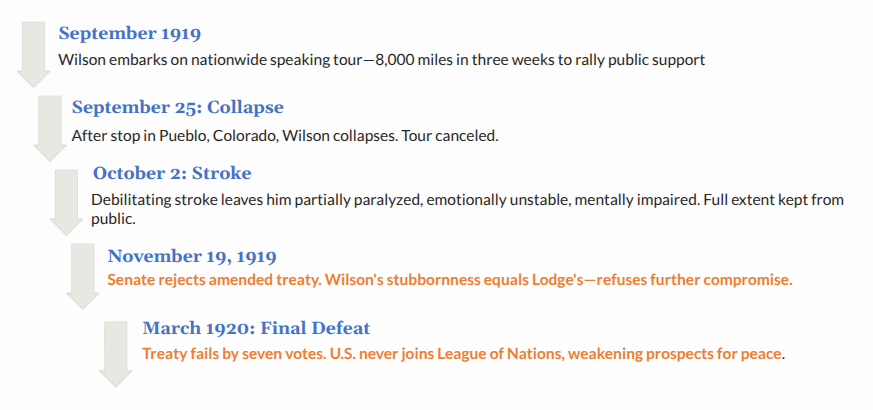
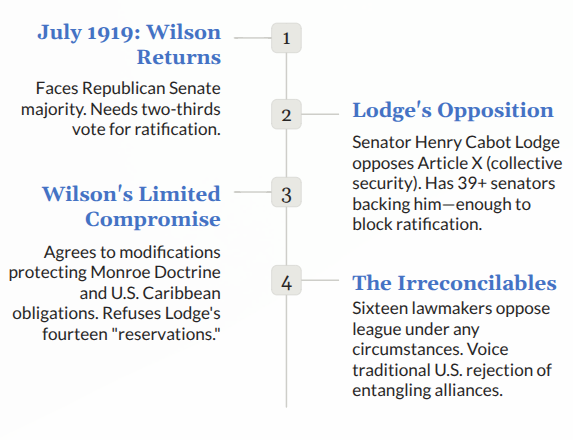
39 Republican senators did not want to ratify the Treaty of Versailles
The Battle for Ratification
Tragedy Strikes