Enzymes - Key Concepts
METABOLIC PATHWAYS
Definition: Series of chemical reactions in cells required to sustain life.
Classification of Reactions:
Catabolism:
Definition: The breaking down of molecules to release energy.
Example: Breakdown of carbohydrates, proteins, and fats into glucose, amino acids, glycerol, and fatty acids.
Anabolism:
Definition: The building up of molecules to store energy.
Example: Synthesizing glucose, proteins from amino acids, and forming fats from glycerol and fatty acids.
Catabolic and Anabolic Pathways
Major Biomolecules:
Carbohydrates
Proteins
Fats
Key Intermediates:
Glycolysis → Glucose → Pyruvate (TCA cycle)
Acetyl CoA → TCA cycle → NADH/FADH2 → Oxidative phosphorylation → ATP
Important Note:
Continuous ATP production is vital for life.
Even during rest, ATP is required.
Glycogen breakdown is crucial during low glucose availability.
Glycogen acts as the body's storage form of glucose.
Key definitions
Spectrophotometer: a machine that shines light through a sample to measure how much light is absorbed.
Absorbance: the amount of light the sample “soaks up.”
Higher absorbance = more of a particular molecule present.
Enzyme Characteristics
Nature of Enzymes:
Enzymes are proteins encoded in the genome.
Function as catalysts that speed up biological reactions without being consumed; they can be reused.
They facilitate the conversion of substrate into product, demonstrating massive catalytic power.
(107 times faster than without enzyme).
Enzyme Specificity
High Selectivity:
Enzymes exhibit high specificity for their substrates, e.g., trypsin for lysine and arginine, and thrombin for blood coagulation.
Errors can lead to genetic diseases due to incorrect hydrolysis reactions.
Studying Enzymes
Objective of Enzyme Studies: Understand how enzymes speed up reactions through enzyme kinetics.
What is Enzyme Kinetics?
Focused on studying the rate at which enzyme reactions occur by manipulating conditions.
Valuable for understanding:
Catalytic mechanisms.
Regulation within metabolic pathways (parameters like Km, presence of inhibitors).
Drug efficacy and mechanisms for drug design.
defined using Km and Vmax
Enzyme Kinetics Experimental Approaches
Example - TCA CYCLE
Measuring Reaction Rates
Setup: Mix enzyme (Lactate dehydrogenase) and substrate (Pyruvate or Lactate) in a spectrophotometer.
Observations: Measure the absorbance at specific wavelengths (e.g., 340 nm for lactate dehydrogenase).
Under aerobic conditions, pyruvate enters the TCA cycle - NADH produced
Under anaerobic conditions, it converts pyruvate to lactate. - NAD⁺ produced
NADH absorbs strongly at 340 nm, but NAD⁺ does not.
So the spectrophotometer can detect how much NADH is present by measuring A340.
THIS MEANS THAT IF
Mix enzyme (LDH) + substrate (pyruvate or lactate).
NAD⁺ ↔ NADH changes depending on direction of reaction.
NADH absorbs light at 340 nm.
Spectrophotometer measures absorbance over time.
Change in absorbance = how fast the enzyme converts substrate → product.
This gives us the enzyme’s initial reaction rate.
Additional Examples:
Fumarase: Catalysis the reversible reaction from Fumarate + H2O ⇌ Malate in the TCA cycle
Works as the fumarate has a double bond but the malate enzyme doesn’t
instead has a OH group
The enzyme fumarate removes the double bond and adds the OH group
Or removes the oxygen in the form of water and adds the double bond.
the double bond absorbs light at the wavelength of 250 nm.
Fumarate absorbs strongly around 250 nm
Malate does not, because it does not contain a C=C double bond
Alkaline phosphatase:
An enzyme found in the liver, intestine, and bones that removes phosphate groups.
It is used in:
Liver function tests - (A405 nm for p-nitrophenol production)
ELISA assays (lab tests)
starts with the substate PNPP which is converted by Alkaline phosphatase into PNP and a inorganic phosphate
PNP absorbs light at 450 nm
Understanding Reaction Rates
When doing a enzyme experiment you should get a graph with time on the x axis and the product production on the y axis
the begging of the line is the initial rate of reaction which starts off linear and then tails off
Due to
Product inhibition, Reverse reactions, or Substrate depletion.
Plotting product formation over time means we can quantify the rate of reaction
Observations may show initial rates tailing off due to factors such as product inhibition, reverse reactions, or substrate depletion.
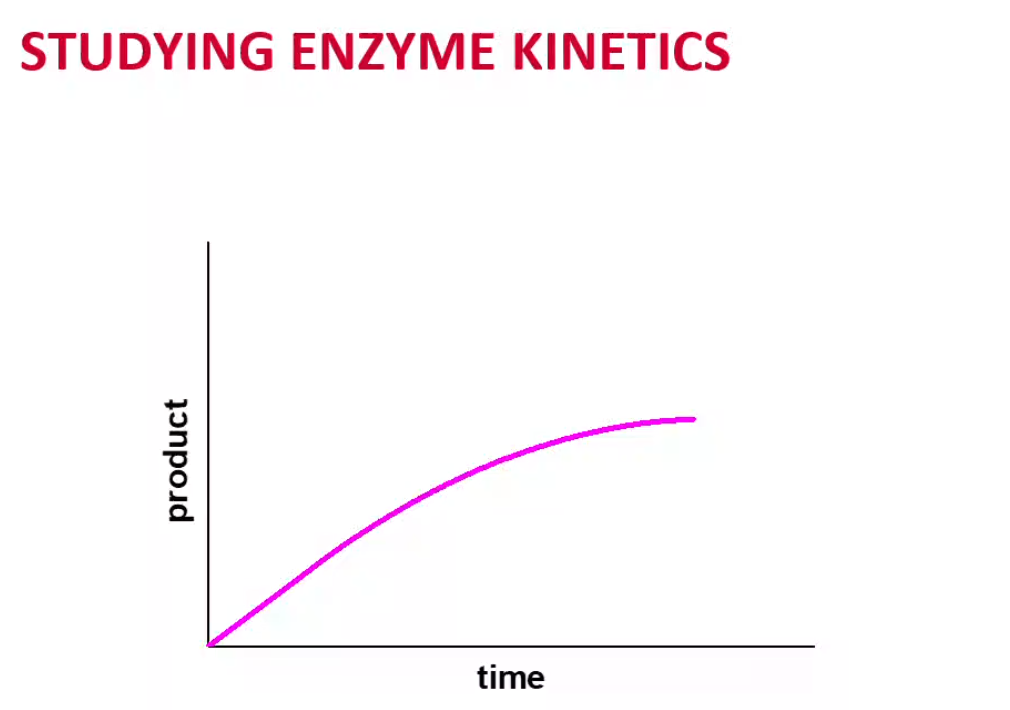
Product inhibition: The product that the enzyme makes begins to slow the enzyme down.
Why it happens
As the reaction continues, more product builds up.
Sometimes the product can bind to the enzyme or interfere with it.
This makes the enzyme work less efficiently.
Simple version : The product gets in the way and slows the enzyme down.
Reverse reaction: The product starts turning back into the substrate.
Why it happens
Many enzyme reactions are reversible.
At the start, everything moves forward (substrate → product).
But as product builds up, some of it can go backwards.
This reduces how fast the forward reaction increases product.
Simple version : Some product turns back into substrate, so the net increase slows down.
Substrate depletion: The substrate (starting material) begins to run out.
Why it happens
At the beginning, there is plenty of substrate.
As the enzyme keeps converting it into product, there’s less substrate left.
With less substrate available, the enzyme cannot keep working at the same speed.
Simple version : The enzyme is running out of substrate, so it slows down.
MEASURING ENZYME REACTION RATES
Beer–Lambert Law: a formula used to convert absorbance into actual concentration of proteins - A=εcl
Measure absorbance changes (units/min)
then rearrange the equations to c = A / εl to give you rate of reaction in moles per minute (mol/min)
The concentration is the number of moles per liter
so if we know the volume we can work out the number of moles
by dividing the concentration by the volume
Calculating specific activity in mmol/min/mg total protein gives insights into purity.
A = Absorbance
Absorbance is how much light the sample “soaks up.”
High absorbance = a lot of light absorbed = lots of product present
Low absorbance = little light absorbed
It is what the spectrophotometer measures directly.
ε (epsilon) = molar extinction coefficient
This number tells you how strongly a molecule absorbs light at a particular wavelength.
Think of ε as the molecule’s “light‑absorbing strength.”
Key points:
Every molecule has its own ε.
ε depends on the wavelength being used (example: NADH has a known ε at 340 nm).
If ε is large → the molecule is very good at absorbing light.
This value is usually provided in lab manuals or literature.
c = concentration
This is how much of the absorbing molecule (e.g., product) is present in the solution.
Beer–Lambert Law lets you calculate c (concentration) from the absorbance.
Why this is useful
If you know the concentration at each time point, you can calculate:
how many moles of product are made
the rate of the enzyme reaction
l = path length
This is the distance the light travels through the solution inside the cuvette (the little container in the spectrophotometer).
In almost all enzyme assays:
l = 1 cm
Why?
Because standard cuvettes are manufactured to be exactly 1 cm wide, so the light travels 1 cm from one side to the other.
Why does path length matter?
The longer the path, the more molecules the light passes through → the more light is absorbed.
Imagine shining a flashlight:
Through a thin layer of coloured water → light easily passes
Through a thick layer → light is absorbed more
Example Calculation:
Q = Absorbance Increase: In an enzyme assay, if the absorbance increases by 0.05 units in 20 seconds, calculate the initial rate:
Options:
A: 0.15 absorbance units/sec
B: 0.05 absorbance units/min
C: 0.15 absorbance units/min
Rate = change in absorbance / time
The absorbance increases by 0.05 in 20 seconds.
That equals 0.0025 per second.
Converted to per minute = 0.15 per minute.
So the initial rate is 0.15 absorbance units/min.
CONTROLLING REACTION CONDITIONS
The Beer Lambic equation is not accurate as it only gives the concentration for one substrate but in experiments we use multiple conditions
multiple conditions are needed as the specific rate of reaction is a limited value so to get enzyme kinetic data we need a number of different concentrations
to do this we need to repeat the experiment and alter the substrate concentration and then determine that initial rate for each concentration
Altering substrate concentrations is essential to gather comprehensive kinetic data.
Perform trials over a range of substrate concentrations to determine initial rates and construct reaction profiles.
DEPENDENCE OF INITIAL RATE ON SUBSTRATE CONCENTRATION
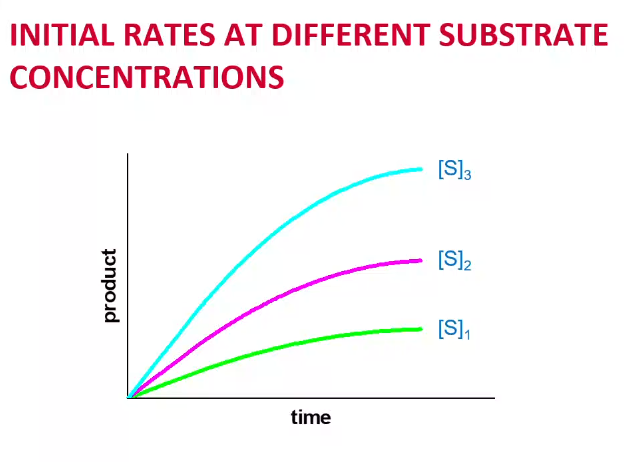
with the data from the different conditions you can create a graph that looks like this.
this shows that the linear parts of the graph are steeper as you go up the lines meaning the rates are also higher
we can calculate those rates after this
Initially, there is a linear increase in rate with substrate concentration
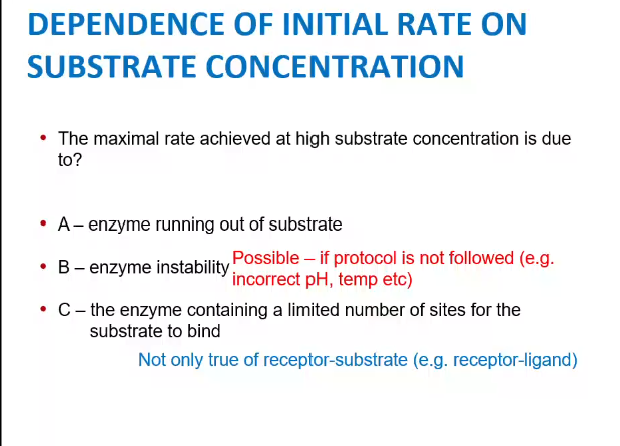
[S]At high substrate concentrations, the rate approaches a maximal level, indicating enzyme saturation.
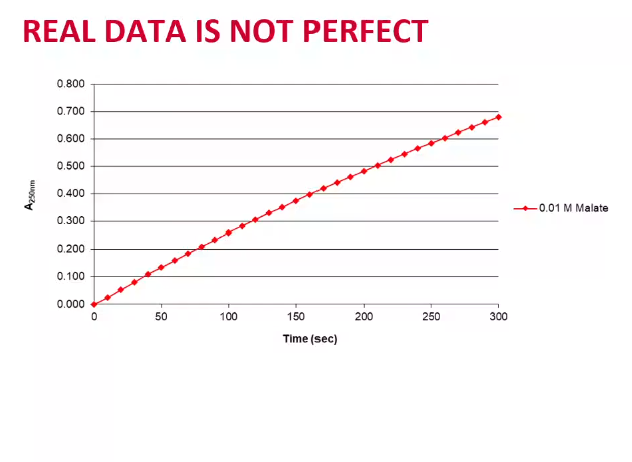
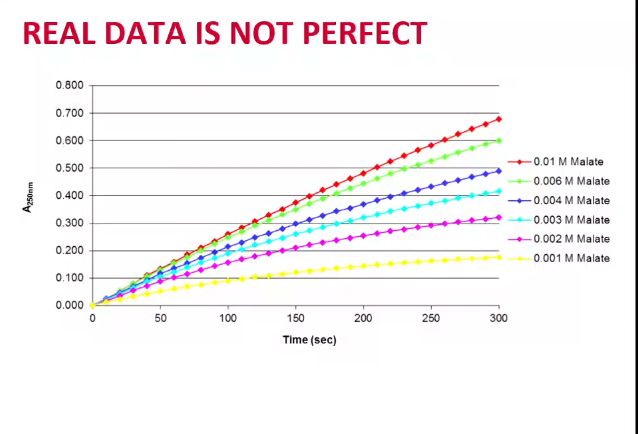
This measures the fumarate reactions
At first there is not much of a curve but as you go down the substrate concentrations you can start to see the curve becomes more pronounces.
Diagrammatic Representation: Graphs of rate vs. substrate concentration visualize linear dependence at low
[S]
and saturation at high
[S]
.
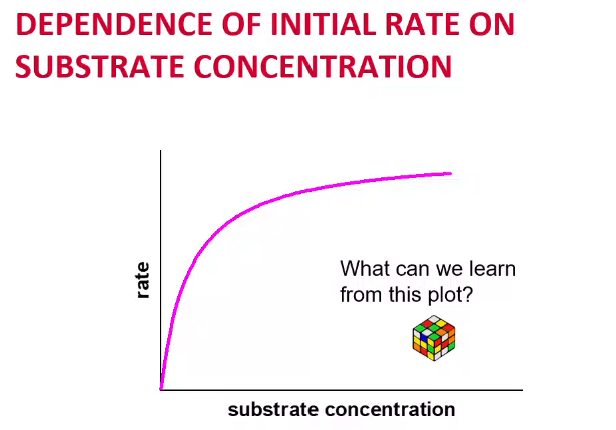
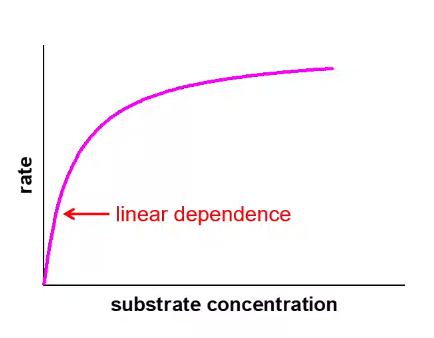
Here at this point the substrate concentration is low (number of rubik’s cubes)
If we increase the number of substrates we get a big increase in the rate, as the substrate concentration doubles the rate also doubles
E.G. so if you have 2 cubes you can solve 2, but if you have 4 you can solve 4
But at the other end of the graph its more saturated as it doesn’t matter if you have 100 cubes you’v only got one pair of hands and can only solve then at a certain rate
so increasing substrate concentration has little effect on the rate
The maximum rate is the Vmax
MICHAELIS-MENTEN MODEL
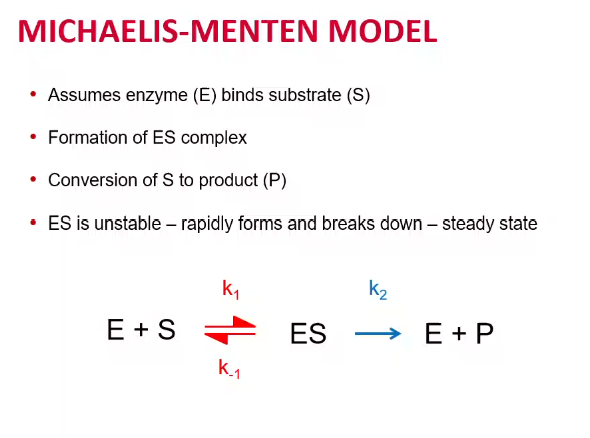
Fundamental Assumptions
Enzyme (E) binds substrate (S) to form the enzyme-substrate complex (ES).
however this equation has some assumptions these are:
the enzyme substrate complex is unstable as it rapidly forms and breaks down, but for this equation the ES is in a steady state which is why we need to know the initial rate of reaction
the enzyme substrate complex can form from the substrate which has a rate called K1
Rate constants (k₁, k₋₁, k₂)
The slide labels each step with a rate constant:
k₁: speed of E + S → ES
k₋₁: speed of ES → E + S
k₂: speed of ES → E + P
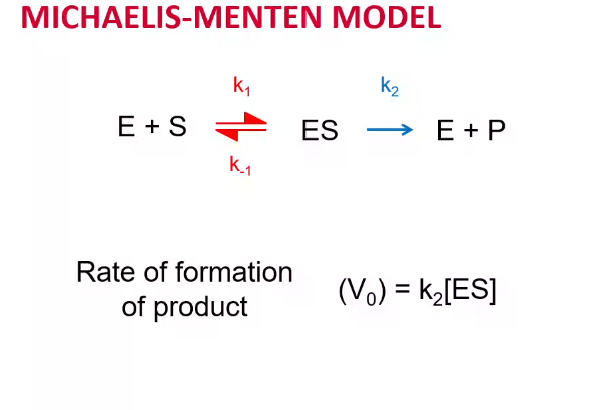
The conversion of substrate to product (P) happens via an unstable ES.
Reaction rates of product formation are derived as follows:
V0 = k2[ES]
What each symbol represents
V₀ → Initial reaction rate
The speed of the reaction at the very beginning, before substrate is used up or the reaction starts to slow down.
k₂ → Rate constant for product formation
This is the rate at which the enzyme–substrate complex turns into product.
It’s also called kcat (the turnover number) in many textbooks.
[ES] → Concentration of the enzyme–substrate complex
This is how much enzyme is currently bound to substrate.
Square brackets [ ] = concentration
[E] = concentration of free enzyme
[S] = concentration of substrate
[ES] = concentration of enzyme–substrate complex
V0 = k2[ES] Means that?
The initial rate of the reaction is directly proportional to how much enzyme-substrate complex is present
The reaction only makes product when enzyme and substrate are bound together
Each ES complex produced product at a rate given by K2.
The more ES you have the faster product is formed
Steady-State Consideration
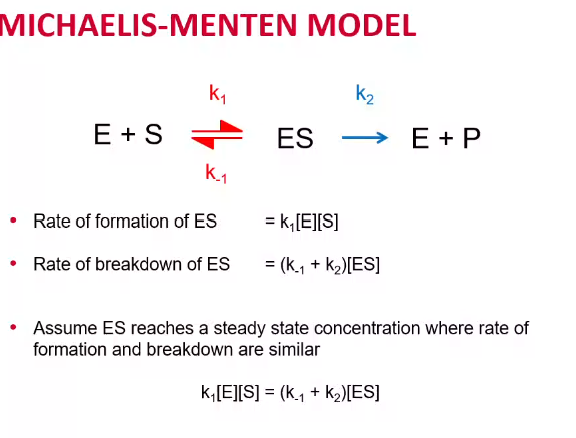
Means the amount of ES stays approximately constant over time.
ES is being formed
ES is being broken down
At steady state, these happen at the same rate
Formation rate of ES (the left side)
Rate of ES formation=k1[E][S]
Why?
ES forms only when E and S collide
More E or more S → more collisions
That’s why concentrations multiply: [E][S]
Breakdown rate of ES (the right side)
ES can disappear in two ways:
It falls apart → E + S (rate constant k₋₁)
It turns into product → E + P (rate constant k₂)
Total breakdown rate:
(k−1+k2)[ES]
Key idea:
Both processes depend on how much ES exists
More ES = more breakdown per second
At steady state:
Formation rate=Breakdown rate
So:
k1[E][S] = (k−1+k2)[ES]

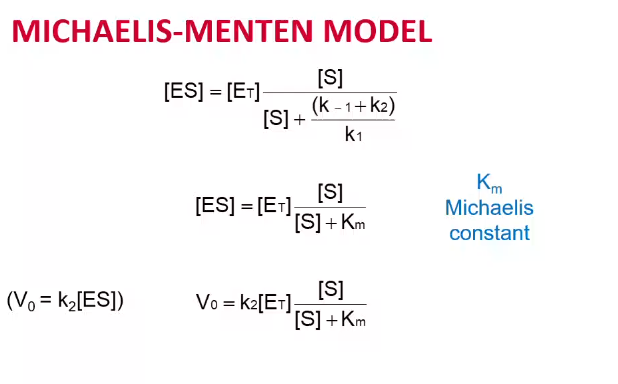
Total enzyme concentration:
If [ES] much less than [S]
[S] represents total substrate concentration. The Michaelis-Menten equation can then be expressed as:
V0 = Vmax[S] / Km + [S]
Rate of formation of ES
ES = k₁ [E][S]
What this means
k₁ = rate constant for enzyme + substrate coming together
[E] = concentration of free enzyme
[S] = concentration of free substrate
The more enzyme and substrate you have, the faster ES forms.
Simple version - ES forms when enzyme and substrate bump into each other.
The speed of that happening depends on k₁, [E], and [S].
Rate of breakdown of ES = (k₋1 + k₂)[ES]
Why these two terms?
ES can break down in two ways:
k₋1 [ES] → ES goes back to E + S
k₂ [ES] → ES forms E + P (product)
So the total breakdown rate is k₋1 + k₂, multiplied by how much ES is present.
Simple version: ES can fall apart back to start, or turn into product. Both processes remove ES.
Steady-state assumption
“Assume ES reaches a steady state concentration where rate of formation and breakdown are similar.”
What steady state means
ES is made quickly
ES breaks down quickly
After a short moment, the amount of ES stays constant, even though reactions continue happening fast in both directions
So at steady state:
Rate of ES formation = Rate of ES breakdown
k₁[E][S] = (k₋1 + k₂)[ES]
Simple version - ES forms and breaks at the same speed → ES stays constant.
This assumption makes it possible to derive the Michaelis–Menten equation.
Summary
ES forms at a rate: k₁[E][S]
ES breaks down at a rate: (k₋1 + k₂)[ES]
At steady state, these rates are equal.
That equality is essential for getting the Michaelis–Menten equation.
Everything on the slide is preparing you for defining Km and Vmax in later slides.
Total enzyme = free enzyme + ES complex
→ [Eᵀ] = [E] + [ES]So free enzyme = total enzyme minus ES complex
→ [E] = [Eᵀ] − [ES]Total substrate = free substrate + bound substrate
→ [S] + [ES]But ES is tiny compared to S, so
→ total substrate ≈ [S]
What it means
V₀ = initial rate of the reaction (how fast product forms at the very beginning)
k₂ = rate constant for ES → E + P (the step that makes product)
[ES] = concentration of the enzyme–substrate complex
So the rate depends entirely on how much ES is present, because the only way to make product is through the ES complex.
V-max
Introducing Vmax and connecting it to the Michaelis–Menten equation.
Km — Michaelis constant
Michaelis–Menten model
V₀ = k₂[ES]
Vmax = k₂[Eₜ]
Michaelis–Menten equation
V₀ = k₂[ES]
The reaction rate (V₀) depends on how much ES complex exists.
More ES → faster reaction.
This is the foundation for defining Vmax.
What is Vmax?
Vmax = k₂[Eₜ]
Vmax is the maximum possible rate of the enzyme reaction.
It occurs when:
All enzyme molecules are in the ES form
→ the enzyme is fully saturated with substrate
So instead of using [ES], which changes during the reaction, we use [Eₜ] (total enzyme), which is fixed.
Super simple version - If every enzyme is busy (full), the enzyme runs at its fastest speed → Vmax.
Why Vmax = k₂[Eₜ]?
Because:
At saturation, all enzyme is in ES form
→ [ES] = [Eₜ]
So put [ES] = [Eₜ] into the equation:
V₀ = k₂[ES]
becomes
Vmax = k₂[Eₜ]
This is why Vmax depends on how much enzyme you have.
Michaelis–Menten Equation begins here
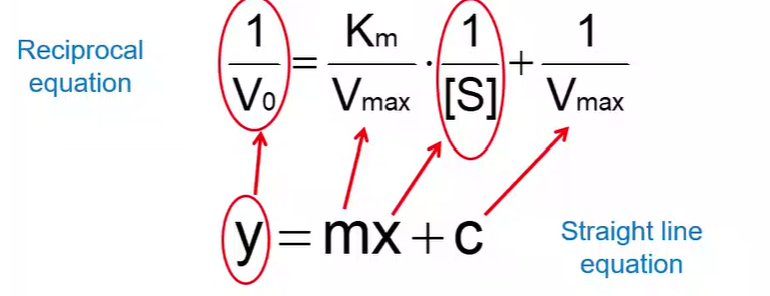
V0= Vmax [S] / Km+[S]
It shows the pieces you need to build it:
Km (Michaelis constant)
Vmax
The relationship between V₀, ES, and Eₜ
V₀ = k₂[ES] (rate depends on the ES complex)
Vmax = k₂[Eₜ] (maximum rate when all enzyme is bound to substrate)
This is the final step before writing the Michaelis–Menten equation.
It shows the transition from the enzyme mechanism (E + S → ES → E + P) into the mathematical formula describing how enzyme speed changes with substrate concentration.
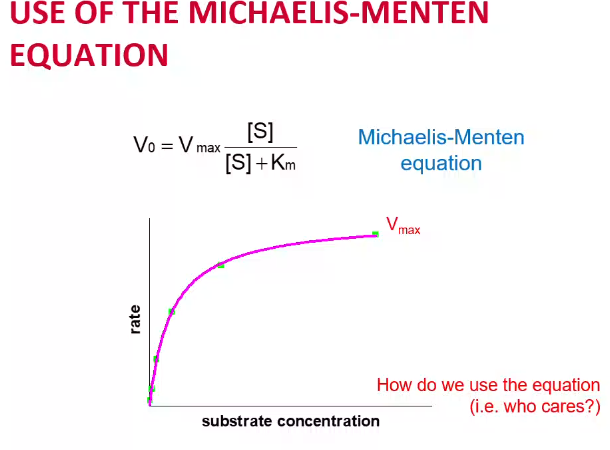
How the equation helps you predict enzyme speed
How it helps you understand saturation
How it helps you compare different enzymes
How you can calculate V₀ at low or high [S]
How drugs, inhibitors, and mutations affect Km and Vmax
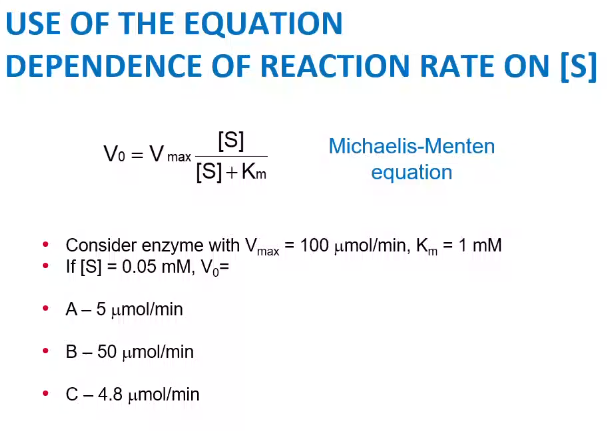
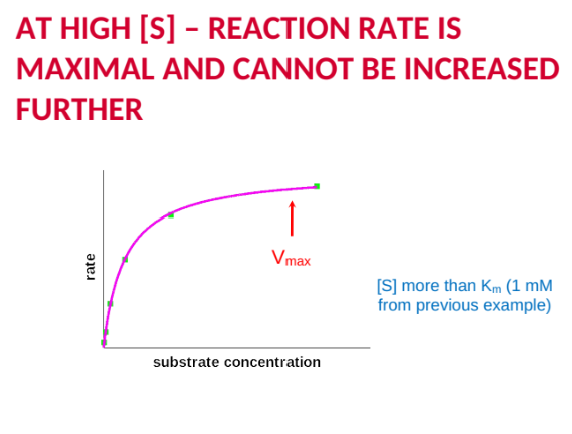
even when you increase the substrate at a certain point the Km will not increase in the same proportion as the Vmax is approaching
Km = how much substrate an enzyme needs to work at half speed.
Or even simpler:
👉 Low Km = enzyme grabs substrate easily
👉 High Km = enzyme is picky and needs lots of substrate
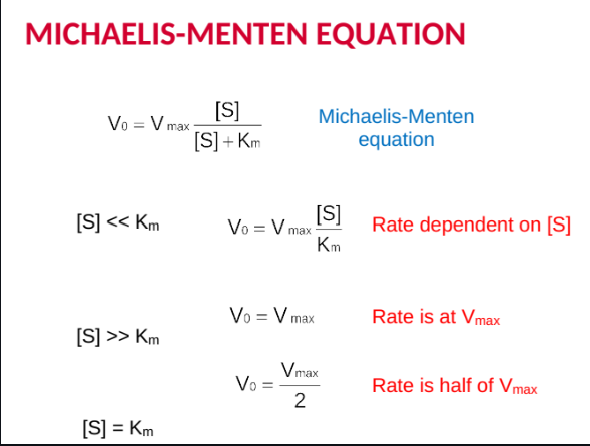
when the enzyme concentration is the same as the Km the rate will half of the Vmax.
KINETIC CONSTANTS - Km
Km: The substrate concentration needed to achieve half of Vmax.
Interpretation: High affinity substrates correspond with low Km.
Influenced by various conditions:
Substrate specificity
pH, temperature, and ionic strength.
Physiological Significance of Km
Variations in Km illustrate enzyme adaptations in different tissues or conditions (e.g., hexokinase vs. glucokinase).
Enzyme Km values for specific substrates elucidate physiological roles and activities in metabolic pathways.
EFFECTS ON ENZYME KINETICS
Effects of pH
Influences on enzyme activity can arise from:
Changes in ionization of amino acid side chains that affect substrate binding.
Proteins' structural integrity may falter at extreme pH conditions.
Effects of Temperature
Enzyme activity generally increases with temperature due to reasoning relating to flexibility and induced fit mechanisms.
However, temperatures above 50°C can lead to denaturation, affecting enzyme function.