Concentration
Concentration
Defining Concentration
Definition of Concentration: Concentration is the attention that involves mental effort focused on sensory or mental events.
Key Principle: Concentration is fundamentally linked to attention, signifying the ability to maintain focus on pertinent environmental cues.
Components of Concentration: Includes four main components:
- Focusing on relevant environmental cues: This is also referred to as selective attention which entails selecting which cues to attend to while disregarding others.
- Maintaining attentional focus: Human beings engage in approximately 4,000 distinct thoughts within a 16-hour day.
- Situation awareness: This is the ability of an individual to understand and interpret the ongoing events and dynamics around them, effectively sizing up a situation.
- Shifting attentional focus: The capacity to redirect focus when necessary, adapting to different situational demands.
Talk It, Trash It Activity
Activity Description: Participants write down something that is bothering them on paper, then crumple it or rip it and dispose of it.
Purpose of Activity: This exercise serves to help individuals "park that thought," enabling them to concentrate on the present moment without external distractions.
Attentional Selectivity
Definition: Attentional selectivity is the process of permitting certain information to enter the processing system while screening out or ignoring other information. This concept is likened to using a searchlight to focus on specific elements.
Common Errors in Attentional Selectivity:
- Having an excessively broad focus, which can result in missing pertinent details.
- Becoming distracted by irrelevant information, which diverts attention from the relevant cues.
- Struggling to shift focus rapidly among multiple relevant cues.
Attentional Capacity
Limitation of Attention: Attention is inherently limited in its capacity to process information at any given time.
Types of Processing:
- Controlled Processing: This involves conscious attention and awareness when performing a skill in sports. It requires mental effort and is more deliberate.
- Automatic Processing: Refers to mental processing that occurs without conscious attention, typically when tasks become well practiced.Elite Athletes: Peak performance for elite athletes is often characterized by complete absorption in the moment, without thoughts of past or future events. They achieve a state of mental relaxation coupled with a heightened degree of concentration and awareness of both their body and environment. Less proficient athletes tend to switch from controlled processing to automatic processing as their skill level increases.
Attentional Alertness
Emotional Arousal Effects: Increases in emotional arousal result in a narrowing of the attentional field.
Example of Arousal's Effect: Heightened emotional states can lead individuals to lose sensitivity to cues in their peripheral vision.
Concentration and Optimal Performance
Essential Focus: Athletes must concentrate on only relevant cues within their environment and eliminate distractions.
Critical Importance of Automatic Processing: The ability to automatically execute movements is pivotal in performance settings.
Analysis to Paralysis Concept: Athletes must be cautious of over-analyzing their actions, as excessive scrutiny can hinder performance.
Types of Attentional Focus
Several attentional focus types serve distinct purposes in sports:
- Broad Attentional Focus: To encompass a wide array of environmental cues.
- Narrow Attentional Focus: To concentrate on specific cues or tasks.
- External Attentional Focus: Focus on effects of movements in the environment.
- Internal Attentional Focus: Focus on internal thoughts or feelings related to performance.Nideffer’s Attentional Model: Explores these types of attentional focus in detail (explore through provided video material).
Recognizing Attentional Problems: Internal Distracters
Common Internal Distracters That Impair Concentration:
- Ruminating on past events: e.g., "What was?"
- Worrying about future events: e.g., "What if?"
- Experiencing choking under pressure.
- Over-analysis of body mechanics during performance.
- Fatigue impacting mental and physical performance.
- Inadequate motivation to perform.
Philosophical Perspective on Presence
Lao Tzu Quote: "If you are depressed, you are living in the past. If you are anxious, you are living in the future. If you are at peace, you are living in the present."
Choking as an Attentional Problem
Definition of Choking: Choking is an attentional phenomenon that leads to underperformance and difficulty in maintaining control without external aids. It often involves conscious and deliberate execution of previously automated motor skills.
Characteristics of Choking: Performers revert to a conscious step-by-step execution of skills, resulting in performance breakdown.
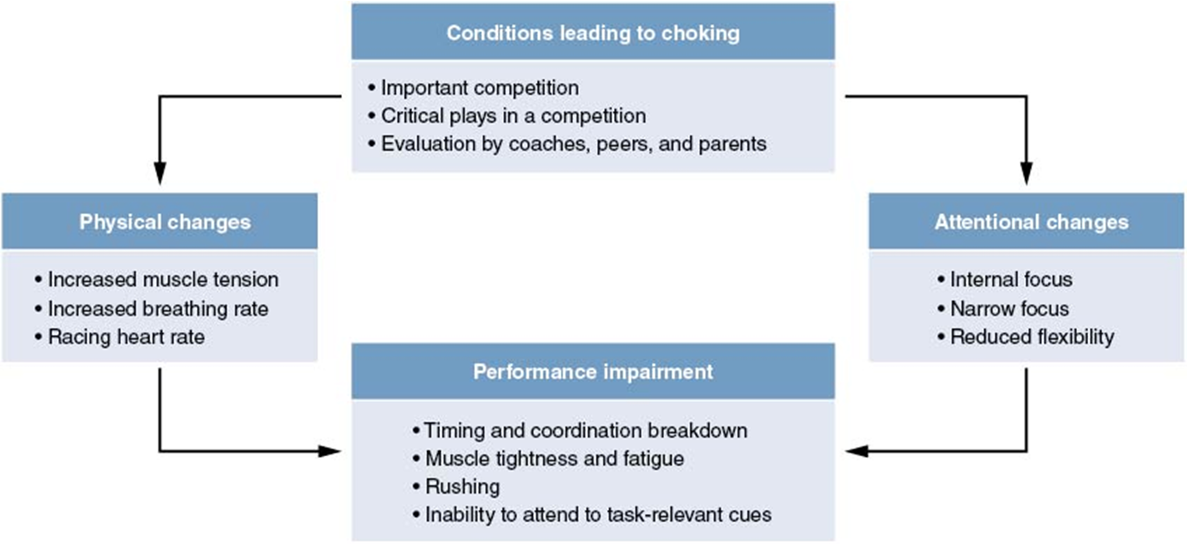
Choking as Attentional Disturbance
Two Common Primary Categories to attention Disturbances
Self-focus Theories: Propose that pressure leads athletes to consciously reconsider their motor skill execution, disrupting automatic processing and hindering expert performance.
Conscious Processing Hypothesis: Suggests choking happens when skilled performers are overly attentive to the task, similar to novice performance.
Distraction Theories: Propose that pressure diverts attention away from the necessary focus on skill execution, resulting in performance deterioration due to insufficient on-task attention.
Attentional Threshold Hypothesis: Argues that increased pressure can overload attentional capacity, leading to a decline in performance.
Worried about the outcome
Strategies to Avoid Choking
Maintaining Perspective: Encourage athletes to keep sports in balance with life.
Mental Skills Training Program: Programs should be customized to address individual athlete's strengths and weaknesses in areas like:
- Process Goal setting
- Performance routines to manage pre-performance stress.
- Techniques for centering and relaxation.External Task-Focused Approach: Focus on process-related goals instead of detailed technique goals that could detract from automatic execution.
Normalizing Pressure: Help athletes to identify sources of pressure and reframe it as a privilege, viewing stress as a challenge rather than a threat.
Recognizing Attentional Problems: External Distractors
Definition of External Distractors: Environmental stimuli that divert attention from relevant cues necessary for performance.
Types of External Distractors:
- Visual Distractors: Such as spectators in various sporting scenarios.
- Auditory Distractors: Such as unexpected loud noises or aircraft overhead.
Mindfulness and Self Compassion
Definition of Mindfulness: As per Kabat-Zinn (2003, p. 145), mindfulness is defined as “the awareness that emerges through paying attention on purpose, in the present moment, and nonjudgmentally to the unfolding of experience moment by moment.”
Distinction from Meditation: Unlike meditation, mindfulness involves actively acknowledging specific thoughts and feelings and observing them nonjudgmentally; while meditation typically centers on clearing the mind.
Benefits of Mindfulness: Research shows mindfulness enhances various behaviors, including:
- Overcoming challenges.
- Enhancing performance.
- Improving attentional focus.
- Reducing anxiety.
- Quality of life improvements outside competition contexts.Experimental Research Findings: Initial studies have demonstrated mindfulness training effectiveness across several domains and in reducing emotional reactions to stress in military personnel.
The MAC Approach (Mindfulness Acceptance Commitment)
Mindfulness: Focuses on present attention without judgment, aiding athletes in concentrating on tasks and limiting ruminations about past mistakes or future anxieties.
Acceptance: Encourages acknowledgment of thoughts and feelings rather than attempting to suppress them, leading to lower emotional reactivity and better performance.
Commitment: Encourages alignment of actions with personal values, enhancing motivation and resilience amid challenges.
Using Self-Talk to Enhance Concentration
Definition of Self-Talk: Any internal dialogue or thought pertaining to oneself.
Benefits of Appropriate Self-Talk: Helps maintain focus on the present, preventing the mind from drifting.
Uses of Self-Talk:
- Motivational: To engage and inspire oneself.
- Initiating Action: To prompt commitment to starting the task.
- Sustaining Effort: Encouraging perseverance through difficult tasks.
- Instructional: Providing cues about skill acquisition and breaking bad habits.
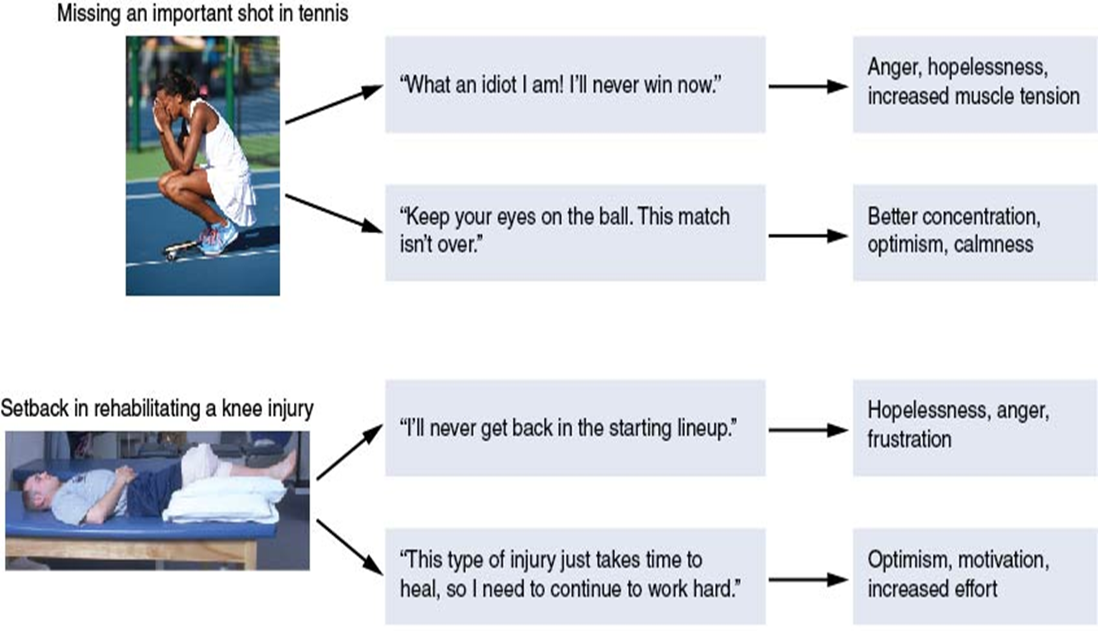
Types of Self-Talk
Positive Self-Talk: Motivational and instructional statements.
Increase energy and Positive attitude
Instructional Self-Talk: Focused on technical instruction.
Negative Self-Talk: Discouraging thoughts that can hinder performance.
Examples from NFL athletes demonstrate various applications of self-talk.
More Specific Categories of Self-Talk With Examples
Positive Self-Talk Examples:
- Psych-up statements like “I have power.”
- Confidence affirmations like “I can make it.”
- Instructional cues such as “Focus on technique.”
- Anxiety control phrases like “Calm down.”Negative Self-Talk Examples:
- Worry such as “I’m wrong again.”
- Disengagement thoughts like “I can’t keep going.”
- Fatigue acknowledgments like “I’m tired.”Neutral Self-Talk: Involves irrelevant or wandering thoughts that do not contribute to performance focus.
Ironic Processing: The phenomenon where attempts to avoid negative actions may inadvertently lead to those actions occurring (illustrated by a golf example).
Quick Activity: The Pink Elephant Problem
Activity Overview: Instruct oneself, “don’t imagine a pink elephant.”
Observation: Did participants imagine a pink elephant anyway? This common psychological response highlights the difficulties with intentional thought avoidance.
Techniques for Improving Self-Talk
Six Rules for Effective Self-Talk:
1. Keep phrases short and specific.
2. Use the first person and present tense.
3. Construct positive phrases.
4. Say phrases with meaning and purpose.
5. Speak kindly to oneself.
6. Repeat phrases regularly.Thought Stopping Technique:
- Identify negative thoughts.
- CATCH: Stop those thoughts.
- CHECK: Re-focus on task-relevant thoughts.
- CHANGE: Transform negative self-talk into positive self-talk.Example of Negative Talk Management:
- Negative: “He robbed me on the line call—the ball was in.”
- Positive: “There’s nothing I can do about it now. If I play well, I’ll win anyway.”
Example of Consultant Teaching Thought Stopping and Eliminating Negative Thoughts
Practical illustrations of how professionals guide athletes in overcoming negative self-talk and enhancing focus.
Rational Emotive Behavior Therapy (REBT)
Core Proposition: It posits that individuals’ beliefs (self-talk) regarding adversities determine whether their emotional and behavioral reactions are adaptive or maladaptive.
Outcomes of Beliefs:
- Irrational Beliefs: Lead to dysfunctional emotions (e.g., anxiety, depression) and maladaptive behaviors (e.g., avoidance).
- Rational Beliefs: Result in functional emotions (e.g., optimism) and adaptive behaviors (e.g., proactive engagement).Prevalence in Athletes: Research indicates that irrational beliefs are common among athletes, often causing performance-disrupting emotions.
Intervention Research: Demonstrate that REBT interventions can reduce irrational beliefs while promoting rational thinking, emphasizing the importance of rational thought in overcoming performance anxiety.
- Example Reflection by Athlete Rory McIlroy: Recognition of the less critical nature of sporting failures compared to larger life challenges.
Assessing Attentional Skills
Test of Attention and Interpersonal Style (TAIS): A general measure of attention traits is available, alongside sport-specific assessments.
Effective Attending: Individuals who can balance attention among various stimuli without feeling overwhelmed. They can also narrow focus while retaining critical information.
Ineffective Attending: Leads to confusion when exposed to multiple stimuli.
Psychophysiological Measures: Include EEG for brain activity and neurological heart rate measurements, which show that elite shooters can reduce cognitive strain pre-performance, demonstrated by significant cardiac decelerations just before shooting.
Improving Concentration: On-Site Techniques
Simulation in Practice: Incorporate distractions to replicate performance environments.
Cue Words for Focus: Use both instructional and motivational words to maintain attention.
Nonjudgmental Thinking: Cultivate a mindset free from judgmental self-assessment during performance.
Establish Routines: Pre-event and during-event routines established to stabilize focus.
Develop Competition Plans: Strategy planning for competitions to enhance concentration.
Overlearning Skills: Skill mastery leads to better automaticity and concentration during critical moments.
Thinking Aloud: Engaging in an inner monologue for clarity and focus.
Example of Pre-performance Routine for Tennis Serve
Sequential Steps:
1. Determine proper positioning and foot placement.
2. Decide on the grip for the serve and approach to the ball.
3. Adjust racket and ball accordingly based on preparation phase.
4. Take a deep breath to induce calm and focus.
5. Bounce ball in rhythm to maintain composure and expectation.
6. Visualize the ideal serve while primed for execution.
7. Concentrate on the ball toss and targeting the predetermined spot for serve.
Exercises To Try For Improving Concentration
Exercise 1: Learning to Shift Attention
- Focus on auditory stimuli, labeling them, then listen without judgment. Move to body sensations, labeling and experiencing thoughts with acceptance.Exercise 2: Learning to Maintain Focus
- Select an object to focus on diligently, feeling its textures while documenting focus duration.Exercise 3: Searching for Relevant Cues
- Engaging in the concentration grid activity developed earlier allows for quick scanning of information, with efficiency indicative of excellent concentration stemming toward high scoring.
Concentration Grid Activity: Searching for Relevant Cues
A grid of numbers provided to engage in the concentration task of identifying and locating patterns or relevant cues within a time frame, demonstrating attentional skills effectively.