Drug Classifications
The Misuse of Drugs Act 1971
The Misuse of Drugs Act (1971) is the primary legislation controlling drug use in the UK.
Aim: To prevent misuse by classifying drugs based on harm [to society, medical use, potential for misuse]
Introduced a system of Class A, B, and C drugs - Controlled vs. non-controlled drugs.
Advisory Council on the Misuse of Drugs (ACMD) advises the government on drug classification.
Recent ACMD recommendations: drugs that have been reclassified, e.g. cannabis.
Classification System - Overview
Three Main Categories of Drugs:
Class A: Most harmful and heavily penalised.
Class B: Intermediate harm.
Class C: Least harmful.
Differentiation between medical use and abuse potential.
Class A Drugs
Heroin, Cocaine, Ecstasy (MDMA), Methamphetamine, LSD, Crack Cocaine.
High risk of addiction, overdose, and mental health issues.
Medical use limited, except in specific cases (e.g., methadone for heroin treatment).
Possession: Up to 7 years in prison and an unlimited fine.
Supply/production: Life imprisonment and an unlimited fine.
Implications for users: Criminal records, societal stigma, reduced access to employment.
Class B Drugs
Cannabis, Amphetamines, Barbiturates, Methylphenidate (Ritalin), Codeine.
Moderate risk for addiction and health damage.
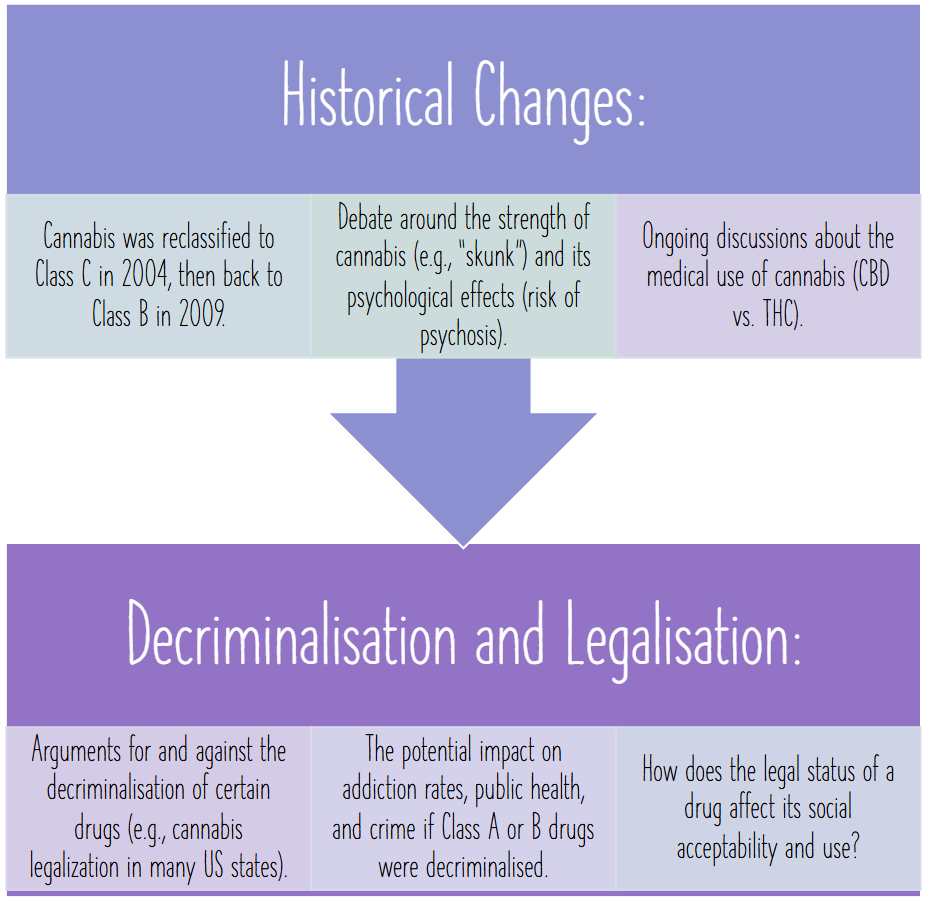
Cannabis is particularly notable due to its historical reclassification and debates around its use.
Possession: Up to 5 years in prison and an unlimited fine.
Supply/production: Up to 14 years in prison and an unlimited fine.
Psychological impact of penalties: Effect on young people’s behaviour, attitudes towards law enforcement.
Class C Drugs
Anabolic steroids, Benzodiazepines (Valium, Diazepam), GHB (Gamma-Hydroxybutyrate).
Used medically but with a potential for abuse and dependence.
Lower risk compared to Class A and B but still significant health consequences, especially in long-term use.
Possession: Up to 2 years in prison and an unlimited fine.
Supply/production: Up to 14 years in prison.
Drugs like opioids (e.g., codeine, morphine) and benzodiazepines, though legal, can lead to addiction and misuse. Rising concerns about prescription drug abuse, especially among youth.
The Psychoactive Substances Act 2016
Introduction of new legislation targeting "legal highs" and New Psychoactive Substances (NPS).
Examples: Spice, synthetic cannabinoids, “bath salts.”
Banned the sale and supply of psychoactive substances intended for recreational use.
Does not criminalize possession for personal use (except in specific settings like prisons).
Cannabis Classification
Summary
The structure of drug classifications in the UK (Classes A, B, and C).
Legal, psychological, and social consequences of drug misuse.
The role of psychologists in understanding addiction and advocating for effective drug policies.
Final thought: What’s next for UK drug classification—should reform be on the horizon?