HIV & AIDS
HIV & AIDS Overview
HIV: Infectious disease caused by the Human Immunodeficiency Virus, affecting the immune system.
AIDS: Acquired Immunodeficiency Syndrome, representing the most advanced stage of HIV infection.
Human Immunodeficiency Virus
Transmission Methods:
Body fluids via:
Sexual contact
Blood-to-blood contact, including:
Contaminated needles
Blood transfusions
From mother to child during pregnancy, birth, or via breast milk
Infectiousness: Patients can transmit the virus even when asymptomatic.
Characteristics of HIV
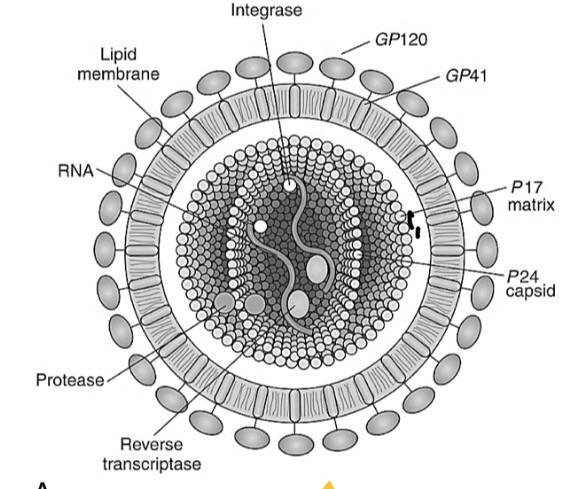
Type of Virus: Retrovirus
Genetic Material: Carries RNA instead of DNA
Strains of HIV:
HIV-1 - most common in America; more aggressive
HIV-2 - mainly found in West Africa; same pathophysiology as HIV-1 but spreads slower
Target Cells: Infects CD4+ T helper cells.
HIV Infection & Replication Process
Attachment: Virus binds to CD4+ receptors on host cells
Internalization: Virus enters the host cell
Reverse Transcription: Converts RNA to DNA using reverse transcriptase
For it to reproduce, it has to change from the 2 RNAs to 2 strands of DNA through reverse transcriptase
Integration: Viral DNA integrates into host genome
The newly formed viral DNA enters the nucleus
Viral enzyme integrate inserts HIV DNA into the host’s genome
Once integrated, HIV becomes a permanent part of the cell
This is why HIV cannot be cured and virus can stay latent (inactive for years)
Transcription: Host machinery transcribes integrated viral DNA
Translation: Viral RNA is translated into proteins
Host ribosomes translate viral mRNA into long, immature protein chains including:
Structural proteins
Enzymes (protease, reverse transcriptase, integrase)
Cleavage: Proteins are cleaved into functional units by protease
Proteins have to be cut because long proteins cannot penetrate the cells
Assembly and Release: New virions are assembled and exported from the host cell
Attach → Enter → Copy → Hide → Read → Build → Cut → Escape
Life Cycle of HIV in a Cell
Steps 1-3 (HIV Infects a Cell):
Binding of HIV to CD4 receptor
Reverse transcriptase function in converting viral RNA to DNA
Steps 4-8 (Infected Cell Produces New HIV):
Polyprotein processing by protease
Dormancy potential in the host genome for years before activation
Production of long, stringy polyproteins followed by cleavage into subunits
Assembly into new virus particles
Clinical Course of HIV Infection
Primary Infection Phase:
Duration varies; window period where signs of systemic infection occur
Seroconversion happens within 1-6 months, where antibodies appear
Virus is replicating, resulting in gradual T cell count decline
Latency Phase:
May last 10-11 years
Characterized by asymptomatic state or lymphadenopathy
Overt AIDS Phase:
CD4 count drops below 200 cells/μL or development of AIDS-defining illnesses
Without treatment, prognosis may be 2-3 year
Key Metrics: CD4 count and viral load help monitor disease progression
Normal CD4 count = 800-1000
Symptoms in Each Stage of Disease
Primary Infection Stage:
Symptoms resemble acute mononucleosis
Latent Stage:
Asymptomatic or presents lymphadenopathy
Main Symptoms of AIDS
Neurological:
Encephalitis
Meningitis
Eyes:
Retinitis
Lungs:
Pneumocystis pneumonia
Tuberculosis (may affect multiple organs)
Skin:
Tumors
Gastrointestinal:
Esophagitis
Chronic diarrhea
Tumors
AIDS-Defining Illnesses:
Opportunistic infections
Malignancies
Wasting syndrome
Diagnostic Tests for HIV
HIV Antibody Tests:
ELISA (Enzyme-Linked Immunosorbent Assay): Used for screening test
Western Blot: Confirmatory test if ELISA positive
Polymerase Chain Reaction (PCR):
Detects presence of HIV DNA instead of antibodies
Also used on infants/children up to 18 months
CD4 Count/T-cell Count:
Used to monitor immune system impact
Testing Differences: Diagnostic procedures may differ for adults vs. infants
Treatment for HIV/AIDS
Cure Status: Currently, no cure for HIV/AIDS
HAART: Highly Active Antiretroviral Therapy
Composed of a 3-drug combination (e.g., emtricitabine, tenofovir, ritonavir)
Goals: Suppress HIV replication (lower viral load and increase CD4 count)
Notable significant side effects
Other Treatments:
Medications and vaccines to prevent and/or treat opportunistic infections
PrEP: Pre-Exposure Prophylaxis as a preventive measure
Anti-HIV Medication Mechanisms
Target Sites:
Binding and entry inhibitors
Reverse transcription inhibitors
Integration inhibitors
Transcription inhibitors
Assembly inhibitors
Release and protease inhibitors
HIV Considerations in Pregnancy, Infants & Children
Reducing Transmission:
Administering zidovudine to mother during pregnancy, labor, delivery, and to the infant post-birth
Counseling and Testing:
Offered to all pregnant women
Child-Specific Patterns:
Failure to thrive
Central nervous system (CNS) abnormalities
Developmental delays
Lower weight
Higher incidence of Pneumocystis pneumonia (PCP) compared to adults
Stigma and Community Perspective on HIV
Stigma: The concept of U=U (Undetectable = Untransmissible) as a public health message
Prevention Strategies:
PrEP: Pre-Exposure Prophylaxis
PEP: Post-Exposure Prophylaxis