Physics
PHYSICS
The scientific study of matter, energy, space, and time, and the relationship or
interactions between them.
It is the study of nature in an attempt to understand the world around us or
Furthermore, how the universe behaves.
Branches of Physics
Mechanics
Optics
Electromagnetism
Thermodynamics
Relativity
Acoustic
What is the relationship between MATH and PHYSICS?
“ Mathematics is the language with which God has written the universe” - Galileo (Father of science and physics)
QUANTITIES - The amount or number of something.
PHYSICAL QUANTITIES - is a characteristic or property of an object that can be measured with instruments or even by using our senses.
BASIC PHYSICAL QTY
-Length
• Mass
• Time
• Electric current
• Temperature
• Amount of substance
• Luminous intensity (intensity of light)
SI Base Units
• Length (meter)
• Mass (kilogram)
• Time (second)
• Electric current (ampere)
• Temperature (kelvin)
• Amount of substance (mole)
• Luminous intensity (candela)
SI unit is an international system (SI) of measurements that are used universally in technical and scientific research to avoid the confusion with the units.
Vector is…
direction
Force
Displacement
Velocity
Acceleration
weight
Scalar is…
temperature,
distance,
speed ,
Mass
volume,
Density,
energy,
Time.
MOTION (moving)
Distance, displacement, speed, velocity and acceleration
MECHANICS
Motion, Force and energy
KINEMATICS
How objects move
DYNAMICS
Why is the object moving
Motion
Movement of an object was brought by force
Shown in change of position
CLASSIFY MOTION
The path the object took
Frame of reference
How far the object traveled
How fast the object traveled
PATH REFERENCE
Rectilinear Motion
Motion of straight path
Curvilinear Motion
Motion of a curve path
Angular Motion
- Motion of a specific angle
2. FRAME OF REFERENCE
MOTION IS RELATIVE
THE POSITION OF AN OBJECT IS RELATIVE
RELATIVE- MEANING RELATION TO SOMETHING ELSE
3. HOW FAR
Distance
Refers to the total path traveled
Longest path traveled
Total path traveled
HOW FAR
Displacement
Distance + direction
It refers to the total path traveled with direction
From start to end SHORTEST PATH
Change in position of an object
NSEW
Moving something from it’s position/place
HOW FAST
Rate
Rate is a ratio of two quantities
Tells how quickly one quality changes in relation to another quantity
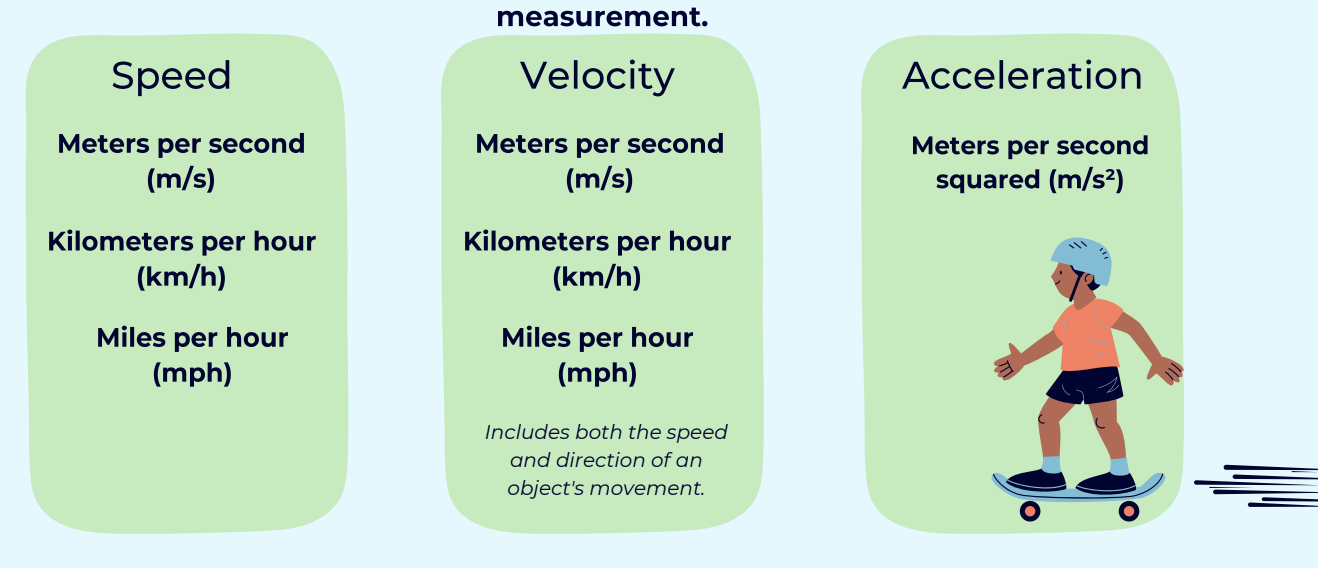
Speed
d/t
The distance over time
How fast or slow an object moves
The rate of a distance
d
s | t
d
v | t
Acceleration
The rate of change in speed per unit time
Velocity
V = displacement/time =
Change In position is
Distance over time with direction
Gresa method serves as a guide in answering word problems
G - GIVEN (Write and identify any info (number))
R - REQUIRED (assess which being asked)
E - EQUATION
S - SOLUTION
A - ANSWER
WAVES
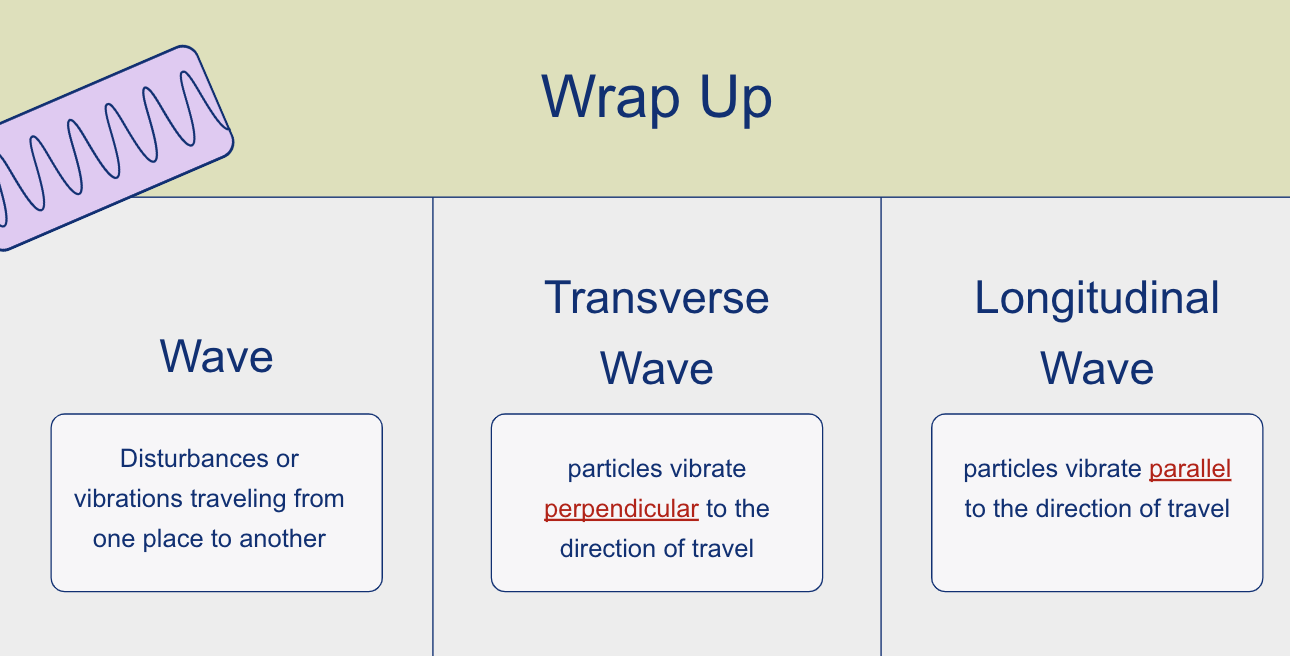
It is a disturbance or series of vibrations traveling from one place to another.
It carries energy with or without medium.
MEDIUM
It is a substance or material through which a wave travels.
EXP : water, air solid
TYPES OF WAVES
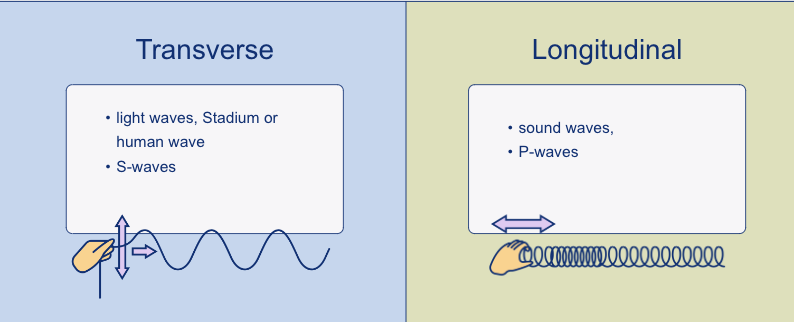
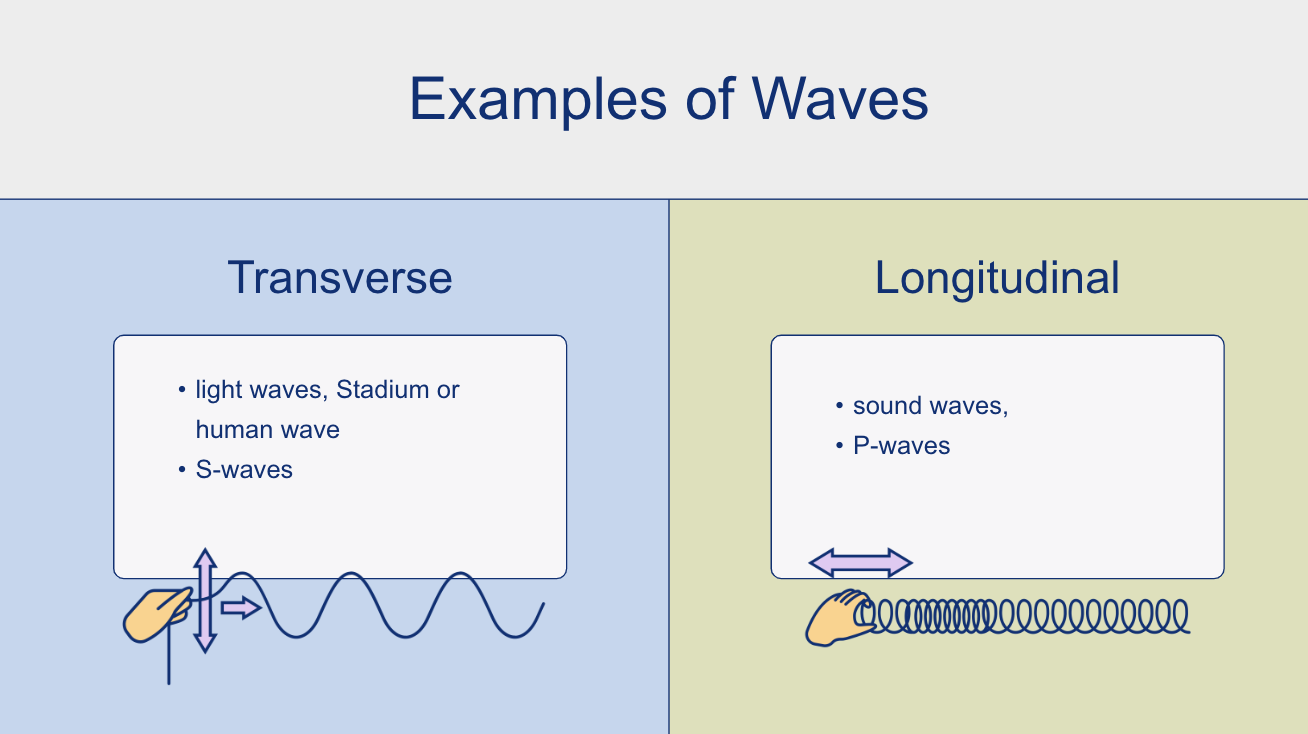
Transverse waves
vibrations of particles are perpendicular to the direction of travel
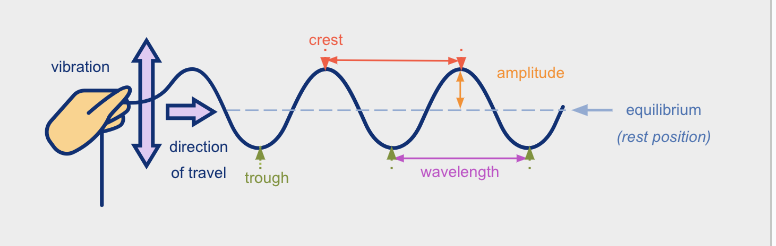
Equilibrium Position
- position of the medium where there is no disturbance.
Crest
- point on the wave with maximum positive or upward displacement from the equilibrium position
Trough
- point on the wave with maximum negative or downward displacement from the equilibrium position
Amplitude
- distance from rest position to crest or trough
Wavelength
- distance between any two adjacent point on a wave
- length of one complete wave cycle.
crest to crest
trough to trough
Frequency
the number of waves that pass a point in a certain period of time.
Unit: hertz (Hz)
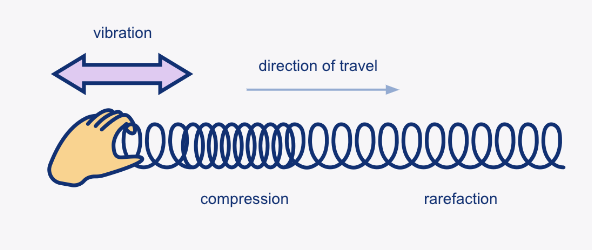
Longitudinal Wave
vibrations of particles are parallel to the direction of travel
Surface Wave
vibrations of particles undergo a circular motion
Some of these waves cause the ground to shake up and down (S-waves) or side to side (P-waves).
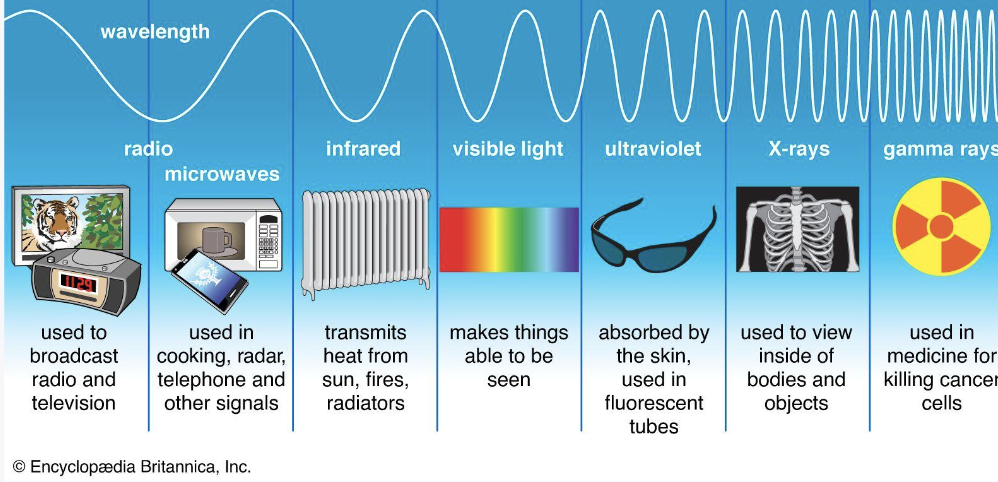
Electromagnetic Wave
A transverse wave that DO NOT NEED matter (medium) to transfer energy
Electromagnetic Spectrum