Chapter 7 : Voting & Election
  Elections in the United States
Presidential elections: held every four years on the first Tuesday in November following a Monday
Congressional elections:held every two years on the first Tuesday in November following a Monday
Example :
2024: November 5
2042 :November 4
2648: November 7
3892: November 8
Presidential versus Parliamentary system
In the parliamentary system we do not know when the next election will be held. However, elections have to be held within a certain number of years.
The U.S. system { presidential } provides more stability
Parliamentary system allows the political system to respond quicker to dissatisfaction with the government
  Elections in the United States
Most places in the United States use plurality/first past-the- post voting. Whoever receives the most votes wins the elections.
Electoral rules { Louisiana runoff, Maine ranked choice voting, Nebraska, and Maine splitting electoral votes }
Majority party protects itself by adjusting voting rules
Different types of ballots
straight-ticket option on ballot
More than 30 stated elect judges
Drain Inspectors
Coroners
Why do people vote ?
Founding elections tend to have a very high voter turnout
Some important factors that explain different voter turnouts include:
Socioeconomic status
political environment
State electoral laws
Socioeconomic Status
Those with higher socioeconomic status are more likely to vote for :
higher income
higher levels of education
older people are also more likely to vote
  Population with tertiary education
Compared to most countries in the organisation for Economic Co-operation and Development
( OECD ), the United States has a very highly educated population.
Based on this, we would expect voters turnout rate in the United States to be among the highest
  Turnout in the United States
However, the United States have a lower voter turnout compared to many other countries
the turnout of the voting age population in the United States for presidential elections is between 50-60 %
It’s much lower for midterms elections
State Electoral Laws
in the United States, it’s up to the states to hold elections
Easier to vote in some states in comparison to other
After the 2020 elections, several states. including Texas , have proposed legislation that are seen as making voting more difficult
These laws are most likely to impact those that have never voted before
Different types of ballots
Why does the United States have a low voter turnout rate
U.S. has one of the lowest voters turnouts rates in developed world
Election are held on Tuesday
U.S. holds more frequent elections
U.S. holds primary elections
Registering to vote can be burdensome and complicated
 Compulsory Voting
Numerous countries around the world have compulsory voting…. if you don’t vote you’ll be punished
Brazil: 18-17 compulsory, 16-18 optional. Military conscripts do not vote. Small fines for not voting. Cannot take professional exams. No loans or passports
Australia : 18 and over compulsory. $20 fines for not voting. If you fight it in court and lose it’s a $50 fine plus court cost
Rational For voting
V= PB - C
V= casting a vote
P= the probability of the preferred candidate winning
B= the benefit expected from the preferred candidate
C= the cost of voting
Stages of presidential elections : Deciding whether to run or not
Family obligations
Is there a possibility of winning the nominees
Incumbent: the current office holder. an open seat is one whose incumbent is not running for reelection
Frequent visits to Iowa, New Hampshire, and Nevada signal potential presidential runs.
Stages of presidential elections : Nominations
Raising Money
Get media attention
Partake in debates
closed primary versus open primary
Texas has an open primary system
example: In Texas people do not register with a party like in many other states
Primary versus Caucus
Proportional representation versus winner-take -all
 Stages of presidential elections : Conventions
Both parties hold three -day conventions to officially nominate their presidential nominee
Political theater
Politician wish to speak at these conventions for the attentions
The major network all broadcast these events
Example: In , 2024 more than 25 million people watched the speeches of Donald trump and Kamala Harris
The nominees tend to get a bounce in the polls, after their party’s convention
 Stages of presidential elections : General election and election day
After the convention are over the candidates have a busy schedule in which they go across the country
Tends to focus on the battleground states
Visits large states such as California and Texas to raise money
Presidential debates
Example: In 2020 the last debate took place 12 days before the election
October surprises
Voters make their decision on the first Tuesday in November following a Monday
Example: More common for people to vote early
Some important factors deciding the elections results:
State of the economy
Is the United States in a war at the time
How long has the power in the white House been in power
Are the parties unified or fractured
Stages of presidential elections : Electoral College
On the first Monday after the second Wednesday in December, the electors met in their respective states to cast their votes for president and vice president of the United States
Congress convenes to count the electoral votes in January
Inauguration on January 20th
Among the 538 electors chosen to represents their states in the Electoral college, five were faithless to the Democratic nominee and two to the Republican, Prior to this year, there hasn’t been more than one faithless elector in any presidential election since 1948
Electoral College
Five presidents have been elected without having recived the most votes
John Quincy Adams {1842}
Rutherford B. Hayes {1876}
Benjamin Harrison {1888}
George W. Bush {2000}
Donald Trump {2016}
Congress decided if there is a tie { 269 - 269 }
Arguments in favor and against the electoral college
Sates joining a pact to circumvent the Electoral College
Congressional Job Approval
Based upon this dissatisfaction with Congress we would expect large turnover rate
However, reelection of incumbents is the norm. Tends to be over 90 percent.
Paradox of people not liking congress, but at the same time reelecting their own representative
Members of congress want to get rejected, and they act accordingly to increase the likelihood of reelection
Incumbency Advantage
Members claim credit for what their constituents like, but try to divert blame for what the constituents do not like.
the leadership of both political parties if often willing to spare its members from taking controversial votes if they are seen as being vulnerable
If members of congress are strategic they can minimize controversial votes
Former speakers of the United States House of Representatives Famously said “all politics is local “
Members of congress have set up rules that help them get reelected:
Committee assignments
war chest
499 letters
able to travel back to their constituency frequently
Hold speeches on the floor for political purposes
More on Incumbency Advantage
Can use the “political machine” of their party to their advantages
Strong fundraising to fight off potential challengers
The campaigns to run for congress can cost millions of dollars
on average much more expensive to run for the senate
Name recognition
Hard for the other party to recruit good candidates when there is a strong incumbent
The challenger needs to be able to raise money
Unless they can self finance
Can be partly negated when the political climate is in their party’s favor
The party of the president tends to do poorly in midterms elections
The party not in power often does well in Congressional seats elections during wartime
Unpopular president
Jacobson {1990}
The amount spent by the challenger is more important compared to incumbent
Inverse Relationship
Mini summary: In campaigns against incumbents the more the challenger spends, the more votes they receive, and the more likely they are to win. The more incumbents spent on the other hand…. the lower their votes, and the greater their chance of losing
Question: What helps explain this anomaly ?
Challenger can build up name recognition by buying advertisement
The incumbent tends to be already well known
Strong challengers are more likely to be able to fundraise the money needed to win
Mini summary: No matter how persuasive the message, it will not do any good if voters do not hear it, so the money, if not sufficient, is almost certainly necessary
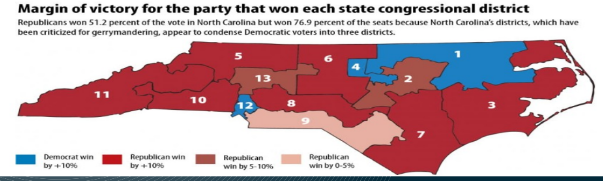
 Redistricting
Mini summary: reapportionment reorganization of the boundaries of the House district, a process that follows the result of the U.S. census, taken every ten years, District lines are redrawn to ensure rough equality in the number of constituents represented by each House Member
Gerrymander: redrawing an election district in a way that gives the advantage to one party
Packing: placing all like-minded voters into one district
Cracking: Spreading out like-minded voters so they form a minority in many districts
Stacking: Merging two districts from the same party to make two incumbents run against each other
2018 Election in North Carolina
Democrats received more votes in both chambers of the North Carolina legislature, but Republican won 66 of 120 seats in the House and 29 out of 50 seats in the North Carolina Senate