A4.1 Evolution and Speciation IB Bio- Evolution
Evolution- a change in the heritable characteristics of a population over
Lamarck- acquired traits when alive and these are beneficial for survival. And can be passed down to offspring evolution over time
not supported by genetics
acquired traits are not passed on to the offspring
Darwin- variation exists within a population. Nature selects individuals with the traits best adapted to survival and reproduction which are passed to the offspring- causing evolution over time
supported by genetics bc variation is present in a pop. bc of alleles
Evidence for Evolution
DNA, RNA, and protein sequences
same genes present in organisms→ evolution from a common ancestor
differences in base sequences of DNA and RNA are a result of mutations
Mutations accumulate gradually over long periods at a constant rate
Closely related species→ have similar gene and protein sequences w/differences due to mutations
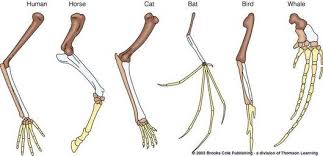
Homologous structures
similar in structure but different functions.
common ancestor migrated to different areas and adapted to different environments
Selective breeding-
humans choosing plants or animals with desirable traits to breed together and produce offspring with desirable traits
Convergent Evolution- evolution of similar structures in species not related due to a recent common ancestor
Analogous Structures- common function but not a common structure- result
of convergent evolution ie wings
Speciation- formation of a new species through evolution
occurs as pre-existing species evolved into new species over time to the point where they cannot reproduce with each other.
Extinction- no living members of a species remaining
Pre-zygotic isolation vs. Post-zygotic isolation
pre-mating isolation occurs before fertilization
post-mating isolation occurs after fertilization
Geographical Isolation- often results in reproductive isolation

occurs when two populations are prevented from mating because of geographical features (rivers, mountains, etc.)
I.e. chimps and bonobos being separated by the Congo River. Chimps are nicer and the bonobos are meaner- speciation
HL Content
Sympatric Speciation- population divides into different species wile inhabiting the same habitat. aka behavioral or temporal
Behavioral Isolation- reproductive isolation due to behavior→ sympatric speciation ie. mating behavior in birds (different songs)
Temporal Isolation- organisms reproduce at different times i.e. Cicadas and their 13/17 yr life cycle underground

Allopatric Speciation- the physical separation of two populations of the same species - aka geographical isolation which leads to speciation
Adaptive Radiation- the evolution of a single ancestral species into several species. A result of divergent evolution- a single species moves to a variety of different niches and evolves different features due to different selective pressures. = more biodiversity
Hybrids- offspring of two different species
donkey+horse= mule
Sterile and are not considered a species
Hybridization is rare due to prezygotic and postzygotic barriers preventing the mixing of alleles between species.
Prezygotic barriers- prevent fertilization of egg and sperm
Behavioral Isolation
Temporal Isolation
Ecological Isolation- different habitats
Mechanical Isolation- physical differences prevent sexual intercourse
Post-zygotic barriers- in-viable or infertile offspring
Hybrid Inviability- offspring due no survive to become sexually mature adults
Hybrid Infertility- hybrids are not capable of producing fertile gametes
Hybrid breakdown- first generation of hybrids are capable of reproducing but the offspring cannot
Polyploidy- organisms with more than two sets of chromosomes in their cells. It is a result of non-disjunction, an error during meiosis
not polyploidy- haploid (one set of chromosomes) and diploid (two sets of chromosomes)
yes polyploidy- diploid+haploid= triploid 3n), diploid+dilploid= tetraploid (4n)
may produce immediate speciation because an organism is produced with a different number of chromosomes. (ie. bigger fruit in plants)
Polyploid plants with an even number of sets of chromosomes (4n, 6n, 8n …) are capable of reproducing sexually, as meiosis can occur with homologous pairs of chromosomes.
Polyploid plants with an uneven number of sets of chromosomes (3n, 5n, 7n …) are sterile, as not all of the chromosomes can form homologous pairs during meiosis. Many of these plants can reproduce asexually.