9. Radiation
Ionising radiation - the splitting of atoms or molecules into 2 or more parts
Ionising radiation can damage the DNA directly or indirectly via free radicals and reactive oxygen species. These can cause double strand breaks or single strands which if not repaired will result in cell death or the formation of a tumour
Isotopes
Atoms of the same element have the same protons. Atoms with the same number of protons and electrons, but a different number of neutrons are called isotopes.
Nuclide is an atom with a given number of protons and neutrons
Radioisotopes/radionuclides are unstable and decay
Half-life
Radioisotopes are constantly decaying - the radiation is constantly decreasing.
Half-life - time for half the material to be lost to radioactive decay
Radioactivity is measure in Becquerel (Bq)
Types of decay
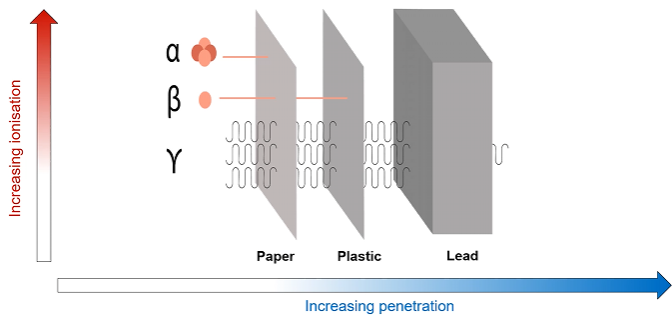
In decreasing ionisation and increasing penetration order:
-particles are helium nuclei. They have a +2 charge as they have no electrons
-decay particles are high energy electrons. They are formed when a neutron in an unstable nucleus decays to give a proton and an electron
radiation is photons emitted when daughter nuclides are in excited states and electrons drop from excited energy levels to ground state energy levels